
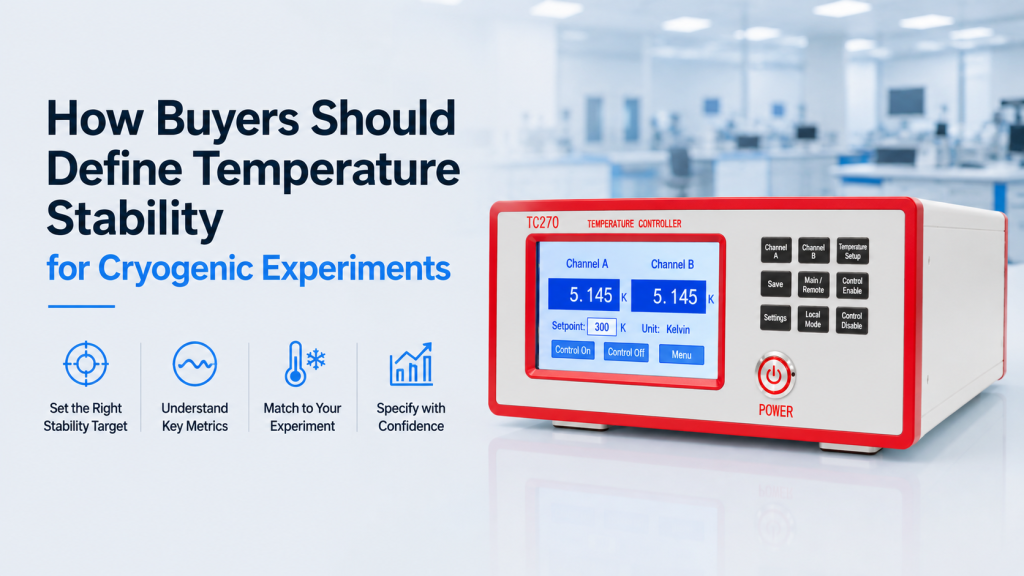
A cryogenic inquiry often contains a specification that looks precise:
“Temperature stability: ±0.01 K.”
At first glance, there seems to be nothing left to clarify.
In reality, this is one of the most ambiguous specifications in cryogenic procurement.
Does ±0.01 K mean:
- Peak-to-peak fluctuation over 10 seconds?
- Maximum deviation over 10 minutes?
- Standard deviation over one hour?
- Stability after the system has fully settled?
- Stability at 4 K, 77 K, or 300 K?
- Controller sensor stability or actual sample-temperature stability?
- Zero magnetic field or during a magnetic-field sweep?
- No experimental heat load or while current is flowing through the sample?
These conditions can produce completely different engineering requirements.
More importantly, cryogenic temperature stability is not the same as temperature accuracy, resolution, repeatability, or controller display resolution.
A buyer who specifies “±0.01 K” without defining the measurement conditions may receive quotations based on completely different assumptions—and therefore very different prices.
This guide explains how buyers should define cryogenic temperature stability in a way that a supplier can actually design, quote, and verify.
1. What Does Cryogenic Temperature Stability Actually Mean?
In practical terms, temperature stability describes how much the temperature varies around a desired operating condition over a defined period of time.
If a sample is nominally controlled at 20 K, a stability requirement might mean that after reaching equilibrium, the measured temperature must remain within a defined band.
For example:
20 K ±0.02 K for 30 minutes after stabilization.
That is already far more useful than simply:
Stability: ±0.02 K.
A technically meaningful stability specification should normally define:
- Target temperature
- Allowed variation
- Measurement duration
- Stabilization condition
- Sensor location
- Thermal load
- Magnetic-field condition, if relevant
- How variation will be calculated
Cryogenic control performance depends on the complete thermal system. Lake Shore notes that sensor sensitivity, electrical noise, heater response, sensor/heater placement, thermal conductivity, and thermal lag all influence control-loop stability; poor thermal design cannot simply be corrected by selecting a better controller.
That is why “temperature controller stability” and “sample temperature stability” should never automatically be treated as the same specification.
2. Stability Is Not Accuracy
This is probably the most important distinction.
Suppose the true sample temperature is:
10.100 K
but the controller continuously displays:
10.000 ±0.002 K
The displayed temperature may be extremely stable.
It may also be inaccurate.
Temperature Stability
Answers:
How much does the temperature fluctuate with time?
Temperature Accuracy
Answers:
How close is the measured temperature to the actual temperature?
NIST explains that thermometer accuracy depends not only on electrical resolution but also on calibration uncertainty, thermometer reproducibility, and other parts of the measurement chain. Its cryogenic measurement review explicitly separates accuracy, reproducibility, temperature resolution, magnetic-field effects, calibration, and related performance factors.
A buyer therefore should not write:
“Accuracy/stability: ±10 mK”
unless the two specifications genuinely mean the same thing—which they usually do not.
3. Stability Is Not Resolution Either
A controller may display temperature to:
0.001 K
This does not mean it can stabilize the sample to ±0.001 K.
Display resolution merely tells you how finely the value is represented.
Example
A controller display may show:
- 20.001 K
- 20.008 K
- 19.995 K
- 20.012 K
The display resolution is 0.001 K.
But the actual peak-to-peak temperature variation is:
0.017 K.
And even that does not tell you the absolute temperature accuracy.
Buyers Should Separate
- Display resolution
- Measurement resolution
- Temperature stability
- Absolute accuracy
A quotation that combines all four into one number is not sufficiently defined.
4. Stability Is Not Repeatability
Repeatability asks a different question.
Imagine you stabilize a sample at 20 K today.
Tomorrow, you repeat exactly the same procedure.
Next week, you repeat it again.
If the experimental result is reproducibly reached each time, the system has good repeatability.
Stability
Short- or medium-term variation around one operating point.
Repeatability
Ability to return to the same condition across repeated operations.
Accuracy
How close that condition is to the true temperature.
A system can have:
- Excellent stability
- Good repeatability
- Poor absolute accuracy
or almost any other combination.
Cryogenic procurement becomes much clearer when these specifications are separated.
5. “±0.01 K Stability” Still Does Not Define How Variation Is Calculated
Even after a buyer gives a number, the calculation method matters.
Several definitions are possible.
Maximum Deviation
Temperature must remain between:
Setpoint − ΔT
and
Setpoint + ΔT
Example:
20.00 K ±0.01 K.
This means the measured temperature must stay between:
19.99 K and 20.01 K.
Peak-to-Peak Stability
Calculate:
Tmax − Tmin
over the specified measurement period.
If temperature varies between:
19.992 K and 20.008 K,
peak-to-peak variation is:
0.016 K.
Standard Deviation
A statistical measure of the variation around the mean.
This can be useful for noise analysis, but it is not equivalent to a maximum tolerance band.
A system can have a small standard deviation but still experience occasional large excursions.
RMS Variation
Some systems or experiments may use RMS temperature fluctuations.
Again, this must be defined explicitly.
Long-Term Drift
The concern may not be rapid fluctuation at all.
The buyer may instead care that temperature does not slowly move by:
- 20 mK/hour
- 100 mK over eight hours
These are drift specifications.
The supplier cannot infer which definition you mean from “±0.01 K.”
6. Always Define the Time Window
Temperature stability without time is incomplete.
Compare:
±10 mK for 10 seconds
with:
±10 mK for 8 hours
Those are not equivalent requirements.
Short-Term Stability
May matter for:
- Fast electrical measurements
- Optical acquisition
- Single hysteresis loops
- Short magnetic-field sweeps
Medium-Term Stability
May matter for:
- Hall measurements
- MOKE
- VSM
- Magnetoresistance
- Spectroscopy
where one data set may require tens of minutes.
Long-Term Stability
May matter for:
- Overnight automated experiments
- Long field sweeps
- Repeated averaging
- Device-aging measurements
- Multi-hour transport studies
A cryogenic controller can appear extremely stable over one minute while thermal drift becomes obvious over several hours.
Better Specification
Instead of:
“Temperature stability: ±0.01 K”
write:
“After stabilization at 20 K, temperature shall remain within ±0.01 K over a continuous 30-minute measurement.”
Now the engineering target is understandable.
7. Define When the Stability Measurement Starts
This matters more than it seems.
Suppose the controller changes the setpoint from:
100 K → 50 K.
The system may:
- Cool rapidly
- Overshoot
- Approach 50 K
- Oscillate slightly
- Gradually settle
At what moment does the ±0.01 K requirement begin?
Immediately after commanding 50 K?
That may be physically unrealistic.
A Better Definition Includes a Stabilization Criterion
For example:
“The stability evaluation begins after the sample reaches 50 K and remains within ±0.1 K of the setpoint for five minutes.”
After that condition is met:
“Temperature shall remain within ±0.02 K for the following 30 minutes.”
Now both parties can perform the same acceptance test.
8. Settling Time and Stability Are Different Specifications
A system may ultimately stabilize very well but take a long time to reach that state.
Another system may reach the target quickly but fluctuate more.
These should be specified separately.
Settling Time
“How long after changing the setpoint until the temperature reaches an acceptable stable condition?”
Temperature Stability
“How much does it fluctuate once stable?”
For automated experiments, settling time can have enormous practical value.
Imagine an experiment measuring 30 temperature points.
If each point requires:
- 5 minutes to settle
the waiting time is manageable.
If each requires:
- 30 minutes
the entire experiment becomes much longer.
Procurement Lesson
If experiment throughput matters, specify both:
- Stability
- Maximum acceptable settling time
Do not ask the supplier to optimize one and assume the other will automatically improve.
9. Stability Must Be Defined at a Specific Temperature
A controller cannot normally guarantee identical absolute stability across:
4 K to 300 K
without considering the thermal system.
Cryogenic thermal behavior changes dramatically with temperature.
Important quantities such as:
- Heat capacity
- Thermal conductivity
- Sensor sensitivity
- Cooling power
- Heater effectiveness
can vary substantially across the range.
Lake Shore’s control guidance notes that sensor sensitivity and loop gain can change strongly with temperature, while noise and thermal lag constrain how aggressively the control loop can be operated.
Therefore, This Specification Is Weak
“Temperature stability: ±0.01 K from 4–300 K.”
This Is Better
- At 4.2 K: required stability ±0.005 K
- At 20 K: required stability ±0.01 K
- At 77 K: required stability ±0.02 K
- At 300 K: required stability ±0.05 K
These are only examples of how to structure a specification—not universal recommended limits.
The correct values should come from the experiment.
10. Ask Why You Need the Stability Before Choosing the Number
This is where many specifications go wrong.
A buyer sometimes requests ±1 mK because:
“That sounds like a good controller.”
That is backwards.
Temperature stability should come from the allowable impact on the measured physical quantity.
Hall Measurement Example
If carrier mobility changes very little over ±0.1 K around 300 K, demanding ±1 mK may provide no useful scientific benefit.
Superconducting Transition Example
If the experiment studies a very narrow transition, a few millikelvin may genuinely matter.
MOKE Example
If coercivity changes significantly with temperature, tighter thermal stability may improve comparison between loops.
The specification should therefore answer:
How much temperature variation can occur before it meaningfully changes the experimental result?
That is the number worth purchasing.
11. Sensor Location Must Be Part of the Stability Specification
The controller only knows the temperature measured by its sensor.
The experiment cares about the sample.
Those may not be identical.
Sensor Could Be Mounted On
- Cold finger
- Sample holder
- Copper block
- Heater stage
- Cryostat wall
- Radiation shield
The actual sample can have a different temperature because of:
- Contact thermal resistance
- Electrical heating
- Laser heating
- Radiation
- Wiring heat leak
- Poor mounting
- Weak thermal anchoring
The Dangerous Specification
“Controller stability ±0.01 K.”
The Scientifically Relevant Question
“What is the stability at the sample location?”
If the sample temperature cannot be measured directly, the thermal relationship between the control sensor and sample should at least be understood.
12. The Control Sensor and Measurement Sensor Can Serve Different Purposes
For demanding experiments, one useful architecture is:
Control Sensor
Located where it provides fast and stable feedback to the heater.
Sample or Verification Sensor
Located closer to the actual sample to measure its temperature independently.
This can help distinguish:
- Control-loop performance
from
- Real sample-temperature behavior
Why This Matters
Placing the control sensor directly on a difficult sample may produce poor control because of thermal lag.
Placing it close to the heater may produce excellent control-loop behavior but underestimate gradients to the sample.
There is no universal correct placement.
The sensor, heater, thermal block, and sample must be designed as one system.
Lake Shore explicitly notes that finite thermal resistance between the heater, block, and sensor introduces phase lag that can reduce control stability.
13. Heater Position Matters Too
A controller cannot stabilize the sample effectively if heater energy reaches the sensor and sample through a badly designed thermal path.
Heater Too Close to Sensor
The sensor may respond rapidly while the sample remains thermally behind.
The controller thinks the target has been reached.
The sample has not.
Heater Too Far Away
The system may exhibit:
- Long delay
- Slow settling
- Overshoot
- Oscillation
because the controller does not immediately see the effect of its own output.
Good Thermal Design Requires
- Appropriate heater location
- Appropriate sensor location
- High thermal conductance within the controlled stage
- Predictable thermal link to the cold source
Controller specifications alone cannot repair poor thermal architecture.
14. Heater Power and Stability Are Connected
More heater power is not automatically better.
Suppose the experiment needs approximately:
50 mW
to maintain the target temperature.
Using a heater control range intended for tens of watts may make fine control more difficult if the output resolution at low power is insufficient.
High Power Is Useful For
- Warm-up
- Large thermal loads
- High-temperature operation
Fine Low-Power Control Is Useful For
- Low-temperature stabilization
- Small sample stages
- Sensitive cryogenic experiments
A good control architecture may therefore use:
- Multiple heater ranges
or
- Separate warm-up and fine-control outputs.
When requesting tight stability, provide the heater resistance and approximate operating power near the relevant temperature.
15. PID Tuning Is Part of the Stability Problem
Temperature controllers commonly use PID feedback.
But “PID control” does not guarantee a particular stability.
The proper settings depend on:
- Thermal mass
- Cooling power
- Sensor response
- Heater response
- Thermal lag
- Operating temperature
Too Aggressive
The system may:
- Oscillate
- Overshoot
- Become noisy
Too Conservative
The system may:
- Respond slowly
- Drift under changing load
- Take too long to settle
Lake Shore’s cryogenic-control guidance emphasizes that electrical noise and thermal phase lag limit usable loop gain and can produce instability when control gain is too high.
Therefore, acceptance testing should evaluate the complete tuned system—not only whether the controller has a PID menu.
16. Cryocooler Temperature Oscillations Can Become Part of the Specification
Closed-cycle cryogenic systems can introduce periodic temperature fluctuations.
These may originate from:
- Mechanical refrigeration cycle
- Compressor operation
- Cold-head dynamics
- Vibration-related thermal coupling
Lake Shore’s cryogenic-control application note discusses periodic temperature variation associated with mechanical refrigeration and explains why controller response and sampling behavior can matter when temperature variations occur faster than the control system can effectively respond.
Procurement Consequence
If your system uses a cryocooler, ask whether stability is specified:
- At the cold head
- At the sample stage
- Before or after thermal filtering
- Peak-to-peak
- Averaged over several refrigeration cycles
A single number without this context may be misleading.
17. Do You Care About Fast Noise or Slow Drift?
These are different problems.
Imagine the following temperature trace.
System A
Rapid fluctuation:
±5 mK
but almost no drift over eight hours.
System B
Very smooth short-term reading:
±1 mK
but slowly moves by:
50 mK over eight hours.
Which is better?
It depends on the experiment.
Fast Measurements
May be more sensitive to short-term noise.
Long Measurements
May be dominated by drift.
Best Practice
When long-duration stability matters, specify both:
- Short-term fluctuation
- Long-term drift
For example:
- Peak-to-peak fluctuation ≤20 mK over any 10-minute interval
- Drift ≤50 mK over 8 hours
That is much more informative than one generic “stability” value.
18. Magnetic Field Can Change the Temperature Measurement
For magnetic experiments, another complication appears:
the thermometer itself may respond to magnetic field.
Different cryogenic thermometer technologies have different magnetic-field sensitivities. NIST emphasizes that thermometer selection should consider magnetic-field effects in addition to accuracy, reproducibility, range, and resolution.
Therefore, a sample may appear to change temperature during a field sweep even when part of the apparent variation comes from the sensor.
If You Need Stability During Magnetic Field Sweeps, Define
- Maximum field
- Field orientation
- Sweep rate if important
- Sensor type
- Sensor location
- Whether stability applies during the sweep or only after the field settles
This is particularly important for:
- Hall measurements
- MOKE
- VSM
- Magnetoresistance
- Superconducting experiments
19. “Stable at Zero Field” Is Not the Same as “Stable During ±9 T”
Consider two acceptance tests.
Test A
Sample at 4 K
Magnetic field = 0 T
No changing external load
Test B
Sample at 4 K
Magnetic field swept from −9 T to +9 T
Electrical current applied to sample
Cryocooler operating
Even with the same controller, the second experiment may have more disturbances.
If the actual application is Test B, accepting the system based only on Test A does not fully verify the real requirement.
Better RFQ Language
“Required sample-temperature stability is ±20 mK at 10 K during a magnetic-field sweep between −3 T and +3 T under the normal electrical measurement load.”
Now the requirement reflects the experiment.
20. Electrical Measurement Can Create Its Own Thermal Load
Cryogenic samples can heat themselves.
Potential sources include:
- Measurement current
- Gate voltage leakage
- Microwave power
- RF excitation
- Heater current
- Device dissipation
This matters especially for:
- High-resistance devices
- Nanoelectronics
- Superconducting devices
- 2D materials
- Low-temperature Hall measurements
Two Stability Conditions May Be Needed
No-load stability
Temperature fluctuation with the experiment idle.
Loaded stability
Temperature fluctuation under the real measurement power.
For many research systems, loaded stability is the more meaningful specification.
21. Optical Experiments Can Also Heat the Sample
In optical cryogenic experiments such as MOKE or spectroscopy, incident light can add a thermal load.
Possible consequences include:
- Local sample heating
- Temperature gradient between sample and sensor
- Setpoint shift
- Slow drift after laser power changes
If optical power changes during the experiment, the controller may need to compensate.
Buyer Question
Does your stability requirement apply:
- With the laser off?
or
- At the actual optical power used during measurement?
The latter is normally more representative.
22. Sample Temperature Stability Can Be Worse Than Sensor Stability
This is worth repeating because it is one of the biggest procurement traps.
The control sensor may report:
20.000 ±0.005 K.
The sample may still experience larger fluctuations.
Why?
Because the sample may have:
- Weak thermal contact
- Small thermal mass
- Variable heat load
- Long thermal path
- Poor thermal anchoring
The controller is stabilizing its sensor location.
It is not directly stabilizing an abstract point called “the sample.”
High-End Controller ≠ High-End Thermal System
A better controller improves the control electronics.
It cannot eliminate thermal gradients created by mechanical design.
23. Stability at the Cold Finger Is Not Automatically Stability at the Sample
This distinction becomes especially important in custom cryostats.
Imagine:
Cold finger → copper sample holder → insulating substrate → thin film.
There may be several thermal interfaces between the sensor and active material.
The more demanding the experiment, the more carefully this needs to be considered.
For Routine Measurements
A sensor mounted to the sample holder may be entirely sufficient.
For Precision Experiments
The buyer may need:
- Sensor closer to sample
- Secondary verification sensor
- Improved thermal anchoring
- Lower thermal resistance
The appropriate solution depends on scientific requirements, not simply the controller model.
24. Do Not Confuse Controller Noise With Complete System Stability
A controller may specify very low electrical input noise.
That is valuable.
But actual cryogenic temperature stability also depends on:
- Sensor
- Sensor excitation
- Calibration
- Wiring
- Heater
- Thermal block
- Cryostat
- Cooling source
- Environmental disturbances
- Experimental heat load
NIST’s cryogenic thermometry review treats temperature measurement as a complete uncertainty chain involving calibration, reproducibility, resolution, sensor behavior, and environmental factors rather than a single display specification.
So a supplier should be cautious about promising system-level stability based solely on controller-electronics specifications.
25. Stability at 300 K and Stability at 4 K Are Not Equally Difficult
An absolute fluctuation of:
±10 mK
has a different practical meaning at different temperatures.
At 300 K:
10 mK / 300 K ≈ 0.003%.
At 4 K:
10 mK / 4 K = 0.25%.
But relative percentage alone does not determine difficulty either.
Cryogenic behavior depends strongly on:
- Sensor sensitivity
- Heat capacity
- Cooling power
- Thermal conductance
- Heat leak
That is why specifications should normally be stated as actual requirements at important operating temperatures, rather than one percentage for the entire range.
26. The Lowest Temperature May Not Be the Hardest Control Point
Buyers often assume:
“If the system can stabilize at 4 K, 50 K will automatically be easier.”
Not necessarily.
Different parts of the operating range can introduce different difficulties.
For example:
- Sensor sensitivity changes
- Cryocooler capacity changes
- Thermal mass changes
- Heater power required changes
- PID tuning changes
Some systems benefit from temperature-dependent control zones with different PID parameters or heater ranges.
Procurement Question
Which temperature points are scientifically important?
Define stability at those points first.
Do not ask for an unnecessarily uniform specification across every kelvin.
27. Stability During Temperature Sweeps Is Different Again
Some experiments do not operate at fixed setpoints.
Instead, the user wants:
“Ramp from 10 K to 100 K at 1 K/min.”
Now “stability” is no longer the only relevant parameter.
The buyer may need to define:
- Ramp rate
- Allowed deviation from programmed trajectory
- Temperature lag
- Overshoot at the end of the ramp
- Settling time before measurement
Fixed-Point Experiment
“Stabilize at 50 K.”
Continuous-Ramp Experiment
“Follow a programmed temperature trajectory.”
These require different acceptance criteria.
28. A Temperature Monitor Cannot Guarantee Temperature Stability
This follows directly from the monitor-versus-controller distinction.
A temperature monitor can tell you:
“The sample temperature varied by ±0.05 K.”
But without a heater control loop, it cannot actively correct that variation.
If the user specifies active stability, the system generally requires:
- Control sensor
- Temperature controller
- Heater
- Cooling source
- Suitable thermal design
A monitor can still provide independent verification.
But it does not create the stability.
29. A Controller Cannot Guarantee Stability Without a Cooling Source
The opposite misunderstanding also occurs.
A controller normally regulates temperature by adding controlled heater power.
It does not generate cryogenic cooling.
For example, if the cryostat naturally reaches 4 K, the controller may stabilize at:
- 5 K
- 10 K
- 20 K
- 50 K
by balancing cooling against heater power.
If the cryogenic system can only reach 20 K, the temperature controller cannot independently create a 4 K environment.
Therefore, quoted stability is always part of a larger thermal-system specification.
30. Sample Size and Thermal Mass Affect Stability and Response
A large copper block and a microscopic chip behave very differently.
Large Thermal Mass
Potential benefits:
- Lower short-term temperature fluctuation
- Better thermal averaging
Potential disadvantages:
- Slow settling
- Long warm-up and cooldown
Small Thermal Mass
Potential benefits:
- Fast response
Potential disadvantages:
- Greater sensitivity to changing heat load
- Electrical self-heating
- Optical heating
- Wiring heat leaks
So “±10 mK stability” may require very different solutions depending on the object being controlled.
31. Stability Can Compete With Speed
There is often a trade-off between:
- Fast response
- Minimal overshoot
- Very low fluctuation
An aggressively tuned system can reach its setpoint quickly but risk oscillation.
A conservative loop may provide smoother behavior but settle slowly.
Buyers Should Prioritize
If your experiment changes temperature once per day:
stability may matter much more than speed.
If you automatically measure 50 temperatures:
settling time can become a major productivity issue.
The correct controller setup depends on the workflow.
32. How Should a Supplier Demonstrate Stability?
Acceptance criteria should ideally be agreed before the purchase order.
A useful stability test can define:
Setpoint
Example:
20 K.
Initial Condition
Cryostat cooled and operating normally.
Stabilization Requirement
Allow system to settle according to agreed criteria.
Measurement Duration
Example:
30 minutes.
Sampling Rate
Example:
1 reading per second.
Sensor
Specify model and location.
Applied Loads
Specify:
- Magnetic field
- Sample current
- Optical power
- Cryocooler condition
Calculation
Specify whether stability means:
- Maximum deviation
- Peak-to-peak
- Standard deviation
- RMS
Now the acceptance test is reproducible.
33. The Sampling Rate Can Change the Reported Stability
Suppose one system records temperature:
- Once every minute
and another records:
- 100 times per second.
They may report different apparent fluctuations.
Fast temperature variation can disappear when sampling is slow or data are heavily averaged.
Therefore, for demanding specifications, define:
- Sampling interval
- Averaging method
- Filtering
- Measurement duration
Otherwise, two parties can measure the same thermal system and report different “stability.”
34. Heavy Averaging Can Make Stability Look Better Than It Is
Averaging is useful for reducing random noise.
But it should not be used to hide physical temperature fluctuations.
Example
Raw data vary:
±20 mK.
After aggressive averaging, displayed values vary:
±2 mK.
Which is the real stability?
The answer depends on the experimental bandwidth.
If the experiment is sensitive to the faster variation, the averaged value is misleading.
Procurement Lesson
Ask whether the specified stability refers to:
- Raw temperature data
- Filtered data
- Averaged data
For precision work, this should be documented.
35. Stability Should Match the Timescale of the Experiment
This provides a practical way to define the requirement.
If One Measurement Takes 5 Seconds
Temperature behavior across those seconds matters most.
If One Hall Sweep Takes 20 Minutes
Twenty-minute stability is more relevant.
If One MOKE Experiment Takes Two Hours
Slow drift becomes important.
If a Quantum Device Runs Overnight
Both short-term noise and long-term drift may matter.
The correct specification is therefore linked to your measurement duration.
36. Think About Stability in Terms of Experimental Error Budget
A more rigorous buyer can work backward from the experiment.
Suppose the measured parameter X changes with temperature according to approximately:
dX/dT
If the permitted temperature-induced error in X is known, the required temperature stability can be estimated from:
ΔX ≈ (dX/dT) × ΔT
This is a much stronger engineering basis than arbitrarily requesting the smallest available stability number.
Example Logic
If changing temperature by 0.1 K produces a negligible change in the experiment:
you probably do not need ±1 mK.
If changing temperature by 5 mK measurably changes the phenomenon:
then millikelvin-class stability may be scientifically justified.
Buy the stability your physics requires.
37. Tight Stability Can Increase System Cost Outside the Controller
Demanding tighter stability may require improvements in:
- Cryostat thermal design
- Sensor calibration
- Sensor mounting
- Heater architecture
- Wiring
- Vacuum
- Vibration reduction
- Cooling stability
- Radiation shielding
- Environmental control
This is why a seemingly small change from:
±0.1 K
to:
±0.01 K
should not automatically be viewed as a simple controller specification change.
It may affect the entire cryogenic system.
38. Do Not Ask for Millikelvin Stability and Ignore Sensor Calibration
There is little value in controlling the sensor reading to ±1 mK if absolute temperature uncertainty is tens of millikelvin—unless the experiment only needs relative stability.
NIST notes that commercial cryogenic thermometer calibration uncertainty varies with temperature and that total measurement uncertainty must also include factors such as reproducibility and measurement-system resolution.
This does not make excellent stability useless.
It means buyers should know whether they need:
Relative Stability
“Keep temperature essentially unchanged during the measurement.”
or
Absolute Temperature Knowledge
“Know that the sample is actually at 10.000 K to a defined uncertainty.”
Those are different requirements.
39. Relative Stability Can Be More Important Than Absolute Accuracy
Many experiments care primarily about maintaining constant conditions.
For example:
“Measure magnetic hysteresis repeatedly at nominally 20 K.”
The absolute sample temperature might actually be:
20.05 K.
If it remains constant during every measurement, the experiment may still obtain highly repeatable comparative data.
Other experiments require an accurate phase-transition temperature.
Then absolute calibration becomes critical.
Tell the Supplier Which One Matters
- Absolute accuracy
- Short-term stability
- Long-term repeatability
- Or all three
Otherwise, the supplier may optimize the wrong specification.
40. A Stronger Cryogenic RFQ Uses Multiple Temperature Specifications
Instead of one line:
“Temperature: 4–300 K, stability ±0.01 K.”
consider separating the requirement.
Measurement Range
4–300 K
Active Control Range
5–300 K
Stability at Critical Points
- 5 K: ±X K
- 20 K: ±Y K
- 77 K: ±Z K
Stability Duration
30 minutes after equilibrium
Settling Time
Maximum acceptable time after each temperature change
Sensor Location
Sample holder near the sample
Operating Condition
During normal cryocooler operation and specified measurement load
This immediately produces a much higher-quality technical discussion.
41. A Weak Temperature Stability RFQ
“We need a cryogenic system from 4 K to 300 K with ±0.01 K temperature stability.”
The supplier still does not know:
- At which temperature?
- For how long?
- At which sensor?
- Under what heat load?
- Peak-to-peak or ± deviation?
- After what settling time?
- In magnetic field?
- Is ±0.01 K actually scientifically necessary?
A precise-looking number has produced an imprecise RFQ.
42. A Better Temperature Stability RFQ
“We require sample-stage temperature control from approximately 5 K to 300 K. At the main operating points of 10 K, 20 K, and 77 K, after the temperature has stabilized, the control sensor should remain within ±0.02 K of the setpoint for at least 30 minutes. Stability should be evaluated during normal cryocooler operation and while the electrical measurement system is active. Please state the expected settling time and clarify the control-sensor position relative to the sample.”
Now the supplier can evaluate:
- Controller
- Sensor
- Heater
- Cryostat
- Thermal design
- Acceptance method
That is a real engineering specification.
43. For Magnetic Experiments, Add the Field Condition
A better specification for Hall, MOKE, VSM, or magnetotransport might say:
“Sample-stage temperature stability of ±0.02 K at 20 K for 30 minutes, including during magnetic-field sweeps from −1 T to +1 T.”
Now the supplier must consider:
- Sensor magnetic-field response
- Magnet heating
- Measurement heat load
- Field-dependent disturbance
This is far more representative than testing temperature stability with the magnet switched off.
44. For Optical Experiments, Add the Optical Load
For cryogenic MOKE or optical spectroscopy:
“Temperature stability shall be evaluated with the laser operating at the normal measurement power.”
This prevents an acceptance test from demonstrating excellent performance under:
- Laser OFF
while the real experiment operates with:
- Laser ON.
Again, specifications should describe the actual experiment.
45. For Electrical Transport, Add the Sample Excitation
For Hall or transport measurements:
“Stability shall be evaluated while the normal measurement current is applied.”
This is particularly important when the sample is:
- Small
- Highly resistive
- Poorly thermally anchored
- Operated at very low temperature
The relevant temperature is the temperature during data acquisition.
46. When a Temperature Monitor Is Enough
If the experiment only needs to observe temperature variation, a monitor may be appropriate.
For example:
- Monitor cryostat cooldown
- Record magnet temperature
- Log radiation-shield temperature
- Verify environmental stability
In that case, the specification might be:
“Temperature measurement resolution and repeatability sufficient to resolve 20 mK changes over a one-hour period.”
No active heater control is implied.
47. When a Temperature Controller Is Required
A controller becomes necessary when the specification says:
- Maintain
- Stabilize
- Hold
- Regulate
- Ramp to
- Automatically step through temperatures
These words imply active thermal control.
The system then needs:
- Sensor input
- Heater output
- Control loop
- Proper PID tuning
- Appropriate thermal design
The controller should therefore be quoted as part of the thermal system rather than as an isolated display instrument.
48. How Cryomagtech Approaches Cryogenic Temperature Stability Requirements
Cryomagtech evaluates cryogenic temperature stability as a system-level requirement rather than simply a number on a temperature-controller datasheet.
Depending on the application, the evaluation may consider:
- Temperature measurement range
- Active control range
- Critical operating temperatures
- Stability definition
- Stability duration
- Settling time
- Sensor type
- Sensor location
- Heater resistance
- Heater power
- PID requirements
- Cryostat configuration
- Magnetic-field environment
- Optical or electrical heat load
- Data acquisition and remote control
- Required temperature-monitor channels
For quotation purposes, the most useful requirement is not:
“Best possible temperature stability.”
It is a stability specification tied to the real experiment and a clearly defined acceptance condition.
49. Cryogenic Temperature Stability Checklist for Buyers
Before requesting a quotation, answer the following.
Target Temperature
- At which temperatures is stability important?
Stability Value
- What maximum variation can the experiment tolerate?
Definition
- ± deviation?
- Peak-to-peak?
- Standard deviation?
- RMS?
- Long-term drift?
Duration
- 10 seconds?
- 10 minutes?
- 1 hour?
- 8 hours?
Stabilization
- When does the test begin?
- What settling criterion is used?
Sensor
- Which sensor?
- Where is it installed?
- Is it calibrated?
Sample
- Is sample temperature expected to differ from sensor temperature?
Heat Load
- Is electrical current applied?
- Is laser illumination present?
- Are RF or microwave signals applied?
Magnetic Field
- Zero field?
- Fixed field?
- Field sweep?
- Maximum field?
Cooling
- Liquid cryogen?
- Closed-cycle cryocooler?
- Other refrigeration system?
Control
- Heater resistance?
- Required heater power?
- PID control?
- Temperature ramping?
Acceptance
- Sampling interval?
- Raw or averaged data?
- Calculation method?
If these questions can be answered, “temperature stability” becomes a real engineering requirement rather than a marketing number.
50. Key Takeaways
- Cryogenic temperature stability should never be specified as only “±X K.”
- Stability must be separated from accuracy, resolution, and repeatability.
- The target temperature and measurement duration must be stated.
- Peak-to-peak variation, maximum deviation, standard deviation, RMS fluctuation, and drift are not interchangeable definitions.
- Settling time and stability should be specified separately.
- Stability at the controller sensor is not automatically the same as stability at the sample.
- Sensor and heater placement can determine control performance as much as the controller itself.
- PID performance depends on the full thermal system.
- Cryocoolers can introduce periodic temperature variation that should be considered in the acceptance condition.
- Magnetic field, electrical current, and optical power can change real experimental temperature behavior.
- Tight stability should be justified by the sensitivity of the actual experiment to temperature.
- Millikelvin-level display resolution does not prove millikelvin-level sample accuracy.
- A meaningful RFQ should define stability at the actual operating point and under the actual measurement load.
The wrong specification is:
“Temperature stability: ±0.01 K.”
The better specification is:
“At 20 K, after stabilization, the sample-stage sensor shall remain within ±0.01 K for 30 minutes under the normal experimental heat load and magnetic-field condition.”
That single change can prevent a large amount of misunderstanding before quotation.
References
- NIST — Cryogenic Measurements
NIST discusses cryogenic thermometer accuracy, reproducibility, resolution, calibration uncertainty, and magnetic-field effects, showing why temperature measurement performance cannot be represented by one stability number alone.
https://trc.nist.gov/cryogenics/Papers/Review/2015-Cryogenic_Measurements.pdf - Lake Shore Cryotronics — Fundamentals for Usage of Cryogenic Temperature Controllers
This technical application note explains control-loop gain, sensor sensitivity, thermal lag, heater response, sensor/heater placement, noise, and why complete thermal design determines achievable control performance.
https://www.lakeshore.com/docs/default-source/product-downloads/literature/3300_fundamentals.pdf