
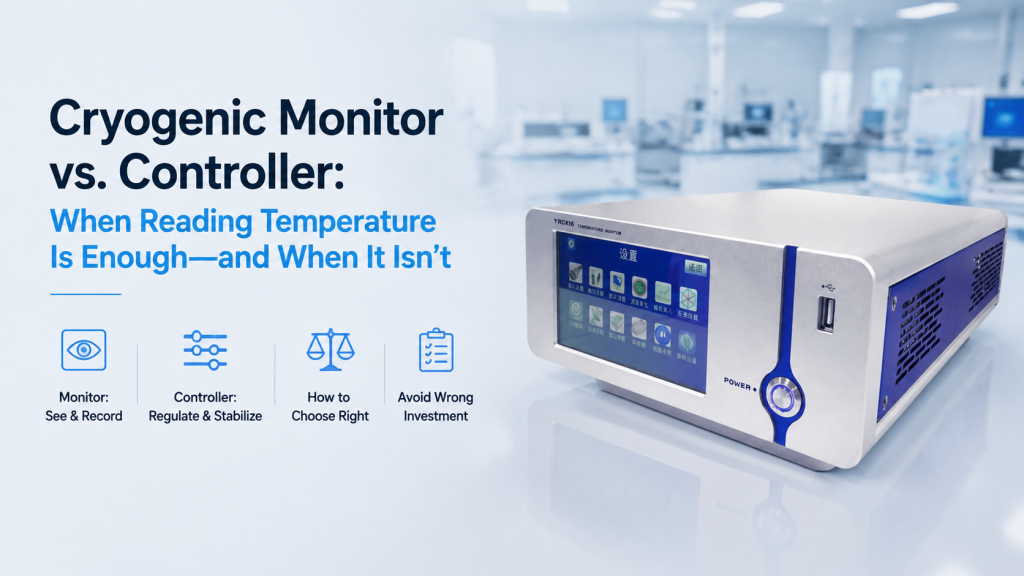
A cryogenic buyer sends an inquiry:
“We need to measure temperature from 4 K to 300 K. Please recommend a temperature controller.”
But after a few technical questions, the real requirement turns out to be much simpler:
The laboratory only needs to read temperatures from several sensors and record them on a computer.
No heater.
No temperature setpoint.
No closed-loop regulation.
In that case, a cryogenic temperature monitor may be the more appropriate instrument.
The opposite mistake happens too.
A buyer asks for a “temperature monitor” because the immediate requirement is to display a Cernox or silicon-diode temperature. Later, the laboratory realizes that it needs to hold the sample at 20 K while sweeping magnetic field—or automatically stabilize at 10 K, 20 K, 30 K, and 40 K during an experiment.
Now a monitor is no longer enough.
Understanding cryogenic temperature monitor vs controller is therefore not just about product naming. It determines whether the instrument merely observes the thermal system or actively becomes part of the thermal-control loop.
This guide explains when temperature monitoring is enough, when closed-loop control is necessary, and which specifications buyers should define before requesting a quotation.
1. The Simplest Difference: Observe or Act?
The basic distinction can be summarized in one question:
Do you only need to know the temperature, or do you need the instrument to maintain a target temperature?
Cryogenic Temperature Monitor
A monitor primarily:
- Excites temperature sensors
- Measures their electrical response
- Converts sensor signal into temperature
- Displays temperature
- Records or transmits temperature data
- Provides alarms or auxiliary outputs, depending on the model
Cryogenic Temperature Controller
A controller does all or most of the above, but also closes the loop:
- A sensor measures the temperature.
- The controller compares it with a setpoint.
- A control algorithm calculates the required correction.
- A heater output adds controlled thermal power.
- The process repeats continuously.
Commercial instruments illustrate this distinction clearly. For example, Lake Shore’s Model 218 is an eight-input cryogenic temperature monitor with sensor measurement, interfaces, analog outputs, alarms, and relays, while the Model 336 temperature controller combines four sensor inputs with four PID-controlled outputs, including higher-power heater outputs.
The difference is not simply “more channels versus fewer channels.”
It is measurement versus feedback control.
2. When a Cryogenic Temperature Monitor Is Enough
A monitor can be the correct—and more economical—choice when temperature is an experimental parameter that must be observed but not actively regulated by that instrument.
Typical applications include:
- Cryostat temperature monitoring
- Magnet temperature monitoring
- Radiation-shield monitoring
- Multiple cold-head temperatures
- Liquid-level-related thermal diagnostics
- Facility cryogenic systems
- Superconducting magnet protection monitoring
- Long-term temperature logging
- Checking cooldown and warm-up progress
- Auxiliary temperature monitoring around another main controller
Example
A closed-cycle cryostat already has its own dedicated control system.
Your experiment only needs independent temperatures from:
- Sample mount
- Radiation shield
- Magnet
- Cold head
- Vacuum chamber
Buying another high-power PID controller may add little value.
A multi-channel monitor can be the better tool.
3. When a Controller Becomes Necessary
A controller is required when the experiment needs a specific component to reach and remain near a defined temperature.
For example:
“Cool the cryostat naturally to 4 K, then stabilize the sample at 10 K.”
or:
“Measure Hall mobility at 20 K, 40 K, 60 K, 80 K, and 100 K.”
or:
“Hold the sample at 77 K within the required stability while magnetic field is swept for two hours.”
These are not monitoring tasks.
They are temperature-control tasks.
The system needs:
- A control sensor
- A setpoint
- A feedback algorithm
- Heater output
- Sufficient heater power
- Appropriate thermal design
A monitor can tell you that the sample has drifted from 20.0 K to 21.5 K.
A controller is intended to do something about it.
4. A Monitor Can Have Relays Without Becoming a Full Controller
This is an important distinction.
Some cryogenic temperature monitors provide:
- Alarm relays
- Analog outputs
- High/low limits
- Simple on/off actions
For example, Lake Shore’s Model 218 provides high- and low-temperature alarms, and certain versions provide relays that can alert an operator or perform simple on/off control.
That does not make it equivalent to a dedicated PID temperature controller.
Simple On/Off Control
Imagine controlling a heater like this:
- Below 19 K → heater ON
- Above 21 K → heater OFF
That may work for:
- Rough thermal protection
- Simple auxiliary heating
- Non-critical processes
But it is very different from continuously modulating heater power to stabilize around:
20.000 K
using a closed-loop control algorithm.
Procurement Lesson
Do not ask:
“Does the monitor have a relay?”
Ask:
“Do we need alarm/on-off functionality or true continuous closed-loop temperature regulation?”
5. Monitoring Channels and Control Loops Are Different Specifications
This is one of the biggest sources of confusion in cryogenic quotations.
Suppose a specification says:
8 sensor inputs
That tells you how many temperatures the instrument can potentially read.
It does not tell you:
- How many heaters it can drive
- How many temperatures it can regulate
- Whether the loops are independent
- How much heater power is available
Example
You might need to monitor:
- Sample
- Radiation shield
- Cold head
- Magnet
- Cryostat wall
- Gas return line
But only actively control:
- Sample
In that case, six control loops would be unnecessary.
Better RFQ Language
Instead of:
“We need six channels.”
write:
“We need six temperature measurement channels and one independent closed-loop heater-control channel.”
Now the supplier knows what “channel” actually means.
6. Multi-Channel Monitoring Can Be More Valuable Than Extra Heater Power
For large cryogenic systems, the priority may not be temperature stabilization.
It may be thermal visibility.
A monitor with many inputs can help users understand:
- Where heat is entering the system
- Whether thermal stages cool at the expected rate
- Whether one radiation shield is warmer than another
- Whether the magnet is overheating
- Whether temperatures return to normal after a field sweep
- Whether a cryocooler is performing consistently
Lake Shore’s cryogenic-monitor range, for example, includes multi-channel instruments specifically intended for monitoring multiple sensors, including configurations with eight or twelve channels.
For these applications, paying for large heater outputs may solve the wrong problem.
7. The Control Sensor Has a Different Role From a Monitoring Sensor
In a temperature-control system, not every sensor is equally important.
Monitoring Sensor
Its purpose may be to tell you:
“The radiation shield is currently at 42 K.”
If the reading changes slowly, the experiment may continue normally.
Control Sensor
Its reading is fed directly into the feedback loop.
If it is:
- Noisy
- Poorly mounted
- Too far from the heater
- Too far from the sample
- Slow to respond
the entire control loop can behave badly.
Possible results include:
- Overshoot
- Oscillation
- Slow settling
- Apparent instability
- Large temperature gradients
The controller cannot compensate for a badly designed thermal system.
8. Sensor Placement May Matter More Than the Controller Specification
Suppose a controller displays:
10.000 K
The number looks precise.
But where is the sensor?
It might be attached to:
- Cold finger
- Heater block
- Sample holder
- Cryostat body
- Radiation shield
The sample itself may not be exactly 10.000 K.
Thermal gradients can exist because of:
- Poor thermal contact
- Wiring heat load
- Optical heating
- Electrical current through the sample
- Heater position
- Cooling-path geometry
This is why a controller with excellent electronic specifications cannot guarantee excellent sample-temperature control unless the sensor and heater are thermally integrated correctly.
9. Sensor Compatibility Matters Equally for Monitors and Controllers
Whether buying a monitor or controller, sensor compatibility remains fundamental.
Common cryogenic sensors can include:
- Cernox
- Silicon diode
- Platinum RTD
- Ruthenium oxide
- Thermocouple
- Other resistive cryogenic sensors
But “supports Cernox” or “supports diode sensors” is not enough.
Buyers should verify:
- Exact sensor type
- Sensor resistance or voltage range
- Excitation method
- Excitation level
- Calibration curve support
- Temperature range
- Magnetic-field conditions
This requirement does not disappear simply because the instrument is “only” a monitor.
10. Sensor Excitation Still Matters in a Monitor
A temperature monitor is not a passive display.
It must electrically interrogate the temperature sensor.
For resistance thermometers, this requires an excitation current or voltage.
Too little excitation can make the sensor signal more difficult to measure.
Too much excitation can heat the thermometer itself.
NIST identifies self-heating as an important effect in cryogenic resistance thermometry and discusses evaluating thermometer behavior as measurement power changes.
Therefore, Monitor Buyers Should Still Ask
- What sensor excitation is used?
- Is excitation selectable?
- What sensor-resistance ranges are supported?
- How is self-heating managed?
- Are four-wire resistance measurements supported?
The word “monitor” should not be interpreted as “simple electronics.”
11. Calibration Curves Matter Whether You Control or Only Read
A cryogenic resistance sensor does not directly output:
“4.20 K.”
It outputs an electrical quantity such as resistance.
The instrument converts that measurement into temperature using an appropriate calibration curve.
Both Monitors and Controllers May Need
- Standard sensor curves
- User-defined curves
- Individual calibration tables
- Curve upload
- Nonvolatile curve storage
If your calibrated sensor comes with its own resistance-versus-temperature table, confirm that the instrument can actually use it.
Otherwise, the sensor may be electrically compatible but not usable at the desired accuracy.
12. A Controller Adds the Heater Side of the Equation
Once active control is required, sensor specifications are no longer enough.
Now the buyer must define the heater.
Important parameters include:
- Heater resistance
- Required maximum power
- Maximum voltage
- Maximum current
- Control range
- Warm-up requirement
- Fine-stabilization requirement
Lake Shore’s Model 336, for example, combines sensor inputs with independent PID outputs, including 100 W and 50 W heater outputs plus lower-power control outputs.
The exact values are model-specific, but the purchasing principle is universal:
A controller must be matched to the heater load—not just to the temperature sensor.
13. “50 W Heater Output” Does Not Mean 50 W Into Every Heater
Heater power depends on electrical load.
A controller output is constrained by combinations of:
- Maximum current
- Maximum voltage
- Heater resistance
Therefore, the same output stage may behave differently with:
- 25 Ω heater
- 50 Ω heater
- 100 Ω heater
Before Buying a Controller, Provide
- Heater resistance
- Approximate required power
- Desired temperature range
- Thermal stage being controlled
If the heater has not been selected yet, the cryostat and controller should ideally be evaluated together.
14. A Monitor Does Not Need Heater Sizing
This sounds obvious, but it has an important commercial consequence.
If your experiment only requires temperature measurement, you can eliminate an entire group of specifications:
- Heater power
- Heater resistance
- PID loop
- Warm-up output
- Control stability
- Heater wiring
That can simplify:
- Instrument selection
- System integration
- Cryostat wiring
- Budget
This is exactly why buyers should determine monitor versus controller before asking for a quotation.
15. PID Control Is the Key Functional Difference
Most scientific temperature controllers use closed-loop feedback to regulate temperature.
PID stands for:
- Proportional
- Integral
- Derivative
The controller continuously adjusts heater output according to the relationship between the measured temperature and the desired setpoint.
Why PID Matters
A poorly tuned thermal loop may:
- Overshoot the target
- Oscillate around it
- Approach the target too slowly
- Drift under changing thermal load
A good loop should reach the desired operating condition and maintain appropriate stability for the experiment.
Monitor
No PID tuning required if the instrument only observes temperature.
Controller
PID configuration can become one of the most important parts of commissioning.
That is another significant difference in real operating complexity.
16. A Controller Cannot Create Cooling Power
This is a surprisingly common misunderstanding.
A temperature controller can normally add heat through a heater.
It does not automatically make the cryostat colder.
Suppose your cryocooler reaches:
4 K
and you want to stabilize the sample at:
20 K
The controller can add controlled heat until the balance settles around 20 K.
But if your cooling system only reaches:
30 K
a heater controller cannot create a 10 K environment.
The Complete Thermal System Still Needs
- Cryocooler or cryogen
- Adequate cooling power
- Thermal link
- Heater
- Sensor
- Controller
The temperature controller regulates the balance.
It does not replace the cooling system.
17. Temperature Control Usually Means Controlling Above the Natural Base Temperature
Consider a cryostat that naturally cools a sample stage to approximately 4 K.
Researchers may want measurements at:
- 5 K
- 10 K
- 20 K
- 50 K
- 100 K
- 200 K
A controller can regulate these elevated setpoints by balancing:
- Cryogenic cooling
against
- Controlled heater power
This is one of the most common reasons a monitor is insufficient for variable-temperature experiments.
18. When a Monitor Is Perfectly Adequate in a Magnet System
Consider a superconducting magnet system.
The user may need to observe:
- Coil temperature
- Current-lead temperature
- Cryostat shield temperature
- Cold-head temperature
But these stages may already be thermally managed by the magnet or cryogenic system.
The external instrument only needs to provide:
- Independent monitoring
- Alarm limits
- Data logging
- Remote readback
A monitor may be the correct architecture.
Buying multiple high-power PID channels would add cost without improving the experiment.
19. When a Controller Is Necessary in a Hall Measurement System
Now consider temperature-dependent Hall measurements.
The experimental sequence may be:
- Stabilize at 300 K
- Measure carrier concentration and mobility
- Stabilize at 250 K
- Repeat
- Stabilize at 200 K
- Repeat
- Continue toward cryogenic temperature
The temperature must not merely pass through each value.
It must typically settle sufficiently for a meaningful transport measurement.
This Requires Integration Between
- Temperature sensor
- Temperature controller
- Heater
- Cryostat
- Hall electronics
- Magnetic field
A temperature monitor alone cannot execute the thermal-control part of the sequence.
20. MOKE and Magnetic Measurements Create the Same Distinction
Temperature-dependent magnetic measurements may require the system to:
- Stabilize sample temperature
- Sweep magnetic field
- Measure Kerr signal or magnetization
- Change temperature
- Repeat
Examples can include:
- MOKE
- Hall effect
- Magnetoresistance
- VSM
- Other magnetic characterization
Here, temperature becomes an actively controlled experimental axis.
That favors a controller rather than a monitor.
21. Data Logging Does Not Require a Controller
Another common assumption is:
“We need computer data acquisition, so we need a controller.”
Not necessarily.
Modern monitors can provide remote interfaces and data outputs without any heater-control function. Lake Shore’s Model 218, for example, provides computer interfaces in addition to its multi-channel monitoring functions.
A Monitor Can Be Suitable for
- Long-duration logging
- Cooldown curves
- Warm-up curves
- Thermal diagnostics
- Facility monitoring
- Magnet monitoring
If you only need a time series such as:
Temperature vs. time
you may not need PID control at all.
22. Remote Automation Also Does Not Automatically Mean Controller
Suppose you want Python or LabVIEW to read:
- T1
- T2
- T3
- T4
every second.
That is a data-acquisition requirement.
Not a temperature-control requirement.
A Controller Becomes Necessary When Software Must Also Command
- New temperature setpoint
- Heater range
- PID parameters
- Temperature ramp
- Control-loop state
The computer interface alone does not determine whether you need a monitor or controller.
The function being automated does.
23. Alarms Can Be a Strong Reason to Buy a Monitor
A monitoring instrument can provide important protection even without closed-loop control.
Possible alarm conditions include:
- Magnet temperature too high
- Cryostat shield unexpectedly warm
- Cooling water failure indicated by temperature rise
- Cold head not reaching operating range
- Sensor disconnected
Depending on the model, alarms may trigger:
- Front-panel warning
- Remote software notification
- Relay output
- External equipment action
For example, Lake Shore’s Model 218 provides configurable high and low alarms and relay functionality on certain versions.
For large cryogenic installations, that can be a much more valuable function than heater control.
24. Safety Interlocks Are Not the Same as PID Control
A monitor relay can potentially be used to trigger:
- Magnet shutdown
- Pump action
- Warning beacon
- External interlock
That remains a protective function.
It does not necessarily mean the monitor should regulate the experiment continuously.
Think of the Difference This Way
Alarm/interlock:
“If temperature exceeds 50 K, take emergency action.”
PID control:
“Continuously maintain temperature at 20.000 K.”
These are fundamentally different tasks.
25. How Many Temperatures Need to Be Measured?
This is often where monitors have an advantage.
Suppose a cryogenic facility needs:
12 temperature sensors.
Only one temperature stage is actively regulated by another system.
A multi-channel monitor may be much more logical than buying several controllers.
Count Sensors by Function
For every sensor, label it as:
- Control
- Monitoring
- Safety
- Diagnostic
- Backup
You may discover that most sensors do not require any heater loop.
26. How Many Temperatures Need Independent Control?
Now ask the second question.
Perhaps the system must independently stabilize:
- Sample stage
- Radiation shield
- Detector stage
That means multiple control loops may be justified.
The controller architecture now needs to consider:
- Three control sensors
- Three heaters
- Three PID loops
- Three output-power requirements
This is where simply asking for:
“Three temperature channels”
becomes dangerously ambiguous.
27. One Controller Plus One Monitor Can Be Better Than One Huge Controller
There is no rule that every sensor must connect to the same instrument.
A practical architecture might be:
Controller
Used for:
- Sample sensor
- Sample heater
- Critical thermal regulation
Monitor
Used for:
- Radiation shield
- Magnet
- Cold head
- Vacuum chamber
- Gas line
- Backup sensors
This can provide:
- More measurement channels
- Lower cost
- Cleaner system architecture
- Easier troubleshooting
- Better separation between control and diagnostics
For larger cryogenic setups, this architecture deserves serious consideration.
28. But Two Instruments Are Not Automatically Better Either
Splitting monitoring and control introduces its own costs:
- More rack space
- More cables
- More software connections
- More interfaces
- Additional synchronization
- More equipment to configure
If one controller already provides enough inputs and control outputs at a reasonable cost, adding a second monitor may be unnecessary.
The objective is not to maximize instrument count.
It is to use the simplest architecture that satisfies the experiment.
29. Monitor vs. Controller for a Simple Liquid-Nitrogen Experiment
Suppose a laboratory puts a sample into a liquid-nitrogen environment and only wants to know:
“What is the sample temperature?”
A monitor may be sufficient.
If the desired experiment is:
“Measure continuously as the sample cools from 300 K toward 77 K,”
again, monitoring may be enough.
But if the experiment requires:
“Stabilize the sample at 100 K, then 120 K, then 150 K,”
active heater control becomes necessary.
Same cryogenic system.
Different measurement objective.
Different instrument.
30. Monitor vs. Controller for a Closed-Cycle Cryostat
Closed-cycle cryostats make the distinction even clearer.
Monitor May Be Enough When
- The cryostat already has its own controller
- An external instrument provides additional sensor channels
- Only independent verification is needed
- Auxiliary components must be monitored
Controller Is Needed When
- The sample stage needs independent temperature regulation
- A custom heater is installed
- Temperature sweeps are part of the experiment
- Other instruments must synchronize with thermal setpoints
Do not duplicate control functions unless there is a clear reason.
31. Monitor vs. Controller for Superconducting Magnet Experiments
In a magnetic-field experiment, there may be two completely different thermal requirements.
Magnet Thermal Monitoring
You may only need to know whether:
- Magnet remains safely cold
- Current leads remain within acceptable temperature
- Cryostat behaves normally
That favors monitoring.
Sample Temperature Control
You may want to measure a sample at:
- 4 K
- 10 K
- 20 K
- 50 K
while sweeping the magnetic field.
That favors closed-loop control.
One experiment may therefore require both functions simultaneously.
32. Temperature Stability Is a Controller Requirement, Not a Monitor Requirement
A buyer asks:
“We need temperature stability of ±0.01 K.”
That statement already suggests active control.
A monitor can characterize stability.
It cannot create thermal stability on its own.
Final Stability Depends on the Entire Loop
Including:
- Sensor sensitivity
- Measurement electronics
- Heater resolution
- PID tuning
- Cooling stability
- Thermal mass
- Sensor location
- Heater location
- Environmental heat load
Therefore, a controller quotation should never reduce temperature stability to one isolated electronics specification.
33. Measurement Accuracy Still Matters in Both
The monitor/controller decision should not be confused with measurement quality.
A high-quality monitor may measure temperature more accurately than an unsuitable controller.
Both should be evaluated for:
- Sensor compatibility
- Electrical measurement range
- Resolution
- Calibration curves
- Excitation
- Self-heating
- Magnetic-field behavior
- Input isolation
A controller adds control capability.
It does not automatically mean better thermometry.
34. A Controller Is Usually More Complex to Commission
A monitor typically requires:
- Connect sensor
- Select sensor type
- Load calibration curve
- Verify reading
- Configure logging or alarms
A controller may additionally require:
- Connect heater
- Verify heater resistance
- Set heater range
- Configure setpoint
- Tune PID
- Verify overshoot
- Test stability
- Test safety behavior
That extra complexity is justified when active control is necessary.
It is unnecessary when measurement alone solves the problem.
35. Monitor vs. Controller Is Also a Budget Decision
A lower-cost monitor should not be viewed as an inferior controller.
It is a different instrument class.
If your project only requires:
- Four temperature readings
- Data logging
- Alarms
- Computer communication
then money spent on:
- High-power heater outputs
- PID loops
- Autotuning
- Temperature ramps
may produce no scientific value.
But Buying Too Low Can Cost More Later
If temperature sweeps are realistically planned, choosing a monitor today may eventually require buying a controller as well.
The correct budget decision therefore considers:
- Current requirement
- Credible future experiments
- Cryostat architecture
- Expected system lifetime
36. When “Future-Proofing” Justifies Buying a Controller
Starting with a controller may make sense when:
- A heater is already installed
- Variable-temperature experiments are planned
- Temperature-dependent Hall measurements are likely
- Low-temperature magnetic characterization is planned
- Software automation is expected
- The price difference is reasonable relative to future replacement cost
When It Does Not
Do not buy a controller merely because:
- “Controllers are more advanced.”
- “We may possibly need it in five years.”
- “It has more buttons.”
- “The budget is currently available.”
Unused capability is still wasted capability.
37. Seven Questions That Usually Solve Monitor vs. Controller Immediately
Before requesting a quotation, answer these seven questions.
1. Do You Need to Measure or Maintain Temperature?
Measure only → monitor may be enough.
Maintain a setpoint → controller.
2. How Many Sensors?
Specify the actual number.
3. How Many Independent Thermal Stages Need Control?
This determines control-loop count.
4. Are Heaters Already Installed?
If yes, provide:
- Resistance
- Required power
5. What Temperature Range Is Required?
For example:
- 4–300 K
- 1.5–300 K
- 77–400 K
6. Is Automated Temperature Sweeping Required?
If yes, controller capability becomes much more important.
7. Will the Requirement Expand Later?
Define a credible future requirement rather than a theoretical possibility.
38. A Weak Monitor/Controller RFQ
A buyer writes:
“We need a cryogenic temperature instrument supporting Cernox, 4 K to 300 K. Please quote.”
The supplier still does not know:
- Monitor or control?
- Number of sensors?
- Number of heaters?
- Heater resistance?
- Heater power?
- Required stability?
- Automated temperature sweep?
- Interfaces?
Any quotation will contain assumptions.
39. A Better Monitor RFQ
“We need to monitor eight cryogenic temperature sensors between approximately 4 K and 300 K. No heater control is required. The instrument should support our existing calibrated cryogenic sensors, user calibration curves, high/low alarms, computer data acquisition, and continuous temperature logging.”
Now the requirement is clear.
The buyer needs a monitor.
40. A Better Controller RFQ
“We need closed-loop temperature control of a sample stage from approximately 4 K to 300 K. One calibrated Cernox sensor will be used for control, with two additional sensors for monitoring. The sample heater is 50 Ω with approximately 1 W maximum required power. We need programmable PID control, temperature ramping, Ethernet communication, user calibration curves, and remote data acquisition.”
Now the supplier can evaluate:
- Sensor input
- Heater output
- Control loop
- Software interface
- System compatibility
That is a technically useful RFQ.
41. How Cryomagtech Approaches Cryogenic Monitor and Controller Selection
Cryomagtech evaluates cryogenic temperature instrumentation according to what each temperature channel actually needs to do.
For monitoring applications, configuration may focus on:
- Sensor type
- Temperature range
- Number of sensor inputs
- Calibration curves
- Alarms
- Data logging
- Computer communication
For closed-loop temperature-control applications, additional requirements include:
- Number of independent control loops
- Heater resistance
- Heater power
- PID control
- Setpoint ramping
- Thermal stability
- Remote automation
👉 Product link placeholder: Cryomagtech Cryogenic Temperature Monitors and Temperature Controllers
For larger cryogenic systems, a controller and multi-channel monitor can also be evaluated together rather than forcing every sensor into one instrument.
The right product level begins with the thermal task—not the product name.
42. Practical Buyer Decision Guide
Choose a cryogenic temperature monitor when:
- You only need temperature measurement
- The cryostat already controls itself
- Multiple auxiliary temperatures must be logged
- No heater output is required
- Alarm functions are sufficient
- Temperature is observed rather than actively swept
Choose a cryogenic temperature controller when:
- A specific temperature must be maintained
- A heater must be driven
- Temperature stability is specified
- Setpoint ramps are required
- Temperature-dependent experiments are planned
- Remote automation must change temperature
- Multiple thermal stages require independent regulation
Choose a controller plus monitor when:
- One or two stages require active control
- Many additional temperatures require observation
- Large systems need separate diagnostic channels
- Keeping monitoring and control functions separated simplifies the architecture
43. Key Takeaways
- Cryogenic temperature monitor vs controller is fundamentally a choice between observing temperature and actively regulating it.
- A monitor can provide sophisticated sensor measurement, calibration, alarms, logging, and remote communication without providing full PID heater control.
- Alarm relays and simple on/off actions should not be confused with continuous closed-loop temperature regulation.
- Sensor-input count and independent control-loop count are different specifications.
- A controller must be matched to both the temperature sensor and heater load.
- Heater resistance and required power should be specified before selecting a controller.
- A controller normally adds heat; it does not replace the cryogenic cooling system.
- Temperature-dependent Hall, MOKE, magnetotransport, and other measurements often require active stabilization and therefore favor a controller.
- Large cryogenic systems may benefit from a dedicated controller for critical stages plus a multi-channel monitor for auxiliary sensors.
- A controller is not automatically a better temperature-measurement instrument simply because it has heater outputs.
- The cheapest monitor can become expensive if the laboratory genuinely needs active control later—but unused PID capability is also wasted budget.
The wrong question is:
“Which is better, a cryogenic monitor or a controller?”
The better question is:
“Do we need to know the temperature—or do we need the instrument to actively keep the experiment at that temperature?”
References
- Lake Shore Cryotronics — Cryogenic Temperature Monitors and Controllers
Official product information illustrates the functional distinction between multi-channel temperature monitoring and instruments that add independent PID-controlled heater outputs.
Monitor: https://www.lakeshore.com/products/categories/overview/temperature-products/cryogenic-temperature-monitors/model-218-temperature-monitor
Controller: https://www.lakeshore.com/products/categories/overview/temperature-products/cryogenic-temperature-controllers/model-336-cryogenic-temperature-controller - National Institute of Standards and Technology (NIST) — Calibration of Cryogenic Resistance Thermometers
NIST discusses cryogenic resistance thermometry, measurement excitation, and sensor self-heating—issues that remain important whether the sensor is connected to a monitor or a controller.
https://nvlpubs.nist.gov/nistpubs/SpecialPublications/NIST.SP.250-91.pdf