
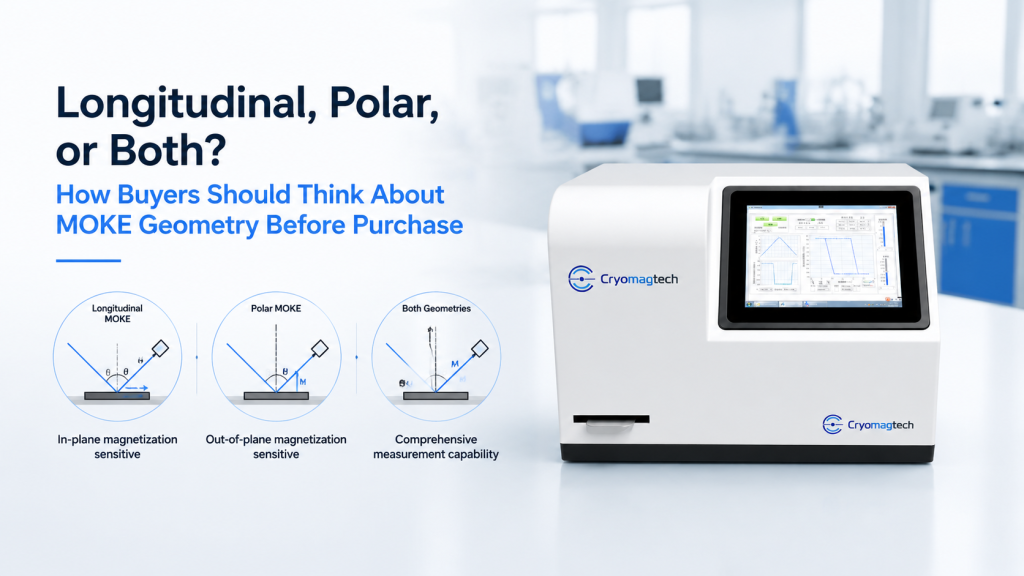
When purchasing a Magneto-Optical Kerr Effect system, buyers often begin with a general request:
“We need a MOKE system for magnetic thin-film measurements.”
That description is not enough.
One of the first decisions should be the required MOKE geometry: longitudinal, polar, or a system capable of both. This choice determines which magnetization component can be measured, how the magnetic field must be applied, how the optical head is arranged, and whether the sample, cryostat, probes, and magnet can physically fit together.
Choosing the wrong geometry may produce a system that works technically but cannot measure the magnetic behavior that matters to your research.
This article explains how buyers should evaluate MOKE geometry before requesting a quotation.
1. Start With the Magnetization Direction, Not the Instrument Name
The magneto-optical Kerr effect describes changes in the polarization of light reflected from a magnetized surface. Depending on the relationship between the sample magnetization, sample surface, and optical plane of incidence, the measurement is commonly classified as longitudinal, polar, or transverse MOKE.
Longitudinal MOKE is sensitive to an in-plane magnetization component lying in the optical plane of incidence. Polar MOKE is primarily sensitive to magnetization perpendicular to the sample surface. These are not simply two software modes applied to an otherwise identical instrument; they represent different physical measurement geometries.
Before discussing laser wavelength, Kerr-angle sensitivity, or maximum magnetic field, buyers should answer a more fundamental question:
Which component of magnetization must the system detect?
That answer should be based on:
- Expected easy-axis direction
- In-plane or perpendicular magnetic anisotropy
- Film structure and thickness
- Device operating principle
- Magnetic field orientation
- Whether the objective is hysteresis measurement, domain imaging, or both
A system with excellent sensitivity in the wrong geometry is still the wrong system.
2. Longitudinal MOKE: Measuring In-Plane Magnetization
What Longitudinal MOKE Detects
In longitudinal MOKE, the magnetization lies:
- Parallel to the sample surface
- Within the plane of incidence of the probing light
The system therefore measures an in-plane magnetization component.
This geometry is widely used for magnetic films and patterned structures in which the important magnetic behavior occurs mainly along the sample plane.
Typical Applications
Longitudinal MOKE is often appropriate for:
- Soft magnetic thin films
- In-plane magnetic anisotropy studies
- Magnetic multilayers
- Exchange-bias systems
- Patterned magnetic elements
- Spintronic devices with in-plane magnetization
- Coercivity and remanence measurements along an in-plane axis
It is also useful when researchers need to compare hysteresis loops at different in-plane sample angles.
For example, rotating the sample relative to the applied field can reveal:
- Easy and hard magnetic axes
- Uniaxial anisotropy
- Switching-field variation
- Angular dependence of coercivity
- Differences between patterned and unpatterned directions
Optical Requirements
Longitudinal measurements normally require oblique optical incidence because the system must interact with the magnetization component within the plane of incidence.
The optical head may therefore need:
- Adjustable incident angle
- Sufficient working distance
- Stable focusing at oblique incidence
- Space between the magnet poles
- Accurate positioning of the laser spot
- Control of reflections from substrates, holders, and nearby hardware
This optical geometry becomes especially important when the sample is mounted inside a cryostat or vacuum chamber.
Magnetic Field Requirements
The applied field normally needs to lie in the sample plane.
This may be produced by:
- A conventional C-shaped electromagnet
- An H-frame electromagnet
- A compact in-plane magnet assembly
- Helmholtz coils for lower-field measurements
- A vector magnetic field system
The magnet must provide enough pole gap for the optical beam, sample holder, electrical probes, and any temperature-control hardware.
A buyer should not specify only the target field. The required field must always be connected to the actual working gap.
3. Polar MOKE: Measuring Out-of-Plane Magnetization
What Polar MOKE Detects
In polar MOKE, the magnetization component is perpendicular to the sample surface.
This makes polar geometry the natural choice for materials and devices dominated by perpendicular magnetic behavior.
Typical Applications
Polar MOKE is often selected for:
- Perpendicular magnetic anisotropy films
- Magnetic recording materials
- Co/Pt and Co/Pd multilayers
- Magnetic tunnel junction structures
- Perpendicular spintronic devices
- Out-of-plane switching studies
- Magnetic domain nucleation and propagation
- Current-induced perpendicular magnetization reversal
The method is valuable when the main scientific question is whether magnetization points upward or downward relative to the sample plane.
Optical Requirements
Polar MOKE commonly uses light incident close to the sample normal, although the exact optical arrangement depends on the instrument design.
Compared with longitudinal geometry, this can simplify some alignment tasks. However, the optical path may compete directly with the out-of-plane magnet structure.
The system may require:
- An axial aperture through the magnet
- Optical access through a pole piece
- A magnet with sufficient objective clearance
- A long-working-distance objective
- A transparent cryostat window
- Careful control of window birefringence
- Alignment between the optical axis and field axis
These physical requirements can become more difficult than the MOKE detection itself.
Magnetic Field Requirements
Polar MOKE requires a field component normal to the sample surface.
Possible field sources include:
- A perpendicular electromagnet
- An axial solenoid
- A magnet with optically accessible pole pieces
- A superconducting magnet with optical access
- A vector electromagnet
- A compact out-of-plane coil assembly
For perpendicular-anisotropy materials, the required saturation field may be considerably higher than expected. The buyer should therefore provide either an estimated field requirement or previous VSM, AGM, SQUID, Hall, or MOKE data.
4. Longitudinal vs. Polar MOKE Is Not a Software Selection
A common procurement mistake is assuming that switching from longitudinal to polar MOKE only requires changing a setting in the control software.
In reality, the geometry affects at least five parts of the system.
Optical Head
The positions of the laser, polarizer, analyzer, detector, beam splitter, and focusing optics may need to change.
Magnetic Field Direction
Longitudinal measurements normally require an in-plane field, while polar measurements require an out-of-plane field.
Magnet Structure
The magnet must generate the correct field without blocking the incident or reflected beam.
Sample Stage
The stage must orient the sample correctly relative to both the optical plane and magnetic field.
Calibration and Signal Separation
The system must verify that the measured signal originates from the intended magnetization component rather than optical drift, unwanted geometry mixing, or mechanical movement.
A supplier stating that a system “supports both” should be asked to explain exactly how the geometry is changed.
5. When a Longitudinal-Only System Is the Better Purchase
A longitudinal-only system can be the most rational choice when the laboratory has a clearly defined in-plane research program.
It may offer:
- Simpler optical alignment
- A more open sample area
- Easier integration of electrical probes
- Lower system complexity
- Faster sample exchange
- More predictable in-plane field performance
- Lower acquisition and maintenance costs
A dedicated system may also deliver better practical performance than a highly configurable platform because fewer compromises are required.
Longitudinal-only MOKE is often sufficient when:
- All current samples have in-plane easy axes
- No perpendicular films are planned
- The laboratory already has separate out-of-plane characterization equipment
- Fast routine hysteresis measurements are the priority
- Budget is limited
- Cryogenic or probe access is more important than geometry flexibility
Buying unnecessary capability can make a system harder—not easier—to use.
6. When a Polar-Only System Makes Sense
A polar-only system is appropriate when the laboratory is focused on perpendicular magnetic materials or devices.
This can be especially practical for:
- Wafer-level magnetic screening
- Perpendicular anisotropy process development
- Routine up/down switching measurements
- Domain imaging under perpendicular fields
- Quality control of magnetic multilayer stacks
- Repeated testing of similarly structured samples
A dedicated polar platform may provide a more direct optical path and a more optimized out-of-plane magnet structure.
However, buyers must confirm whether the system measures:
- Only global hysteresis loops
- Localized micro-MOKE loops
- Wide-field magnetic domains
- Both loops and domain images
“Polar MOKE” alone does not define the complete measurement capability.
7. When Buying Both Geometries Is Justified
A dual-geometry MOKE system can be a strong investment for laboratories working across multiple material platforms.
Supporting both longitudinal and polar measurements may be justified when:
- Both in-plane and perpendicular films are studied
- The research direction may change over several years
- Different research groups will share the system
- Magnetization reorientation is part of the research
- Spin-orbit torque or current-induced switching is being investigated
- Samples may contain mixed magnetic anisotropy
- Both academic research and industrial screening are required
- A central facility needs broad measurement capability
MOKE is widely used as a non-destructive optical method for investigating magnetic states and thin-film magnetization behavior, including modern spintronic and magnetic heterostructure research.
The key question is not whether both geometries sound useful. It is whether both can be implemented without unacceptable compromises.
8. The Hidden Trade-Offs of a “Both” Configuration
Reduced Maximum Field
A magnet optimized for multiple field directions may produce less field along each individual axis than a dedicated single-axis magnet.
Smaller Working Space
Additional coils, pole pieces, optical mounts, and sample stages can reduce the usable sample area.
More Difficult Alignment
Switching geometry may require:
- Moving the optical head
- Rotating the sample
- Replacing a magnet assembly
- Repositioning the detector
- Refocusing the laser
- Recalibrating the Kerr response
Longer Measurement Preparation
A flexible research platform may require more setup time than a dedicated routine-testing instrument.
Geometry-Dependent Sensitivity
A system may support both modes but provide different:
- Noise floors
- Kerr-angle sensitivity
- Spot sizes
- Working distances
- Maximum fields
- Field uniformities
These values should be specified separately for each geometry.
Higher Calibration Burden
The supplier should demonstrate that each geometry has been independently aligned, calibrated, and verified.
“Both” should never be interpreted as “identical performance in both.”
9. Three Common Ways Suppliers Implement Both Geometries
Reconfigurable Optical Head
The optical head or sample stage is mechanically repositioned to change the measurement geometry.
Advantages:
- Lower hardware cost
- One primary optical system
- Compact overall design
Limitations:
- Manual realignment may be required
- Repeatability depends on the mechanical design
- Switching modes can take time
Separate Magnet or Optical Modules
The system uses dedicated modules for longitudinal and polar operation.
Advantages:
- Better optimization for each geometry
- Clearer performance boundaries
- Potentially higher field capability
Limitations:
- Higher cost
- More laboratory space
- More components to maintain and store
Vector Magnetic Field Architecture
A two-axis or three-axis magnet produces different field orientations without physically rotating the main magnet.
Advantages:
- Flexible field direction
- Useful for angular and vector-dependent studies
- Reduced need for repeated mechanical changes
Limitations:
- More complicated field calibration
- Lower maximum field may be available on secondary axes
- Coil interactions and thermal limits must be considered
- Optical access can become more constrained
Cryomagtech offers MOKE measurement platforms and magnetic field systems that can be evaluated according to the required Kerr geometry, field direction, optical access, temperature environment, and sample configuration.
👉 Product link placeholder: Cryomagtech MOKE Measurement Systems and Magnetic Field Integration
10. Do You Need Hysteresis Loops, Magnetic Domain Imaging, or Both?
MOKE geometry and MOKE measurement mode are related, but they are not the same question.
Point or Spot MOKE
A focused laser measures a localized area of the sample.
This is suitable for:
- Local hysteresis loops
- Coercivity measurements
- Remanence measurements
- Saturation-field determination
- Small patterned devices
- Position-dependent scanning
Wide-Field Kerr Imaging
A camera-based optical system visualizes magnetic domain contrast across a larger field of view.
This is suitable for:
- Domain nucleation
- Domain-wall motion
- Reversal mechanisms
- Defect-related pinning
- Spatially nonuniform switching
- Dynamic domain evolution
A buyer may require longitudinal hysteresis loops but polar domain imaging, or the reverse.
Therefore, an RFQ should separately define:
- Required Kerr geometry
- Required measurement mode
- Required field orientation
- Required spatial resolution
- Required field of view
Do not allow these requirements to be compressed into the single phrase “MOKE system.”
11. Sample Rotation Is Not the Same as Vector MOKE
Rotating the sample within a fixed in-plane field can provide angular hysteresis measurements. However, this does not automatically make the system a vector MOKE instrument.
Sample rotation changes the relationship between:
- Sample crystallographic axes
- Magnetic field direction
- Optical plane of incidence
A true vector measurement may require the simultaneous or independently calibrated detection of multiple magnetization components.
Buyers should clarify whether they need:
- Angular longitudinal loops
- Longitudinal and polar measurements performed separately
- Simultaneous in-plane and out-of-plane detection
- Two-axis magnetic field control
- Full three-dimensional field control
- Quantitative vector reconstruction
These requirements lead to very different optical and magnetic architectures.
12. Cryogenic, Vacuum, and Electrical-Probe Integration
MOKE geometry should be finalized before designing any environmental integration.
Cryogenic Measurements
A cryostat introduces:
- Optical windows
- Limited working distance
- Potential window birefringence
- Condensation-control requirements
- Restricted sample rotation
- Larger magnet gaps
- Thermal drift
- More difficult focusing
Longitudinal geometry may require angled optical access through multiple windows. Polar geometry may require optical access along the same axis as the magnetic field.
Vacuum Measurements
Vacuum chambers can restrict:
- Incident angle
- Reflected beam path
- Objective position
- Sample manipulation
- Cable routing
- Magnetic pole spacing
Window material, coating, thickness, angle, and stress can also influence polarization measurements.
Electrical Transport Integration
For MOKE combined with Hall, magnetoresistance, anomalous Hall effect, or spin-orbit torque measurements, the system may need:
- DC probes
- High-frequency probes
- Current injection
- Voltage measurement
- Sample rotation
- Electrical isolation
- Magnetic-field synchronization
- Software-trigger integration
The optical geometry must leave enough physical access for these components.
13. Questions Buyers Should Ask Before Requesting a Quote
A useful MOKE RFQ should answer the following questions.
Sample and Magnetization
- What materials will be measured?
- Are the samples thin films, wafers, devices, or bulk surfaces?
- Is the expected magnetization in-plane, out-of-plane, or mixed?
- What are the sample dimensions?
- Is the sample reflective enough for the proposed wavelength?
Field Requirements
- Is the required field in-plane or perpendicular?
- What maximum field is needed?
- At what pole gap or working distance?
- Is bipolar field reversal required?
- Is continuous field operation necessary?
- Is angular or vector field control needed?
Optical Requirements
- Is the priority hysteresis measurement or domain imaging?
- What laser spot size is needed?
- What field of view is required?
- Is automated sample scanning required?
- Must the same sample alignment remain fixed when changing geometry?
Environmental Requirements
- Is room-temperature operation sufficient?
- Is low-temperature or high-temperature control required?
- Will the sample be in vacuum?
- Are electrical or microwave probes required?
- Are there restrictions on vibration, noise, or available space?
Dual-Geometry Verification
- How is the system switched between longitudinal and polar modes?
- Which components must be moved or replaced?
- Is realignment required?
- What is the maximum field in each mode?
- What sensitivity is guaranteed in each mode?
- Are separate reference samples used during acceptance testing?
These questions help suppliers propose a realistic configuration rather than a generic instrument with poorly defined capability.
14. A Practical MOKE Geometry Decision Guide
Choose longitudinal MOKE when:
- The important magnetization lies mainly in the sample plane
- In-plane anisotropy and switching are the main research targets
- Open sample access is important
- Electrical probes or cryogenic integration require a wide pole gap
- A simpler, dedicated system is preferred
Choose polar MOKE when:
- The important magnetization is perpendicular to the sample
- Perpendicular magnetic anisotropy is the main research target
- Up/down switching or perpendicular domains must be observed
- Wafer or multilayer screening is required
- The magnet and optics can provide axial access
Choose both geometries when:
- The laboratory studies both in-plane and perpendicular materials
- Future research direction is not limited to one anisotropy type
- Multiple groups will share the equipment
- Mixed or changing magnetization states are scientifically important
- The additional complexity is justified by real measurement needs
Do not choose both merely because it appears more complete on a specification sheet.
15. How Cryomagtech Supports MOKE System Selection
Cryomagtech evaluates a MOKE project as a combined optical, magnetic, mechanical, and environmental system.
The configuration should be matched to:
- Longitudinal, polar, or combined geometry
- Required magnetic field and working gap
- Laser spot size and optical working distance
- Hysteresis or domain-imaging requirements
- Sample dimensions and mounting method
- Room-temperature or cryogenic operation
- Vacuum and electrical-probe integration
- Manual, motorized, or vector field control
A properly specified MOKE system begins with the sample physics—not with the longest possible equipment specification.
References
- American Physical Society — Magneto-optical Kerr effect from layered systems when using the full 4 × 4 matrix formalism
https://link.aps.org/doi/10.1103/PhysRevB.70.134411 - Scientific Reports — Interference-induced enhancement of the magneto-optical Kerr effect in ultrathin magnetic films
https://www.nature.com/articles/s41598-017-18794-w
Key Takeaways
- MOKE geometry determines which magnetization component the system measures.
- Longitudinal MOKE is mainly used for in-plane magnetization.
- Polar MOKE is mainly used for out-of-plane magnetization.
- Supporting both geometries usually requires more than a software change.
- The optical head, magnet structure, sample stage, and field direction must be designed together.
- Hysteresis measurement and magnetic domain imaging should be specified separately.
- Cryogenic, vacuum, and electrical-probe requirements must be considered before the geometry is frozen.
- A dedicated single-geometry system may outperform a flexible system when the research requirement is clearly defined.
The right question is not:
“Which MOKE system has the most functions?”
The right question is:
“Which geometry measures the magnetization component that matters to our samples?”