
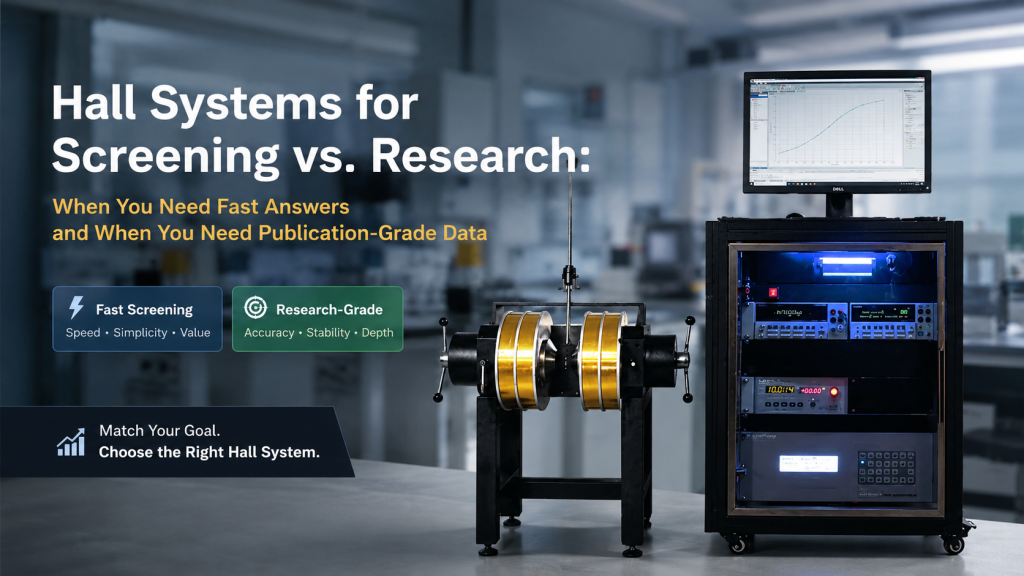
Not every Hall effect measurement project needs the same system.
Some users need fast screening:
“Is this sample conductive? Is it n-type or p-type? Is the mobility roughly in the expected range?”
Other users need publication-grade data:
“Can we trust the carrier concentration, mobility, resistivity, temperature dependence, field dependence, uncertainty, and repeatability enough for a paper, thesis, or formal research report?”
Both needs are valid.
The problem begins when buyers choose a Hall system without first deciding whether they need fast answers or defensible data.
This article explains the difference between Hall systems for screening and Hall systems for research, and how buyers can choose the right configuration based on sample type, measurement accuracy, temperature range, magnetic field, contacts, automation, and reporting requirements.
1. What a Hall Effect Measurement System Actually Measures
A Hall effect measurement system is used to study electrical transport properties of materials under a magnetic field.
Common measured or calculated results include:
- Carrier type
- Carrier concentration
- Mobility
- Sheet resistance
- Resistivity
- Hall voltage
- Conductivity
- Temperature-dependent transport behavior
- Field-dependent transport behavior
NIST explains that Hall measurement techniques are used to determine carrier density and mobility in semiconductor materials, and that both resistivity and Hall measurements are needed to determine mobility and sheet density.
Reference link: https://www.nist.gov/pml/nanoscale-device-characterization-division/popular-links/hall-effect/hall-effect-measurements-3
Reference link: https://www.nist.gov/pml/nanoscale-device-characterization-division/popular-links/hall-effect/hall-effect
The Hall effect is also widely described as a method that can help determine either carrier density or magnetic field, depending on the known parameters of the setup.
Reference link: https://en.wikipedia.org/wiki/Hall_effect
For buyers, the important point is simple:
A Hall system is not just a meter.
It is a measurement platform whose data quality depends on the magnet, electrical measurement unit, sample holder, contacts, temperature control, software, and test procedure.
2. What “Screening” Means in Hall Measurement
Screening means getting a fast, practical answer.
The user may not need the highest accuracy or complete uncertainty analysis. The goal is to quickly classify or compare samples.
Typical Screening Questions
A screening Hall system may answer:
- Is the sample measurable?
- Is the carrier type n-type or p-type?
- Is the mobility low, medium, or high?
- Is the film conductive enough for further study?
- Is this batch similar to the previous batch?
- Does processing condition A look better than condition B?
- Is the sample worth sending to a more advanced system?
Typical Screening Users
Screening-oriented users may include:
- Material preparation labs
- semiconductor process development teams
- thin-film groups
- teaching labs
- quality-control teams
- early-stage R&D teams
- labs handling many samples with limited time
Screening does not mean careless measurement.
It means the system is optimized for speed, usability, and practical comparison rather than maximum research depth.
3. What “Publication-Grade Data” Means
Publication-grade data means the measurement should be strong enough to survive deeper technical questioning.
It should be repeatable, traceable in method, and suitable for comparison with literature or internal research standards.
Publication-Grade Data Usually Requires
- Clear sample geometry
- Reliable ohmic contacts
- controlled magnetic field
- low-noise voltage measurement
- stable current source
- temperature control, if needed
- repeatable measurement sequence
- field reversal
- current reversal
- contact verification
- data fitting or correction method
- clear reporting of assumptions
- enough documentation for review
For research papers, it is not enough to report a mobility number.
A reviewer or collaborator may ask:
- How was the sample contacted?
- Was the Hall voltage separated from offset voltage?
- Was field reversal used?
- Was temperature stabilized?
- Was the sample uniform?
- Was the van der Pauw method applied correctly?
- Was the signal large enough compared with noise?
- Were multiple samples measured?
Publication-grade data is not defined only by equipment price.
It is defined by measurement confidence.
4. Why Buyers Often Choose the Wrong Hall System
Many buyers start with only one sentence:
“We need a Hall effect measurement system. Please quote.”
That is not enough.
The supplier still needs to know whether the system is for:
- Fast sample screening
- teaching demonstration
- semiconductor wafer characterization
- thin-film material research
- low-temperature transport measurement
- high-resistance sample measurement
- low-mobility material testing
- publication-grade research
- production quality control
These applications require different configurations.
A low-cost system may be enough for fast screening.
A research system may need stronger magnetic field control, better electrical sensitivity, lower noise, temperature control, better sample fixtures, and more complete software.
The wrong purchase is not always “too cheap.”
Sometimes the wrong purchase is buying a complex research system when the real need is fast internal screening.
5. Screening Systems: What They Should Do Well
A screening Hall system should make routine measurements easy.
Key Priorities
For screening applications, buyers usually care about:
- Fast setup
- simple operation
- stable basic magnetic field
- easy sample mounting
- quick carrier type identification
- rough mobility and carrier concentration
- repeatable comparison across samples
- low training burden
- reasonable cost
Useful Features
A screening system may include:
- Room-temperature measurement
- fixed or moderate magnetic field
- simple sample holder
- standard current source
- basic voltage measurement
- automatic switching
- basic software calculation
- simple data export
For many labs, this is enough to support daily screening and internal decision-making.
6. Screening Systems: What They May Not Prove
A screening system may not be enough when the sample is difficult or the data will be used for publication.
Possible limitations include:
- limited magnetic field strength
- limited temperature range
- lower voltage sensitivity
- higher noise floor
- fewer correction procedures
- less automation
- weaker sample contact diagnostics
- limited uncertainty analysis
- less flexible sample geometry support
- insufficient data for peer review
This does not mean the system is bad.
It means the system is doing the job it was designed for.
A screening system should not be judged like a full research platform.
7. Research Hall Systems: What They Must Do Better
A research-grade Hall system should support more demanding measurement conditions.
Key Priorities
For research applications, buyers usually need:
- Higher measurement sensitivity
- better current and voltage stability
- stronger or more controllable magnetic field
- lower electrical noise
- temperature-dependent measurements
- field-dependent measurements
- automated current and field reversal
- contact quality checks
- flexible sample geometries
- data logging
- repeatable test protocols
- detailed reporting
Why These Features Matter
Research measurements often deal with samples that are:
- low mobility
- high resistance
- very thin
- non-uniform
- temperature-sensitive
- contact-sensitive
- weak Hall signal materials
- emerging semiconductors
- oxide films
- 2D materials
- organic semiconductors
- doped materials
These samples may produce small Hall voltages. In such cases, noise, offset voltage, contact quality, field strength, and measurement procedure become critical.
8. Sample Contact Quality Is Often the Real Bottleneck
Buyers often compare Hall systems by magnet strength or software features.
But in many real projects, the biggest problem is sample contact quality.
Poor contacts can cause:
- unstable readings
- non-ohmic behavior
- contact heating
- offset voltage
- wrong resistivity
- unreliable Hall voltage
- poor repeatability
- misleading mobility values
The van der Pauw method is widely used for measuring resistivity and Hall-related properties of thin samples with suitable contact arrangements. The method relies on measuring resistance between different contact configurations and is commonly associated with sheet resistance and Hall measurements.
Reference link: https://en.wikipedia.org/wiki/Van_der_Pauw_method
For buyers, this means:
A better Hall system cannot fully compensate for bad sample preparation.
If publication-grade data is required, sample contact method must be part of the measurement plan.
9. Magnetic Field: How Much Is Enough?
The required magnetic field depends on the sample and measurement goal.
For Screening
A moderate magnetic field may be enough if:
- the Hall voltage is easy to detect
- the sample mobility is reasonable
- the material is conductive
- approximate carrier type and mobility are sufficient
- room-temperature measurement is enough
For Research
A stronger or more stable magnetic field may be needed if:
- the Hall signal is weak
- the sample has low mobility
- carrier concentration is high
- noise is difficult to suppress
- field-dependent behavior must be studied
- temperature-dependent data is required
- publication-quality fitting is expected
A higher field is not automatically better, but it can improve signal strength for difficult measurements.
The right field level should be chosen based on the sample and required data confidence.
10. Temperature Range: Room Temperature or Variable Temperature?
Temperature range is one of the biggest differences between screening and research systems.
Room-Temperature Screening
Room-temperature Hall systems are useful for:
- fast batch comparison
- basic carrier type check
- process screening
- teaching labs
- routine measurements
- early-stage material evaluation
They are usually simpler and more cost-effective.
Variable-Temperature Research
Variable-temperature Hall systems are useful when the user needs to study:
- carrier freeze-out
- mobility mechanisms
- scattering behavior
- semiconductor transport
- temperature-dependent resistivity
- low-temperature phase behavior
- activation energy
- material transitions
A temperature-dependent Hall system usually requires more hardware:
- cryostat or temperature stage
- temperature controller
- vacuum or low-temperature environment
- compatible sample holder
- low-noise wiring
- thermal stabilization
- longer measurement time
If the paper needs transport behavior across temperature, a room-temperature-only system may not be enough.
11. Automation: Convenience or Data Integrity?
Automation is not only about saving time.
In Hall measurements, automation can improve repeatability by reducing operator variation.
Useful Automation Functions
A research-oriented Hall system may automate:
- current reversal
- magnetic field reversal
- contact configuration switching
- temperature stabilization
- field sweep
- data logging
- calculation workflow
- error checking
- report generation
For screening, automation improves throughput.
For research, automation improves traceability and repeatability.
But automation only helps if the measurement method is correctly configured.
Bad automated measurement is still bad measurement.
12. Data Reporting: Simple Output vs. Defensible Results
Screening reports may only need basic outputs:
- carrier type
- carrier concentration
- mobility
- resistivity
- test date
- sample ID
Research reports may need more complete information:
- sample geometry
- contact configuration
- test current
- magnetic field
- temperature
- raw voltage data
- reversal method
- calculation method
- fitting parameters
- repeatability data
- measurement uncertainty, if required
- notes on sample preparation
For publication-grade work, raw data and method transparency matter.
A mobility value without method details is weak evidence.
13. Budget Levels: What Buyers Are Really Paying For
Hall systems can vary widely in price.
The difference is not only brand margin.
Buyers may be paying for:
- stronger magnet
- better field stability
- variable-temperature capability
- better current source
- lower-noise voltage measurement
- automated switching
- flexible sample holders
- software workflow
- data reporting
- safety features
- system integration
- test support
- documentation
A screening system and a research system should not be compared by price alone.
They solve different problems.
14. When a Screening Hall System Makes Sense
A screening Hall system is often suitable when:
- fast material comparison is the main goal
- room-temperature data is enough
- approximate values are acceptable
- samples are relatively easy to measure
- throughput matters more than deep analysis
- budget is limited
- the system is used for internal process feedback
- publication is not the immediate goal
Typical Example
A lab grows multiple thin-film samples each week and wants to quickly compare carrier type and rough mobility.
In this case, a screening system may provide enough value without overcomplicating the workflow.
15. When a Research Hall System Makes Sense
A research-grade Hall system is more appropriate when:
- data may be used in publications
- reviewers may question method details
- samples have weak Hall signals
- temperature-dependent measurement is needed
- field-dependent behavior is important
- high resistance or low mobility samples are involved
- repeatability and raw data matter
- the lab needs long-term research capability
- multiple research groups will use the system
Typical Example
A university lab studies new semiconductor materials and needs temperature-dependent mobility and carrier concentration data from 80 K to 300 K.
In this case, a simple screening system may not be enough.
16. Questions to Ask Before Requesting a Hall System Quote
A good RFQ should define the measurement level clearly.
Sample Information
- Material type:
- Bulk, wafer, thin film, 2D material, or device:
- Expected resistance range:
- Expected carrier concentration:
- Expected mobility:
- Sample size:
- Contact method:
- Number of samples per week or month:
Measurement Goal
- Screening or research:
- Room-temperature only or variable temperature:
- Carrier type only or full transport data:
- Publication-grade data required:
- Field sweep required:
- Temperature sweep required:
- Raw data export required:
System Requirements
- Magnetic field range:
- Electromagnet or permanent magnet:
- Manual or automated measurement:
- Contact switching:
- Low-noise measurement:
- Software calculation:
- Data reporting:
- Cryostat or temperature stage:
- Vacuum requirement:
- Sample holder requirement:
Commercial and Workflow Requirements
- Budget level:
- Delivery timeline:
- Required documentation:
- Training requirement:
- Warranty and support:
- Future upgrade need:
These questions help the supplier recommend the right system level instead of quoting blindly.
17. How Cryomagtech Supports Different Hall Measurement Needs
Cryomagtech supplies Hall effect measurement systems and related magnetic field platforms for material screening, semiconductor research, and transport measurement applications.
Depending on the project, we can help evaluate:
- Screening vs. research requirements
- room-temperature or variable-temperature measurement
- magnetic field range
- sample holder design
- contact configuration
- current source and voltage measurement needs
- data acquisition and software workflow
- electromagnet or compact field source selection
- upgrade path for higher-level research requirements
👉 Product link placeholder: Cryomagtech Hall Effect Measurement Systems
The best Hall system is not always the most expensive one.
It is the system that matches the level of confidence required by the user’s real measurement goal.
References
- NIST – Hall Effect Measurements Introduction
https://www.nist.gov/pml/nanoscale-device-characterization-division/popular-links/hall-effect/hall-effect-measurements-3 - NIST – The Hall Effect
https://www.nist.gov/pml/nanoscale-device-characterization-division/popular-links/hall-effect/hall-effect - Wikipedia – Hall Effect
https://en.wikipedia.org/wiki/Hall_effect - Wikipedia – Van der Pauw Method
https://en.wikipedia.org/wiki/Van_der_Pauw_method
Key Takeaways
- Screening Hall systems are designed for fast, practical answers.
- Research Hall systems are designed for repeatable, defensible, publication-grade data.
- Hall measurement quality depends on magnetic field, electrical sensitivity, contacts, sample geometry, temperature control, automation, and reporting.
- A simple system may be enough for batch comparison or early material screening.
- Publication-grade work often requires stronger method control, better data logging, field or current reversal, temperature capability, and clearer reporting.
- Buyers should define the measurement goal before comparing Hall system prices.
For Hall measurement projects, the right question is not only:
“How much does the Hall system cost?”
The better question is:
“Do we need fast screening results, or do we need data strong enough for research publication and technical review?”