
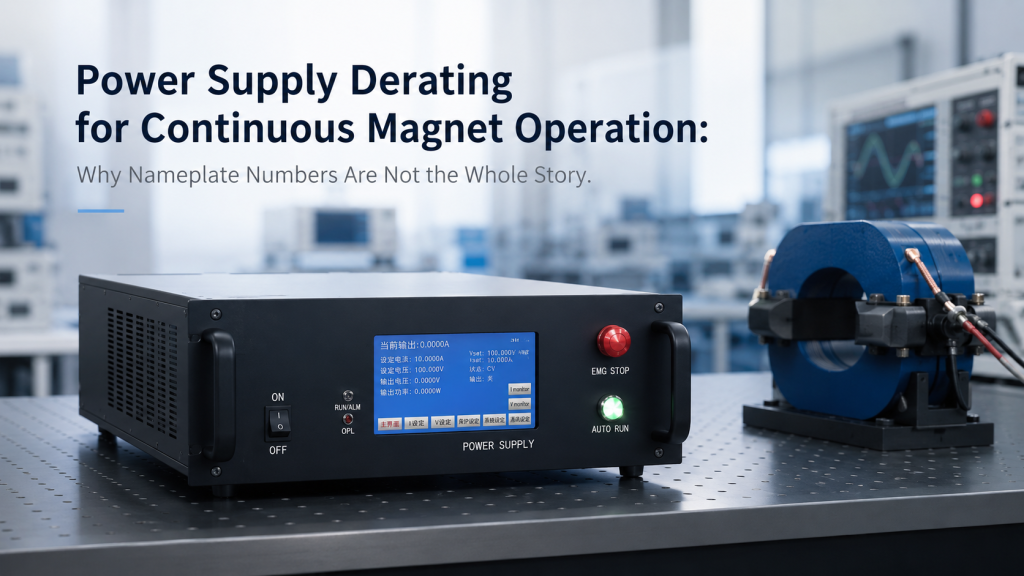
When buyers select a power supply for an electromagnet or Helmholtz coil system, they often start with the nameplate numbers:
- Maximum current
- Maximum voltage
- Maximum output power
These numbers are important, but they are not the whole story.
For continuous magnet operation, a power supply must be evaluated under real load conditions: ambient temperature, cooling, coil resistance, coil heating, duty cycle, voltage headroom, current stability, protection limits, and long-term reliability.
A supply marked “40 A” may not be the right choice if the magnet needs stable 40 A output for hours. A supply marked “100 V” may still be unsuitable if the coil needs fast current ramping, low noise, or continuous operation near thermal limits.
This article explains why power supply derating matters in magnet systems and how buyers should evaluate excitation power supplies beyond nameplate ratings.
1. What Does Power Supply Derating Mean?
Power supply derating means operating a power supply below its maximum rated output under certain conditions.
These conditions may include:
- Higher ambient temperature
- Restricted airflow
- High continuous load
- Long operating time
- Limited cooling
- High altitude
- Enclosed cabinet installation
- Multiple units installed close together
- demanding load dynamics
Power supply manufacturers commonly provide derating guidance because safe continuous operation depends on thermal conditions, airflow, and installation environment. Murata, for example, advises users to follow temperature derating guidelines in product specifications to support reliability and product life.
Reference link: https://www.murata.com/products/power/requirements
TDK-Lambda also explains that output power derating depends on ambient temperature, and gives examples where a supply can provide full rated output up to a defined temperature but must provide reduced output above that level.
Reference link: https://www.us.lambda-tdk.com/resources/blogs/20071205.html
In simple terms:
A power supply may be capable of a maximum output rating, but it may not be intended to operate at that maximum under every condition, forever.
2. Why Derating Matters More in Magnet Systems
Magnet systems are demanding loads.
Electromagnets and Helmholtz coils are not like simple electronic test loads. They may require high current, stable output, long operation time, and controlled ramping.
A magnet power supply must support:
- Continuous DC current
- Stable magnetic field output
- Coil heating over time
- Changing coil resistance
- Voltage headroom
- Low ripple and noise
- Repeatable ramping
- Protection against overheating or overcurrent
- Safe operation under inductive load conditions
For magnet applications, derating is not only about protecting the power supply.
It also affects magnetic field stability.
If the power supply operates too close to its limit, current regulation may become less stable, thermal protection may trigger, output noise may increase, or the system may fail during long calibration runs.
3. Nameplate Current Is Not Continuous Magnet Current
A power supply may list a maximum output current.
For example:
- 20 A
- 40 A
- 100 A
- 200 A
But buyers should ask:
“Can this current be delivered continuously under our operating conditions?”
Why This Matters
A power supply may be rated for high current under ideal conditions, such as:
- Correct ambient temperature
- Proper ventilation
- Adequate spacing
- Rated input voltage
- Suitable load
- No blocked airflow
- Internal temperature within limits
In a real magnet system, conditions may be harder:
- The supply is installed in a rack
- Lab temperature is high
- Cooling airflow is limited
- The magnet is operated for hours
- The coil heats up
- Voltage demand changes
- The user runs repeated test cycles
The nameplate current is only the starting point.
The continuous operating current under real conditions is what matters.
4. Nameplate Voltage Is Not the Same as Voltage Headroom
Voltage rating is also easy to misunderstand.
A power supply may have enough current, but not enough voltage headroom.
For a magnet coil, the driver must provide enough voltage to push the required current through the coil resistance. During dynamic operation, it may also need additional voltage to change current quickly through coil inductance.
Voltage Demand Depends On
- Coil resistance
- Coil temperature
- Required current
- Cable resistance
- Ramp rate
- Coil inductance
- AC or waveform operation
- driver control mode
For DC operation, the basic voltage requirement is related to current and resistance.
For changing current, inductance becomes important.
If the voltage headroom is too small, the power supply may not reach the target current, may ramp too slowly, or may fail to maintain current as the coil heats up.
5. Coil Heating Changes the Load Over Time
When current flows through a magnet coil, the coil heats up.
As the coil heats, its resistance usually increases. For copper windings, resistance increases with temperature.
That means a coil that starts at one resistance when cold may require more voltage after it warms up.
Example
Suppose a coil needs 30 A for a continuous test.
At the beginning, the coil resistance may be low enough for the power supply to maintain 30 A comfortably.
After one hour, the coil warms up. Resistance rises. The power supply must now provide more voltage to keep the same current.
If the power supply has enough voltage headroom, the magnetic field can remain stable.
If not, current may drift downward or regulation may become unstable.
This is why coil heating and power supply derating should be evaluated together.
6. Current Stability Directly Affects Field Stability
For most electromagnet and Helmholtz coil systems, the generated magnetic field is strongly related to current.
In a Helmholtz coil, the field near the center depends on coil geometry and applied current, and the classic Helmholtz arrangement is used to generate a relatively uniform magnetic field region.
Reference link: https://en.wikipedia.org/wiki/Helmholtz_coil
For buyers, this means:
If current drifts, the magnetic field drifts.
That is why excitation power supplies for magnet systems should be evaluated not only by maximum current, but also by:
- Current stability
- Current resolution
- Long-term drift
- Temperature coefficient
- Output ripple
- Noise
- Load regulation
- Line regulation
- response behavior under coil load
A low-cost high-current supply may be acceptable for simple exposure tests, but unsuitable for precision calibration or long-duration field stability requirements.
7. Continuous Operation Is a Thermal Question
Continuous magnet operation is mainly a thermal and reliability question.
The power supply must remove heat from its internal components while delivering load power for the required time.
Important Thermal Factors
Buyers should check:
- Ambient temperature
- Airflow direction
- Required clearance
- Rack ventilation
- Internal fan operation
- Heat from nearby equipment
- Output power level
- duration of operation
- protection threshold
- derating curve
TDK-Lambda notes that when considering derating, designers should account for internal temperature rise in the system and measure ambient temperature at or near the power supply air inlet.
Reference link: https://www.us.lambda-tdk.com/resources/blogs/20090220.html
For magnet systems installed in racks, cabinets, or crowded lab benches, this point is not theoretical.
Poor ventilation can turn a suitable supply into an unreliable one.
8. Duty Cycle: Short Test vs. Long Calibration Run
A magnet system may run in different modes.
Short Test
A short test may require:
- High current for a few seconds
- Step field exposure
- occasional measurements
- low average heating
In this case, the power supply may handle brief high-output operation if it stays within safe limits.
Long Calibration Run
A long calibration run may require:
- Stable current for hours
- low drift
- repeatable field output
- continuous software control
- thermal equilibrium
- uninterrupted operation
In this case, derating becomes much more important.
A system that works for five minutes may not be acceptable for five hours.
9. Constant Current Mode Is Usually Essential
For magnet operation, constant current mode is usually preferred because magnetic field depends primarily on current.
A constant voltage supply may cause field drift if coil resistance changes.
Constant Current Operation Helps Maintain
- Stable field output
- predictable field-current relationship
- repeatable calibration points
- controlled ramping
- better long-term field consistency
However, constant current mode only works properly if the supply has enough voltage headroom and thermal capacity.
A power supply can be in constant current mode on paper, but still fail to maintain current if it reaches voltage or thermal limits.
10. Ripple and Noise Matter in Precision Magnet Applications
Power supply noise can appear as magnetic field noise.
This is especially important in:
- Magnetometer calibration
- Hall measurement
- low-field simulation
- MOKE experiments
- sensor characterization
- low-noise magnetic testing
- long-term drift studies
Buyers should check whether the power supply specification includes:
- Current ripple
- voltage ripple
- output noise
- stability over time
- filtering
- grounding guidance
- shielding and cable layout recommendations
For high-field exposure, noise may be less critical.
For low-field calibration, small current noise may become a real measurement problem.
The correct supply depends on the application.
11. Inductive Loads Require Proper Protection
Magnet coils are inductive loads.
Inductive loads store energy, and current changes must be controlled safely.
A suitable magnet power supply should consider:
- output protection
- overcurrent protection
- overvoltage protection
- thermal shutdown
- controlled ramp-down
- emergency stop behavior
- polarity reversal safety
- safe handling of stored magnetic energy
- cable and connector rating
For electromagnets and large coils, protection is not a minor feature.
It is part of system safety.
12. Cable and Connector Ratings Also Need Derating
The power supply is not the only component that must be checked.
Continuous magnet operation also depends on:
- Cable current rating
- connector current rating
- cable temperature rise
- contact resistance
- cable length
- voltage drop
- heat dissipation
- insulation rating
- mechanical strain relief
A power supply may be capable of delivering the required current, but poor cables or connectors can create heat, voltage drop, instability, or safety risk.
For continuous operation, the entire current path must be evaluated.
13. Rack Installation Can Change the Real Rating
Many buyers install power supplies in racks.
Rack installation is convenient, but it changes the cooling environment.
Rack-Related Questions
Before choosing a supply, ask:
- Is airflow front-to-back or side-to-side?
- Is there enough space above and below?
- Are other heat-generating devices installed nearby?
- Is rack ventilation forced or natural?
- Is air inlet temperature higher than room temperature?
- Is dust accumulation expected?
- Can hot exhaust air recirculate into the inlet?
- Is maintenance access available?
A power supply rated under open-air conditions may need derating in a crowded rack.
For continuous magnet operation, this can be the difference between stable operation and thermal shutdown.
14. Derating Is Not Only About Avoiding Failure
Some buyers think derating is only about preventing damage.
That is too narrow.
Proper derating can improve:
- Field stability
- reliability
- component lifetime
- thermal margin
- safety
- repeatability
- uptime
- user confidence
- acceptance test success
A power supply running near its limit may not fail immediately.
But it may drift more, run hotter, trigger protection earlier, or age faster.
For research and calibration systems, this can create hidden cost.
15. How Much Margin Should Buyers Consider?
There is no universal derating percentage that fits every magnet project.
The right margin depends on:
- Required current
- required voltage
- duty cycle
- cooling method
- ambient temperature
- stability requirement
- load inductance
- ramp speed
- rack installation
- safety requirements
- long-term operation needs
Practical Guidance
For simple short-duration tests, a smaller margin may be acceptable.
For long continuous operation, buyers should consider more generous margins.
For precision calibration, buyers should prioritize stability and thermal margin over minimum price.
For high-current electromagnets, the supply, cables, cooling, and protection should be reviewed as one system.
The goal is not to oversize blindly.
The goal is to avoid operating continuously at the edge of the system.
16. What Buyers Should Ask Before Selecting a Magnet Power Supply
A serious RFQ should include more than target current and voltage.
Magnet and Coil Information
- Coil resistance
- coil inductance
- required current
- required field
- field-current relationship
- required ramp rate
- DC, AC, sweep, or waveform operation
- continuous operation time
- cooling method
Power Supply Requirements
- Constant current operation
- current stability
- current resolution
- voltage headroom
- ripple and noise
- bipolar or unipolar output
- protection functions
- communication interface
- software control
- rack or benchtop installation
Operating Conditions
- Ambient temperature
- airflow condition
- installation space
- rack ventilation
- daily operating schedule
- duty cycle
- warm-up requirement
- field stability over time
- cable length
- connector type
Without these details, suppliers may quote a power supply that meets the nameplate requirement but not the real operating condition.
17. Common Buyer Mistakes
Mistake 1: Selecting by Current Rating Only
A 40 A supply is not automatically suitable for a 40 A continuous magnet load.
Voltage, thermal capacity, cooling, and stability matter.
Mistake 2: Ignoring Coil Heating
A cold coil and a warm coil are not the same load.
Resistance changes can increase voltage demand during long operation.
Mistake 3: Forgetting Voltage Headroom
Enough current is not enough if the supply cannot maintain that current at the required coil resistance and ramp conditions.
Mistake 4: Treating Ripple as an Electronics Detail
For magnet systems, current ripple can become field ripple.
This can affect sensitive measurements.
Mistake 5: Ignoring Installation Environment
Ambient temperature, airflow, rack layout, and nearby heat sources can change continuous operating capability.
Mistake 6: Separating Coil and Power Supply Purchasing
Buying the coil and power supply separately without checking compatibility can create performance problems later.
18. How Cryomagtech Supports Power Supply Selection for Continuous Magnet Operation
Cryomagtech supplies high-precision excitation power supplies and matched magnetic field driver solutions for electromagnets, Helmholtz coils, and custom Magnet & Field Systems.
For continuous magnet operation, we help evaluate:
- Required current and voltage
- coil resistance and inductance
- voltage headroom
- current stability and resolution
- output ripple and noise
- duty cycle
- cooling and derating margin
- rack or benchtop installation
- software control requirements
- protection functions
- long-duration field stability
A good power supply selection is not about choosing the biggest nameplate number.
It is about choosing the supply that can maintain the required current, stability, and safety under the real operating conditions of the magnet system.
References
- Murata – Power Products Operating Requirements
https://www.murata.com/products/power/requirements - TDK-Lambda – What Do They Mean by Output Power Derating?
https://www.us.lambda-tdk.com/resources/blogs/20071205.html - TDK-Lambda – Power Supply Considerations for Industrial Applications
https://www.us.lambda-tdk.com/resources/blogs/20090220.html - Wikipedia – Helmholtz Coil
https://en.wikipedia.org/wiki/Helmholtz_coil
Key Takeaways
- Power supply derating is critical for continuous magnet operation.
- Nameplate current, voltage, and power ratings do not automatically prove long-term suitability.
- Coil heating can increase resistance and voltage demand over time.
- Constant current stability directly affects magnetic field stability.
- Voltage headroom, cooling, airflow, rack installation, ripple, and protection functions must be evaluated.
- Cables, connectors, and cooling conditions are part of the continuous operation chain.
- A magnet power supply should be selected together with the coil, not as an isolated component.
For magnet power supplies, the key question is not only:
“What is the maximum current rating?”
The better question is:
“Can this supply maintain the required current, voltage headroom, stability, and safety for our full continuous magnet operation?”