
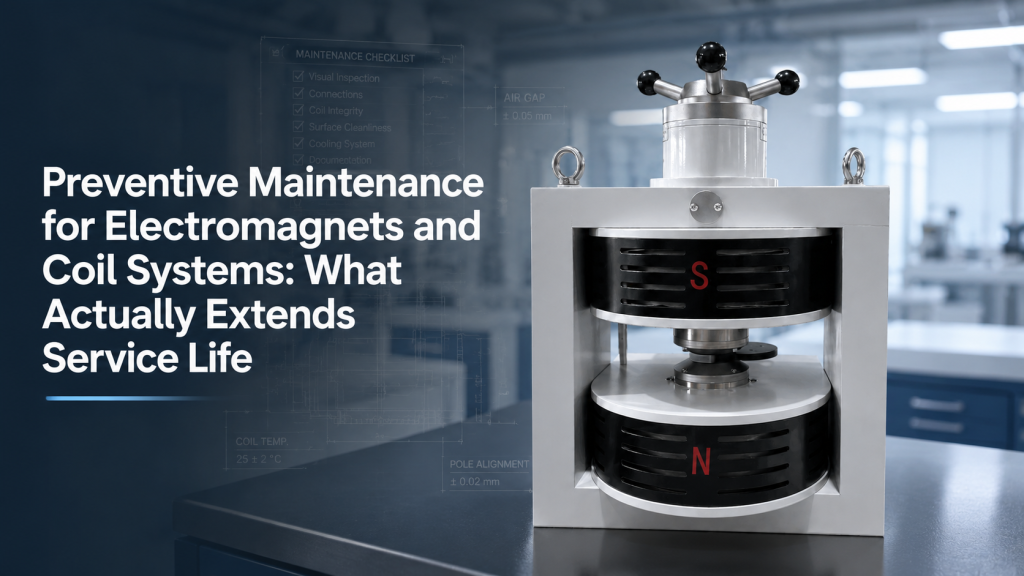
Electromagnets and coil systems are often purchased for long-term laboratory use.
A well-designed system may operate for many years, but service life does not depend only on the original hardware. It also depends on how the system is used, cooled, inspected, cleaned, and protected during daily operation.
For electromagnets, Helmholtz coils, water-cooled systems, excitation power supplies, field sensors, and control cabinets, preventive maintenance is not complicated — but it must be consistent.
This article explains what actually extends the service life of electromagnets and coil systems, and what laboratories should include in a practical maintenance plan.
1. Preventive Maintenance Is About Avoiding Small Failures Becoming Big Failures
Preventive maintenance is not the same as repairing a broken system.
The purpose is to identify early signs of wear, overheating, cooling problems, loose connections, cable damage, contamination, or abnormal operation before they become serious failures.
For lab magnet systems, preventive maintenance helps reduce:
- Unexpected downtime
- Coil overheating
- Cooling blockage
- Connector damage
- Power supply faults
- Field instability
- Measurement drift
- Water leakage
- Cable failures
- Safety risks
NIST defines preventive maintenance as maintenance designed to preserve and restore equipment reliability by replacing worn components before they fail. (csf.tools)
For magnet systems, the same logic applies: maintenance is not cosmetic. It protects reliability.
2. Temperature Is the First Thing to Watch
Heat is one of the biggest enemies of electromagnets and coil systems.
During operation, coil windings generate heat because current flows through electrical resistance. If heat is not removed properly, the coil temperature rises.
High temperature can affect:
- Coil resistance
- Magnetic field stability
- Insulation life
- Connector condition
- Cable aging
- Power supply stress
- Measurement repeatability
- Long-term reliability
A practical maintenance routine should include:
- Monitoring coil temperature during operation
- Checking temperature rise under normal test conditions
- Recording abnormal temperature behavior
- Confirming cooling fan operation
- Confirming water cooling flow
- Avoiding operation beyond rated duty cycle
- Allowing cooling time between heavy runs when needed
If a magnet system starts running hotter than usual under the same current and cooling conditions, treat it as an early warning.
Do not ignore it.
3. Duty Cycle Must Be Respected
Many coil failures are not caused by one dramatic accident.
They are caused by repeated operation beyond the intended duty cycle.
Duty cycle defines how long a coil or magnet can operate under specific load conditions before temperature becomes unsafe or unstable.
For example:
- A low-power coil may support continuous operation.
- A high-current air-cooled coil may require intermittent operation.
- A water-cooled electromagnet may support long-duration operation only when flow, temperature, and pressure conditions are correct.
An electromagnet maintenance manual from Ohio Magnetics warns users to monitor duty cycle and voltage because exceeding the recommended duty cycle or voltage can cause overheating, and it also warns not to leave the power on when the magnet is not in use. (ohiomagnetics.com)
The lesson is direct:
Do not treat the maximum current as the normal operating point unless the system is designed and cooled for that condition.
4. Cooling System Maintenance Is Critical for Water-Cooled Electromagnets
For water-cooled electromagnets and high-duty-cycle coils, cooling maintenance is not optional.
The cooling loop should be checked regularly for:
- Flow rate
- Pressure
- Inlet temperature
- Outlet temperature
- Hose condition
- Connector condition
- Leaks
- Filter blockage
- Chiller alarm history
- Water level
- Coolant quality
- Pump noise
- Flow sensor function
- Condensation risk
A water-cooled magnet may look normal externally while cooling flow is gradually reduced by filter blockage, scaling, algae, corrosion, or hose restriction.
That is dangerous because the coil may overheat even though the system appears to be operating.
For long service life, cooling should be treated as part of the magnet system, not an external accessory.
5. Water Quality Matters More Than Many Users Expect
Poor water quality can shorten the life of a cooling system.
It may cause:
- Scale buildup
- Corrosion
- Biological growth
- Filter blockage
- Reduced flow
- Pump wear
- Cooling channel contamination
- Leak risk
- Poor heat transfer
- Unstable temperature
A good maintenance plan should define:
- Approved coolant type
- Water replacement interval
- Filter inspection interval
- Conductivity or cleanliness check, if required
- Anti-corrosion additive, if recommended
- Chiller maintenance schedule
- Whether tap water is prohibited
- How to drain the system before long storage
For overseas laboratories, water quality varies widely by site. Do not assume local tap water is acceptable unless the supplier and chiller manufacturer approve it.
A small saving on coolant can become an expensive repair later.
6. Inspect Electrical Connections and Keep Them Tight
Loose electrical connections are a major source of equipment failures.
For magnet systems, check:
- High-current terminals
- Power supply output terminals
- Cable lugs
- Grounding points
- Interlock connectors
- Sensor connectors
- Cabinet terminals
- Emergency stop wiring
- Cooling interlock wiring
- Communication connectors
A Hartford Steam Boiler / Munich Re equipment care bulletin states that loose connections are the most common source of electrical equipment failure, and that keeping connections properly maintained and tight is the single most important part of an electrical preventive maintenance program. (munichre.com)
For high-current magnet systems, this matters even more.
A loose connection can create heating, voltage drop, unstable current, insulation damage, or safety risk.
Always follow the supplier’s instructions before tightening or inspecting electrical terminals. Power must be safely isolated before work.
7. Cables Should Be Treated as Service Items
Cables are often ignored until they fail.
For electromagnets and Helmholtz coil systems, inspect:
- High-current cables
- Sensor cables
- Communication cables
- Ground wires
- Interlock cables
- Chiller signal cables
- Power cords
- Control cabinet wiring
- Cable strain relief
- Cable labels
Look for:
- Cracked insulation
- Loose connectors
- Discoloration
- Overheating marks
- Stiff or brittle cable jackets
- Bent pins
- Broken shields
- Damaged strain relief
- Friction points
- Poor cable routing
- Excessive bending
A cable failure can make a good magnet system appear unstable or defective.
For overseas customers, spare cables and connectors are often worth preparing early, because international replacement can take time.
8. Insulation Condition Should Not Be Ignored
Coil insulation protects the winding from short circuits and leakage paths.
Over time, insulation can be affected by:
- Heat
- Moisture
- Dust
- Chemical exposure
- Mechanical stress
- Vibration
- Overvoltage
- Contamination
- Aging
Insulation resistance testing is widely used in electrical equipment maintenance. IEEE Std 43 describes recommended procedures for measuring insulation resistance of armature and field windings in rotating machinery, and the same general maintenance concept is relevant when thinking about winding insulation health in electrical coil equipment. (roshdsanatniroo.com)
For lab magnet systems, insulation testing should only be performed using appropriate procedures and voltage levels recommended by the supplier. Incorrect testing can damage sensitive electronics or connected instruments.
The principle is simple:
If insulation is degrading, you want to know before it becomes a short circuit.
9. Fans, Filters, and Ventilation Need Routine Checks
Air-cooled coil systems, power supplies, and control cabinets often rely on airflow.
Check:
- Fan operation
- Air intake
- Exhaust path
- Dust filters
- Cabinet vents
- Clearance around equipment
- Chiller exhaust direction
- Room temperature
- Blocked airflow from nearby objects
A fan failure or blocked air intake may not stop the system immediately. Instead, it may slowly increase temperature and reduce service life.
For rack-mounted or cabinet-based systems, ventilation planning is especially important.
Do not push cabinets against walls unless rear clearance is allowed.
Do not stack objects on air vents.
Do not ignore dust filters.
Cooling air is part of the electrical design.
10. Keep the System Clean, Dry, and Mechanically Stable
Basic environmental care extends service life.
Avoid:
- Dust accumulation
- Water spills
- Condensation
- Chemical vapor exposure
- Corrosive environments
- Excessive vibration
- Unstable benches
- Loose fixtures
- Metal debris near coil gaps
- Magnetic particles near sensors
- Cable clutter around hot surfaces
For laboratory environments, the magnet system should be kept clean and dry.
If the system uses water cooling, check for condensation when the coolant temperature is set too low relative to room humidity.
Condensation can damage electrical parts, connectors, sensors, and insulation.
A colder chiller setpoint is not always better.
11. Field Sensors and Probes Need Protection
Field sensors and probes are often delicate.
They may be damaged by:
- Mechanical impact
- Over-bending cables
- Incorrect insertion
- Excessive temperature
- Stronger fields than rated
- Wrong orientation
- Cable strain
- Contamination
- Poor storage
For field feedback and calibration-related systems, the probe condition directly affects measurement quality.
Maintenance should include:
- Inspecting probe cable condition
- Protecting probe tips
- Avoiding force during positioning
- Keeping calibration records
- Storing probes properly
- Avoiding unnecessary connector mating cycles
- Confirming probe orientation before measurement
A damaged probe can create misleading field readings even if the magnet itself is working normally.
12. Software, Logs, and Parameters Should Be Backed Up
Modern magnet systems may include control software, recipes, calibration files, communication settings, and data logs.
Preventive maintenance should include:
- Backing up software installers
- Backing up configuration files
- Saving calibration parameters
- Recording communication settings
- Exporting important logs
- Keeping user manuals accessible
- Documenting firmware versions
- Protecting license files or dongles
- Recording alarm history
If the control computer fails, a backup can greatly reduce downtime.
For systems using remote monitoring or network access, maintenance should also consider access control and software security.
Hardware maintenance without software backup is incomplete.
13. Keep a Maintenance Log
A simple maintenance log is one of the best tools for long service life.
Record:
- Date
- Operator
- Current and voltage during normal operation
- Coil temperature
- Cooling water temperature
- Flow and pressure
- Chiller alarms
- Any unusual noise or smell
- Cable or connector inspection
- Cleaning performed
- Filter replacement
- Software changes
- Faults and corrective actions
A log helps users see trends.
For example:
- The coil is running hotter than before.
- Flow rate is slowly decreasing.
- A connector has been heating repeatedly.
- A fan has become noisy.
- A power supply alarm is appearing more often.
A maintenance log turns scattered observations into usable evidence.
14. Recommended Maintenance Frequency
The exact schedule depends on system design, usage intensity, and supplier recommendations.
A practical starting point:
Before Each Use
- Check cables and connectors visually
- Confirm cooling is connected if required
- Confirm emergency stop status
- Confirm no visible leaks
- Confirm sample and fixtures are clear
- Confirm correct operating recipe or current limit
Weekly or Monthly
- Clean dust from accessible surfaces
- Check fan and ventilation paths
- Inspect cooling hoses
- Review alarm logs
- Check cable strain relief
- Confirm connectors are not loose
- Check field sensor cable condition
Every 3–6 Months
- Inspect water filters
- Check coolant condition
- Review temperature records
- Inspect high-current connection areas
- Check chiller performance
- Verify grounding connections
- Review software and configuration backups
Annually
- Perform a more complete electrical and mechanical inspection
- Review insulation or safety testing needs with the supplier
- Check field measurement calibration status
- Replace aging consumables if needed
- Review spare parts stock
- Update maintenance documentation
This schedule should be adjusted based on actual operating conditions.
A system used daily at high current needs more attention than a teaching coil used occasionally.
15. Common Maintenance Mistakes
Common mistakes include:
- Running beyond duty cycle
- Ignoring water quality
- Waiting until cooling alarms occur
- Blocking ventilation
- Leaving power on unnecessarily
- Using damaged cables
- Ignoring loose connectors
- Storing field probes carelessly
- Using unapproved coolant
- Setting chiller temperature too low and causing condensation
- Not backing up software settings
- Treating warning alarms as normal
- Not keeping maintenance records
- Cleaning with inappropriate solvents
- Replacing fuses or protection parts with incorrect ratings
Most of these mistakes are avoidable.
The hard truth: many “equipment failures” are actually maintenance failures.
16. What Actually Extends Service Life?
The most useful maintenance actions are not complicated.
They are:
- Keep temperature under control.
- Respect duty cycle.
- Maintain cooling flow and water quality.
- Keep electrical connections tight and clean.
- Protect cables and connectors.
- Maintain ventilation.
- Avoid moisture and condensation.
- Protect field sensors and probes.
- Keep software and configuration backups.
- Record maintenance and abnormal behavior.
- Use correct spare parts.
- Ask the supplier before modifying wiring, cooling, or safety circuits.
These actions extend service life because they address the real failure mechanisms: heat, poor cooling, loose connections, insulation stress, contamination, mechanical damage, and uncontrolled operation.
17. How Cryomagtech Supports Long-Term Magnet System Operation
Cryomagtech supplies electromagnets, Helmholtz coil systems, excitation power supplies, water-cooled magnetic field systems, control cabinets, and related support accessories for research and industrial laboratories.
For long-term operation, we can help customers clarify:
- Preventive maintenance schedule
- Cooling system requirements
- Cable and connector inspection
- Water-cooled system care
- Spare parts planning
- Field sensor protection
- Test report and calibration documentation
- Remote troubleshooting information
- Operation and training scope
Our goal is not only to deliver equipment that works on the first day.
Our goal is to help customers operate magnet systems safely, stably, and reliably over years of real laboratory use.
A well-maintained magnet system is not only longer-lasting.
It also produces more trustworthy data.
References
- NIST / CSF Tools – Preventive Maintenance
Preventive maintenance is designed to preserve and restore equipment reliability by replacing worn components before they fail.
https://csf.tools/reference/nist-sp-800-53/r4/ma/ma-6/ma-6-1/ - Munich Re / Hartford Steam Boiler – Electrical Preventive Maintenance
This bulletin states that loose connections are the most common source of electrical equipment failure and that maintaining tight connections is a key part of electrical preventive maintenance.
https://www.munichre.com/content/dam/munichre/hsb/hsb-canada/pdfs/english/knowledge-centre/equipment-care-bulletins/eb-recommended-practice-for-electrical-preventative-maintenance.pdf/_jcr_content/renditions/original./eb-recommended-practice-for-electrical-preventative-maintenance.pdf - IEEE Std 43-2000 – Insulation Resistance Testing
IEEE Std 43 describes recommended procedures for measuring insulation resistance of armature and field windings in rotating machinery, illustrating the importance of insulation condition monitoring in electrical winding systems.
https://roshdsanatniroo.com/pdf/IEEE%20Std.%2043-2000.pdf
Key Takeaways
- Preventive maintenance extends service life by controlling heat, cooling, connections, insulation, cables, and operating habits.
- Temperature rise is one of the most important warning signs in electromagnets and coil systems.
- Water-cooled systems need regular checks of flow, pressure, filters, coolant quality, hoses, and leak risk.
- Loose electrical connections can cause heating, instability, and equipment failure.
- Cables, connectors, fans, filters, field probes, and software backups should be treated as part of the system.
- Duty cycle must be respected; maximum current is not always a continuous operating condition.
- A maintenance log helps identify slow changes before they become failures.
- The best maintenance actions are simple, consistent, and documented.
Preventive maintenance is not paperwork.
It is the difference between a magnet system that merely works today and one that remains reliable for years.