
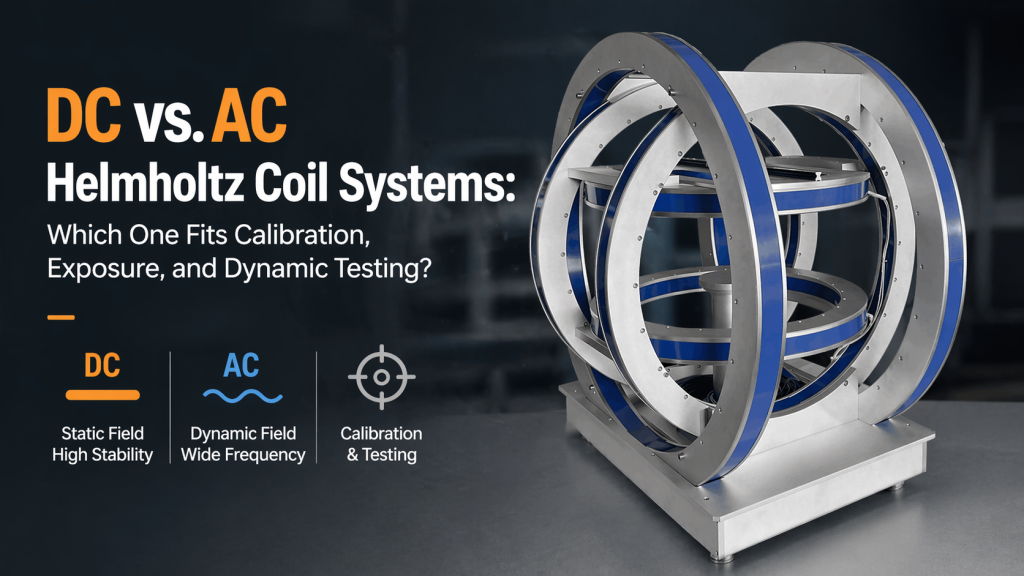
When selecting a Helmholtz coil system, one of the first questions is:
👉 Should I use DC or AC?
At first glance, the difference seems simple:
- DC → static magnetic field
- AC → time-varying magnetic field
But in practice, the choice affects:
- Measurement accuracy
- System complexity
- Power requirements
- Experimental validity
This article helps you decide which approach fits your application—especially for:
- Calibration
- Field exposure
- Dynamic testing
1. What Defines DC and AC Helmholtz Systems
DC Helmholtz Systems
- Provide stable, constant magnetic fields
- Typically driven by precision DC current sources
- Used for steady-state experiments
AC Helmholtz Systems
- Generate time-varying magnetic fields
- Require AC or bipolar drivers
- Used for dynamic or frequency-dependent studies
According to Wikipedia:
https://en.wikipedia.org/wiki/Helmholtz_coil
Helmholtz coils are designed to produce uniform magnetic fields, but their behavior depends heavily on how they are driven.
2. Calibration: Why DC Is Usually Preferred
Calibration requires:
- Stable reference fields
- High accuracy
- Repeatability
Why DC Works Better
- No waveform distortion
- No phase lag
- Easier to control and verify
Typical Use Cases
- Magnetometer calibration
- IMU alignment
- Sensor offset correction
👉 DC systems provide clean, predictable reference conditions
3. Exposure Testing: When AC Becomes Necessary
In exposure studies, the goal is often to simulate:
- Environmental electromagnetic conditions
- Time-varying magnetic fields
Why AC Is Used
- Represents real-world signals
- Enables frequency-dependent studies
- Supports regulatory testing scenarios
Examples
- Biological exposure experiments
- EMC-related testing
- Environmental simulation
4. Dynamic Testing: AC as the Only Option
Dynamic experiments require:
- Controlled variation over time
- Frequency sweeps
- Transient responses
AC System Advantages
- Adjustable frequency
- Controlled waveform
- Real-time field variation
Applications
- Magnetic material characterization
- Lock-in detection experiments
- AC susceptibility measurements
👉 DC cannot reproduce these conditions
5. System Complexity: DC vs AC
DC Systems
- Simpler design
- Lower noise
- Easier integration
AC Systems
- More complex drivers
- Requires waveform control
- Sensitive to distortion and phase lag
According to IEEE studies, AC magnetic systems require careful control of waveform quality and phase stability to maintain measurement accuracy.
6. Power and Thermal Considerations
DC Systems
- Continuous current → steady heating
- Predictable thermal behavior
AC Systems
- RMS current determines heating
- High-frequency operation increases losses
- Additional effects (skin effect, inductive behavior)
👉 AC systems often require more careful thermal design
7. Field Quality: A Critical Difference
DC Field Quality
- Defined by stability and noise
- Easier to maintain
AC Field Quality
- Defined by waveform purity
- Affected by harmonics and phase lag
👉 A distorted AC field can invalidate experimental results
8. When You Might Need Both
Some advanced setups require:
- DC bias field + AC modulation
Examples
- Magnetic hysteresis studies
- Spintronics experiments
- Precision material characterization
These systems require:
- Combined DC + AC drivers
- Careful synchronization
9. Practical Selection Guide
Choose DC If You Need
- Calibration
- Static field generation
- High stability
- Low noise
Choose AC If You Need
- Dynamic testing
- Frequency-dependent behavior
- Environmental simulation
Choose Hybrid (DC + AC) If You Need
- Bias + modulation
- Advanced material studies
10. How Cryomagtech Supports DC and AC Helmholtz Systems
At Cryomagtech, Helmholtz coil systems are designed together with their drive solutions.
We consider:
- Application type (calibration vs dynamic testing)
- Required field characteristics
- Driver compatibility (DC, AC, or hybrid)
- System stability and integration
👉 Product link placeholder: Cryomagtech Helmholtz Coil Systems with DC / AC Drive Solutions
Instead of offering coils alone,
we provide matched systems that ensure:
- Correct field behavior
- Reliable experimental results
- Efficient system integration
References
- Wikipedia – Helmholtz Coil
https://en.wikipedia.org/wiki/Helmholtz_coil - IEEE – AC magnetic field systems and signal integrity
https://ieeexplore.ieee.org/
Key Takeaways
- DC systems are ideal for calibration and stable reference fields
- AC systems are required for dynamic and frequency-dependent testing
- AC introduces complexity in waveform and thermal behavior
- Field quality is easier to control in DC systems
- Some applications require combined DC + AC configurations
Choosing between DC and AC is not just a technical detail.
👉 It determines whether your experiment is valid.