
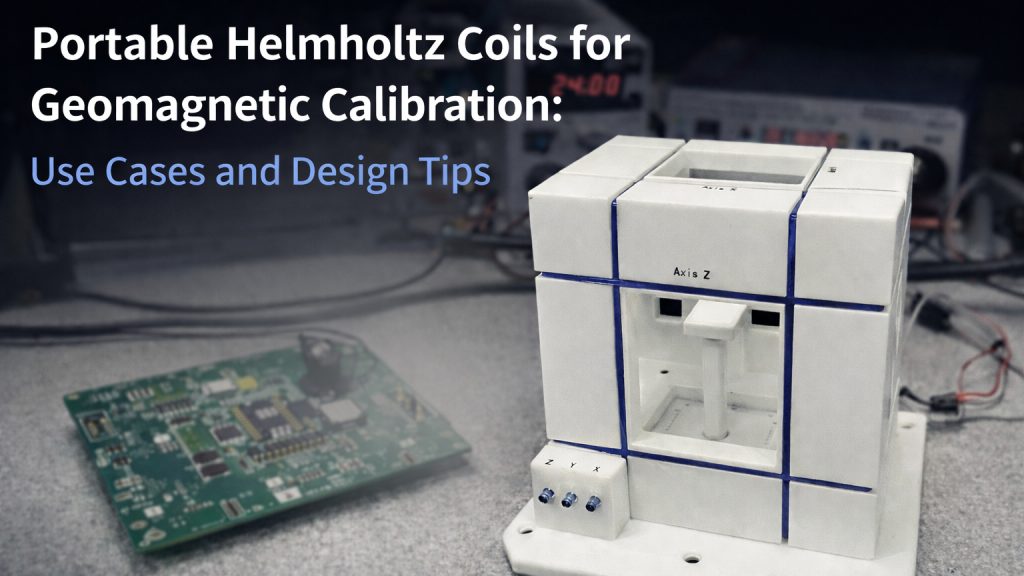
Calibrating magnetometers or IMUs is often assumed to be a lab-based task.
But in many real-world scenarios, calibration must happen:
- On-site
- In field environments
- Under non-ideal conditions
This is where portable Helmholtz coil systems become essential.
They allow controlled magnetic fields to be generated outside traditional laboratory setups—while still maintaining calibration accuracy.
1. Why Geomagnetic Calibration Matters
Magnetometers and IMUs rely on accurate magnetic field references.
Even small errors can lead to:
- Heading drift
- Orientation inaccuracies
- Sensor bias
According to Wikipedia:
https://en.wikipedia.org/wiki/Geomagnetic_field
The Earth’s magnetic field varies by location and environment, making calibration necessary for precise measurements.
2. Why Portability Changes Everything
Traditional Helmholtz systems are:
- Large
- Fixed
- Lab-based
Portable systems must deal with:
- Limited space
- Power constraints
- Environmental interference
Key Challenge
👉 Maintaining field uniformity and stability in a compact form
3. Typical Use Cases
Portable Helmholtz coil systems are widely used in:
IMU and Magnetometer Calibration
- Sensor calibration before deployment
- Field verification of sensor accuracy
Aerospace and UAV Systems
- Compass calibration
- Navigation system validation
Defense and Field Electronics
- On-site calibration
- Rapid deployment scenarios
Research and Outdoor Experiments
- Experiments outside controlled labs
- Environmental magnetic studies
4. 3-Axis Control: The Core Requirement
Geomagnetic calibration requires full vector control.
Why 3-Axis Matters
- Earth’s magnetic field has three components
- Sensors measure vector fields, not scalar values
System Requirements
- Independent X, Y, Z coil control
- Precise current regulation
- Minimal cross-axis coupling
👉 Without proper 3-axis control, calibration accuracy is limited.
5. Mechanical Design: Portability vs Stability
Portable systems must balance:
- Lightweight structure
- Mechanical rigidity
Key Considerations
- Frame alignment accuracy
- Coil spacing stability
- Foldable or modular structures
Common Pitfall
- Lightweight designs that deform under handling
Result:
👉 Field uniformity is compromised
6. Power Supply: The Hidden Constraint
Portability often means:
- Battery operation
- Limited power availability
Design Trade-Offs
- Lower current capability
- Limited field strength
- Shorter operation time
Engineering Challenge
👉 Achieving stable current output under portable power conditions
7. Fixture and Sensor Positioning
Calibration accuracy depends on precise positioning.
Important Factors
- Sensor alignment with coil axes
- Repeatable positioning
- Adjustable fixtures for different devices
Typical Issues
- Misalignment leading to calibration errors
- Inconsistent positioning across tests
8. Environmental Compensation
Field calibration introduces new variables:
- Ambient magnetic noise
- Nearby metallic structures
- Power line interference
Solutions
- Background field measurement and compensation
- Shielding or controlled environments
- Software-based correction
According to IEEE studies, environmental magnetic noise can significantly affect calibration accuracy if not properly compensated.
9. System Integration: More Than Just Coils
A usable portable system includes:
- Coil structure
- Bipolar current drivers
- Control software
- Calibration routines
Why Integration Matters
- Reduces setup time
- Improves repeatability
- Minimizes user error
10. How Cryomagtech Supports Portable Calibration Systems
At Cryomagtech, portable Helmholtz coil systems are designed as integrated solutions.
We consider:
- Compact 3-axis coil configurations
- Portable power supply options
- Mechanical stability and alignment
- Calibration workflows and compensation strategies
👉 Product link placeholder: Cryomagtech Portable 3-Axis Helmholtz Coil Systems
Instead of offering standalone coils,
we provide systems that enable:
- Reliable field calibration in real environments
- Consistent measurement results
- Efficient field deployment
References
- Wikipedia – Geomagnetic Field
https://en.wikipedia.org/wiki/Geomagnetic_field - IEEE – Magnetic field measurement and calibration techniques
https://ieeexplore.ieee.org/
Key Takeaways
- Portable calibration systems must balance size and performance
- 3-axis control is essential for accurate geomagnetic calibration
- Mechanical stability directly affects field uniformity
- Power constraints limit achievable field performance
- Environmental factors must be measured and compensated
- Integrated systems improve reliability and repeatability
Portable calibration is not just about mobility.
👉 It is about maintaining accuracy outside the lab.