
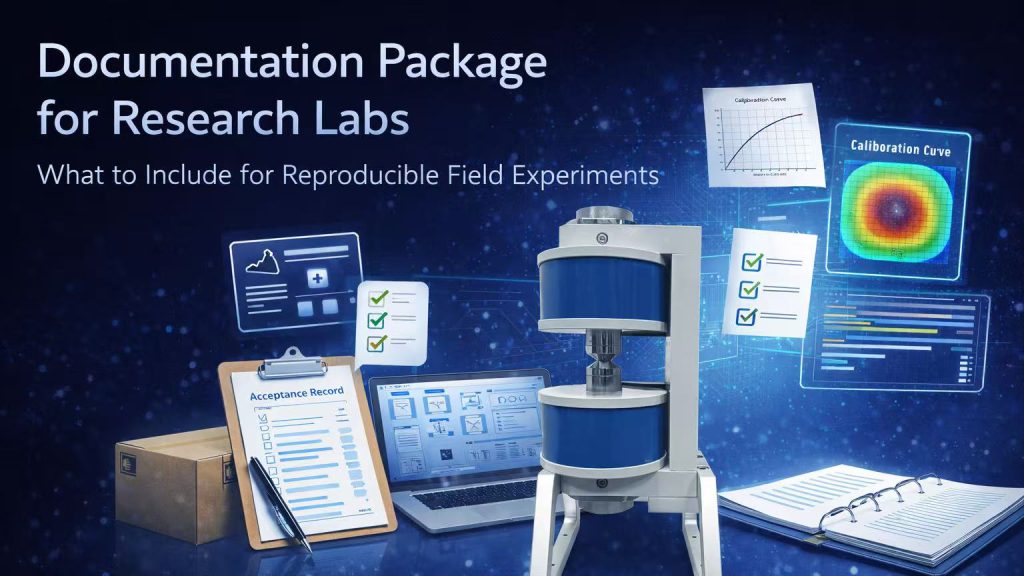
A magnet system can meet every specification on paper—
- Field strength
- Uniformity
- Stability
Yet still fail one critical test:
👉 reproducibility
In research environments, results must be:
- Verified
- Repeated
- Published
This is where documentation becomes essential.
A complete documentation package is not just a formality.
It is what turns a system into a reliable research tool.
1. Why Documentation Matters in Research Systems
Reproducibility is a fundamental principle in scientific work.
According to Nature discussions on reproducibility challenges:
https://www.nature.com/articles/d41586-019-03776-8
Lack of reproducibility often stems from incomplete or unclear experimental conditions.
In magnet systems, missing documentation can lead to:
- Inconsistent results
- Misinterpretation of data
- Difficult troubleshooting
2. Calibration Curves: The Basis of Field Accuracy
Calibration defines the relationship between:
- Input current
- Output magnetic field
What Should Be Included
- Field vs current curves
- Multiple measurement points
- Conditions (temperature, setup)
Why It Matters
Without calibration:
👉 Field values are assumptions, not measurements
3. Field Mapping Data: Understanding Spatial Behavior
Magnetic fields are rarely perfectly uniform.
Mapping Data Should Include
- Field distribution across the working volume
- Uniformity metrics
- Measurement grid definition
Practical Value
- Defines usable sample space
- Supports experimental design
- Enables comparison between setups
4. Interface and Control Documentation
Modern systems rely on software and control interfaces.
Essential Elements
- Communication protocols (USB, LAN, etc.)
- Command structure
- Data formats
- Integration guidelines
Why It Matters
- Enables automation
- Reduces integration time
- Prevents user errors
5. Acceptance Test Records (FAT / SAT)
Factory Acceptance Test (FAT) and Site Acceptance Test (SAT) validate system performance.
Typical Contents
- Verified specifications
- Test conditions
- Measurement methods
- Recorded results
Importance
👉 Provides traceability and confidence before and after delivery
6. Maintenance and Operation Guidelines
Even the best systems degrade without proper care.
Documentation Should Cover
- Cooling system maintenance
- Inspection intervals
- Cleaning procedures
- Replacement schedules
Outcome
- Longer system life
- Stable performance over time
7. Wiring and System Integration Diagrams
Incorrect setup is a common source of issues.
Required Documentation
- Electrical wiring diagrams
- Grounding scheme
- Signal routing
Why It Matters
- Prevents installation errors
- Reduces troubleshooting time
- Ensures safe operation
8. Environmental and Operating Conditions
Performance depends on conditions such as:
- Temperature
- Power supply stability
- Mechanical environment
Documentation Should Specify
- Recommended operating ranges
- Environmental limits
- Sensitivity factors
According to IEEE standards, environmental factors significantly affect measurement accuracy and system stability.
9. What Happens Without Proper Documentation
Systems without complete documentation often face:
- Inconsistent experimental results
- Difficulty in publishing data
- Repeated troubleshooting cycles
- Loss of confidence in measurements
👉 The system may work—but not reliably
10. How Cryomagtech Delivers Complete Documentation Packages
At Cryomagtech, system delivery includes more than hardware.
We provide structured documentation covering:
- Calibration curves
- Field mapping data
- Interface and control details
- Acceptance test records
- Maintenance guidelines
👉 Product link placeholder: Cryomagtech Magnet Systems with Complete Documentation Package
Our goal is to ensure that users can:
- Reproduce results
- Integrate systems efficiently
- Maintain performance over time
References
- Nature – Reproducibility in research
https://www.nature.com/articles/d41586-019-03776-8 - IEEE – Measurement and system documentation standards
https://ieeexplore.ieee.org/
Key Takeaways
- Reproducibility depends on complete documentation
- Calibration curves define field accuracy
- Field mapping reveals usable working volume
- Interface documentation enables system integration
- Acceptance tests provide verification and traceability
- Maintenance guides ensure long-term stability
A system without documentation may work once.
👉 A system with proper documentation works every time.