
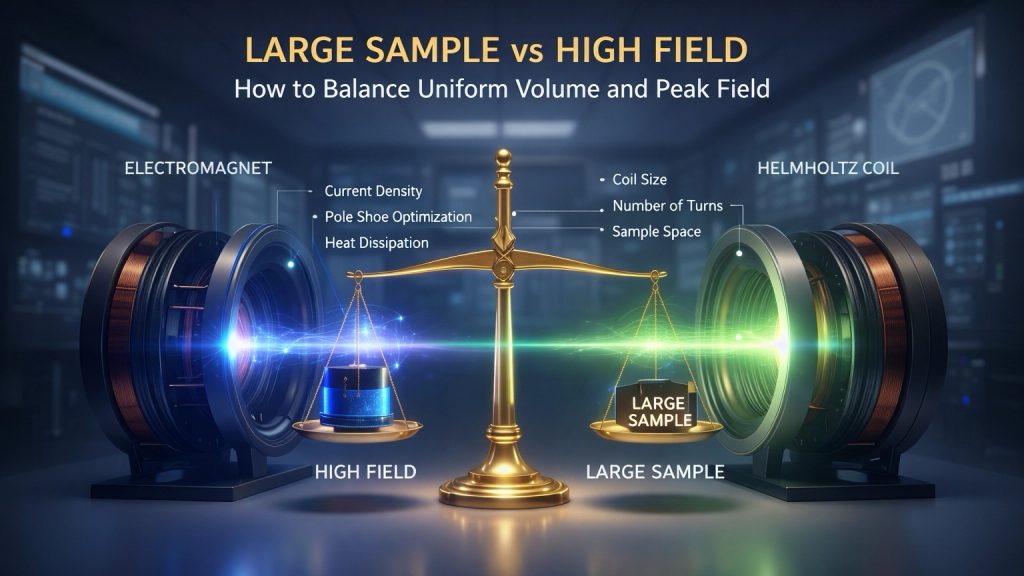
In magnetic field system design, one trade-off appears repeatedly:
- Large uniform region
- High peak magnetic field
Improving one usually reduces the other.
Understanding this trade-off is essential when selecting between Helmholtz coils and iron-core electromagnets.
This article explains the physics behind the conflict and how to balance uniform volume and peak field in real laboratory systems.
1. Why Large Uniform Volume Reduces Peak Field
For air-core systems such as Helmholtz coils, magnetic field strength follows:
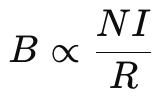
Where:
- N = number of turns
- I = current
- R = coil radius
As described in Wikipedia under Helmholtz coil theory:
https://en.wikipedia.org/wiki/Helmholtz_coil
If you increase R to enlarge the uniform region:
- Field strength decreases
- More current is required
- Copper losses increase
- Thermal load rises
Uniform region size scales roughly with coil radius.
High field strength scales inversely with radius.
This is the core contradiction.
2. Helmholtz Coils: Optimized for Uniformity
Helmholtz coils are designed for:
- Excellent uniformity
- Predictable field geometry
- Low magnetic distortion
Advantages:
- Large homogeneous region
- Clean field (no iron saturation effects)
- Ideal for calibration and sensor testing
Limitations:
- Field limited by current and thermal constraints
- Large coils require high power
- Efficiency decreases as radius increases
Typical applications:
- mT-level fields
- Magnetic sensor calibration
- Biological or material exposure experiments
👉 Product Link Placeholder – Cryomagtech Helmholtz Coil Systems
3. Electromagnets: Optimized for High Field
Iron-core electromagnets concentrate flux using high-permeability material.
Magnetic flux concentration is discussed in IEEE literature on magnetic circuits:
https://ieeexplore.ieee.org/
Advantages:
- Higher peak field (hundreds of mT to Tesla range)
- Lower required current for same field
- Compact gap design
Limitations:
- Smaller uniform region
- Edge effects near pole tips
- Magnetic saturation
- Stronger sensitivity to pole geometry
Peak field increases as gap decreases.
Uniform volume decreases as gap decreases.
Again, the trade-off appears.
4. Coil Size vs Current Density
Increasing field strength in large-volume systems requires:
- More turns (N)
- Higher current (I)
- Higher current density
But higher current density causes:
- Temperature rise
- Copper resistance increase
- Field drift
- Reduced duty cycle
Cooling design becomes critical.
Water cooling enables:
- Higher continuous duty cycle
- Stable long-duration operation
Air cooling limits sustained peak field performance.
5. Pole Piece Optimization in Electromagnets
For iron-core systems, pole design determines:
- Field concentration
- Uniform region size
- Gradient behavior
Techniques include:
- Conical pole shaping
- Flat pole expansion
- Shim ring correction
However:
- Larger pole face → larger uniform area
- Larger pole face → lower peak field
Flux spreads across wider area.
You cannot increase both infinitely.
6. Thermal Management: The Hidden Constraint
Thermal limits often define the true system boundary.
In large-volume designs:
- Copper mass increases
- Inductance increases
- Ramp time increases
In high-field compact designs:
- Local heating intensifies
- Core loss increases
- Cooling becomes mandatory
System specification must consider:
- Continuous vs intermittent operation
- Duty cycle
- Temperature stability
Ignoring thermal design leads to performance collapse under real load.
7. Practical Decision Framework
When evaluating large sample vs high field requirements, ask:
- What is the required uniform region size (mm)?
- What is the required peak field (mT or T)?
- What is acceptable duty cycle?
- Is field uniformity more critical than maximum field?
- Is there physical space limitation?
If uniformity dominates → Helmholtz solution preferred.
If peak field dominates → Iron-core electromagnet preferred.
Hybrid optimization may involve:
- Moderate gap size
- Optimized pole shaping
- Controlled current density
- Enhanced cooling
👉 Product Link Placeholder – Cryomagtech Electromagnet Systems
8. Why This Trade-Off Is Inevitable
Magnetic systems obey physical laws.
You cannot:
- Double uniform region
- Double peak field
- Keep power constant
The governing relationships tie geometry, current, and thermal constraints together.
Design is optimization — not wish fulfillment.
Key Takeaways
- Larger uniform region requires larger coil radius
- Larger radius reduces peak field strength
- Iron-core electromagnets increase peak field but shrink uniform region
- Current density and cooling limit real-world performance
- Pole optimization improves balance but cannot eliminate trade-off
Large sample and high field are competing design objectives.
The correct solution depends on experimental priority, not theoretical maximum.
References
- Wikipedia – Helmholtz Coil
https://en.wikipedia.org/wiki/Helmholtz_coil - IEEE – Magnetic circuit theory and flux concentration
https://ieeexplore.ieee.org/