
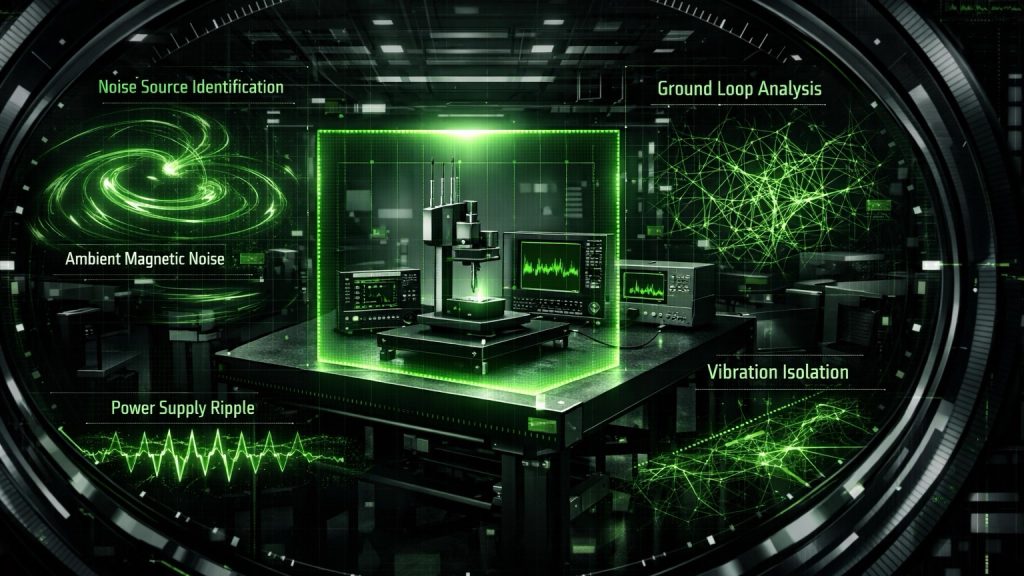
Magnetic measurement accuracy is rarely limited by magnet strength.
It is limited by noise.
Whether you are running Hall measurements, spintronics experiments, magnetic material characterization, or superconducting magnet testing, your data quality depends on how well you control hidden noise sources.
This article explains the most commonly overlooked noise contributors in magnetic measurement labs — and how to prevent them from corrupting your data.
1. Power Supply Noise: The Silent Data Killer
Most users focus on current range and resolution.
Few ask about output noise density, ripple, and long-term drift.
Why It Matters
In magnetic systems:
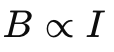
Any fluctuation in excitation current directly translates into magnetic field noise.
Even a 10 ppm ripple in current can destroy low-field measurements.
According to IEEE publications on precision power electronics, output ripple and transient response significantly affect sensitive instrumentation performance.
Reference:
IEEE Xplore – Power Supply Noise Considerations
https://ieeexplore.ieee.org/
What to Check
- Current ripple (mA RMS or ppm)
- Low-frequency drift (<1 Hz)
- Transient overshoot
- Current stability over hours
High-precision excitation power supplies are not optional in magnetic measurement labs — they are the foundation of field stability.
👉 Product Link Placeholder – Cryomagtech High Precision Excitation Power Supply
2. Grounding Errors and Ground Loops
Ground loops are among the most misunderstood noise sources.
A ground loop forms when multiple return paths exist between equipment, creating unintended circulating currents.
These loops inject 50/60 Hz noise directly into measurement signals.
The physics behind electromagnetic interference (EMI) is well explained in Wikipedia:
Electromagnetic interference (EMI)
https://en.wikipedia.org/wiki/Electromagnetic_interference
Symptoms
- Periodic oscillations at mains frequency
- Unstable low-field readings
- Noise increases when additional equipment is powered
Mitigation
- Single-point grounding strategy
- Shielded cables
- Isolation transformers when required
- Differential measurement techniques
If your power supply has floating output capability, grounding control becomes much easier.
3. Cable-Induced Noise and Inductive Pickup
Long excitation cables behave like antennas.
They can:
- Pick up environmental magnetic fluctuations
- Introduce inductive spikes
- Increase loop area noise
In superconducting magnet systems, improper cable routing can introduce transient field noise during current ramps.
Best Practices
- Minimize loop area
- Use twisted-pair or shielded cables
- Separate power cables from signal lines
- Avoid unnecessary connectors
Precision systems are designed as complete current paths — not just boxes with terminals.
4. Mechanical Vibration and Microphonic Effects
Magnetic measurement labs are rarely vibration-free.
Sources include:
- Cooling fans
- Pumps
- Building HVAC systems
- Nearby traffic
Mechanical vibration can cause:
- Coil movement in non-rigid assemblies
- Probe misalignment
- Microphonic noise in sensors
This is especially critical in:
- Low-field calibration setups
- SQUID systems
- Spintronic measurements
Water-cooled systems reduce thermal drift but may introduce pump vibration if not isolated properly.
5. Environmental Magnetic Noise
Even if your internal system is perfect, the environment may not be.
Common external magnetic noise sources:
- Elevators
- Nearby transformers
- Steel structures
- Moving vehicles
- AC mains wiring
Low-frequency magnetic noise (<10 Hz) is particularly difficult to filter digitally.
High-sensitivity labs often require:
- Magnetic shielding
- Active field compensation
- Baseline environmental measurement before installation
6. Long-Term Drift: The Hidden Enemy
Short-term noise is visible.
Long-term drift is worse.
Causes include:
- Coil temperature rise
- Resistance drift
- Power supply thermal instability
- Room temperature variation
Superconducting magnet systems require ultra-stable current control to prevent field drift during long experiments.
👉 Product Link Placeholder – Cryomagtech Superconducting Magnet Power Supply
Precision current stability directly determines magnetic field repeatability.
7. Why Noise Control Is a System-Level Problem
Noise does not come from one component.
It comes from:
- Power supply design
- Ground architecture
- Mechanical structure
- Cable layout
- Environmental conditions
This is why we approach excitation systems as integrated solutions, not isolated products.
We are not just supplying a power source — we are protecting your data integrity.
Key Takeaways
- Magnetic field noise = current noise
- Ground loops create 50/60 Hz interference
- Cables can act as unintended antennas
- Mechanical vibration affects field stability
- Long-term drift destroys reproducibility
- Precision excitation power supplies are essential for reliable magnetic data
Ignoring these factors can invalidate months of research.
References
- IEEE – Power electronics and noise considerations
https://ieeexplore.ieee.org/ - Wikipedia – Electromagnetic interference (EMI)
https://en.wikipedia.org/wiki/Electromagnetic_interference