
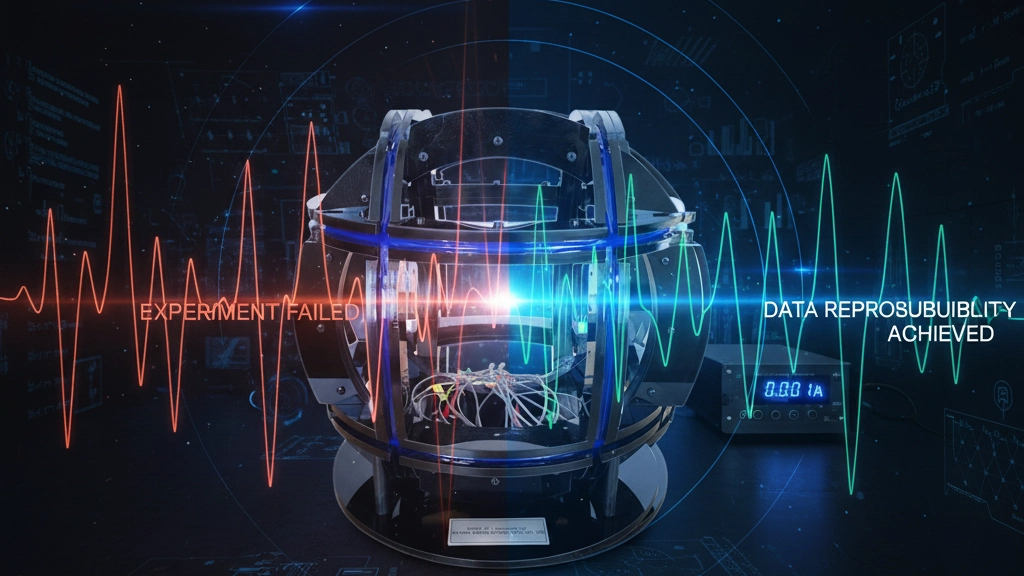
Reproducibility has become one of the most discussed challenges in modern physics research.
Many experiments fail to reproduce published results, even when procedures appear identical.
One often underestimated factor is magnetic field stability.
This article explains how field instability affects data reproducibility and why magnetic field systems deserve more attention.
1. The Reproducibility Problem Starts Earlier Than Data Analysis
Reproducibility issues are often blamed on:
- Sample variation
- Statistical treatment
- Experimental protocols
However, many failures start before data is even collected.
If the magnetic field changes during measurement, the experiment is no longer repeatable by definition.
2. What “Magnetic Field Stability” Really Means
Magnetic field stability is not a single number.
It includes:
- Short-term noise
- Long-term drift
- Thermal effects
- Power supply regulation
A field that looks stable for minutes may drift significantly over hours or days.
For long experiments, this drift directly alters physical conditions.
3. How Field Drift Breaks Reproducibility
Small magnetic field variations can cause large experimental differences.
Typical examples include:
- Shifted transport curves
- Inconsistent Hall coefficients
- Irreversible magnetization paths
- Temperature-dependent coupling effects
When results cannot be reproduced, the real cause is often hidden field instability, not theory.
4. Common Sources of Magnetic Field Instability
Thermal Effects
Coil resistance changes with temperature.
This alters current and field strength over time.
Power Supply Limitations
Standard power supplies may show:
- Current ripple
- Long-term drift
- Poor resolution at low fields
Environmental Magnetic Noise
Nearby equipment and power lines introduce background fluctuations.
These effects accumulate during long measurements.
5. Why Long Measurements Are the Most Vulnerable
Many physics experiments run for:
- Several hours
- Overnight
- Multiple days
During this time:
- Coils heat up
- Power electronics drift
- Ambient conditions change
Without proper control, the magnetic field slowly deviates from its target value.
The experiment becomes non-repeatable.
6. Engineering Solutions That Improve Reproducibility
Reproducible experiments require engineering discipline, not luck.
Key elements include:
- Stable electromagnet or Helmholtz coil design
- Low-drift, high-precision current sources
- Thermal management strategies
- Optional closed-loop field feedback
Each component contributes to long-term field stability.
7. How Cryomagtech Supports Reproducible Magnetic Experiments
Cryomagtech provides integrated magnetic field systems designed for stability.
These systems combine:
- Electromagnets or Helmholtz coils
- High-precision excitation power supplies
- Thermal and drift-aware design principles
👉 Product link placeholder: Cryomagtech Magnet & Field Systems with Precision Power Supplies
The goal is simple:
a magnetic field that stays where you set it.
8. Reproducibility Is an Engineering Problem
Reproducibility is not only about methods and statistics.
It is also about controlling physical boundary conditions.
Magnetic field stability is one of those conditions that cannot be ignored anymore.
References
- Nature – Challenges in experimental reproducibility
https://www.nature.com - Wikipedia – Reproducibility
https://en.wikipedia.org/wiki/Reproducibility
Final Thoughts
If two experiments run under different magnetic fields, they are not the same experiment.
Stability is not a luxury.
It is a requirement for reproducible physics.