
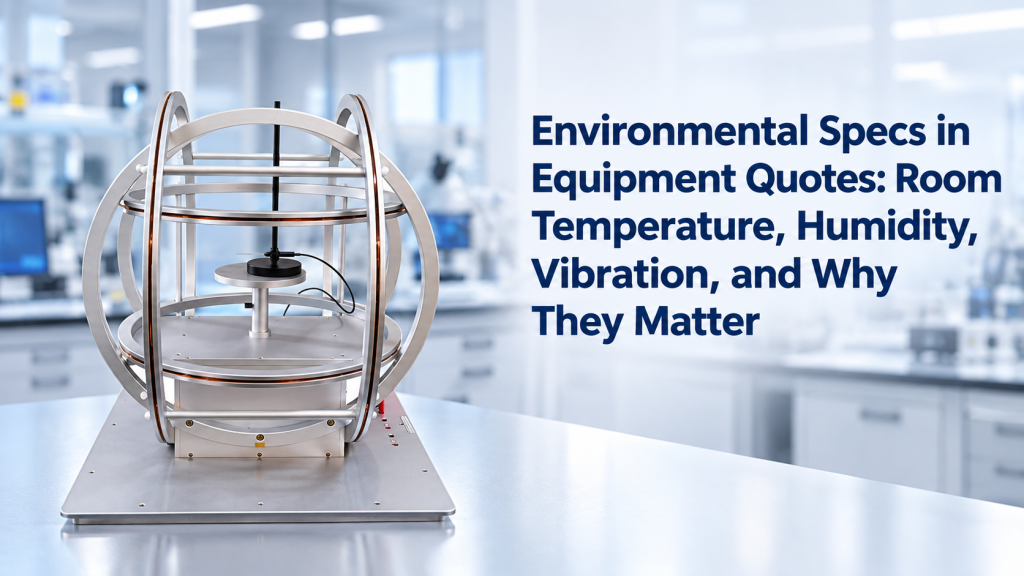
When laboratories request quotations for electromagnets, Helmholtz coil systems, Hall effect measurement systems, VSMs, MOKE platforms, cryogenic instruments, or precision power supplies, technical discussions usually focus on the equipment itself:
- Magnetic field range
- Field uniformity
- Current and voltage
- Measurement sensitivity
- Temperature range
- Accuracy
- Resolution
- Stability
But there is another section in a professional quotation or technical specification that buyers often overlook:
Environmental operating conditions.
A system may meet every electrical and magnetic specification on paper but still perform poorly if it is installed in a laboratory with:
- Large room-temperature fluctuations
- Excessive humidity
- Condensation risk
- Strong floor vibration
- Unstable cooling-water temperature
- Direct air-conditioning airflow
- Nearby mechanical equipment
This does not mean laboratories need expensive clean rooms for every magnetic instrument.
It means equipment performance must always be understood within a defined operating environment.
For export projects and formal procurement, laboratory equipment environmental requirements should be treated as part of the technical specification—not as fine print at the bottom of the quotation.
1. Why Environmental Specifications Belong in the Equipment Quote
A quotation normally describes what the equipment can do.
But a complete quotation should also explain under what conditions those specifications apply.
This distinction is important.
Consider a power supply specified with excellent current stability.
Does that stability apply:
- At 23 °C?
- Across 15–30 °C?
- Immediately after power-on?
- After a warm-up period?
- With the room temperature changing several degrees per hour?
The same question applies to:
- Hall sensors
- Precision voltmeters
- Optical MOKE systems
- VSM pickup systems
- Cryogenic temperature controllers
- Gaussmeters
- Mechanical stages
NIST measurement guidance explicitly recognizes temperature and humidity as laboratory conditions that can contribute to measurement uncertainty, while its calibration guidance also recommends controlling vibration and other environmental influences so they do not invalidate measurement results. NIST
The practical procurement lesson is simple:
An instrument specification without its environmental assumptions is incomplete.
2. Do Not Confuse Operating Range With Guaranteed Performance Conditions
This is probably the most important distinction.
A specification may say:
Operating temperature: 5–40 °C
That does not automatically mean the instrument delivers its best published accuracy and stability across that entire range.
There are usually several different environmental concepts.
Operating Range
The equipment can function safely within this range.
Recommended Operating Range
The manufacturer expects normal laboratory operation within this range.
Specification or Performance Range
The published accuracy, drift, noise, or stability may only be guaranteed under narrower conditions.
Storage Range
The equipment can be stored, powered off, within a wider temperature or humidity range.
Transportation Range
Packaged equipment may tolerate an even broader short-term environment during shipping.
These numbers should not be treated as interchangeable.
For formal procurement, buyers should ask:
At what environmental conditions are the quoted performance specifications guaranteed?
That question is much more useful than simply asking for “operating temperature.”
3. Room Temperature Affects More Than User Comfort
Laboratory temperature is one of the most common environmental variables.
Temperature changes can affect:
- Electronic component characteristics
- Sensor offsets
- Mechanical dimensions
- Coil resistance
- Optical alignment
- Measurement drift
- Thermal equilibrium
NIST notes that environmental temperature should be sufficiently stable for the measurement system to reach thermal equilibrium and that changing environmental conditions can become part of the measurement uncertainty. NIST
For magnetic and materials characterization systems, the consequences depend on the instrument.
4. Electromagnets: Room Temperature Affects the Coil
Copper resistance increases with temperature.
As an electromagnet operates, its coils generate heat.
That creates an important distinction between:
laboratory ambient temperature
and
coil operating temperature.
For a current-regulated electromagnet system, a precision power supply may continue to maintain the commanded current as the coil warms.
However, increasing coil resistance changes:
- Required supply voltage
- Electrical power dissipation
- Thermal load
- Cooling demand
- Maximum sustainable continuous operation
This becomes especially important for high-current water-cooled electromagnets.
A system designed and tested with cooling water entering at one temperature may behave differently if installed with substantially warmer water.
Cryomagtech electromagnet systems, for example, include different air- and water-cooled architectures depending on magnet size and required continuous operation. Cryomagtech Blog
This is why a magnet quotation should distinguish:
- Room ambient temperature
- Cooling-water inlet temperature
- Required water flow
- Water pressure
- Continuous-duty conditions
These are not secondary installation details.
They define whether the magnet can operate continuously at the quoted field.
5. Helmholtz Coils Have Similar Thermal Considerations
A Helmholtz coil may appear simpler than an iron-core electromagnet.
But its field is still generated by current flowing through copper conductors.
Higher current creates more heat.
For low-field calibration systems, heating may be modest.
For large-diameter or high-field Helmholtz coils, thermal behavior can become a major design constraint.
Important environmental questions include:
- Is the coil air-cooled or water-cooled?
- What room-temperature range is assumed?
- Is continuous operation required?
- How much coil temperature rise is acceptable?
- Does coil heating change mechanical dimensions enough to affect the calibration?
- Is field feedback available?
Cryomagtech offers both air- and water-cooled Helmholtz configurations, including closed-loop field-control architectures depending on the application. Cryomagtech
For calibration applications, this matters because the laboratory is not merely asking:
“Can the coil generate 500 µT?”
It is asking:
“Can it repeatedly generate the required field under our real laboratory conditions?”
6. Temperature Stability Can Matter More Than the Absolute Room Temperature
Consider two laboratories.
Laboratory A
Room temperature:
24.0 ± 0.3 °C
Laboratory B
Room temperature:
20–27 °C during the day
Laboratory B may technically remain inside an instrument’s broad operating-temperature range.
But it can still be a worse environment for precision measurements.
Rapid or repeated temperature changes may create:
- Electronic drift
- Mechanical expansion
- Sensor offset changes
- Optical alignment drift
- Longer stabilization periods
For high-precision measurement work, temperature stability can therefore be more meaningful than simply specifying a minimum and maximum temperature.
NIST laboratory guidance makes the same general distinction: higher-precision measurements require tighter control of environmental temperature variation. NIST Publications
7. Why “23 ± 2 °C” Should Not Be Copied Into Every Specification
A common procurement habit is to write something like:
Operating environment: 23 ± 2 °C
without understanding whether the equipment actually needs that condition.
That is not good specification practice.
Some systems may work perfectly well across a much wider room-temperature range.
Others may require tighter stability.
The correct value depends on:
- Required measurement uncertainty
- Sensor type
- Optical configuration
- Electronics
- Cooling method
- Calibration procedure
Environmental requirements should therefore come from the actual instrument architecture and performance target, not from copying another tender document.
8. Relative Humidity: The Problem Is Not Just “Too Humid”
Humidity creates several different engineering concerns.
High humidity can contribute to:
- Corrosion
- Surface leakage
- Connector degradation
- Optical contamination
- Condensation
Very low humidity can increase:
- Electrostatic charging
- ESD risk
- Dust attraction
NIST precision measurement guidance is a useful illustration of why humidity control matters: its mass-calibration guidance describes controlled humidity environments and specifically notes that very low humidity can contribute to electrostatic effects that disturb precise measurements. NIST Publications
However, this does not mean every electromagnet or Hall system must operate at exactly the same RH range used by a metrology laboratory.
The correct environmental limit remains product-specific.
9. Condensation Is Often More Dangerous Than High Relative Humidity Alone
Suppose a laboratory operates at:
70% RH
That may or may not immediately cause a problem.
But imagine a cold component whose surface temperature drops below the room’s dew point.
Now moisture can condense directly onto:
- Electrical connectors
- Sample holders
- Sensors
- PCB surfaces
- Optical windows
That is a much more serious condition.
This is particularly relevant for:
- Cryogenic systems
- Low-temperature Hall systems
- LN2-assisted measurements
- Water-cooled equipment with unusually cold coolant
Therefore, equipment specifications sometimes use wording such as:
non-condensing humidity
rather than only stating a numerical RH limit.
The distinction matters.
10. Cryogenic Equipment Needs Special Attention to Humidity and Dew Point
Cryogenic systems deliberately create very cold surfaces.
A properly designed cryostat isolates these surfaces from room air through:
- Vacuum
- Radiation shields
- Sealed sample spaces
- Purging where appropriate
But installation and operation can still be affected by environmental moisture.
Potential issues include:
- Frost around exposed cold components
- Condensation during warm-up
- Moisture entering vacuum systems
- Water accumulation around transfer connections
So when a laboratory purchases cryogenic Hall, transport, or temperature-control equipment, environmental planning should consider not only room RH but also:
what happens whenever a component becomes colder than the laboratory dew point.
11. Vibration Can Directly Become Measurement Noise
Temperature and humidity often affect measurements indirectly.
Vibration can affect them directly.
NIST notes that mechanical vibration can deform sensitive devices and increase measurement noise, and its laboratory guidance recommends preventing excessive vibration from adversely affecting measurements. NIST
This becomes especially important for instruments in which the measurement principle itself involves:
- Motion
- Optical alignment
- Micro-positioning
- Extremely small signals
12. VSM Systems Are an Obvious Example
A Vibrating Sample Magnetometer intentionally vibrates the sample at a controlled frequency.
The system then detects the magnetic signal produced by that vibration.
Now imagine the entire instrument also receives uncontrolled vibration from:
- A nearby compressor
- A vacuum pump
- HVAC equipment
- Heavy machinery
- Foot traffic
- Building resonance
That unwanted motion may interfere with the measurement chain.
This is why VSM installation planning may need to consider:
- Floor stability
- Mechanical isolation
- Pump location
- Nearby rotating machinery
- Equipment tables
The solution is not necessarily an expensive vibration-isolation foundation.
But the installation environment should be evaluated before commissioning.
13. MOKE Systems Can Be Sensitive for a Different Reason
Magneto-Optical Kerr Effect systems combine magnetic field generation with optical measurement.
Environmental vibration may affect:
- Laser alignment
- Sample positioning
- Microscope imaging
- Motorized stages
- Domain imaging stability
Temperature drift can also alter mechanical alignment over long experiments.
For a basic hysteresis loop with a relatively large optical spot, the requirement may be modest.
For microscopy or high-resolution domain imaging, environmental stability can become much more important.
The same product family can therefore have very different site requirements depending on configuration.
14. Probe Stations and Small Samples Increase Environmental Sensitivity
Small-sample characterization often introduces:
- Fine probe tips
- Micro-positioners
- Small contact pads
- Thin films
- 2D materials
A small mechanical disturbance that would be irrelevant for a bulk sample can matter greatly when a probe is sitting on a microscopic electrical contact.
For probe-station Hall measurements, vibration can cause:
- Probe movement
- Contact resistance changes
- Pad scratching
- Intermittent contact
- Measurement instability
Again, the instrument may be operating correctly.
The installation environment may be creating the problem.
15. Cryocoolers Create Their Own Vibration Environment
Closed-cycle cryogenic systems have an additional complication.
The system itself can generate vibration through components such as:
- Compressors
- Cold heads
- Pulse-tube assemblies
- Mechanical pumps
For many electrical transport experiments, this may be acceptable.
For sensitive optical, scanning, or mechanical measurements, vibration isolation may need to be designed into the complete system.
This means the procurement question should not simply be:
“Does the system reach 4 K?”
It may also be:
“What vibration reaches the sample at 4 K?”
Those are different performance requirements.
16. Airflow Is Another Overlooked Environmental Variable
A laboratory air-conditioning outlet directed straight at precision equipment can create:
- Local temperature fluctuations
- Mechanical movement
- Optical instability
- Uneven cooling
For large electromagnets, airflow may not matter much mechanically.
For:
- Microbalances
- Fine probe stations
- Optical MOKE systems
- Sensitive temperature sensors
it may.
NIST laboratory guidance also recognizes air currents as environmental influences that can reduce measurement validity in precision laboratories. NIST Publications
This is why the physical position of equipment in the room matters.
17. Do Not Install Precision Equipment Based Only on Available Floor Space
During laboratory planning, people often ask:
“Where can we fit this machine?”
A better question is:
“Where can this machine achieve its specified performance?”
Before deciding the installation position, check for nearby:
- HVAC outlets
- Doors
- Windows
- Compressors
- Vacuum pumps
- Elevators
- Heavy machinery
- High-current electrical equipment
- Strong magnets
A convenient corner of the room may not be the best measurement location.
18. Environmental Requirements Also Affect Magnetic Field Measurements
Magnetic systems introduce another environmental factor:
external magnetic fields.
For a 2 T electromagnet system, ordinary environmental magnetic disturbances may have little practical significance.
For a 50 µT calibration system, they can dominate the experiment.
So for Helmholtz coil systems, low-field Hall measurements, or magnetic sensor calibration, site conditions may also include:
- Ambient magnetic field
- Nearby ferromagnetic structures
- Elevators
- Motors
- Moving vehicles
- AC magnetic interference
This is a useful reminder that “environmental specifications” should be defined by the measurement principle.
There is no universal checklist that applies equally to every instrument.
19. Power Quality Can Also Be Part of the Environmental Specification
A quotation may specify:
AC 220 V, 50 Hz
But formal procurement may require more detail.
Depending on the equipment, buyers may need to confirm:
- Voltage range
- Frequency
- Maximum current
- Grounding
- Phase requirement
- UPS requirement
- Surge protection
This matters particularly for:
- High-power electromagnets
- Large power supplies
- Chillers
- Compressors
- Vacuum pumps
A laboratory may have the correct nominal voltage but insufficient electrical capacity for the full system.
20. Cooling Water Is an Environmental Requirement Too
For water-cooled electromagnets, the laboratory cooling loop is effectively part of the machine.
A professional quotation should therefore state, where applicable:
- Required flow
- Pressure
- Inlet temperature
- Cooling capacity
- Coolant type
- Water quality
- Hose connection
- Flow or temperature interlocks
A buyer who receives only:
“Water cooling required”
does not yet have enough information to prepare the site.
Cryomagtech’s water-cooled magnet configurations, for example, specify cooling requirements such as flow, pressure, and inlet temperature for applicable models. Cryomagtech Blog
21. Export Projects Make Environmental Specifications Even More Important
For domestic equipment, an engineer may be able to visit the site and solve an installation problem directly.
International projects are different.
The supplier and customer may be thousands of kilometers apart.
The equipment may arrive after:
- Sea transport
- Air freight
- Customs clearance
- Warehouse storage
- Local delivery
A clear quotation should therefore separate:
Transportation Conditions
Conditions the packaged equipment can survive during shipping.
Storage Conditions
Conditions acceptable before installation.
Operating Conditions
Conditions under which the system can safely run.
Performance Conditions
Conditions under which the quoted accuracy and stability apply.
This reduces ambiguity when the system reaches the end user.
22. Equipment Should Stabilize After Major Environmental Changes
Imagine an instrument arriving from an air-conditioned delivery vehicle into a warm laboratory.
Or equipment that has been stored in a cold warehouse.
Immediately switching on precision electronics may not always be the best idea.
The equipment may need time to reach thermal equilibrium.
For some systems, this is simply a short acclimatization period.
For precision instruments, manufacturers may specify a longer warm-up or stabilization requirement.
The correct period is equipment-specific.
Procurement documents should therefore distinguish:
power-on warm-up time
from
environmental acclimatization.
23. Environmental Conditions Should Be Recorded During Acceptance Testing
Suppose the contract requires:
Field stability: ±X ppm/h
The factory demonstrates it successfully.
At the customer site, the buyer obtains worse results.
Who is responsible?
Without environmental records, this can become difficult to diagnose.
A better acceptance test records:
- Room temperature
- Relative humidity
- Cooling-water conditions
- Instrument warm-up status
- Magnet operating point
- Relevant vibration or disturbance conditions
This creates a meaningful comparison between:
factory acceptance test (FAT)
and
site acceptance test (SAT).
24. Factory Acceptance and Site Acceptance Should Not Be Identical by Default
The supplier controls the factory environment.
The customer controls the installation site.
Therefore, a formal project should define which specifications are verified during:
Factory Acceptance Test
Before shipment.
Site Acceptance Test
After installation.
For example:
Factory testing may verify:
- Maximum magnetic field
- Electrical output
- Communication
- Basic stability
- Safety interlocks
Site testing may verify:
- Installation
- Cooling
- System communication
- Basic functional operation
Expecting the supplier to reproduce laboratory-grade stability at a site with uncontrolled temperature or vibration can create unnecessary disputes.
The environmental assumptions should be agreed before the purchase order.
25. High Precision Requires More Environmental Discipline
There is a general engineering principle:
The tighter the measurement requirement, the more the environment matters.
A system intended to generate:
1 T ±1%
may tolerate a fairly normal research laboratory.
A system intended for:
- ppm-level current stability
- nT-level residual field
- weak magnetic signals
- micron-scale positioning
- precision optical measurements
may require substantially tighter environmental control.
NIST’s guidance reflects the same principle: environmental conditions must be appropriate for the uncertainty level and operating characteristics of the measurement system. NIST Publications
Buyers should therefore avoid specifying extremely tight instrument performance without also considering whether their laboratory can support it.
26. Do Not Over-Specify the Laboratory Either
There is an opposite mistake.
A procurement engineer may demand:
- 20 ±0.5 °C
- 45 ±2% RH
- Specialized vibration isolation
- Dedicated clean room
for equipment that does not scientifically require those conditions.
That increases:
- Facility cost
- Installation time
- Procurement complexity
without improving the experiment.
Environmental specifications should be driven by the measurement objective, not by the desire to make a tender look technically sophisticated.
27. A Practical Environmental Specification Structure
For formal RFQs or quotations, a useful structure is:
Ambient Temperature
State:
- Operating range
- Recommended range
- Performance specification range, if different
Temperature Stability
If relevant, specify:
- Maximum allowable change per hour
- Required stabilization period
Relative Humidity
State:
- Acceptable RH range
- Non-condensing requirement
Vibration
State either:
- General laboratory environment acceptable
or
- Defined vibration limit / isolation requirement for sensitive instruments
Cooling
For water-cooled systems, define:
- Flow
- Pressure
- Inlet temperature
- Cooling capacity
Electrical Supply
Define:
- Voltage
- Frequency
- Phase
- Power
- Grounding
Magnetic Environment
For low-field systems, define:
- Background field
- Required compensation
- Nearby magnetic disturbances
This gives both supplier and buyer a much clearer engineering boundary.
28. Example: Electromagnet System
For an electromagnet quotation, environmental considerations might include:
Important
- Room temperature
- Cooling-water temperature
- Water flow
- Water pressure
- AC power
- Ventilation around power supply and chiller
Usually Less Critical
- Moderate laboratory vibration
- Normal indoor humidity, provided there is no condensation
Unless the magnet is integrated with more sensitive measurement equipment.
Once it becomes part of a Hall, MOKE, optical, or probe-station system, the environmental requirement may change.
29. Example: Helmholtz Coil Calibration System
For a precision 3-axis Helmholtz coil system, consider:
- Ambient magnetic field
- Nearby ferromagnetic material
- Room-temperature stability
- Coil heating
- Current-source stability
- Sensor placement
- External magnetic disturbances
If the objective is geomagnetic simulation, ordinary laboratory background field may be part of the calibration problem itself.
30. Example: Hall Effect Measurement System
A Hall system may need attention to:
- Room temperature
- Electrical noise
- Sample-contact stability
- Magnet temperature
- Cryogenic environment, if applicable
- Probe vibration for very small devices
Routine room-temperature Hall testing may have modest site requirements.
Low-temperature or microprobe Hall systems can require substantially more environmental control.
31. Example: VSM
For a VSM, pay particular attention to:
- Floor vibration
- Mechanical isolation
- Nearby pumps or motors
- Room-temperature stability
- Magnetic background
Because the measurement involves detecting small magnetic signals associated with controlled mechanical vibration, installation quality can directly affect data quality.
32. Example: MOKE
For MOKE systems, consider:
- Optical-table stability
- Floor vibration
- Airflow
- Ambient light control
- Room-temperature drift
- Laser and optical alignment
When magnetic-domain microscopy is included, the installation requirement may be tighter than for a simple Kerr hysteresis measurement.
33. How Cryomagtech Approaches Environmental Requirements
Cryomagtech supplies equipment across multiple magnetic and materials-research platforms, including:
- Electromagnets
- Helmholtz coil systems
- Hall Effect Measurement Systems
- Vibrating Sample Magnetometers
- MOKE systems
- Precision excitation power supplies
- Superconducting magnet power supplies
- Cryogenic temperature instruments
These systems do not all require the same laboratory environment. Cryomagtech’s product portfolio spans magnetic field generation, materials characterization, excitation power supplies, and cryogenic temperature control, so site requirements depend on the actual system architecture and measurement objective. Cryomagtech
For a formal quotation, environmental requirements should therefore be defined together with:
- Technical performance
- Cooling requirements
- Power requirements
- Installation conditions
- Acceptance criteria
This reduces surprises after delivery and makes the quotation more useful for the customer’s technical team, purchasing department, and laboratory facilities team.
34. Questions Buyers Should Ask Before Issuing a Purchase Order
Before purchasing laboratory equipment, ask:
Temperature
- What is the allowable room-temperature range?
- Is there a narrower range for guaranteed accuracy or stability?
- Is a warm-up period required?
- How quickly may room temperature change?
Humidity
- What RH range is acceptable?
- Is operation required to be non-condensing?
- Are there special requirements for cryogenic components?
Vibration
- Is a normal laboratory floor sufficient?
- Does the system need a vibration-isolation table?
- Should compressors or pumps be installed remotely?
Cooling
- Does the equipment require water cooling?
- What flow and pressure are required?
- What cooling-water temperature is acceptable?
Electrical
- What AC power is required?
- Is a dedicated circuit required?
- Is protective grounding required?
- Does the system need a UPS?
Installation
- How much clearance is required?
- Are there restrictions on nearby magnets or motors?
- Is direct HVAC airflow acceptable?
Acceptance
- Under which environmental conditions will the performance specification be verified?
That final question is especially important.
35. What Buyers Should Ask Suppliers to Put in the Quote
A professional equipment quote should ideally state environmental information explicitly rather than relying on assumptions.
A useful specification section may contain:
- Operating ambient temperature
- Recommended ambient temperature
- Relative humidity
- Non-condensing requirement
- Storage temperature
- Power requirement
- Cooling requirement
- Ventilation requirement
- Vibration requirement, where applicable
- Installation notes
- Warm-up time
- Acceptance-test conditions
Not every line is necessary for every product.
But any environmental condition that can materially affect the promised performance should be documented.
36. Key Takeaways
- Environmental specifications are part of equipment performance, not administrative fine print.
- Operating temperature and guaranteed-performance temperature are not necessarily the same.
- Temperature fluctuations can affect electronics, sensors, mechanical dimensions, coil resistance, and long-term measurement stability.
- Humidity requirements should consider both corrosion and condensation; very low humidity can also increase electrostatic problems in precision measurement environments. NIST Publications
- Vibration can directly affect precision instruments, particularly VSM, optical, microprobe, and other mechanically sensitive systems. NIST
- Water-cooled magnets require clearly specified flow, pressure, temperature, and cooling capacity.
- Low-field magnetic systems may require environmental magnetic-field assessment in addition to ordinary temperature and humidity specifications.
- Factory acceptance and site acceptance should be evaluated under defined environmental conditions.
- High-precision equipment generally demands more environmental stability, but laboratories should also avoid unnecessary over-specification.
- Environmental requirements should be tailored to the actual instrument and experiment rather than copied from another tender.
The most useful question is therefore not simply:
“Will this equipment work in our laboratory?”
It is:
“Under what laboratory conditions will this equipment deliver the performance stated in the quotation?”
That question turns environmental specifications from fine print into a real procurement tool.
References
NIST – Measurement Configuration Within the Laboratory
NIST’s measurement-process guidance identifies temperature and humidity among laboratory factors that can contribute to measurement uncertainty and should be considered when evaluating measurement performance. NIST
NIST – Measurement Configuration Within the Laboratory
NIST Handbook 143 – Laboratory Environmental Conditions
NIST guidance states that environmental variations including vibration, air currents, and rapid temperature changes should be controlled so they do not diminish measurement validity. It also emphasizes that environmental limits should match the required uncertainty and instrument operating characteristics. NIST Publications