
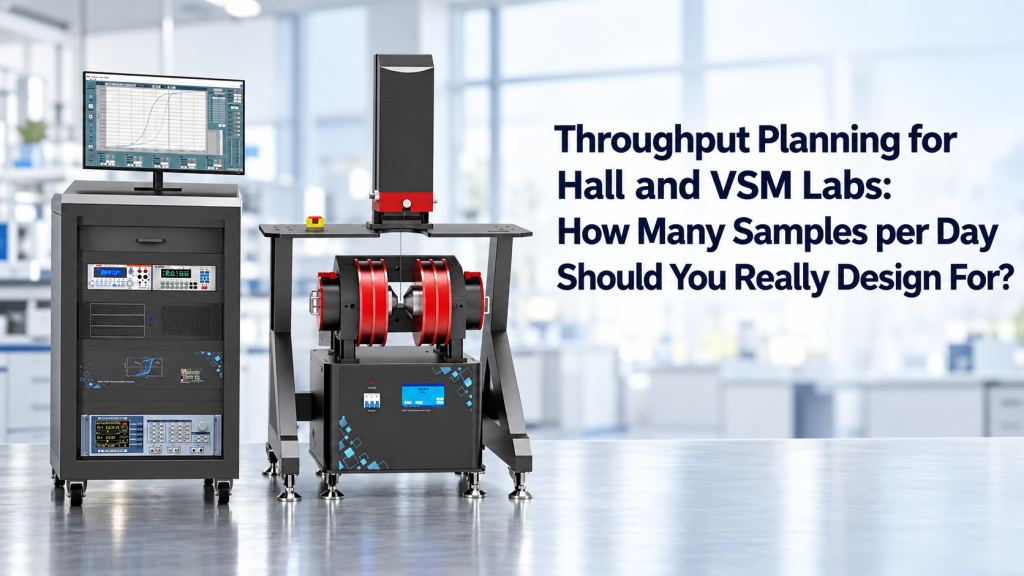
When laboratories purchase a Hall effect measurement system or vibrating sample magnetometer (VSM), the discussion usually starts with technical specifications:
- Maximum magnetic field
- Measurement sensitivity
- Temperature range
- Resistance range
- Field uniformity
- Measurement accuracy
But for a shared university facility, semiconductor laboratory, or industrial R&D center, another question can become equally important:
How many samples can the laboratory realistically measure per day?
This is where Hall and VSM lab throughput becomes a system-level question rather than an instrument-speed question.
A measurement may take only seconds or minutes once everything is ready. But sample mounting, electrical contact verification, centering, temperature stabilization, magnetic field cycling, quality checks, data export, and occasional repeat measurements all consume laboratory time.
The right system should therefore be designed around the complete sample workflow, not only the fastest possible acquisition speed.
1. “Measurement Time” Is Not the Same as “Samples per Day”
A common procurement mistake is to ask:
“How fast can one measurement be completed?”
A more useful question is:
“From removing Sample A to obtaining validated data from Sample B, how long does one complete cycle take?”
The Real Sample Cycle
For throughput planning, total cycle time should include:
- Sample preparation
- Loading and mounting
- Probe or electrical contact connection
- Sample alignment or centering
- Instrument initialization
- Magnetic field stabilization
- Temperature stabilization, if required
- Actual data acquisition
- Data verification
- Sample unloading
- Occasional repeat measurements
In many laboratories, data acquisition is not the largest part of this cycle.
That distinction becomes especially important when comparing manual and automated measurement systems.
2. Hall Effect Measurement Throughput: Where Does the Time Go?
Hall measurements illustrate this problem very clearly.
A basic Hall measurement is more than applying one magnetic field and reading one voltage.
NIST describes Hall measurements using multiple voltage measurements with current reversal and positive and negative magnetic fields. These redundant measurements help control offset errors and verify measurement consistency. NIST
Typical Hall Workflow
A practical Hall effect measurement workflow may involve:
- Installing the sample
- Connecting four electrical contacts
- Checking contact quality
- Confirming sample thickness and geometry
- Measuring resistivity
- Applying positive magnetic field
- Reversing current
- Measuring Hall voltage
- Reversing magnetic field
- Repeating measurements
- Calculating carrier concentration and mobility
- Checking whether the results are internally consistent
This is why an automated Hall effect measurement system can create more value than simply reducing the time required for an individual voltage reading.
Automation can reduce repetitive operator actions between these steps.
Sample Preparation May Be the Real Bottleneck
If every sample arrives already prepared with reliable contacts, the measurement system may process samples relatively quickly.
But if laboratory staff must:
- Attach wires
- Apply silver paste
- Inspect contacts
- Wait for contact material to cure
- Diagnose unstable resistance
then purchasing a faster meter will not necessarily increase daily laboratory capacity.
The bottleneck is upstream of the instrument.
3. VSM Throughput Has a Different Bottleneck
A vibrating sample magnetometer has a different workflow.
Modern VSM systems can acquire magnetic moment data rapidly. For example, Quantum Design specifies a typical VSM averaging time of approximately one second per data point for one of its commercial systems. Quantum Design
However, one-second data acquisition does not mean one-second sample throughput.
A Complete VSM Cycle May Include
- Weighing the sample
- Mounting powder, film, pellet, or bulk material
- Installing the sample holder
- Positioning and centering the sample
- Selecting the field sweep profile
- Ramping the magnetic field
- Measuring the M-H loop
- Returning the magnet to the required field state
- Performing background correction if necessary
- Removing the sample
- Cleaning or preparing the holder for the next sample
For thin films, powders, weak magnetic materials, or temperature-dependent measurements, setup and validation may take much longer than the actual magnetic moment acquisition.
Fast VSM Measurement Does Not Automatically Mean High Throughput
Consider two laboratories.
Laboratory A measures 30 similar bulk samples at room temperature every day.
Laboratory B measures four research samples, each requiring:
- Different mounting methods
- Multiple field orientations
- Several temperatures
- Background subtraction
- Repeated low-noise measurements
The second laboratory may own exactly the same VSM but have dramatically lower daily sample throughput.
Neither laboratory is inefficient.
They are simply running different measurement workflows.
4. A Better Way to Calculate Daily Hall and VSM Lab Throughput
Instead of asking suppliers for one universal “samples per day” number, laboratories can estimate capacity using a simple model.
Basic Throughput Formula
Daily sample capacity ≈ Productive measurement minutes per day ÷ Average complete cycle time per sample
Suppose a laboratory operates for eight hours.
That gives:
8 hours × 60 = 480 scheduled minutes
However, assuming 480 productive measurement minutes would usually be unrealistic.
Time is also consumed by:
- Operator breaks
- Instrument checks
- Sample documentation
- Unexpected contact problems
- Calibration
- Data review
- Experimental changes
For planning purposes, a laboratory might initially model 70% productive utilization.
This is only a planning assumption, not a universal laboratory standard.
That would provide:
480 × 70% = 336 productive minutes per day
Now the throughput question becomes much easier.
Planning Example: 15-Minute Total Cycle
336 ÷ 15 ≈ 22 samples per day
Planning Example: 30-Minute Total Cycle
336 ÷ 30 ≈ 11 samples per day
Planning Example: 60-Minute Total Cycle
336 ÷ 60 ≈ 5–6 samples per day
This demonstrates an important purchasing principle:
Small reductions in total sample cycle time can create large increases in annual laboratory capacity.
5. What Should a Hall Lab Really Design For?
There is no universal correct number.
The answer depends on what type of Hall laboratory you are building.
Screening and Routine Characterization Labs
These laboratories may handle:
- Similar semiconductor samples
- Room-temperature measurements
- Standardized sample dimensions
- Repeatable contact configurations
- Routine carrier concentration and mobility testing
For these laboratories, throughput may be a major design priority.
Useful configurations may include:
- Automated field reversal
- Automatic current switching
- Automated calculations
- Predefined test sequences
- Fast sample fixtures
- Multi-sample capability
- Automatic report generation
The goal should be to minimize operator involvement between samples.
Research Laboratories
A university research group may instead work with:
- New materials
- Unusual sample geometries
- Very high or low resistance samples
- Different magnetic field ranges
- Variable-temperature experiments
- Magnetoresistance measurements
- Exploratory test sequences
In this environment, maximizing samples per day may actually be the wrong optimization target.
Experimental flexibility and data quality may matter more than raw throughput.
Shared University Facilities
Shared characterization centers often need both.
They may need:
- Fast standardized measurements for routine users
- Advanced measurement modes for research projects
- User accounts or experiment records
- Repeatable measurement recipes
- Automatic data storage
- Easy switching between sample types
For these laboratories, automation is often valuable because it reduces operator workload rather than simply increasing measurement speed.
6. What Should a VSM Lab Really Design For?
VSM throughput also depends heavily on the laboratory mission.
High-Volume Room-Temperature Testing
Examples include:
- Magnetic powder screening
- Permanent magnet materials
- Ferrites
- Alloy development
- Production-oriented R&D
The main throughput priorities may be:
- Rapid sample mounting
- Fast centering
- Automated field sweeping
- Repeatable measurement recipes
- Automatic data export
- Minimal reconfiguration between samples
Advanced Research Magnetometry
For research involving:
- Thin films
- Nanomaterials
- Weak magnetic signals
- Temperature-dependent magnetization
- Angular measurements
- Very high magnetic fields
measurement time can be dominated by experimental conditions rather than VSM acquisition speed.
A temperature-dependent M-T measurement, for example, may require substantial stabilization time that cannot simply be removed by using faster electronics.
7. The Hidden Variable: Changeover Time
Instrument specifications rarely highlight changeover time.
But laboratories that process many samples should.
Suppose the actual measurement requires ten minutes.
If loading, alignment, verification, unloading, and preparation require another ten minutes, the real sample cycle is:
20 minutes — not 10 minutes.
If automation reduces changeover from ten minutes to four minutes:
Old cycle: 20 minutes
New cycle: 14 minutes
Using the earlier 336-minute productive-day model:
- 20-minute cycle → approximately 16 samples/day
- 14-minute cycle → approximately 24 samples/day
That is roughly 50% more theoretical daily capacity, even though the measurement itself did not become any faster.
This is why sample handling deserves attention during instrument specification.
8. When Is Automation Actually Worth Paying For?
Automation should not be treated as a premium feature simply because it sounds advanced.
It should solve a measurable workflow problem.
Automation Becomes More Valuable When
- Many samples use similar measurement sequences
- Operators repeatedly change field polarity manually
- Measurements frequently run unattended
- Multiple measurements must follow the same procedure
- Staff time is expensive or limited
- Results must be highly repeatable between operators
- The laboratory supports many external or internal users
Automation May Provide Less Value When
- Sample volume is very low
- Every experiment is different
- Sample preparation dominates total time
- Operators frequently need to intervene during measurements
- Research flexibility matters more than standardized throughput
A good automation decision begins with workflow mapping rather than a feature checklist.
9. Design for Peak Demand, Not Just Average Demand
Another common mistake is sizing laboratory capacity around average utilization.
Imagine a university facility that normally receives five samples per day but receives 25 samples immediately before:
- Thesis deadlines
- Project reviews
- Conference submissions
- Grant milestones
An instrument designed only around average demand can develop significant queues.
Ask Three Capacity Questions
Before purchasing a Hall effect measurement system or VSM, estimate:
- Normal demand: How many samples arrive during a typical week?
- Peak demand: What happens during busy periods?
- Acceptable backlog: How long can researchers reasonably wait?
A system that appears oversized during quiet months may be appropriately sized during peak research periods.
10. Do Not Forget Retests and Failed Samples
A theoretical throughput calculation assumes every measurement succeeds the first time.
Real laboratories do not work that way.
Hall measurements can encounter:
- Poor ohmic contacts
- Excessive voltage offsets
- Unstable resistance
- Incorrect sample geometry information
- Unexpected sample nonuniformity
NIST specifically emphasizes consistency checking, contact quality, sample uniformity, and reversal measurements in Hall characterization. NIST
VSM measurements may require repeats because of:
- Sample movement
- Poor centering
- Background signal
- Incorrect sample mounting
- Unexpected hysteresis behavior
- Insufficient field range
Quantum Design also publishes specific guidance on VSM sample mounting and centering, illustrating how these practical details affect measurement quality. Quantum Design
Therefore, a realistic throughput plan should always reserve some capacity for troubleshooting and repeats.
11. Throughput Planning Should Start Before You Request a Quotation
When requesting a Hall or VSM system, laboratories usually provide technical requirements first.
Adding several operational questions can produce a much better system configuration.
For Hall Effect Measurement Systems
Specify:
- Expected samples per day
- Typical sample dimensions
- Typical resistance range
- Whether contacts are prepared before measurement
- Room-temperature or variable-temperature operation
- Required magnetic field
- Number of measurement recipes
- Whether overnight unattended operation is required
- Whether multiple samples should be loaded together
For VSM Systems
Specify:
- Expected samples per day
- Typical sample type
- Required M-H, M-T, or other measurement modes
- Magnetic field range
- Temperature range
- Typical number of field points
- Required sensitivity
- Sample changeover frequency
- Need for unattended sequences
These requirements help determine whether investment should go toward higher field, greater sensitivity, temperature options, faster sample handling, or automation.
12. How Cryomagtech Approaches Hall and VSM Throughput Planning
Cryomagtech provides Hall Effect Measurement Systems and Vibrating Sample Magnetometer solutions for university laboratories, shared characterization facilities, and industrial R&D applications.
Rather than defining system performance only by maximum field or sensitivity, the configuration can also be evaluated around the intended workflow:
- Daily sample volume
- Measurement complexity
- Sample changeover requirements
- Field and temperature sequences
- Automation level
- Data acquisition and calculation
- Multi-sample testing requirements
- Operator involvement
For example, Cryomagtech Hall platforms can be configured with automated measurement and data processing, while different VSM configurations can be selected according to measurement speed, sensitivity, field, temperature, and research requirements. Cryomagtech
The objective is not simply to purchase the fastest instrument.
It is to build a measurement workflow that matches the laboratory’s real workload.
13. A Simple Throughput Checklist Before Buying
Before finalizing a Hall effect measurement system or VSM specification, ask:
- How many samples do we expect on a normal day?
- What is our peak weekly demand?
- How long does sample preparation take?
- How long does sample changeover take?
- How much stabilization time is required?
- How often do measurements need to be repeated?
- Can measurements run unattended?
- Can several samples be prepared or loaded in advance?
- Is the bottleneck the instrument or the operator?
- Are we optimizing for speed, flexibility, or publication-quality data?
If these questions cannot be answered, quoting a precise “samples per day” number is probably premature.
14. Key Takeaways
- Hall and VSM lab throughput is determined by the complete workflow, not acquisition speed alone.
- Hall measurements may require current reversal, field reversal, consistency checks, and contact verification.
- VSM throughput is strongly influenced by sample mounting, centering, field sequences, temperature control, and data validation.
- Sample preparation and changeover can become larger bottlenecks than the measurement electronics.
- Automation creates the most value when experiments are repetitive and operator intervention can be reduced.
- Laboratories should plan around both normal demand and peak demand.
- A realistic throughput model should include troubleshooting, calibration, and repeat measurements.
- The best instrument is not necessarily the one with the shortest measurement time—it is the one that delivers the required data quality at the required laboratory capacity.
For university facilities and industrial R&D laboratories, “How many samples per day?” should be treated as a system-design requirement, not an afterthought.
References
NIST – Resistivity and Hall Measurements
Provides practical Hall measurement procedures covering current reversal, magnetic-field reversal, consistency checking, contact quality, and measurement methodology. NIST
Source: NIST – Resistivity and Hall Measurements
Quantum Design – Vibrating Sample Magnetometer Specifications
Useful reference for understanding VSM acquisition time, averaging time, sample positioning, and practical magnetometry workflow. Quantum Design
Source: Quantum Design – VSM Specifications