
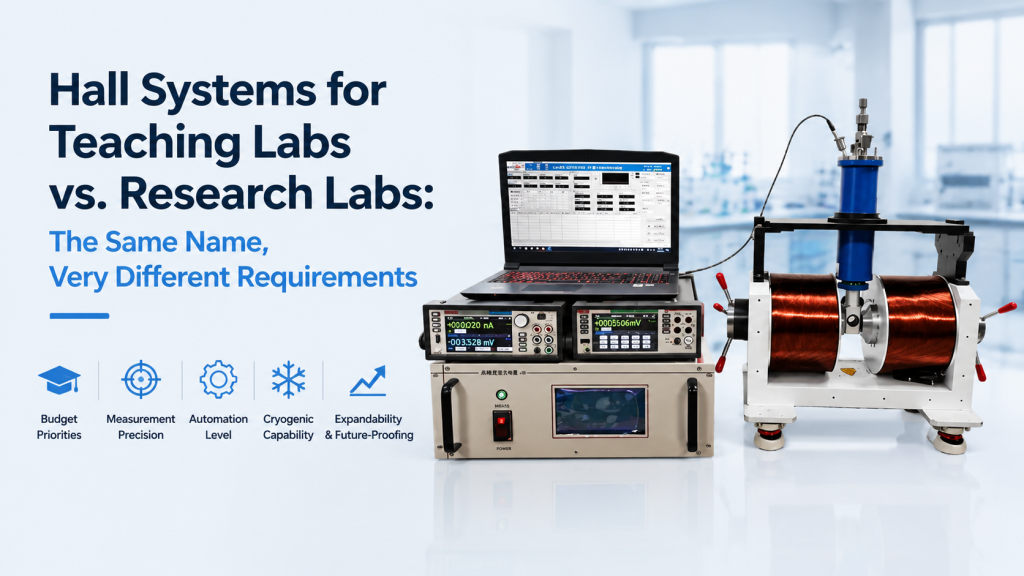
A university buyer asks for a quotation:
“We need a Hall Effect Measurement System.”
That sentence can describe two completely different projects.
One department may need a robust teaching instrument for undergraduate students to observe the Hall effect, change current and magnetic field, determine carrier polarity, and calculate a Hall coefficient.
Another laboratory may need to characterize experimental semiconductor films with unknown resistance, measure carrier concentration and mobility automatically, reverse current and magnetic field, work with van der Pauw and Hall bar samples, perform measurements from cryogenic temperatures to room temperature, and export raw transport data for research.
Both are called Hall systems.
They should not receive the same quotation.
Understanding Hall systems for teaching labs vs research labs is therefore one of the most important steps before specifying magnetic field, electronics, automation, temperature options, or budget.
This guide explains how the requirements diverge—and where universities frequently either overspend on unnecessary capabilities or buy an educational system that cannot support their later research.
1. Start With the Purpose of the Experiment
The first purchasing question should not be:
“What is the maximum magnetic field?”
It should be:
“What do you expect the user to learn or measure?”
Teaching Laboratory
The primary purpose is usually to demonstrate a physical relationship.
Students may investigate:
- Hall voltage
- Magnetic field
- Current direction
- Carrier polarity
- Hall coefficient
- Carrier concentration
- Semiconductor conductivity
For example, UC Berkeley’s semiconductor Hall-effect laboratory introduces students to Hall voltage generated when a current-carrying semiconductor is placed in a perpendicular magnetic field and uses the experiment to connect electrical transport with charge carriers.
A teaching system therefore succeeds when students can see, understand, reproduce, and calculate the underlying physics.
Research Laboratory
The purpose is different.
The researcher usually already understands the Hall effect.
The questions may instead be:
- What is the carrier concentration of this new film?
- How does mobility change with temperature?
- Can we measure a highly resistive semiconductor?
- Is transport n-type or p-type?
- Does annealing change carrier density?
- Can we measure both RXX and RXY?
- Does the sample exhibit anomalous or nonlinear Hall behavior?
- Can we characterize a gated device?
- Can we automate ±B measurements?
NIST describes Hall measurement as a method for determining semiconductor carrier density and mobility and outlines measurement sequences using resistivity, Hall voltage, magnetic field reversal, and multiple electrical configurations.
A research system therefore succeeds when it can generate defensible data from the laboratory’s actual samples.
That distinction should drive the entire procurement process.
2. A Teaching Hall System Should Make the Physics Visible
More automation is not always better in an educational laboratory.
If the instrument automatically:
- Applies current
- Changes magnetic field
- Switches contacts
- Performs calculations
- Displays mobility
and the student only presses “Start,” much of the educational value can disappear.
A Good Teaching Workflow
Students should ideally be able to understand relationships such as:
- Increasing magnetic field changes Hall voltage
- Reversing magnetic field reverses Hall polarity
- Reversing current changes the Hall response
- Different carrier types produce different Hall signs
- Sample thickness affects the relationship between voltage and material properties
The apparatus should make those relationships reasonably transparent.
Teaching Priorities
A teaching system should usually prioritize:
- Clear operating logic
- Robust sample mounting
- Easy access
- Visible field and current values
- Repeatable samples
- Safe operating limits
- Straightforward calculations
- Fast experiment setup
- Low maintenance
The objective is not maximum measurement flexibility.
It is maximum educational clarity per laboratory session.
3. Research Hall Systems Often Need to Hide Complexity from the Operator
Interestingly, research equipment often needs more automation—not because researchers understand less, but because the measurement itself becomes more complex.
A proper Hall sequence may involve:
- Positive current
- Negative current
- Positive magnetic field
- Negative magnetic field
- Multiple contact configurations
- Voltage averaging
- Resistivity measurements
- Hall calculations
NIST’s recommended workflow uses multiple Hall-voltage measurements under both magnetic-field polarities, while sheet resistance and carrier density are combined to determine Hall mobility.
Manually performing every permutation becomes slow and error-prone when researchers measure many samples.
Research Priorities
A research Hall system may therefore prioritize:
- Automatic current reversal
- Automatic field reversal
- Contact switching
- Automated van der Pauw sequences
- Programmable field sweeps
- Temperature control
- Batch measurement
- Raw-data storage
- Repeatable calculation procedures
Here, automation protects data quality and increases throughput.
4. Sample Type Is Usually Fixed in Teaching Labs—and Unknown in Research Labs
This difference has major consequences.
Teaching Laboratory Samples
Teaching systems often use standardized samples supplied with the experiment.
Typical advantages include:
- Known resistance
- Known carrier polarity
- Known sample dimensions
- Reliable contacts
- Predictable Hall voltage
- Repeatable results
The instrument can therefore be optimized around one narrow sample class.
Research Laboratory Samples
Research samples may change every month.
A laboratory may receive:
- GaN
- GaAs
- SiC
- Silicon
- Oxide films
- ITO
- Graphene
- 2D materials
- Magnetic semiconductors
- Experimental heterostructures
The supplier may not know whether the next sample will have:
- 100 Ω resistance
- 100 kΩ resistance
- 100 MΩ resistance
That uncertainty creates a completely different instrumentation problem.
5. Resistance Range Matters Much More in Research Systems
A teaching system can be designed around a known semiconductor sample.
A research system often cannot.
Why Resistance Changes the Electronics
Low-resistance samples may require:
- Higher measurement current
- Good low-voltage resolution
- Stable current sourcing
High-resistance samples may require:
- Higher voltage compliance
- Very low leakage
- High input impedance
- Shielding
- Guarding
- Longer settling times
This is why a research quotation should ask for the expected resistance or sheet-resistance range.
A current source advertised as capable of “100 mA” is not automatically suitable for every sample. Highly resistive materials may hit the source’s voltage-compliance limit long before its maximum current is reached.
Teaching Procurement
A narrow resistance range is normally acceptable.
Research Procurement
Wide resistance coverage can be much more valuable than an impressive maximum current specification.
6. Magnetic Field Requirements Should Also Be Different
Many buyers assume that a research Hall system simply means “more Tesla.”
Not necessarily.
Teaching Laboratory
The magnetic field only needs to be strong enough to produce a clear, measurable Hall signal from the standardized teaching sample.
The educational objective may be to plot:
- Hall voltage versus field
- Hall voltage versus current
A moderate, controllable field can therefore be sufficient.
Research Laboratory
Magnetic-field requirements depend on the sample.
A larger field may help when:
- Carrier density is high
- Mobility is low
- Hall voltage is weak
- Field-dependent transport must be studied
But field strength must be evaluated together with:
- Sample resistance
- Measurement current
- Voltage sensitivity
- Required pole gap
- Probe fixture
- Temperature stage
Do Not Buy Field Strength in Isolation
A 1 T system is not automatically superior to a 0.5 T system.
If the 0.5 T system provides:
- Better voltage measurement
- Automatic ±B reversal
- Appropriate sample fixtures
- Better current sourcing
- Better data processing
it may produce much better Hall measurements for the intended samples.
7. Manual Field Reversal Can Be Fine for Teaching
Teaching laboratories may deliberately benefit from manual interaction.
Students can observe what happens when:
- Field direction changes
- Current direction changes
- Field magnitude increases
This makes the physical relationship visible.
Research Is Different
Repeated manual field reversal becomes inefficient when the laboratory needs:
- Dozens of samples
- Temperature-dependent measurements
- Multiple current values
- Multiple field points
- Automated overnight experiments
NIST specifically incorporates positive and negative magnetic-field measurements into its recommended Hall measurement procedure.
A research platform therefore often benefits from:
- Bipolar electromagnet
- Bipolar power supply
- Programmable ±B control
- Automatic acquisition
The convenience feature becomes a measurement feature.
8. Precision Requirements Should Follow the Scientific Question
A common university procurement error is asking:
“What is your highest-precision Hall system?”
before deciding whether that precision has any value.
Teaching Laboratory
Students usually need:
- Clearly observable Hall voltage
- Reasonable agreement with expected values
- Good repeatability between student groups
They do not necessarily need:
- Nanovolt-level optimization
- Ultra-low leakage
- Complex guarding
- Extremely high-stability magnet power supplies
Paying for performance students cannot meaningfully use is poor budgeting.
Research Laboratory
Small Hall voltages can genuinely challenge the measurement system.
NIST notes that Hall signals can enter the low-microvolt range and that contact asymmetry and other offsets may become substantial compared with the desired Hall signal.
Research systems may therefore require better:
- Voltage resolution
- Stability
- Offset suppression
- Shielding
- Current reversal
- Field reversal
- Averaging
Precision becomes justified because the sample demands it.
9. Accuracy and Resolution Are Not the Same Thing
Research buyers should be especially careful here.
A datasheet may advertise an extremely small voltage resolution.
That does not automatically mean the system can accurately determine a tiny Hall voltage.
Actual data quality also depends on:
- Instrument noise
- Thermal EMF
- Contact offsets
- Current-source stability
- Field stability
- Sample geometry
- Grounding
- Electrical interference
Teaching Buyer
A simple specification can often be sufficient.
Research Buyer
Ask:
- What is the practical measurement range?
- What uncertainty is expected?
- How are offsets removed?
- Is current reversal automatic?
- Is magnetic-field reversal automatic?
- Can raw data be reviewed?
The lowest digit displayed on the screen is not the same thing as experimental confidence.
10. Teaching Labs Usually Benefit From Fixed Fixtures
A fixed sample holder is often ideal for undergraduate experiments.
Advantages
- Fast loading
- Known geometry
- Low risk of probe damage
- Repeatable contact pressure
- Easy student training
- Lower cost
- Reduced alignment time
If 100 students must perform the same experiment each semester, repeatability matters more than unlimited flexibility.
Replaceable Standard Samples
A teaching system can even use multiple known samples, such as:
- n-type semiconductor
- p-type semiconductor
- Different carrier-density samples
This lets students compare physical behavior without requiring advanced sample preparation.
11. Research Labs Often Need Modular Fixtures
Research laboratories rarely remain with one sample design forever.
The system may need to accommodate:
- Different chip sizes
- Different film dimensions
- Van der Pauw samples
- Hall bars
- Pre-wired devices
- Probe-contacted devices
- Gated samples
That may justify:
- Interchangeable holders
- Adjustable contacts
- Multi-probe stages
- Probe stations
- Custom sample PCBs
- Additional electrical channels
Modular Does Not Mean “Buy Everything”
A university should not automatically purchase every fixture option.
A better strategy is:
Standardize the common platform and modularize only the sample interface.
For example:
- One electromagnet
- One bipolar power supply
- One Hall measurement platform
- One van der Pauw holder initially
- Optional Hall-bar fixture later
This often provides better long-term economics.
12. Van der Pauw Is Especially Important for Research Hall Systems
Many materials laboratories use van der Pauw measurements because they want to determine properties such as:
- Sheet resistance
- Resistivity
- Carrier concentration
- Carrier type
- Hall mobility
NIST’s Hall measurement guidance is built around van der Pauw-style resistivity and Hall procedures, using multiple contact configurations and field polarities to calculate semiconductor transport properties.
Teaching Systems
A simplified fixed sample can demonstrate the same underlying physics without requiring full automated van der Pauw switching.
Research Systems
If van der Pauw characterization is routine, automatic contact permutation can save considerable time and reduce operator mistakes.
That is one example where apparently “extra” automation has genuine research value.
13. Hall Bar Capability Pushes the System Toward Device Research
A laboratory working with Hall bars may need more than traditional carrier concentration and mobility.
The researchers may want:
- Longitudinal resistance
- Transverse resistance
- Magnetoresistance
- Gate-dependent transport
- Current-dependent transport
- Temperature-dependent transport
The Hall system then begins to resemble a general electrical-transport platform.
Possible Additional Requirements
- Multiple source-measure units
- Additional voltage channels
- Gate-voltage source
- Lock-in amplifier
- More probe contacts
- Rotation stage
- Custom scripts
This is far beyond the needs of a standard undergraduate Hall experiment.
14. Software Requirements Should Be Completely Different
Software is another area where universities often buy the wrong level of capability.
Teaching Software Should Prioritize Clarity
Useful functions include:
- Live Hall-voltage display
- Magnetic-field display
- Current display
- Simple graph plotting
- Export to CSV
- Student-friendly calculation tools
The student should still understand where the result came from.
Research Software Should Prioritize Control
Research software may need:
- Automatic ±I sequences
- Automatic ±B sequences
- Contact switching
- Temperature sweeps
- Field sweeps
- Multi-channel acquisition
- Measurement recipes
- Raw-data export
- Metadata storage
- User-defined calculations
A polished graphical interface is useful, but researchers should not be trapped inside it.
Raw Data Should Remain Accessible
For research work, the user should ideally be able to export values such as:
- Current
- Voltage
- Magnetic field
- Temperature
- Contact configuration
- Time
- Calculated Hall parameters
The software-generated mobility number should not be the only available result.
15. Teaching Labs Benefit From Faster Setup
Consider the realities of an undergraduate laboratory.
A class may last only:
- Two hours
- Three hours
- One afternoon
If students spend most of that time:
- Aligning probe needles
- Debugging contacts
- Configuring software
- Waiting for vacuum
- Troubleshooting communications
the system has failed as a teaching instrument.
Teaching Priority
A good experiment might follow:
- Install or verify the sample
- Set measurement current
- Apply magnetic field
- Record Hall voltage
- Reverse the field
- Plot the data
- Calculate Hall coefficient and carrier properties
- Discuss the physics
That workflow is much more valuable educationally than operating a research-grade platform that consumes the session in setup.
16. Research Labs Can Justify Longer Measurement Cycles
Research experiments may run:
- Several hours
- Overnight
- Multiple days
The system can therefore trade setup simplicity for experimental capability.
Examples include:
- 300 K → 80 K temperature sweeps
- −1 T → +1 T field sweeps
- Multiple gate voltages
- Multiple measurement currents
- Repeated field cycles
In this environment, automation becomes essential because the user should not manually operate the instrument for eight hours.
17. Do Teaching Labs Need Temperature Control?
Usually not—unless temperature dependence is part of the curriculum.
Adding temperature control may require:
- Heater
- Temperature sensor
- Temperature controller
- Modified sample holder
- Additional wiring
- Longer experiment time
If the educational objective is simply to understand the Hall effect, room-temperature operation is often more practical.
Advanced Teaching Laboratories
Temperature control can make sense when students are expected to investigate:
- Semiconductor carrier concentration versus temperature
- Resistivity versus temperature
- Thermally activated conduction
But the educational benefit should justify the additional complexity.
18. Research Labs May Need Temperature to Be a Core Measurement Axis
For research, temperature can fundamentally change the scientific result.
A research Hall platform may be required to operate over:
- Elevated temperatures
- Liquid-nitrogen-class temperatures
- Cryogenic temperatures near 4 K
This can change almost the entire system.
Low-Temperature Hall Capability May Require
- Cryostat
- Vacuum system
- Temperature controller
- Heater
- Temperature sensors
- Cryogenic wiring
- Thermal anchoring
- Modified sample holder
- More electrical feedthroughs
- Larger electromagnet gap
Procurement Consequence
A room-temperature research Hall system and a cryogenic Hall system should not be treated as the same product with one optional accessory.
Cryogenic capability can alter the mechanical and magnetic architecture from the beginning.
19. The Magnet Working Gap Becomes Critical When Temperature Hardware Is Added
Suppose a buyer requests:
“1 T magnetic field and low-temperature Hall measurement.”
The missing parameter is the actual gap required by the cryostat.
An electromagnet may generate a certain field at:
- 10 mm gap
and a very different field at:
- 30 mm
- 40 mm
- 50 mm
Once a cryostat or probe stage is placed between the poles, the relevant specification becomes:
magnetic field at the final installed working gap.
This is much more important for research systems than for fixed teaching apparatus.
20. Low Temperature Should Not Be Purchased Only Because It Sounds Advanced
University budgets often create a predictable temptation:
“If we have the money now, we should add the cryogenic option.”
That is not always good procurement.
Low-temperature capability can increase:
- Purchase cost
- Maintenance
- Training
- Measurement time
- Installation complexity
- Vacuum-system requirements
- Vibration management
If the laboratory’s actual work is room-temperature semiconductor characterization, the cryogenic option may remain unused.
Better Question
Will a funded or credible research program require low-temperature Hall measurements within the expected lifetime of this system?
If yes, design for it.
If no, invest the budget elsewhere.
21. Teaching Systems Should Be Difficult to Damage
Students will make mistakes.
That is normal.
A teaching instrument should tolerate reasonable operator errors.
Useful protections can include:
- Current limiting
- Voltage limiting
- Magnetic-field limits
- Overtemperature protection
- Robust connectors
- Protected sample contacts
- Simple interlocks
Why This Matters More Than Ultimate Performance
A system with exceptional specifications but delicate probe needles that require expert adjustment may be a poor teaching instrument.
Reliability is a performance specification in education.
22. Research Systems Need Protection Too—but More Freedom
Research users sometimes need to operate close to experimental boundaries.
The system may therefore need:
- Adjustable current limits
- Adjustable voltage limits
- Programmable field limits
- Temperature interlocks
- User-defined sweep ranges
The system should protect expensive hardware without preventing legitimate experiments.
This requires more configurable control than a fixed teaching setup.
23. Teaching Laboratories Need Repeatability Between Students
Imagine 20 student groups measuring the same sample.
The experiment should produce results close enough that differences can be discussed scientifically.
Large variation caused by:
- Probe placement
- Loose contacts
- Misalignment
- Manual wiring errors
reduces educational value.
Good Teaching Design
Standardization helps:
- Fixed sample position
- Fixed contacts
- Known field geometry
- Repeatable current
- Simple data acquisition
In teaching, mechanical repeatability may matter more than ultimate measurement sensitivity.
24. Research Laboratories Need Repeatability Between Samples and Days
Research repeatability is stricter.
A researcher may ask whether a 5% mobility change comes from:
- The material
- The contact
- The instrument
- The temperature
- The magnetic field
- The measurement sequence
This places greater demands on:
- Calibration
- Field reproducibility
- Current-source stability
- Sample geometry
- Temperature control
- Automated measurement sequence
- Data traceability
Research systems should help separate instrument variation from material variation.
25. Calibration Requirements Should Be Different
Teaching System
The objective is usually to maintain credible experimental results across semesters.
Useful calibration may include:
- Magnetic-field verification
- Current verification
- Voltage verification
- Reference sample checks
Research System
Depending on the intended data quality, laboratories may need more formal:
- Field calibration
- Electrical calibration
- Temperature calibration
- Reference sample measurement
- Calibration records
- Acceptance-test procedures
For publication-quality or process-comparison work, calibration history can become part of data traceability.
26. Throughput Has Different Meanings
Teaching Throughput
The question is:
“How many student groups can complete the experiment each week?”
Priorities:
- Fast setup
- Short measurement time
- Fast reset
- Easy troubleshooting
Research Throughput
The question may be:
“How many samples can we characterize with full Hall analysis per day?”
Or:
“How many field/temperature points can we collect overnight?”
Priorities:
- Automatic sequencing
- Sample-change efficiency
- Batch processing
- Reliable unattended operation
The same word—throughput—therefore leads to different hardware.
27. Teaching Labs Usually Do Not Need Probe Stations
If standardized semiconductor samples are used, a dedicated holder is normally easier.
A probe station adds:
- Cost
- Alignment time
- Probe damage risk
- Training
- Mechanical complexity
- Larger magnet gap
For most basic teaching applications, these disadvantages may outweigh the flexibility.
Research Labs May Genuinely Need Them
A probe station becomes useful when researchers must work with:
- Different pad locations
- Hall bars
- Multiple devices on one chip
- Gated devices
- Small patterned structures
The fixture should follow the sample—not prestige.
28. A Teaching System Should Not Automatically Become a Research System Later
This is another common planning mistake.
Universities sometimes buy the cheapest teaching apparatus and assume:
“We can use it for research later.”
Sometimes they can.
Often they cannot.
Typical limitations include:
- Narrow resistance range
- Fixed sample
- Manual field control
- No bipolar automation
- Limited voltage sensitivity
- No van der Pauw switching
- No raw-data automation
- No temperature integration
- Fixed magnet geometry
Adding all of those functions later may cost more than buying the correct platform initially.
29. But a Research System Is Not Automatically a Better Teaching System
The opposite mistake is equally common.
A department purchases a sophisticated research instrument and assigns it to undergraduate teaching.
The result may be:
- Too many controls
- Long startup procedures
- Fragile samples
- Slow measurements
- Difficult troubleshooting
- Expensive repairs
- Students seeing only software output
The system is more capable but less useful for the actual teaching objective.
More specification does not always mean better education.
30. The Most Useful Middle Category: Advanced Teaching + Entry Research
Many university buyers actually belong here.
They need a system primarily for teaching but also want:
- Student research projects
- Master’s projects
- Basic thin-film characterization
- Occasional faculty research
This can justify a configuration between the two extremes.
Possible Configuration
- Bipolar electromagnet
- Programmable magnet power supply
- Moderate magnetic field
- Four-contact sample holder
- Automatic field reversal
- Basic van der Pauw measurement
- Room-temperature operation
- Raw-data export
- Upgradeable software
This provides genuine research capability without moving immediately into:
- Cryogenic operation
- Multi-probe stations
- Extremely high resistance measurement
- Complex gating
- Multi-channel transport
For many universities, this is the most rational budget level.
31. A Practical Three-Level Hall System Strategy
Rather than asking for “basic, standard, and premium,” it is more useful to define three application levels.
Level 1: Teaching Hall System
Best for:
- Undergraduate laboratories
- Fundamental physics demonstrations
- Semiconductor teaching
- High student throughput
Priority features:
- Robust fixture
- Standard samples
- Clear Hall voltage measurement
- Adjustable current
- Adjustable magnetic field
- Simple polarity reversal
- Basic software
- Easy maintenance
Avoid paying unnecessarily for:
- Cryogenic systems
- Multi-probe stages
- Extreme electrical ranges
- Advanced automation
Level 2: Advanced Teaching / Entry Research System
Best for:
- University shared laboratories
- Master’s teaching
- Student research
- Basic semiconductor characterization
Priority features:
- Bipolar electromagnet
- Automatic ±B
- Wider electrical range
- Van der Pauw support
- Carrier concentration
- Hall mobility
- Raw-data export
- Modular sample holder
Possible future options:
- Temperature stage
- Additional sample fixture
Level 3: Research Hall Measurement Platform
Best for:
- Semiconductor research laboratories
- Materials science groups
- Device laboratories
- Shared characterization facilities
Possible requirements:
- Wide resistance range
- High voltage compliance
- Low-noise voltage measurement
- Automatic current reversal
- Automatic ±B
- Programmable contact switching
- Van der Pauw
- Hall bar
- Probe station
- Temperature control
- Cryogenic operation
- Gate bias
- Multi-channel acquisition
- Custom measurement sequences
Now the budget is paying for measurable experimental capability.
32. What a Teaching-Lab RFQ Should Include
A basic teaching request can be relatively simple.
Provide:
Educational Objective
For example:
- Demonstrate Hall voltage
- Determine Hall coefficient
- Determine carrier polarity
- Estimate carrier concentration
Number of Student Groups
This helps determine:
- Required robustness
- Throughput
- Number of systems
Desired Experiment Duration
For example:
- 1 hour
- 2 hours
- 3-hour laboratory session
Sample Preference
- Supplier-provided semiconductor sample
- University-provided sample
Automation Preference
- Manual educational operation
- Semi-automatic
- Fully automated demonstration
Required Software
- Live graph
- CSV export
- Student calculation
That is usually enough to begin a meaningful teaching-system proposal.
33. What a Research-Lab RFQ Should Include
A research RFQ should go much further.
Sample Information
- Material
- Layer structure
- Sample dimensions
- Active-layer thickness
- Substrate
- Van der Pauw or Hall bar
Electrical Information
- Approximate resistance or sheet resistance
- Expected carrier concentration
- Expected mobility
- Maximum safe current
- Contact method
Magnetic Requirements
- Required field
- Pole gap
- ±B reversal
- Sweep requirements
Environmental Requirements
- Room temperature
- Low temperature
- High temperature
- Vacuum
- Controlled atmosphere
Measurement Requirements
- Sheet resistance
- Resistivity
- Carrier polarity
- Carrier concentration
- Hall mobility
- RXX(B)
- RXY(B)
- Raw data
Expansion Requirements
- Probe station
- Hall bar
- Gate source
- Cryostat
- Additional channels
Without this information, a “research Hall system quotation” can easily become guesswork.
34. How Cryomagtech Approaches University Hall System Configuration
Cryomagtech evaluates a Hall Effect Measurement System according to the actual laboratory role rather than assuming every university requires the same configuration.
For teaching projects, the priorities may be:
- Clear experimental logic
- Reliable semiconductor samples
- Robust fixtures
- Safe magnetic-field operation
- Simple data acquisition
- High student throughput
For research projects, the configuration may instead be built around:
- Sample resistance range
- Carrier concentration and mobility
- Van der Pauw or Hall bar geometry
- Magnetic field and working gap
- Automatic field reversal
- Current reversal
- Variable temperature
- Cryogenic integration
- Probe access
- Raw-data acquisition
- Future expansion
For university customers, we recommend defining the expected use level before adding options.
The objective is not to sell a teaching laboratory a research system it will never use—or to sell a research group an educational system it will outgrow within a year.
35. A Simple Buyer Decision Guide
Choose a teaching Hall system when:
- Undergraduate education is the primary objective
- Standard samples will be used
- Room-temperature measurement is sufficient
- Students should interact directly with the experiment
- Fast setup and durability matter most
- Budget is limited
Choose an advanced teaching / entry research system when:
- Teaching remains important
- Graduate projects are expected
- Basic Hall mobility characterization is required
- Van der Pauw samples may be tested
- Automatic field reversal is useful
- Future expansion is possible
Choose a research Hall system when:
- Unknown experimental samples must be characterized
- Wide resistance coverage is required
- Low Hall signals are expected
- Automated measurement is important
- Hall bars or gated devices are involved
- Temperature-dependent measurements are required
- Cryogenic capability is needed
- Raw transport data are scientifically important
36. Key Takeaways
- Hall systems for teaching labs vs research labs may share the same name but should not share the same specification by default.
- Teaching systems should prioritize clarity, robustness, repeatability, safety, and experiment duration.
- Research systems should prioritize sample compatibility, electrical measurement range, automation, data quality, and flexibility.
- A higher magnetic field is not automatically the most valuable research upgrade.
- Teaching systems often benefit from fixed fixtures, while research systems may require modular sample holders or probe stations.
- Automated ±B and ±I measurements become much more important in research.
- Cryogenic capability can fundamentally change the system architecture and should only be purchased when scientifically justified.
- Raw-data access matters far more in research than a single software-calculated mobility result.
- Advanced teaching / entry research is a useful middle configuration for many university laboratories.
- The best Hall system is not the system with the longest specification sheet. It is the one matched to the laboratory’s actual users, samples, and experiments.
A university should therefore not begin with:
“What is your cheapest Hall system?”
or:
“What is your most advanced Hall system?”
The better question is:
“Are we buying an experiment for students, a measurement platform for researchers, or a system that must realistically serve both?”
References
- National Institute of Standards and Technology (NIST) — Resistivity and Hall Measurements
NIST describes recommended resistivity and Hall measurement procedures, including carrier-density and Hall-mobility calculations, multiple electrical configurations, and positive/negative magnetic-field measurements.
https://www.nist.gov/pml/nanoscale-device-characterization-division/popular-links/hall-effect/resistivity-and-hall - University of California, Berkeley — Hall Effect in Semiconductor Laboratory Manual
A practical university teaching example demonstrating Hall voltage and semiconductor transport concepts in an instructional laboratory.
https://experimentationlab.berkeley.edu/sites/default/files/writeups/SHE_Manual_2024-05-03.pdf