
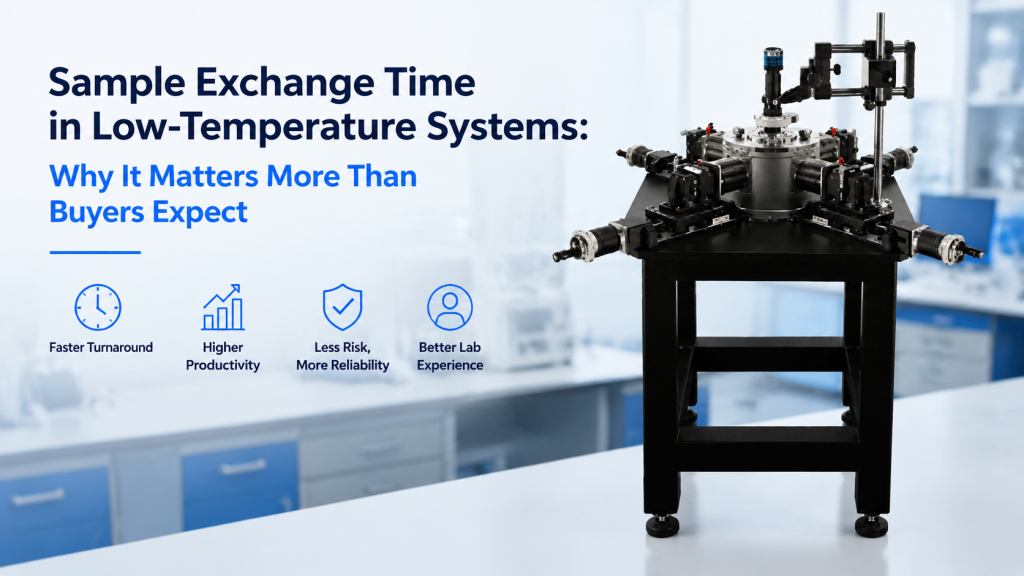
When buyers compare low-temperature measurement systems, they usually focus on headline specifications:
- Minimum temperature
- temperature stability
- magnetic field range
- sample space
- electrical measurement channels
- optical access
- vibration
- automation
These parameters matter.
But they do not fully describe the laboratory’s daily experience.
A cryogenic system may reach an excellent base temperature and produce high-quality data, yet still become frustrating to use if every new sample requires hours of preparation, warm-up, venting, rewiring, pump-down, cooldown, and stabilization.
That is why cryogenic sample exchange time should be treated as a real procurement specification.
The relevant question is not only:
“How quickly can the operator physically remove one sample and install another?”
The more useful question is:
“How much time passes between the last valid measurement on Sample A and the first valid measurement on Sample B?”
For Hall measurement systems, cryogenic probe stations, optical cryostats, low-temperature transport platforms, and magnet-integrated cryostats, this complete turnaround time can determine:
- Daily sample throughput
- operator workload
- instrument utilization
- scheduling flexibility
- student productivity
- risk of mounting errors
- cryogen or electricity consumption
- practical cost per dataset
- whether the platform supports screening or only deep characterization
This article explains how to evaluate cryogenic sample exchange time before purchasing a low-temperature system.
1. Sample Exchange Time Is Not Just Mounting Time
A supplier may say:
“The sample can be changed in ten minutes.”
That statement may refer only to the physical act of removing one sample holder and installing another.
It may exclude:
- Warming the cold stage
- reducing magnetic field to a safe condition
- retracting electrical probes
- stopping the cryocooler or pump
- venting or purging the chamber
- opening radiation shields
- disconnecting sample wiring
- preparing the next sample
- closing and resealing the chamber
- evacuating the chamber
- checking for leaks
- cooling back to the required temperature
- waiting for thermal stability
- verifying electrical contacts
- re-aligning optical access
- running a reference measurement
For procurement purposes, buyers need the complete cycle.
2. Define the True Sample-to-Sample Cycle
A practical definition is:
Cryogenic sample exchange time = time from the final accepted data point on the previous sample to the first accepted data point on the next sample.
This definition includes all necessary steps.
A useful time budget may contain:
- End the previous measurement.
- Ramp magnetic field to zero.
- warm the sample stage.
- confirm safe opening temperature.
- stop or isolate relevant cooling equipment.
- vent or purge the chamber.
- open the vacuum enclosure.
- retract probes or disconnect wiring.
- remove the old sample.
- install and connect the new sample.
- inspect alignment and contacts.
- close the system.
- evacuate and purge.
- start cooldown.
- reach the target temperature.
- wait for thermal equilibrium.
- verify contacts and measurement signals.
- begin the next accepted measurement.
This is the time that affects laboratory throughput.
3. Why Suppliers and Buyers May Quote Different Times
The supplier may quote:
- Hands-on sample replacement time
- chamber-opening time
- cooldown time from room temperature
- time to reach base temperature
- time to reach a higher operating temperature
- total automated cycle time
The buyer may assume all these numbers mean the same thing.
They do not.
Before comparing quotations, ask:
- From what starting condition is the time measured?
- What is the final target temperature?
- Is sample preparation included?
- Is vacuum pump-down included?
- Is thermal stabilization included?
- Is electrical verification included?
- Is the chamber initially cold or warm?
- Is the stated time typical, minimum, or guaranteed?
A time without a defined start and finish point is difficult to compare.
4. Why Sample Exchange Time Matters for Universities
University laboratories often serve several users and projects.
A single cryogenic platform may be shared by:
- Professors
- postdoctoral researchers
- graduate students
- visiting researchers
- undergraduate projects
- external collaborators
If each exchange consumes half a day, the system may support only one practical sample per day.
If the complete cycle can be performed in two hours, several users may share the instrument more effectively.
The difference influences:
- Booking schedules
- training requirements
- project completion
- publication timelines
- instrument access
- student frustration
- sample prioritization
A system’s scientific capability has less practical value when researchers cannot access it efficiently.
5. Why Sample Exchange Time Matters for Materials Laboratories
Materials-development projects often involve many related samples.
Examples include:
- Different film thicknesses
- varying annealing temperatures
- multiple dopant concentrations
- several substrate types
- different contact treatments
- process-development batches
The scientific goal may be comparison rather than one extremely detailed measurement.
If twelve samples must be compared, sample exchange time may dominate the project schedule.
A system optimized only for minimum temperature may be less useful than a slightly warmer platform with much faster turnaround.
6. Minimum Temperature and Throughput Often Compete
Lower temperatures generally require more demanding thermal architecture.
Depending on the system, achieving lower temperature may involve:
- More radiation shielding
- stronger vacuum requirements
- additional thermal anchoring
- more complex sample mounting
- longer cooldown
- more careful warm-up
- stricter condensation control
- lower wiring heat load
- greater operator training
This does not mean low-temperature capability is undesirable.
It means the laboratory should compare the lowest scientifically necessary temperature with the daily throughput requirement.
A platform designed for 80 K screening and a platform designed for millikelvin research solve very different problems.
7. Ultra-Low-Temperature Exchange Can Require Extensive Preparation
In very low-temperature systems, sample preparation may be a scheduled technical operation rather than a quick user task.
For example, NIST states that sample mounting for one of its dilution-refrigerator inserts must be completed by qualified sample-environment staff at least one day before an experiment begins. This is a facility-specific example, but it illustrates how mounting and preparation requirements can increase substantially as temperature and system complexity become more demanding.
Buyers should therefore avoid applying expectations from a room-temperature probe station to a dilution refrigerator or complex magnet cryostat.
8. Cryogenic Probe Station Exchange Workflow
A cryogenic probe station may offer direct access to an unbonded device through movable probe tips.
This can eliminate some fixed wiring work, but sample exchange still involves several controlled steps.
A Lake Shore cryogenic probe-station manual instructs operators to raise and retract probe tips before accessing the sample, then release the chamber vacuum—preferably using a dry inert-gas purge—before opening the chamber and radiation shield. The procedure shows why “opening the lid” is only one part of the exchange process.
The complete workflow may include:
- Retracting probe tips
- warming the sample assembly
- venting with dry gas
- opening the vacuum lid
- removing the radiation shield
- cleaning the sample holder
- mounting the new device
- repositioning probes
- closing the chamber
- pumping down
- checking probe contact
- cooling and stabilizing
9. Opening a Cold Chamber Can Cause Damage
A system should not normally be opened to room air while internal parts remain cold.
Moisture can condense or freeze on:
- Sample stages
- electrical probes
- cryostat windows
- connectors
- wiring
- radiation shields
- cold surfaces
Lake Shore’s operating guidance lists opening a vacuum chamber while the sample cooling assembly is cold as a serious operational mistake. It also warns users to confirm that probes can contact the device before cooling, because correcting the setup after cooldown may require another full cycle.
The safe warm-up and purge requirement is therefore part of sample exchange time.
10. Warm-Up Time Is Often the First Hidden Delay
Before opening a cryogenic chamber, the system may need to warm to:
- Room temperature
- above the local dew point
- a manufacturer-defined safe temperature
- another stage-specific opening temperature
Warm-up can be:
- Passive
- heater-assisted
- automatically controlled
- limited by sensitive components
- slowed to protect samples or windows
Buyers should ask:
- What temperature must be reached before opening?
- Is active warm-up included?
- What heater power is available?
- Is warm-up automated?
- Can all thermal stages warm together?
- Does the system stop automatically at the opening temperature?
- Is dry-gas purging required during warm-up?
The warm-up specification may matter as much as cooldown performance.
11. “Fast Cooldown” Does Not Guarantee Fast Sample Exchange
A system may cool rapidly but still require a long exchange cycle because of:
- Slow warm-up
- difficult chamber access
- many screws
- complex shields
- manual wiring
- long pump-down
- optical realignment
- contact troubleshooting
- slow stabilization near the target temperature
Buyers should evaluate the entire process.
A fast cooling curve is useful, but it represents only one stage of the sample-to-sample cycle.
12. Throughput-Optimized Cryostats Are a Distinct Product Class
Some cryogenic systems are explicitly designed around faster test throughput.
For example, Montana Instruments states that its RapidCycle 100 EC can complete a full warm-up, sample exchange, and cooldown cycle in under 2.5 hours under the product’s specified operating conditions. This is a model-specific performance claim, not a universal benchmark, but it demonstrates that total cycle time can be engineered and quoted as a system-level specification.
Buyers seeking rapid materials screening should request this kind of complete-cycle specification rather than only a base-temperature number.
13. Physical Access Determines Hands-On Time
Sample exchange is faster when the operator can easily reach:
- Sample holder
- electrical contacts
- screws
- probe tips
- optical components
- feedthrough connectors
- alignment references
Poor access may require:
- Removing several shields
- disconnecting optical components
- reaching around magnet poles
- using special tools
- removing the entire sample stick
- disturbing other wiring
Before buying, request:
- Photos of the open sample space
- sample-loading video
- sample-holder drawings
- access dimensions
- list of tools required
- number and type of fasteners
- expected hands-on exchange procedure
The usable access can be more important than the nominal sample-space diameter.
14. Sample Holder Design Strongly Affects Exchange Time
A good sample holder can reduce:
- Mounting time
- alignment errors
- broken wires
- contact mistakes
- thermal-contact inconsistency
- remounting uncertainty
Possible holder architectures include:
- Screw-down plate
- spring clip
- socket
- plug-in cartridge
- removable PCB
- wire-bond carrier
- probe station stage
- sample stick
- puck
- exchange boss
- magnetic or kinematic mount
The holder should match the samples the laboratory actually measures.
15. Prewired Carriers Can Reduce Instrument Downtime
A powerful strategy is to prepare the next sample outside the cryostat.
The laboratory may use several interchangeable carriers.
While Sample A is being measured:
- Sample B is mounted.
- contacts are bonded or soldered.
- continuity is checked.
- dimensions are recorded.
- the carrier is labeled.
- the measurement recipe is prepared.
When Sample A is finished, the complete carrier is exchanged.
This moves preparation work away from the expensive instrument.
16. One Sample Holder Is Often Not Enough
If the system is supplied with only one carrier, all sample preparation must occur after the previous sample is removed.
Additional holders allow parallel preparation.
Buyers should ask:
- How many holders are included?
- Can additional holders be purchased?
- Are drawings available?
- Are holders interchangeable?
- Do holders have unique IDs?
- Is each holder calibrated or verified?
- Can users manufacture compatible holders?
- Are connector parts commercially available?
Several inexpensive spare carriers may create more practical value than a small improvement in cooldown time.
17. Wire Bonding Can Dominate the Exchange Process
Cryogenic Hall and transport samples may require:
- Wire bonding
- soldering
- conductive epoxy
- silver paint
- mechanical clamping
Wire bonding may be fast for an experienced operator but slow for a new student.
The real preparation time may include:
- Cleaning pads
- aligning the sample
- bonding several wires
- inspecting bonds
- checking continuity
- repairing failed contacts
- applying strain relief
If the sample must be bonded while installed in the cryostat, instrument downtime increases.
A removable PCB or carrier that can be bonded separately usually improves throughput.
18. Contact Verification Before Cooldown Is Essential
A failed contact discovered at low temperature can waste an entire cycle.
Before closing the chamber, verify:
- Contact continuity
- expected resistance
- no short circuits
- correct pin assignment
- sample current path
- voltage-pair response
- gate leakage, if applicable
- heater resistance
- sensor resistance
For Hall samples, a basic contact-quality or I–V check can prevent hours of lost time.
The procurement specification should ask whether room-temperature electrical checks are integrated into the system workflow.
19. Probe Stations Reduce Bonding but Add Probe Setup
Cryogenic probe stations can contact device pads directly.
This may avoid permanent bonding for many samples.
However, the operator still needs to:
- Identify the correct pads
- position probes
- control contact force
- avoid scratching delicate devices
- verify every contact
- accommodate thermal contraction
- ensure probes remain stable during cooldown
For small pads or many contacts, probe placement may become the dominant hands-on task.
A fast-access chamber does not automatically mean fast contact setup.
20. Probe Retraction and Re-Landing Matter
Some probe stations require probe tips to be lifted or repositioned during temperature changes to avoid sample damage or contact movement.
This may add:
- Operator intervention
- additional setup time
- contact-repeatability concerns
- risk during unattended sweeps
Buyers should ask:
- Can the probes remain landed during cooldown?
- Must they be raised for temperature changes?
- Does the system compensate for thermal contraction?
- Can contact be maintained across a temperature sweep?
- Is re-landing manual or motorized?
A feature that maintains reliable probe contact through temperature changes may save more time than a slightly faster cryocooler.
21. Sample Sticks Can Simplify Exchange
Top-loading cryostats may use a removable sample stick rather than requiring access to the complete cold head.
NIST describes top-loading closed-cycle refrigerators in which the sample is mounted on a sample stick inserted into a sample well, with exchange gas used for thermal coupling and control.
This architecture can simplify some exchanges because the main cryostat remains assembled.
However, buyers should still define:
- Whether the cryostat remains cold
- sample-stick insertion temperature
- exchange-gas procedure
- vacuum procedure
- seal replacement
- stick cooldown time
- available wiring
- sample-position repeatability
22. Top-Loading Does Not Automatically Mean Instant Exchange
A top-loading system may avoid warming the entire cryostat, but the sample stick may still require:
- Warming
- removal
- disconnection
- sample mounting
- leak checking
- evacuation
- exchange-gas handling
- insertion
- thermal stabilization
The system may be much faster than a full chamber warm-up, but the complete cycle should still be measured.
Ask for actual sample-to-data time at the required temperature.
23. Load-Lock and Exchange Chambers
Some advanced systems use a separate chamber to introduce a sample without fully venting the main cryogenic volume.
Potential benefits include:
- Preserving main-chamber vacuum
- reducing contamination
- shortening pump-down
- limiting moisture exposure
- reducing warm-up of the main cryostat
But a load-lock adds:
- Valves
- seals
- transfer mechanisms
- maintenance
- alignment requirements
- more complex operating procedures
- additional cost
A load-lock is valuable when exchange frequency justifies the complexity.
24. Multi-Sample Holders Can Avoid Frequent Exchanges
Instead of changing one sample at a time, the system may hold several samples.
Possible architectures include:
- Linear sample array
- rotary sample wheel
- multi-device PCB
- several Hall samples
- multi-position probe stage
- sample carousel
- several cryogenic sockets
This can reduce the number of warm-up cycles.
However, it may increase:
- Wiring complexity
- switching requirements
- sample-position uncertainty
- temperature gradients
- magnetic-field variation
- holder size
- software complexity
Multi-sample capability should be evaluated against field and temperature uniformity.
25. Multiple Samples May Not Experience Identical Conditions
When several samples are installed simultaneously, they may occupy different positions relative to:
- Magnetic field center
- temperature sensor
- heater
- optical beam
- cryostat cold head
- wiring heat paths
The buyer should ask:
- Are all sample positions within the qualified magnetic-field volume?
- Are temperatures equal at every position?
- Is each position individually monitored?
- Is there a position-specific correction?
- Can the holder move samples into one common measurement position?
Reduced exchange time is valuable only if measurement quality remains acceptable.
26. Vacuum Pump-Down Can Be a Major Delay
After the chamber is closed, it may need to be evacuated before cooldown.
Pump-down time depends on:
- Chamber volume
- pump type
- seal condition
- moisture
- internal contamination
- sample materials
- wiring insulation
- adhesives
- previous venting method
- required vacuum level
A system opened to humid room air may require longer pump-down than one purged with dry nitrogen.
Buyers should ask for the typical pump-down time after a normal sample exchange under defined laboratory conditions.
27. Vacuum Quality Affects Cooldown and Stability
Poor vacuum can increase thermal transfer through residual gas.
Possible consequences include:
- Slower cooldown
- higher base temperature
- unstable temperature
- increased cryocooler load
- frost or contamination
- poor optical performance
A chamber reaching the target temperature once does not prove that every exchange will reproduce the same vacuum.
The system should provide:
- Vacuum indication
- clear pump-down criteria
- leak-detection guidance
- seal-maintenance instructions
- defined purge procedure
- fault alarms, where appropriate
28. Dry-Gas Purging Can Improve Reproducibility
Using dry nitrogen or argon during venting can reduce moisture entering the chamber.
Lake Shore’s sample-exchange instructions recommend a controlled dry inert-gas purge as the preferred method of releasing vacuum during probe-station access.
The buyer should confirm:
- Whether dry gas is required
- gas purity
- pressure limit
- regulator requirements
- connection type
- whether gas is included in site utilities
- whether purging is automated
A fast exchange specification may assume the correct purge gas is available.
29. Cooldown Time Must Be Quoted to a Defined Temperature
A statement such as “cooldown in 60 minutes” is incomplete.
Ask:
- Cooldown from what initial temperature?
- To what sample temperature?
- With what sample mass?
- With what wiring and accessories?
- At what room temperature?
- Is the system empty or fully configured?
- Is the time to first reach temperature or to stabilize?
- What temperature-stability criterion is used?
Cooling to 80 K is different from cooling to 4 K.
Reaching 4 K is different from producing stable data at 4 K.
30. Time to Temperature vs. Time to Stable Data
The temperature controller may first display the target temperature before the sample is in full equilibrium.
The experiment may need additional time for:
- Sample-to-stage equalization
- resistance stabilization
- probe stabilization
- magnetic-field stabilization
- optical alignment drift
- heater-output settling
- thermal-gradient reduction
The more meaningful specification is:
Time to stable measurement condition.
Buyers should define the stability criterion, such as:
- Temperature within ±0.1 K
- drift below a stated limit
- sample resistance change below a threshold
- heater output stabilized
- fixed dwell time completed
31. Thermal Mass Changes Exchange Performance
Cooldown time depends on what is installed.
A small chip on a thin PCB may cool faster than:
- A large metal sample
- heavy rotation stage
- optical objective
- microwave resonator
- bulky sample holder
- multiple coaxial cables
- large electrical fixture
Suppliers should evaluate the representative sample configuration.
A cooldown time measured with an empty stage may be misleading for a fully equipped experiment.
32. Additional Wiring Can Increase Turnaround Time
More wiring can add:
- Heat load
- longer cooldown
- more connectors
- more continuity checks
- greater mounting complexity
- more failure points
An RF-enabled or multi-channel system may exchange more slowly than a basic four-wire transport setup.
The buyer should request turnaround data using the quoted wiring configuration—not a simpler demonstration configuration.
33. Optical Systems Require Realignment Checks
For optical cryostats, a sample exchange may also require:
- Beam realignment
- objective adjustment
- focus
- polarization check
- fiber positioning
- optical-window inspection
- camera repositioning
- verification of illuminated area
The mechanical sample replacement may be quick, but optical alignment can add substantial time.
Ask whether the sample holder provides:
- Repeatable position
- kinematic references
- camera-assisted alignment
- stored stage coordinates
- external adjustment at low temperature
34. RF and Microwave Systems Add Connector Work
Cryogenic RF measurements may require:
- Coaxial connectors
- torque-controlled connections
- wire bonds
- impedance checks
- continuity testing
- cable-loss calibration
- resonance verification
Sample exchange time should include these tasks.
A quick mechanical cartridge may not deliver quick measurement readiness if every sample requires extensive RF calibration.
35. Hall System Sample Exchange
For a cryogenic Hall system, the complete exchange may include:
- Removing the previous sample carrier
- mounting a van der Pauw or Hall-bar sample
- connecting four or more contacts
- entering thickness and geometry
- checking contact resistance
- identifying current and Hall-voltage pairs
- verifying temperature sensor
- closing and evacuating the cryostat
- cooling
- applying magnetic field
- confirming carrier-sign convention
- performing a reference measurement
The system should support fast electrical validation before the chamber is closed.
36. Hall Sample Carriers Should Preserve Orientation
A Hall result depends on:
- Contact numbering
- magnetic-field direction
- current direction
- sample orientation
- thickness entry
- coordinate convention
A keyed carrier can reduce mistakes.
Useful features include:
- Fixed contact labels
- permanent sample ID
- keyed connector
- field-direction marker
- front/back indication
- stored geometry file
- photograph of the mounted sample
Faster exchange should not create a higher risk of incorrect polarity or geometry.
37. A Room-Temperature Screening Mode May Improve Efficiency
Not every sample needs cryogenic characterization.
A laboratory may first measure samples at room temperature and send only selected samples to the cryogenic system.
This can reduce unnecessary cryogenic exchanges.
The workflow may be:
- Screen all samples at room temperature.
- identify promising or unusual samples.
- prepare selected samples on cryogenic carriers.
- perform detailed low-temperature characterization.
A dedicated room-temperature Hall or probe platform can protect the cryogenic system from becoming a screening bottleneck.
38. Operator Skill Changes the Real Exchange Time
Experienced users may complete mounting quickly.
New users may need more time for:
- Chamber procedures
- fragile probes
- wire bonding
- vacuum seals
- optical alignment
- sample geometry entry
- continuity checks
- software setup
The supplier should distinguish between:
- Demonstration by a factory engineer
- routine operation by a trained user
- operation by a new graduate student
A realistic procurement estimate should include the laboratory’s likely user base.
39. Automation Can Reduce Waiting but Not Every Manual Step
Automation can manage:
- Warm-up
- safe-opening notification
- vacuum pump-down
- purge cycles
- cooldown
- temperature ramps
- stability checks
- data logging
- remote alerts
But automation may not eliminate:
- Sample mounting
- wire bonding
- probe positioning
- optical alignment
- cleaning
- inspection
- seal replacement
Buyers should identify which parts of the exchange are automated and which still require operator presence.
40. Remote Notifications Improve Instrument Utilization
A cryogenic cycle may contain long periods when no operator action is required.
Useful features include notifications when:
- Warm-up is complete
- the chamber can be opened
- vacuum has reached the required level
- cooldown is complete
- target temperature is stable
- a contact has failed
- the system has faulted
- data acquisition is ready
This allows researchers to work elsewhere instead of watching the instrument.
Remote monitoring does not shorten the physical cycle, but it can reduce wasted operator time.
41. Sample Exchange and Contamination Control
Frequent opening increases exposure to:
- Moisture
- dust
- oils
- particles
- oxidation
- residue from adhesives
- debris from sample mounting
Contamination can affect:
- Vacuum
- optical windows
- electrical contacts
- thermal interfaces
- probe tips
- base temperature
Lake Shore’s sample-exchange instructions recommend gloves and careful handling because contamination can degrade vacuum and thermal performance.
A high-throughput platform still needs a disciplined cleaning process.
42. Seal Maintenance Affects Long-Term Exchange Time
Repeated chamber opening can wear or contaminate:
- O-rings
- gaskets
- sealing surfaces
- clamps
- vacuum grease
- valve seats
Over time, pump-down may become slower.
Buyers should ask:
- How often are seals replaced?
- Are spare seals included?
- Are standard parts used?
- Is cleaning required after every exchange?
- How is a small leak diagnosed?
- Can users replace the seal?
- Is a leak detector required?
The first exchange in a factory demonstration may not represent long-term operation without proper maintenance.
43. Measure Hands-On Time and Unattended Time Separately
A two-hour exchange cycle may require:
- 30 minutes of operator work
- 90 minutes of automated pump-down and cooldown
Another two-hour cycle may require continuous operator involvement.
These systems have different labor costs.
Ask suppliers to divide the cycle into:
Hands-On Time
Time during which an operator must actively work.
Unattended System Time
Time during which the system can run automatically.
Stabilization Time
Time after reaching the nominal temperature before reliable data begins.
This breakdown is more useful than one total number.
44. Calculate Annual Lost Time
Consider a laboratory changing samples four times per week.
System A
- Four-hour complete cycle
- 200 exchanges per year
- approximately 800 system-hours spent exchanging
System B
- Two-hour complete cycle
- 200 exchanges per year
- approximately 400 system-hours spent exchanging
The difference is 400 instrument-hours per year.
This simple calculation can justify:
- Faster architecture
- spare sample holders
- automated warm-up
- improved vacuum system
- top-loading insert
- separate screening platform
Throughput features should be evaluated over the expected equipment lifetime.
45. Faster Exchange Is Not Always the Highest Priority
Some laboratories measure only a few samples each month.
Their priorities may be:
- Lowest temperature
- lowest vibration
- highest magnetic field
- optical stability
- maximum wiring capacity
- specialized sample environment
For these laboratories, a slower exchange may be acceptable.
The correct question is not:
“Which system has the shortest exchange time?”
It is:
“Is the exchange time appropriate for our sample volume and research workflow?”
46. Define Sample Exchange Classes
A useful RFQ can divide samples into classes.
Class A: Fast Screening Sample
- Simple mounting
- four electrical contacts
- room-temperature or moderate cryogenic temperature
- frequent exchange
Class B: Research Sample
- Wire bonding
- more contacts
- temperature sweep
- occasional exchange
Class C: Complex Sample
- Optical access
- RF connections
- gate lines
- special atmosphere
- long characterization
The supplier can then estimate turnaround time for each class.
One exchange-time number may not represent all three.
47. What to Ask During a Product Demonstration
Ask the supplier to demonstrate the complete sequence.
Observe:
- How the system reaches a safe opening condition
- how the chamber is vented
- how many covers are removed
- access to the sample
- tools required
- how the holder is removed
- how contacts are connected
- how alignment is checked
- how the chamber is resealed
- how pump-down starts
- how cooldown is controlled
- how measurement readiness is confirmed
A real-time or recorded end-to-end demonstration is more informative than an edited marketing video.
48. Sample Exchange Should Be Included in FAT
Factory Acceptance Testing may include:
- Warm-up from a defined temperature
- safe venting
- chamber opening
- sample-holder removal
- installation of a representative sample
- electrical continuity check
- chamber closure
- pump-down
- cooldown to an agreed temperature
- stability verification
- first measurement
- total-cycle recording
The FAT report should state:
- Starting condition
- target temperature
- representative sample mass
- wiring configuration
- ambient conditions
- hands-on time
- unattended time
- total time
- stability criterion
49. FAT Should Use the Delivered Sample Holder
A supplier may demonstrate exchange using a simple test plate.
But the buyer’s delivered system may include:
- Multi-pin carrier
- optical holder
- Hall sample stage
- RF board
- rotating fixture
Exchange time should be demonstrated with the actual or representative delivered configuration.
Otherwise, the quoted performance may not reflect normal operation.
50. Site Acceptance Should Repeat the Workflow
Overseas installation can affect:
- Vacuum performance
- dry-gas supply
- pump configuration
- electrical power
- room humidity
- cooling-water conditions
- operator workflow
Site Acceptance Testing should therefore confirm the exchange process under local conditions.
The site test may be slower than factory testing if:
- Humidity is higher
- hoses are longer
- the pump is different
- gas supply is unavailable
- operators are inexperienced
- sample preparation tools are not ready
The acceptance boundary should be defined before shipment.
51. Data Buyers Should Request
For a throughput-sensitive platform, request:
- Warm-up curve
- safe-opening temperature
- chamber-opening procedure
- sample-loading video
- sample-holder drawings
- typical mounting time
- vacuum pump-down curve
- cooldown curve
- stabilization data
- contact-check procedure
- full-cycle test record
- maintenance schedule
- seal-replacement procedure
- spare-holder list
- required site utilities
This data allows the laboratory to plan real operation.
52. Better RFQ Language
Weak RFQ
“Please state the sample exchange time.”
Better RFQ
“Please state the complete sample-to-sample turnaround time, defined as the period from the last valid measurement on Sample A to the first valid measurement on Sample B.
Please separate:
- Active warm-up time
- safe venting and chamber-opening time
- hands-on sample removal and installation time
- electrical contact verification
- chamber closure and evacuation time
- cooldown to the specified operating temperature
- thermal stabilization time
- final measurement verification
State the assumed target temperature, sample mass, sample-holder configuration, wiring, vacuum equipment, purge gas, ambient conditions, and operator skill level.”
This produces a much more meaningful response.
53. Better RFQ for a Cryogenic Hall System
“We require a cryogenic Hall measurement system for van der Pauw and Hall-bar samples from 10 K to 350 K. The laboratory expects to measure approximately five samples per week.
Please provide a removable, prewirable sample carrier and quote at least three additional carriers. State whether samples can be mounted and electrically checked outside the cryostat.
Please provide the complete exchange timeline from the final data point on one sample to the first accepted Hall result on the next sample, including warm-up, venting, rewiring, pump-down, cooldown to 20 K, stabilization, contact verification, and magnetic-field verification.
The FAT should include one complete representative sample exchange and provide raw temperature, vacuum, and timing logs.”
54. Better RFQ for a Cryogenic Probe Station
“We require a cryogenic probe station for frequent testing of unpackaged devices. Please describe the full sample exchange procedure, including safe warm-up, probe retraction, chamber venting, sample mounting, probe landing, vacuum pump-down, cooldown, and contact verification.
Please state:
- Maximum sample dimensions
- minimum pad size
- number of probes
- typical probe-positioning time
- whether probes remain in contact during temperature sweeps
- typical pump-down time
- cooldown time to 80 K and base temperature
- time to stable electrical data
- required dry-gas supply
- recommended operator training”
55. Common Buyer Mistakes
Mistake 1: Comparing Only Base Temperature
The lowest temperature does not describe daily throughput.
Mistake 2: Asking Only for Cooldown Time
Warm-up, venting, mounting, pump-down, and stabilization also matter.
Mistake 3: Accepting “Ten-Minute Sample Change”
The statement may exclude most of the full cycle.
Mistake 4: Buying Only One Sample Holder
Parallel sample preparation becomes impossible.
Mistake 5: Discovering Bad Contacts After Cooldown
Room-temperature continuity checks should be mandatory.
Mistake 6: Ignoring Optical or RF Realignment
The sample may be installed but not ready for measurement.
Mistake 7: Comparing Different Target Temperatures
Cooldown to 80 K cannot be compared directly with cooldown to 4 K.
Mistake 8: Ignoring Operator Skill
Factory engineers may exchange samples faster than new laboratory users.
Mistake 9: Not Separating Hands-On and Unattended Time
Two systems with the same total cycle can create very different workloads.
Mistake 10: Failing to Include Exchange in FAT
Daily usability should be verified before shipment.
56. How Cryomagtech Supports Low-Temperature Sample Workflow Planning
Cryomagtech supplies cryostats, cryogenic temperature controllers, temperature monitors, cryogenic sensors, Hall measurement systems, probe-station-compatible magnetic systems, electromagnets, Helmholtz coils, field power supplies, and custom Magnet & Field Systems.
For low-temperature sample workflow planning, we help evaluate:
- Sample dimensions and mounting
- Hall-bar and van der Pauw carriers
- cryogenic probe access
- prewired sample holders
- additional exchange carriers
- sample-stick options
- electrical contact verification
- sensor and heater wiring
- optical and RF access
- vacuum and purge requirements
- safe warm-up procedure
- cooldown and stabilization
- magnet integration
- room-temperature screening options
- multi-sample configurations
- FAT sample-exchange testing
- site installation and training boundaries
- total throughput and cost trade-offs
A low-temperature system should not be selected only by how cold it can become.
It should also be evaluated by how efficiently researchers can move from one reliable measurement to the next.
References
- Lake Shore Cryotronics – CPX-VF Cryogenic Probe Station User’s Manual, Sample Exchange Procedure
https://www.lakeshore.com/docs/default-source/software/manuals/probe-station-manual/cpx-vf-manual.pdf - Lake Shore Cryotronics – CRX-6.5K Cryogenic Probe Station User’s Manual
https://www.lakeshore.com/docs/default-source/software/manuals/probe-station-manual/crx-6_5k_manual.pdf - NIST Center for Neutron Research – ICE Dilution Refrigerator
https://www.nist.gov/ncnr/neutron-instruments/sample-environment/equipment/below-1k-inserts/ice-dil-fridge - NIST Center for Neutron Research – Top-Loading Closed-Cycle Refrigerators
https://www.nist.gov/ncnr/neutron-instruments/sample-environment/equipment/closed-cycle-refrigerators-ccr/top-loading - Montana Instruments – RapidCycle 100 EC
https://www.montanainstruments.com/rapidcycle-100-ec
Key Takeaways
- Cryogenic sample exchange time should be measured from the last accepted result on one sample to the first accepted result on the next sample.
- The full cycle includes warm-up, venting, chamber access, mounting, wiring, pump-down, cooldown, stabilization, and verification.
- Minimum temperature and sample throughput often involve trade-offs.
- Fast cooldown alone does not guarantee a fast complete exchange cycle.
- Prewired carriers and multiple sample holders allow the next sample to be prepared while the current sample is being measured.
- Electrical contacts should be verified before closing and cooling the system.
- Probe stations can reduce permanent wiring work but may require significant probe positioning and contact verification.
- Top-loading sample sticks, load-locks, and multi-sample holders can improve throughput when matched to the application.
- Exchange time should be separated into hands-on time, unattended system time, and stabilization time.
- FAT should include a realistic end-to-end sample exchange using the delivered sample-holder and wiring configuration.
For low-temperature system procurement, the key question is not only:
“How quickly can the cryostat reach base temperature?”
The better question is:
“How quickly and reliably can our laboratory finish one sample, install the next, restore the required conditions, and begin collecting valid data again?”