
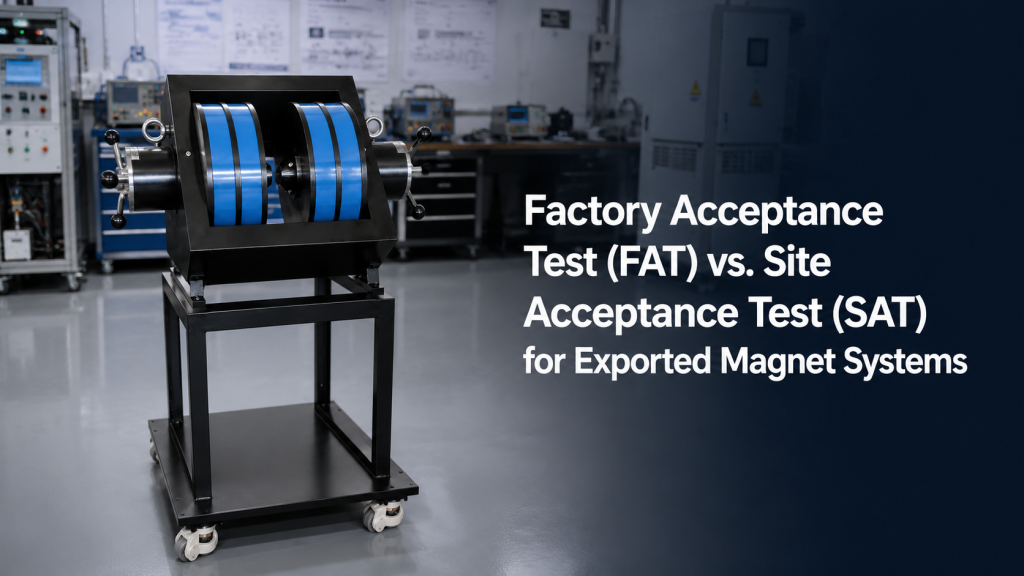
For exported magnet systems, acceptance testing should not be treated as an afterthought.
When an electromagnet, Helmholtz coil system, three-axis field system, or large custom magnetic field platform is shipped internationally, both the supplier and buyer need a clear answer to one question:
“Where and how do we confirm that the system meets the agreed requirements?”
This is where Factory Acceptance Test (FAT) and Site Acceptance Test (SAT) become important.
FAT checks the system before shipment at the supplier’s facility.
SAT checks the system after delivery and installation at the buyer’s site.
Both are useful, but they do not test the same things. For exported magnet systems, misunderstanding this difference can lead to disputes, delays, and unclear responsibility after delivery.
1. What Is a Factory Acceptance Test?
A Factory Acceptance Test, or FAT, is performed before shipment, usually at the manufacturer’s or supplier’s facility.
The purpose is to verify that the magnet system has been built according to the agreed technical scope and can pass defined tests under factory conditions.
TÜV Rheinland describes factory acceptance testing as verification that technical and quality requirements have been met before a component leaves the factory.
Reference link: https://www.tuv.com/world/en/factory-acceptance-test.html
For Magnet Systems, FAT May Include
- Visual inspection
- Mechanical dimension check
- Coil resistance measurement
- Insulation test
- Power supply operation test
- Maximum current test
- Magnetic field output test
- Field-current relationship
- Basic uniformity check
- Cooling function check
- Temperature rise test
- Software communication test
- Safety interlock check
- Cable and connector inspection
- Packing list verification
- Factory photos or video record
- FAT report
FAT is especially valuable for exported magnet systems because it reduces the risk of discovering major problems only after international shipping.
2. What Is a Site Acceptance Test?
A Site Acceptance Test, or SAT, is performed after the system arrives at the buyer’s site and is installed in the real operating environment.
The purpose is to confirm that the delivered system is installed correctly, works with the buyer’s infrastructure, and is ready for practical use.
Operations1 defines SAT as a process in which a machine or plant is tested and accepted at the customer’s site, confirming that the system has been properly installed, configured, and is ready for operation.
Reference link: https://operations1.com/en/glossary/site-acceptance-test
For Magnet Systems, SAT May Include
- Unpacking inspection
- Shipping damage check
- Installation verification
- Power connection check
- Cooling connection check
- Grounding and safety review
- System startup
- Basic field output verification
- Software communication check
- Integration with local equipment
- Fixture or sample access check
- Environmental magnetic background check
- Operator training
- SAT report
SAT is important because some performance issues only appear in the real installation environment.
3. FAT and SAT Are Not the Same Test
FAT and SAT are related, but they serve different purposes.
FAT Answers
- Was the system built correctly before shipment?
- Does it meet the agreed factory test scope?
- Are the main components working?
- Does the magnet produce the expected field under factory conditions?
- Are the documents and accessories ready for delivery?
- Is the system safe to ship?
SAT Answers
- Did the system arrive without damage?
- Is it installed correctly?
- Does it work with local power, cooling, software, and lab infrastructure?
- Is the test environment suitable?
- Can the buyer operate it in the intended application?
- Are there site-related issues that affect performance?
A FAT cannot fully replace a SAT.
A SAT cannot fix an unclear FAT.
For exported systems, both should be defined before the order is confirmed.
4. Why Exported Magnet Systems Need Clear Acceptance Boundaries
International delivery creates extra risk.
Exported magnet systems may involve:
- Long-distance shipping
- Wooden crate packing
- Customs clearance
- Handling by freight forwarders
- Site installation by the buyer
- Local power standards
- Cooling water differences
- Environmental magnetic interference
- Existing lab equipment integration
- Remote technical support
If acceptance criteria are unclear, both sides may disagree later.
For example:
- Is a field deviation caused by the coil, the local environment, or nearby steel structures?
- Is a software issue caused by the system, computer settings, or local network restrictions?
- Is cooling performance limited by the chiller, water flow, or room temperature?
- Is a damaged connector a factory issue or shipping issue?
- Is a field uniformity problem caused by wrong sample position?
These questions are much easier to handle when FAT and SAT scopes are written clearly.
5. What FAT Can Confirm for an Electromagnet
For an exported electromagnet system, FAT can usually confirm the core factory-level performance.
Typical FAT Items for Electromagnets
- Pole gap measurement
- Pole face inspection
- Yoke and frame inspection
- Coil resistance
- Insulation resistance
- Power supply operation
- Maximum current test
- Magnetic field at specified gap
- Field-current relationship
- Cooling function
- Temperature rise under defined conditions
- Polarity and field direction
- Basic safety protection
- Cables and connectors
- User manual and wiring notes
What FAT Cannot Fully Confirm
FAT usually cannot fully confirm:
- Buyer’s site cooling quality
- Buyer’s local power stability
- Final installation vibration
- Magnetic interference from nearby equipment
- Integration with third-party instruments
- Site-specific safety compliance
- Long-term operation under buyer’s exact workflow
That is why SAT remains useful.
6. What FAT Can Confirm for a Helmholtz Coil System
For Helmholtz coil systems, FAT focuses on coil geometry, electrical performance, and field output.
Typical FAT Items for Helmholtz Coils
- Coil dimensions
- Axis alignment inspection
- Coil resistance
- Inductance, if required
- Current driver test
- Field-current relationship
- Center field output
- Basic uniformity verification
- Three-axis polarity check
- Driver communication
- Software control
- Cable labeling
- Mechanical frame inspection
- Packing and accessory check
A Helmholtz coil is commonly used to produce a region of nearly uniform magnetic field near the center, so geometry and test volume should be clearly defined when evaluating field performance.
Reference link: https://en.wikipedia.org/wiki/Helmholtz_coil
What FAT Should State Clearly
For Helmholtz coil FAT, the report should clarify:
- Field range
- Current used during test
- Test position
- Probe position
- Uniform region, if measured
- Axis tested
- Driver used
- Ambient conditions
- Whether values are measured or calculated
Without this information, the FAT result may be hard to interpret.
7. What SAT Can Reveal After Installation
SAT often reveals issues that FAT cannot see.
Site-Related Issues
Examples include:
- Nearby steel structures
- Magnetic lab benches
- Elevator motors or building infrastructure
- Local magnetic noise
- Incorrect grounding
- Insufficient cooling water flow
- Power supply input mismatch
- Cable routing problems
- Software permission restrictions
- Space limitations
- Installation alignment issues
- Fixture or sample positioning errors
For magnetic calibration and low-field testing, the site environment can strongly affect results.
A system may pass FAT but still need careful site setup before reaching reliable measurement performance.
8. FAT Should Be Based on the Quotation Scope
FAT must match what was actually ordered.
If the order includes only a coil, FAT should not be judged like a complete turnkey system test.
If the order includes coil, power supply, cooling, fixture, software, and test report, then the FAT can cover more system-level functions.
Scope Examples
Coil-only FAT may include:
- Dimensions
- Resistance
- Insulation
- Basic field constant
Coil plus driver FAT may include:
- Current output
- Field-current relationship
- Polarity
- driver communication
Turnkey system FAT may include:
- Coil
- driver
- software
- fixture
- cooling
- safety functions
- factory operation sequence
- test report
Buyers should not assume the highest acceptance scope unless it is written in the quotation or technical agreement.
9. SAT Should Be Based on Site Conditions
SAT depends heavily on the buyer’s site readiness.
Before SAT, the buyer should prepare:
- Correct power supply input
- Cooling water or chiller
- Installation space
- Stable table or floor
- Proper grounding
- Computer or software access
- Field probe, if required
- Non-magnetic fixtures
- Clear cable routing
- Operator availability
- Safety access
- Local lifting or unpacking support
A SAT cannot succeed if the site is not ready.
For exported systems, this is especially important because the supplier may not be physically present and remote support may be used.
10. FAT Documentation: What Buyers Should Request
A good FAT report does not need to be unnecessarily long, but it should be clear and useful.
Useful FAT Documents
- FAT checklist
- System configuration list
- Serial numbers
- Visual inspection photos
- Coil resistance results
- Insulation test results
- Field test results
- Field-current curve
- Uniformity data, if included
- Temperature rise result, if included
- Software test screenshots
- Packing list
- Deviation notes
- Operation manual
- Video record, if needed
For formal procurement projects, written documentation is not just administrative work. It helps both sides confirm what was tested before shipment.
NIST’s Quality System for Measurement Services is based on ISO/IEC 17025 and other measurement-service requirements, which reflects the importance of documented procedures, quality systems, and measurement confidence in technical work.
Reference link: https://www.nist.gov/nist-quality-system
11. SAT Documentation: What Buyers Should Prepare
SAT documentation should focus on installation and site readiness.
Useful SAT Documents
- Unpacking inspection record
- Shipping damage photos, if any
- Installation checklist
- Power connection confirmation
- Cooling connection confirmation
- Grounding check
- Startup record
- Basic field verification
- Software communication confirmation
- Site issue notes
- Operator training record
- SAT acceptance form
SAT documentation is especially useful when several parties are involved:
- End user
- Procurement department
- Supplier
- freight forwarder
- installation team
- university facility team
- company safety team
Without documentation, responsibility becomes unclear.
12. Common Mistake: Expecting FAT to Prove Site Performance
FAT is performed under factory conditions.
It cannot fully prove performance under the buyer’s site conditions.
For example, FAT may show:
- Correct coil resistance
- Correct maximum field
- Good power supply operation
- Normal software communication
- Acceptable temperature rise in factory conditions
But after installation, the buyer may still see:
- Magnetic interference from the building
- poor cooling flow
- unstable local power
- software restrictions
- fixture misalignment
- temperature differences
- cable routing issues
These are not necessarily factory defects.
They may be site-related issues that SAT is designed to identify.
13. Common Mistake: Leaving SAT Undefined
Some buyers request SAT but do not define what it means.
This creates risk.
A meaningful SAT should state:
- Who performs the test
- Whether supplier presence is required
- Whether remote support is acceptable
- What site conditions must be ready
- What performance will be checked
- What instruments will be used
- What acceptance criteria apply
- How deviations will be recorded
- What happens if site conditions are not ready
For exported systems, on-site SAT by supplier engineers may involve extra cost, visa requirements, travel schedule, and local safety rules.
If remote SAT support is acceptable, that should also be stated early.
14. Remote FAT and Remote SAT for Exported Systems
For many exported magnet systems, remote acceptance support is practical.
Remote FAT May Include
- Photos
- Test videos
- live video call
- FAT checklist
- test data file
- software demonstration
- packing inspection
Remote SAT May Include
- Video-guided unpacking
- installation review
- wiring confirmation
- remote software setup
- startup guidance
- field verification support
- troubleshooting
Remote acceptance does not replace all formal on-site procedures, but it can reduce risk and speed up communication.
For many university and laboratory systems, remote support is often a practical compromise.
15. Practical FAT Checklist for Exported Magnet Systems
Buyers can use the following FAT checklist as a starting point.
General Inspection
- System model and configuration verified
- Serial numbers recorded
- Visual inspection completed
- Accessories checked
- Labels checked
- Packing list reviewed
Electrical Test
- Coil resistance measured
- Insulation checked
- Cable connection verified
- Power supply output checked
- Polarity confirmed
- Protection functions checked
Magnetic Test
- Field range tested
- Field-current relationship recorded
- Field direction confirmed
- Uniformity checked, if included
- Three-axis function checked, if applicable
Thermal and Cooling Test
- Cooling function checked
- Water flow checked, if applicable
- Temperature rise tested, if included
- Fan or chiller operation confirmed
Control and Software
- Manual control checked
- PC control checked
- Communication interface verified
- Basic software functions tested
- Data logging tested, if included
Documentation
- FAT report prepared
- Manual prepared
- Wiring guide included
- Packing photos recorded
- Deviation list included, if needed
16. Practical SAT Checklist for Exported Magnet Systems
SAT should focus on delivery condition, installation, and site readiness.
Delivery and Unpacking
- Crate condition checked
- Shipping damage inspected
- Accessories confirmed
- Photos recorded before and after unpacking
Installation
- System positioned correctly
- Power connected correctly
- Cooling connected correctly
- Grounding checked
- Cable routing checked
- Mechanical access confirmed
Startup
- Power-on check completed
- Cooling started, if required
- Driver communication confirmed
- Software launched
- Emergency stop or protection checked, if included
Basic Performance
- Low-current test performed
- Field direction confirmed
- Field output checked at defined point
- Three-axis operation checked, if applicable
- Fixture or sample access verified
Training and Handover
- Operator guidance completed
- Documentation reviewed
- Basic maintenance explained
- Site issues recorded
- SAT acceptance form signed
17. How Cryomagtech Supports FAT and SAT for Exported Magnet Systems
Cryomagtech supplies electromagnets, Helmholtz coil systems, three-axis magnetic field systems, magnetic field drivers, and related accessories for research, calibration, and industrial testing applications.
For exported magnet systems, we can support:
- Factory inspection
- Coil resistance and insulation checks
- Field-current relationship testing
- Basic magnetic field verification
- Power supply and driver testing
- Software communication checks
- Packing inspection
- FAT documentation
- Remote installation guidance
- SAT checklist support
- Operation documentation
👉 Product link placeholder: Cryomagtech Electromagnet and Helmholtz Coil Systems for Export Projects
For formal procurement projects, FAT and SAT should be discussed before order confirmation, not after shipment.
Clear acceptance boundaries protect both sides and help the system enter use faster.
References
- TÜV Rheinland – Factory Acceptance Test
https://www.tuv.com/world/en/factory-acceptance-test.html - Operations1 – Site Acceptance Test Definition and Process
https://operations1.com/en/glossary/site-acceptance-test - NIST – Quality System for Measurement Services
https://www.nist.gov/nist-quality-system - Wikipedia – Helmholtz Coil
https://en.wikipedia.org/wiki/Helmholtz_coil
Key Takeaways
- FAT verifies the magnet system before shipment under factory conditions.
- SAT verifies the system after installation under the buyer’s site conditions.
- FAT and SAT should not be treated as the same test.
- For exported magnet systems, clear acceptance boundaries reduce disputes and delivery risk.
- FAT should match the quotation scope; SAT should match site readiness and installation conditions.
- Documentation, photos, videos, checklists, and reports are especially valuable for international projects.
- Remote FAT and SAT support can be practical for many university and laboratory magnet systems.
For exported magnet systems, the right question is not only:
“Does the system work?”
The better question is:
“Where was it tested, under what conditions, against which acceptance criteria, and who is responsible for each stage?”