
In magnetic field experiments, many users focus on the target field value:
“Set the field to 100 mT.”
“Ramp to 1 T.”
“Apply 50 µT along the X-axis.”
“Sweep the field and record data automatically.”
But there is one timing question that can strongly affect data quality:
“How long should you wait before recording data after the field changes?”
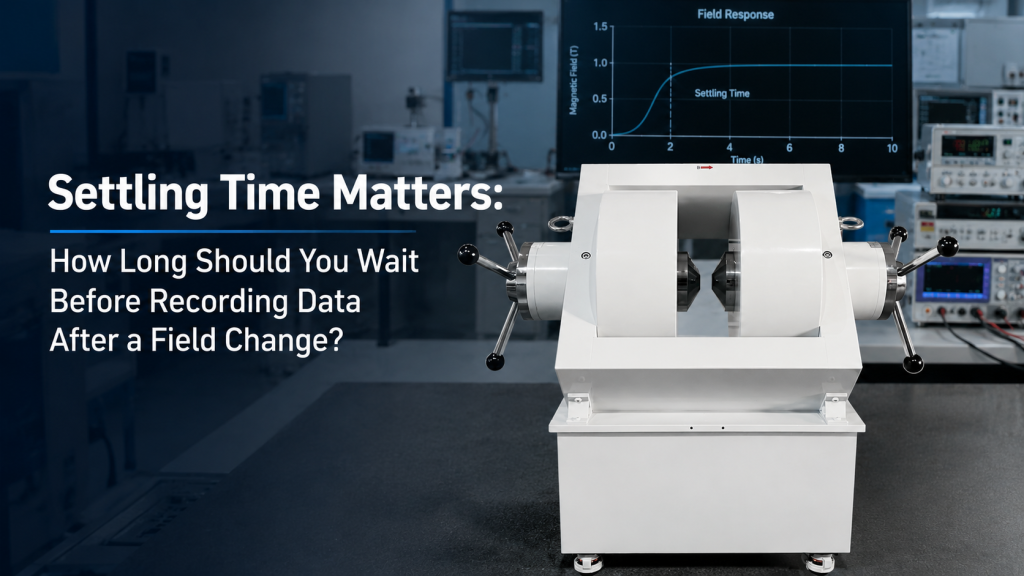
This waiting period is often called settling time.
For electromagnets, Helmholtz coils, precision excitation power supplies, automated field sweeps, and field-dependent measurements, settling time can determine whether your data represents a stable magnetic condition or a transient state.
This article explains why settling time matters, what affects it, and how laboratories can define a practical waiting rule before recording data.
1. What Is Settling Time?
In control and measurement systems, settling time is generally the time required after a change for the output to enter and remain within a defined tolerance band around the final value. In other words, the system is not considered settled just because it has started moving toward the target. It must reach the target region and stay there. (wikipedia.org)
For magnetic field systems, this means that after changing current or field setpoint, the user should wait until the field is stable enough for the measurement purpose.
A practical definition may be:
“Wait until the measured field remains within ±0.1% of the target value for 5 seconds.”
Or:
“Wait 3 seconds after each current step before recording data, based on prior validation.”
The exact rule depends on the system and experiment.
There is no universal settling time for every magnet system.
2. Why Recording Too Early Creates Bad Data
If data is recorded immediately after a field change, the measurement may capture a transient condition instead of the intended stable field.
This can lead to:
- Wrong field-dependent curves
- Poor repeatability
- Apparent hysteresis that is partly procedural
- Noisy calibration results
- Drift between upward and downward sweeps
- Incorrect sensor response
- Unstable Hall or magnetoresistance data
- Misleading acceptance results
The problem may not be the magnet, sensor, or sample.
The problem may be that the measurement software recorded data before the magnetic field, current, thermal state, or sensor output had settled.
This is why settling time is not only an equipment specification.
It is part of the measurement method.
3. Magnetic Field Does Not Always Change Instantly
A coil system has electrical and magnetic dynamics.
When current changes through a coil, several effects may appear:
- Power supply response time
- Coil inductance
- Voltage compliance limit
- Current regulation loop behavior
- Cable inductance and resistance
- Eddy currents in nearby conductive structures
- Magnetic core hysteresis
- Sensor response time
- Software communication delay
- Thermal drift
For simple DC field steps, the current may settle quickly.
For large electromagnets, inductive loads, AC field systems, or metal-rich environments, the response may take longer.
Systems with energy storage cannot respond instantaneously and show transient responses after input changes. This is a basic control-system concept behind settling behavior. (wikipedia.org)
4. Power Supply Response Is Only One Part of the Story
Some users ask:
“What is the settling time of the power supply?”
That is useful, but incomplete.
The measured field settling time depends on the whole system:
- Power supply
- Coil or magnet
- Cables
- Cooling condition
- Sensor
- Measurement software
- Nearby metal structures
- Sample environment
A power supply may regulate current quickly at its output terminals, while the magnetic field at the sample region settles more slowly due to coil inductance, eddy currents, magnetic materials, or sensor filtering.
The correct question is not only:
“How fast is the power supply?”
The better question is:
“How long does the measured magnetic field at the sample position take to become stable enough for this experiment?”
5. Coil Inductance and Current Ramp Behavior
Coils are inductive loads.
Inductance resists rapid changes in current. The larger the inductance and the larger the current step, the more voltage may be needed to change current quickly.
For coil systems, settling behavior depends on:
- Coil inductance
- Coil resistance
- Current step size
- Power supply voltage compliance
- Current control loop
- Cable length
- Ramp rate limit
- Protection settings
A small Helmholtz coil may settle very quickly at low current.
A large electromagnet may need a controlled ramp and additional waiting time after reaching the setpoint.
If the power supply does not have enough voltage compliance, current may rise slowly, especially during large steps or fast ramps.
6. Eddy Currents Can Delay Field Stabilization
Nearby conductive materials can produce eddy currents when the magnetic field changes.
Eddy currents are induced loops of current inside conductors caused by changing magnetic fields. These induced currents create their own magnetic fields that oppose the original field change. (wikipedia.org)
This matters when the coil system is near:
- Aluminum plates
- Copper structures
- Metal chambers
- Vacuum chambers
- Optical tables
- Steel frames
- Sensor housings
- Metallic fixtures
- Shielded enclosures
Even if the coil current reaches its target quickly, eddy currents in nearby metal may cause the actual field at the sample to settle more slowly.
This is especially important for:
- Fast field sweeps
- AC magnetic fields
- Low-field calibration
- Magnetometer testing
- Coil systems inside metal chambers
- Magnetic shielding environments
If the environment changes, the settling time may change too.
7. Magnetic Hysteresis Can Affect Repeatability
Electromagnets with magnetic cores can show hysteresis.
This means the field at a given current may depend on previous magnetization history.
For example, approaching 200 mT from below may not produce exactly the same result as approaching 200 mT from above.
This can affect:
- Field-current curves
- Up-sweep and down-sweep comparison
- Zero-field conditions
- Residual magnetism
- Low-field measurements
- Repeatability after large field changes
Settling time does not fully remove hysteresis, but a consistent measurement protocol helps reduce confusion.
For example, always approaching measurement points from the same direction may produce more repeatable data than alternating randomly between high and low fields.
8. Thermal Settling Is Slower Than Electrical Settling
Electrical current may settle in seconds.
Temperature may settle in minutes.
This distinction is critical.
After a current change, the coil may begin heating. As temperature changes, coil resistance changes. This may affect voltage demand, thermal drift, and sometimes field stability depending on system design.
Thermal settling matters for:
- Long-duration measurements
- High-current operation
- Water-cooled electromagnets
- Air-cooled Helmholtz coils
- Continuous field sweeps
- Precision field stability tests
- Acceptance testing
A system may be electrically stable but thermally drifting.
For experiments that require high field stability over time, thermal behavior should be monitored, not ignored.
9. Sensor and Instrument Response Time Also Matters
The magnetic field may be stable, but the sensor or measurement instrument may still be responding.
This applies to:
- Gaussmeters
- Hall probes
- Fluxgate magnetometers
- Lock-in amplifiers
- DAQ systems
- Temperature sensors
- Hall measurement electronics
- Magnetoresistance measurement systems
- MOKE detectors
- Software filters and averaging functions
Some instruments use internal filtering or averaging.
This can improve noise performance but increase response time.
If the measurement instrument averages over one second, five seconds, or longer, your data logging delay should account for that.
Otherwise, the recorded value may be a mix of old and new conditions.
10. Settling Time Depends on the Required Tolerance
There is no single correct answer to “how long should we wait?”
The right settling time depends on how stable the field must be.
For example:
- Educational demonstration: a short delay may be enough
- Sensor function test: moderate delay may be acceptable
- Hall measurement: stable current and field are more important
- Magnetometer calibration: field must remain within a defined tolerance
- Precision material measurement: longer stabilization may be needed
- Thermal acceptance test: waiting time may be much longer
A ±5% tolerance may settle quickly.
A ±0.1% tolerance may require more time.
A ppm-level stability target may require careful warm-up, monitoring, and controlled environment.
Settling time should always be tied to a tolerance band.
Without a tolerance band, “settled” is just a feeling.
11. Practical Waiting Rules for Different Applications
The following are practical starting points, not universal guarantees.
Simple DC Helmholtz Coil Test
For small field steps and low thermal load, a short fixed delay may be enough after validation.
Possible rule:
“Wait 1–3 seconds after each field change before recording data.”
Larger Electromagnet
For higher current, magnetic core effects, and larger inductance, longer waiting may be needed.
Possible rule:
“Wait until current and measured field remain within the defined tolerance for 5–30 seconds.”
Magnetometer Calibration
For low-field vector calibration, eddy currents, background field, and sensor averaging matter.
Possible rule:
“Wait until the reference magnetometer reading is stable within the required tolerance before logging each point.”
Long-Duration Material Measurement
For Hall, magnetoresistance, MOKE, or temperature-sensitive measurements, thermal drift may dominate.
Possible rule:
“Use field stability plus sample signal stability as the trigger, not only a fixed time delay.”
Automated Field Sweep
For automated measurements, the software should include delay, stability check, or both.
Possible rule:
“Change field → wait fixed minimum delay → check stability → record data only after stability condition is met.”
The best systems do not rely only on blind delay.
They use a validated delay or stability-based trigger.
12. Fixed Delay vs. Stability-Based Trigger
There are two common approaches.
Fixed Delay
The software waits a preset time after each field change.
Advantages:
- Simple
- Easy to program
- Good for repeatable systems
- Suitable after validation
Limitations:
- May be too short for large steps
- May waste time for small steps
- Does not detect unexpected instability
- May fail if environment changes
Stability-Based Trigger
The software records data only after current, field, or signal stability meets a rule.
Advantages:
- More reliable
- Adapts to different step sizes
- Better for precision measurement
- Can detect abnormal behavior
Limitations:
- Requires reference measurement
- More complex software logic
- Needs a defined tolerance
- May be slower
For high-quality data, a combined method is often best:
Minimum delay + stability check.
13. How to Define a Good Settling Criterion
A useful settling criterion should include:
- Controlled parameter
- Measurement point
- Tolerance band
- Required duration
- Sampling rate
- Maximum wait time
- Failure action
Example:
“After each field step, wait at least 3 seconds. Then record data only when the measured field at the sample position remains within ±0.05% of the target for 10 consecutive seconds. If this condition is not met within 60 seconds, flag the point.”
This is much better than:
“Wait until stable.”
A clear rule improves repeatability and makes data easier to compare between runs, users, and laboratories.
14. Why Settling Time Should Be Included in Test Reports
A magnet test report should state the waiting or settling method used before recording data.
For example:
- Current setpoint
- Ramp rate
- Waiting time after setpoint
- Stability criterion
- Field probe position
- Measurement interval
- Averaging method
- Temperature condition
- Whether data was taken during up-sweep or down-sweep
NIST describes measurement uncertainty as a parameter associated with a measurement result that characterizes the dispersion of values reasonably attributed to the measured quantity. Stability and timing conditions can contribute to that uncertainty if they are not controlled. (nist.gov)
For magnet systems, a field value without settling conditions may be incomplete.
15. Common Mistakes in Field-Dependent Measurements
Common mistakes include:
- Recording data immediately after setpoint change
- Using the same delay for small and large field steps
- Ignoring coil inductance
- Ignoring eddy currents in metal structures
- Ignoring thermal drift
- Not checking actual measured field
- Assuming current stability equals field stability
- Using heavy software averaging without accounting for delay
- Mixing up-sweep and down-sweep data without protocol
- Comparing suppliers’ test data without knowing waiting rules
These mistakes can make a good system look bad or make bad data look real.
The field value is not the only condition.
The timing of measurement matters.
16. What to Ask Before Building an Automated Measurement Sequence
Before writing automated measurement software, ask:
- What field values are needed?
- What step size will be used?
- What ramp rate is allowed?
- What is the maximum current change per step?
- Is the system air-cooled or water-cooled?
- Is the field measured directly or inferred from current?
- What tolerance defines “settled”?
- How long must the field stay within tolerance?
- Is thermal drift important?
- Is the sample response delayed?
- Are data taken on up-sweep, down-sweep, or both?
- Should the software use fixed delay, stability trigger, or both?
- What happens if the system fails to settle?
This turns settling time from guesswork into a measurement rule.
17. How Cryomagtech Supports Stable Field Measurement Workflows
Cryomagtech supplies electromagnets, Helmholtz coil systems, excitation power supplies, and magnetic field systems for research and industrial laboratories.
For projects involving automated measurements, field sweeps, sensor calibration, or field-dependent material testing, we can help customers evaluate:
- Magnet or coil response behavior
- Suitable excitation power supply
- Current ramping method
- Field stability requirements
- Waiting time and settling strategy
- Field mapping and test report scope
- Power supply communication and automation needs
- Remote installation and training support
Our goal is not only to provide hardware that reaches a field value.
Our goal is to help customers generate magnetic fields that can be used reliably in real measurement workflows.
In many experiments, the difference between noisy data and clean data is not only the magnet.
It is the timing rule used before recording each point.
References
- Wikipedia – Settling Time
Settling time is the time required for a system output to enter and remain within a specified error band after a change, which is directly relevant to field step and measurement timing.
https://en.wikipedia.org/wiki/Settling_time - Wikipedia – Eddy Current
Eddy currents are induced in conductors by changing magnetic fields and can create opposing magnetic fields, which may delay magnetic field stabilization in metal-rich environments.
https://en.wikipedia.org/wiki/Eddy_current - NIST – Measurement Uncertainty
NIST defines measurement uncertainty as a parameter associated with a measurement result, reminding users that timing, stability, and measurement conditions affect how confidently results can be interpreted.
https://www.nist.gov/itl/sed/topic-areas/measurement-uncertainty
Key Takeaways
- Settling time is the waiting period after a field change before data should be recorded.
- The correct waiting time depends on tolerance, coil inductance, power supply response, eddy currents, thermal drift, sensor response, and software averaging.
- Current stability does not always guarantee magnetic field stability at the sample position.
- A fixed delay is simple, but a stability-based trigger is often better for precision work.
- Thermal settling may be much slower than electrical settling.
- Test reports should state ramp rate, waiting time, stability criterion, and measurement method.
- Automated measurement workflows should define when a data point is allowed to be recorded.
Do not ask only whether the magnet can reach the field.
Ask whether the field has settled enough for the data you are about to record.