
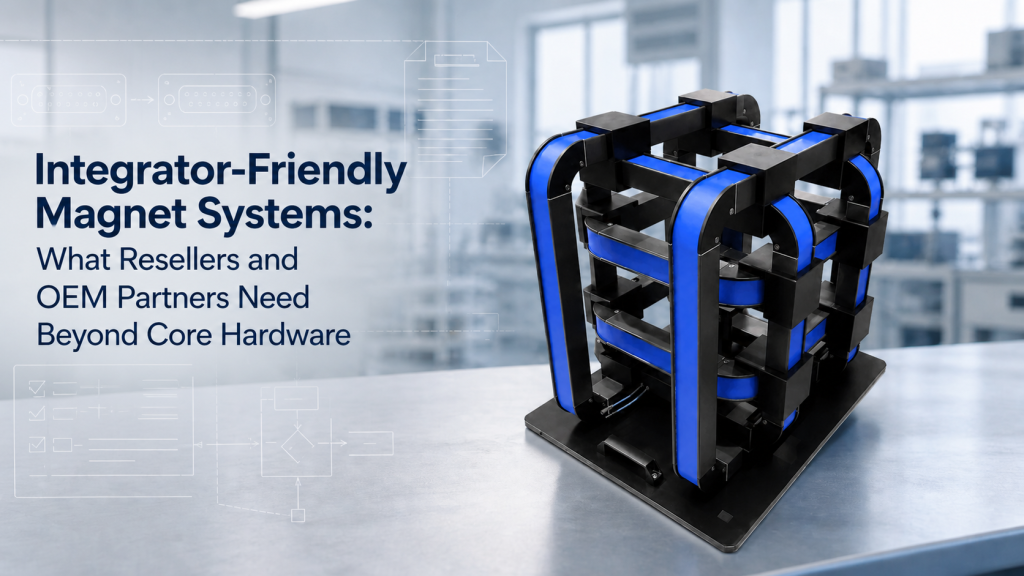
For resellers, system integrators, and OEM partners, selecting a magnet system is not just about specifications.
It is about one critical question:
👉 “How easily can this system be integrated into a larger solution?”
While core parameters such as:
- Field strength
- Uniformity
- Volume
are important, they are not sufficient.
What matters just as much is:
👉 integration readiness
This includes interfaces, documentation, control logic, and clearly defined system boundaries.
1. Why Core Hardware Is Not Enough
A magnet system rarely operates alone.
It is typically part of a larger setup:
- Automated test platforms
- Measurement systems
- Production or calibration lines
In these environments, even a well-performing magnet can fail integration if:
- Interfaces are unclear
- Control is incompatible
- Documentation is incomplete
👉 Performance without integration is not usable performance
2. Electrical Interfaces: Defined, Stable, and Predictable
Integrators require clear electrical interfaces.
Key Requirements
- Defined input/output specifications
- Stable connectors and pinouts
- Clear grounding strategy
Common Issues
- Undocumented signal levels
- Inconsistent wiring
- Grounding conflicts
According to IEEE practices, interface definition is essential for reliable system integration.
👉 Undefined interfaces create integration risk
3. Control Logic and Communication Protocols
Modern systems rely on software integration.
Essential Features
- Standard communication protocols (USB, Ethernet, RS232/485)
- Command structure documentation
- Remote control capability
Integrator Needs
- Deterministic behavior
- Repeatable commands
- Easy automation
👉 Without clear control logic, automation becomes unreliable
4. Documentation: The Real Integration Enabler
For integrators, documentation is not optional.
It is the foundation of system usability.
Required Documentation
- Electrical schematics
- Communication protocols
- API or command reference
- Mechanical drawings
- Safety and operational guidelines
According to Wikipedia:
https://en.wikipedia.org/wiki/Systems_integration
System integration depends on well-defined interfaces and documentation.
👉 Poor documentation delays integration more than poor hardware
5. Mechanical Integration and Mounting Interfaces
Physical integration is often underestimated.
Key Considerations
- Mounting points and tolerances
- Alignment references
- Accessibility for installation
Challenges
- Mismatch with system layout
- Difficult alignment
- Limited access for maintenance
👉 Mechanical compatibility is as critical as electrical compatibility
6. System Boundaries: What Is Included—and What Is Not
Integrators need clarity on:
- Scope of supply
- Responsibilities
- Integration boundaries
Examples
- Who handles cooling integration?
- Who manages grounding?
- What is pre-configured vs user-defined?
👉 Undefined boundaries lead to delays and disputes
7. Reliability and Predictability
For OEM and integrator projects:
- Consistency matters more than flexibility
- Predictability matters more than peak performance
Requirements
- Stable long-term operation
- Low failure rate
- Minimal maintenance interruption
👉 Integrators value systems that behave consistently under defined conditions
8. Pre-Integration Testing and Validation
Before deployment, integrators need:
- Verified system behavior
- Defined test procedures
- Known performance limits
Important Elements
- FAT (Factory Acceptance Test) results
- Integration test guidelines
- Expected performance envelopes
👉 Systems should be validated before entering larger platforms
9. Scalability and Repeatability
OEM partners often require:
- Multiple identical systems
- Repeatable performance
Key Factors
- Manufacturing consistency
- Calibration repeatability
- Documentation standardization
👉 One successful integration is not enough—repeatability is critical
10. How Cryomagtech Supports Integrator-Friendly Systems
At Cryomagtech, systems are designed with integration in mind—not as standalone products.
We provide:
- Defined electrical and communication interfaces
- Structured documentation packages
- Clear system boundaries
- Support for integration and commissioning
👉 Product link placeholder: Cryomagtech Integrator-Ready Magnet System Solutions
Our goal is to ensure that:
- Systems integrate smoothly
- Performance is predictable
- Deployment risk is minimized
References
- IEEE – System interface and integration practices
https://ieeexplore.ieee.org/ - Wikipedia – Systems Integration
https://en.wikipedia.org/wiki/Systems_integration
Key Takeaways
- Integrators require more than core hardware performance
- Clear electrical and communication interfaces are essential
- Documentation is critical for integration success
- Mechanical compatibility affects installation
- Defined system boundaries prevent project delays
- Reliability and repeatability are key for OEM applications
A magnet system is not just a component.
👉 It is part of a larger system—and must be designed accordingly.