
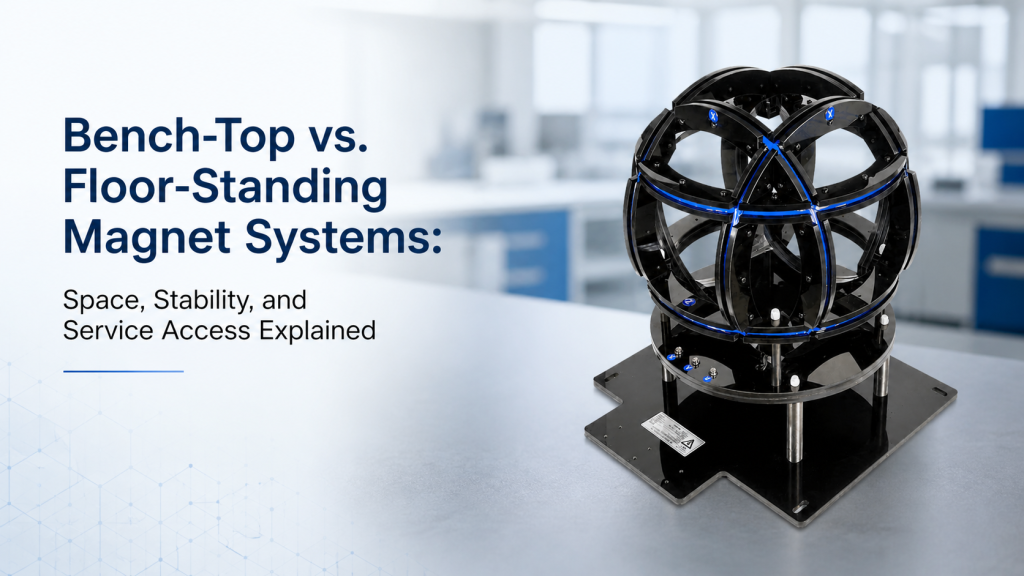
When planning a laboratory setup, one of the earliest practical questions is:
👉 Should the magnet system be bench-top or floor-standing?
At first glance, the difference seems purely mechanical.
But in reality, this decision affects:
- Space utilization
- Mechanical stability
- Cooling and infrastructure
- Maintenance accessibility
Choosing the wrong configuration can lead to:
- Installation constraints
- Reduced performance
- Difficult servicing
This article explains how to select the right system type based on real laboratory needs.
1. What Is a Bench-Top Magnet System
A bench-top system is designed to:
- Sit on a laboratory table or optical bench
- Be compact and relatively lightweight
Typical Characteristics
- Small to medium field range
- Limited working volume
- Integrated or simplified cooling
Common Applications
- Sensor calibration
- Small sample testing
- Educational and general lab use
👉 Bench-top systems prioritize compactness and convenience
2. What Is a Floor-Standing Magnet System
A floor-standing system is:
- Installed directly on the floor
- Built for larger size and higher performance
Typical Characteristics
- Higher field capability
- Larger working volume
- Dedicated support structure
Common Applications
- Large sample experiments
- High-field electromagnets
- Multi-axis Helmholtz systems
👉 Floor-standing systems prioritize performance and scalability
3. Space Considerations: More Than Footprint
Bench-Top Systems
- Require less floor space
- Use existing lab benches
- Easier to relocate
Floor-Standing Systems
- Require dedicated space
- May need reinforced flooring
- Often involve clearance zones
👉 Important insight:
Space planning must consider:
- Access paths
- Operator movement
- Integration with other equipment
4. Mechanical Stability and Vibration
Stability directly affects measurement quality.
Bench-Top Systems
- Dependent on table stability
- Sensitive to vibration
- May be affected by nearby equipment
Floor-Standing Systems
- Rigid structures
- Better load distribution
- Higher mechanical stability
According to IEEE practices, mechanical stability is critical for precision measurement systems.
👉 For high-precision experiments, stability often outweighs convenience
5. Cooling and Infrastructure Requirements
Bench-Top Systems
- Often air-cooled or low-power
- Minimal infrastructure
Floor-Standing Systems
- Frequently require water cooling
- External chillers and plumbing
- Higher power supply demands
👉 Infrastructure can determine feasibility before performance does
6. Service Access and Maintenance
This is often overlooked—but critical.
Bench-Top Systems
- Easy access from all sides
- Faster maintenance
- Minimal disassembly required
Floor-Standing Systems
- May require clearance for servicing
- Heavier components
- More complex access points
👉 Poor service access leads to longer downtime
7. Installation and Logistics
Bench-Top Systems
- Easier to ship and install
- Minimal on-site assembly
Floor-Standing Systems
- Often modular
- Require reassembly and alignment
- May need installation support
👉 Larger systems introduce logistical complexity
8. Performance vs Practicality Trade-Off
Bench-Top Systems
- Limited performance
- High usability
Floor-Standing Systems
- High performance
- Lower flexibility
👉 The decision is not about size—it is about matching capability to constraints
9. When to Choose Each Type
Choose Bench-Top If You Need
- Compact setup
- Moderate field requirements
- Flexible lab usage
Choose Floor-Standing If You Need
- High field strength
- Large uniform volume
- Maximum stability
Mixed Considerations
Some projects require:
- Bench-top coils with external power systems
- Modular floor-standing systems with partial portability
10. How Cryomagtech Supports System Configuration
At Cryomagtech, system type is selected based on application and lab conditions.
We evaluate:
- Available space and layout
- Required field performance
- Cooling and infrastructure
- Maintenance accessibility
👉 Product link placeholder: Cryomagtech Bench-Top and Floor-Standing Magnet Systems
Our goal is to ensure that:
- The system fits the lab
- The performance meets requirements
- Operation and maintenance remain practical
References
- IEEE – Mechanical stability in measurement systems
https://ieeexplore.ieee.org/ - Wikipedia – Magnetic field
https://en.wikipedia.org/wiki/Magnetic_field
Key Takeaways
- Bench-top systems prioritize compactness and usability
- Floor-standing systems provide higher performance and stability
- Space planning must include access and integration
- Mechanical stability affects measurement accuracy
- Cooling and infrastructure influence system choice
- Service access impacts long-term usability
Choosing between bench-top and floor-standing systems is not just about size.
👉 It is about how the system fits into your laboratory environment.