
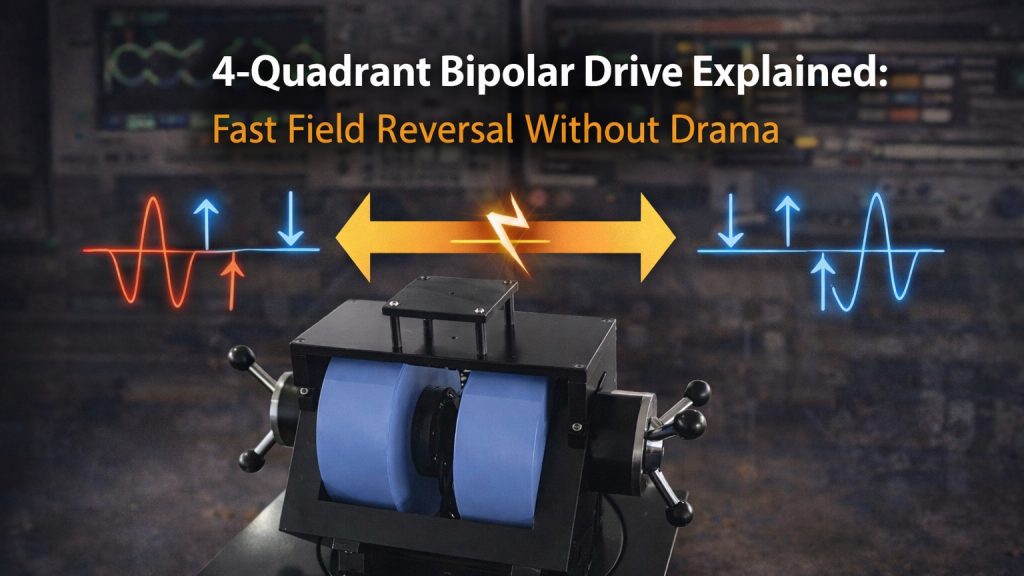
For many magnetic field experiments, generating a field is not the challenge.
Reversing it—cleanly, quickly, and repeatedly—is.
If you are working on:
- Magnetic hysteresis loops
- Magnetoresistance (MR) measurements
- Lock-in detection experiments
then you already know:
👉 Field reversal is where systems either perform… or fall apart.
This is where 4-quadrant bipolar drive becomes essential.
1. What Is a 4-Quadrant Bipolar Drive
A 4-quadrant power supply can:
- Source current (positive direction)
- Sink current (negative direction)
- Operate in both voltage polarities
In simple terms:
👉 It allows full control of current in both directions, including energy flow.
According to Wikipedia:
https://en.wikipedia.org/wiki/Four-quadrant_operation
Four-quadrant operation enables systems to both deliver and absorb power, which is critical for controlling inductive loads like electromagnets.
2. Why Field Reversal Is Harder Than It Looks
An electromagnet is not just a load—it is an inductive energy storage system.
When current flows:
- Energy is stored in the magnetic field
When reversing current:
- That energy must be removed, then reapplied in the opposite direction
What Happens in a Simple System
- Current ramps down slowly
- Residual field persists
- Reversal is delayed or distorted
What Happens Without Proper Control
- Overshoot
- Oscillation
- Thermal stress
This is why “just changing polarity” is not a real solution.
3. The Role of Energy Feedback (Regeneration)
In a 4-quadrant system, the power supply does not just stop current.
It actively absorbs energy from the coil.
Key Mechanism
- Stored magnetic energy flows back into the power stage
- Instead of dissipating as heat, it is controlled and reused or safely managed
Why It Matters
- Faster current decay
- Faster field reversal
- Reduced thermal load
This is especially important in:
- High-current Helmholtz coils
- Large inductance electromagnets
4. Control Strategy: The Real Difference Maker
Not all bipolar supplies behave the same.
The difference lies in control strategy.
Critical Factors
- Current loop bandwidth
- Response time
- Stability under inductive load
- Transition behavior around zero crossing
Poorly Tuned System
- Slow reversal
- Ringing near zero
- Measurement noise
Well-Designed System
- Smooth zero-crossing
- Minimal overshoot
- Repeatable waveform
This is where many “spec-compliant” systems fail in real experiments.
5. Why 2-Quadrant or Switching Solutions Fall Short
Some systems try to simulate bipolar behavior using:
- Polarity switching relays
- External H-bridge configurations
- Manual reversal
Limitations
- Dead time during switching
- No energy recovery
- Increased stress on components
- Poor repeatability
Result:
The system technically works, but the data quality suffers.
6. Noise and Measurement Integrity
In MR and lock-in measurements:
- Signal levels are small
- Stability matters more than absolute field
Where Problems Appear
- Near zero crossing
- During fast sweep
- Under dynamic reversal
A poorly designed drive introduces:
- Electrical noise
- Magnetic instability
- Measurement artifacts
This is not a theoretical issue—it directly affects published data quality.
7. Practical Design Considerations
When selecting a 4-quadrant drive for magnet systems, consider:
Electrical
- Maximum current (continuous, not peak)
- Voltage compliance
- Stability (ppm/hour level if required)
Dynamic Performance
- Slew rate (A/s)
- Settling time
- Zero-crossing behavior
System Integration
- Compatibility with coil inductance
- Protection during fast reversal
- Interface with control systems
8. How Cryomagtech Supports Bipolar Magnet Systems
At Cryomagtech, 4-quadrant drive capability is integrated with magnet system design.
We consider:
- Coil inductance and energy storage
- Required reversal speed
- Measurement sensitivity (MR, hysteresis, lock-in)
- Stability under dynamic conditions
👉 Product link placeholder: Cryomagtech Bipolar Magnet Drive Solutions
Instead of treating the power supply and magnet separately,
we design them as a coupled system to ensure:
- Clean field reversal
- Stable measurement conditions
- Reliable long-term operation
References
- Wikipedia – Four-quadrant operation
https://en.wikipedia.org/wiki/Four-quadrant_operation - IEEE – Power electronics and regenerative drive systems
https://ieeexplore.ieee.org/
Key Takeaways
- 4-quadrant drive enables true bipolar current control
- Field reversal requires energy removal, not just polarity change
- Regenerative capability allows faster and cleaner transitions
- Control strategy defines real-world performance
- Poor bipolar implementation leads to noise and instability
- Proper system integration ensures reliable experimental results
If your experiment depends on accurate field reversal,
the drive system is not optional—it is fundamental.