

In iron-core electromagnets, setting current to zero does not guarantee zero magnetic field.
Residual magnetization in the magnetic circuit can produce:
- Field offsets
- Drift in low-field experiments
- Irreproducible hysteresis loops
- Baseline shifts in precision measurements
Demagnetization (de-gaussing) is therefore not optional in many experiments.
This article explains practical de-gaussing procedures, common mistakes, material considerations, and how to verify that the magnet has truly been demagnetized.
1. Why Residual Magnetization Exists
Iron-core electromagnets exhibit hysteresis.
When magnetizing force (H) returns to zero, magnetic flux density (B) does not return to zero.
This remaining field is called remanence.
Background reference:
- Wikipedia – Magnetic hysteresis
https://en.wikipedia.org/wiki/Magnetic_hysteresis
Key terms:
- Coercivity – field required to bring B back to zero
- Remanent magnetization – residual field after excitation
Residual magnetization depends on:
- Core material
- Previous maximum field
- Magnetic history
- Mechanical stress
For low-field experiments (<10 mT), even small remanence can dominate the measurement.
2. Standard Demagnetization Procedure: Decaying Alternating Field
The most widely used method is:
Apply an alternating magnetic field with gradually decreasing amplitude.
Typical steps:
- Apply AC current at moderate frequency (e.g., 0.1–10 Hz for large electromagnets).
- Start with amplitude slightly below previous maximum magnetizing current.
- Gradually reduce amplitude to zero over multiple cycles.
This forces the magnetic domains through progressively smaller hysteresis loops until they collapse toward zero.
Conceptually similar to AC demagnetization in magnetic materials research.
3. Frequency and Sweep Considerations
Choosing the correct parameters matters:
Frequency
- Too high → inductive voltage limits driver
- Too low → inefficient domain randomization
Large-gap electromagnets typically use low-frequency sweeps.
Amplitude Decay Profile
Common strategies:
- Linear amplitude decay
- Exponential decay
- Stepwise reduction
Smooth decay is generally preferred to avoid abrupt domain reorientation.
Demagnetization waveform must respect driver compliance voltage limits:
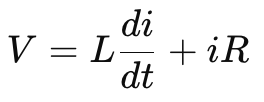
If voltage headroom is insufficient, waveform distortion occurs, reducing effectiveness.
4. Core Material Influence
Magnetic circuit material strongly affects demagnetization behavior.
Low-Carbon Steel
- Moderate coercivity
- Requires proper AC decay
- Common in laboratory electromagnets
Silicon Steel Laminations
- Lower eddy currents
- Better domain response
- More predictable de-gaussing
High-Coercivity Materials
- Harder to demagnetize
- Require higher starting amplitude
Material history and mechanical stress also influence residual field.
Even machining or assembly pressure can change domain alignment.
5. Common Pitfalls in De-Gaussing
1. Starting at Too Low Amplitude
If initial AC amplitude is below prior magnetizing level, domains are not fully cycled.
2. Insufficient Decay Duration
Too few cycles leave partial remanence.
3. Driver Voltage Saturation
Waveform distortion prevents effective domain traversal.
4. Ignoring Thermal Drift
Coil heating during de-gaussing can shift baseline field.
5. Assuming “Zero Current = Zero Field”
This is almost never true in iron-core systems.
6. How to Verify That Demagnetization Worked
Verification is critical.
Field Probe Measurement
Measure field at:
- Center of gap
- Sample plane
Use:
- Hall probe (general verification)
- Fluxgate (low-field precision)
Residual field should be compared to experiment requirement.
Repeated Hysteresis Test
Cycle magnet from small ±field and observe symmetry.
Asymmetry indicates remaining bias.
Long-Term Drift Monitoring
If field drifts after demagnetization, residual domain structure may remain.
Demagnetization is validated by measurement, not assumption.
7. Software-Controlled De-Gaussing Sequences
Modern electromagnet systems benefit from programmable control.
Automated de-gaussing routines can:
- Generate decaying AC waveform
- Respect driver voltage limits
- Log amplitude decay
- Provide repeatable process control
This reduces operator variability and ensures consistency between experiments.
Cryomagtech supports electromagnet systems with control strategies designed for repeatable de-gaussing procedures and low-field operation.
👉 Product Link Placeholder – Electromagnet Systems with Controlled De-Gaussing Capability
In precision magnetic measurements, demagnetization is part of system engineering — not an afterthought.
8. When Is Demagnetization Necessary?
You should perform de-gaussing if:
- Operating at low magnetic fields
- Conducting hysteresis measurements
- Requiring high baseline stability
- Performing publication-grade experiments
- Switching between high and low field regimes
Skipping demagnetization can introduce systematic bias larger than your signal.
9. Key Takeaways
- Residual magnetization persists after current returns to zero
- Decaying AC field is standard de-gaussing method
- Core material influences required procedure
- Driver voltage headroom affects waveform integrity
- Verification must be measurement-based
In precision electromagnet systems,
demagnetization is not a cleanup step.
It is a stability requirement.