
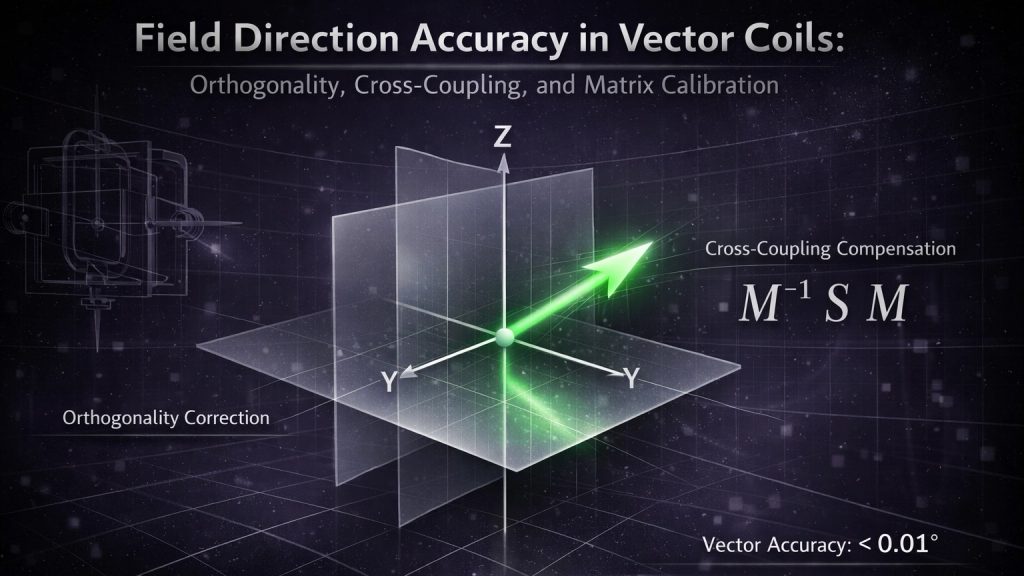
Precise magnetic field direction control is far more difficult than generating magnetic field magnitude.
In 3-axis vector coil systems, field direction accuracy depends on:
- Mechanical orthogonality
- Electromagnetic cross-coupling
- Calibration matrix accuracy
- Software compensation strategy
If these factors are not properly managed, a “10 mT along X” command may actually produce a tilted or distorted field vector.
This article explains how orthogonality errors arise, how coupling matrices are measured, and how modern software compensates them.
1. What Is Field Direction Accuracy?
In a 3-axis vector coil (Helmholtz or cubic configuration), the ideal relationship is:
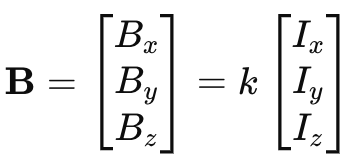
This assumes:
- Perfect 90° mechanical alignment
- No mutual inductance between axes
- Perfect symmetry
In reality, the system behaves as:
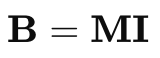
Where M is a 3×3 coupling matrix.
If M is not diagonal, axis cross-coupling exists.
This is the real engineering problem.
2. Orthogonality Errors: Mechanical Reality
Even precision-machined frames cannot guarantee exact 90° alignment.
Sources of non-orthogonality:
- Frame machining tolerances
- Thermal expansion
- Coil deformation under current
- Assembly misalignment
Even a 0.2° misalignment causes measurable directional error in vector field experiments.
Orthogonality is fundamentally a coordinate transformation issue, as described in linear algebra principles referenced by Wikipedia under Orthogonal matrices:
https://en.wikipedia.org/wiki/Orthogonal_matrix
If axes are not perfectly orthogonal, the transformation matrix must compensate.
3. Cross-Coupling: The Invisible Magnetic Interaction
Mutual inductance between coils creates unintended field components.
When current flows in X-axis:
- A small induced field may appear in Y or Z
- Magnetic core material may redirect flux
- Finite coil geometry introduces asymmetry
Cross-coupling becomes significant in:
- Compact cube coil systems
- High-field applications
- Iron-core electromagnet vector systems
This phenomenon relates to magnetic coupling theory studied extensively in electromagnetic systems and discussed in IEEE publications on multi-axis magnetic systems:
https://ieeexplore.ieee.org/
Ignoring cross-coupling leads to vector angle deviation.
4. The Coupling Matrix (M): Why Calibration Is Mandatory
Real systems behave as:
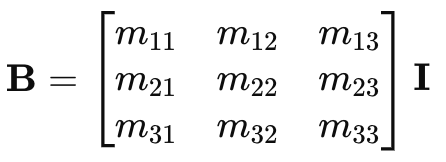
Diagonal terms represent intended axis gains.
Off-diagonal terms represent cross-coupling.
Calibration Procedure
- Apply known current on one axis at a time
- Measure resulting field vector using a calibrated 3-axis probe
- Populate full 3×3 matrix
- Compute inverse matrix M−1
- Implement compensation in control software
After compensation:
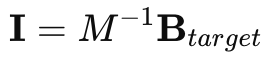
Now field direction accuracy improves dramatically.
5. Software Compensation: Where Precision Happens
Mechanical perfection is expensive.
Matrix compensation is efficient.
Modern vector coil systems integrate:
- Real-time matrix correction
- Field linearization
- Offset cancellation
- Temperature drift compensation
Software-based correction enables:
- Sub-degree vector angle accuracy
- Stable arbitrary field rotation
- Repeatable magnetic trajectories
This is especially critical in:
- Spintronics measurements
- Magnetoresistance studies
- Sensor calibration
- 3D magnetic characterization
👉 Product Link Placeholder – Cryomagtech 3-Axis Vector Coil System with Control Software
Our vector systems combine mechanical alignment, matrix calibration, and software correction to ensure field direction fidelity.
6. Verification Methods
After calibration, validation is essential.
Common verification steps:
- Sweep spherical trajectories
- Apply pure X command and verify Y/Z ≈ 0
- Measure angular deviation over full rotation
- Thermal stability validation over hours
Field direction error should be reported in:
- Degrees
- % orthogonality deviation
- Residual cross-axis field magnitude
Without verification data, direction accuracy claims are meaningless.
7. Why Most Suppliers Avoid This Topic
Because it requires:
- Understanding linear algebra
- Performing full 3×3 calibration
- Developing inversion algorithms
- Providing software-level correction
Many vendors deliver hardware only.
Vector accuracy is a system-level problem.
We design vector magnetic field systems as calibrated mathematical instruments, not just coil assemblies.
Key Takeaways
- 3-axis vector coils are governed by a 3×3 coupling matrix
- Mechanical orthogonality alone is insufficient
- Cross-coupling must be measured and compensated
- Matrix inversion enables software correction
- Verification is essential for directional accuracy
Field direction accuracy is not achieved by geometry alone.
It is achieved by calibration and mathematics.
References
- Wikipedia – Orthogonal Matrix
https://en.wikipedia.org/wiki/Orthogonal_matrix - IEEE – Multi-axis magnetic systems research
https://ieeexplore.ieee.org/