
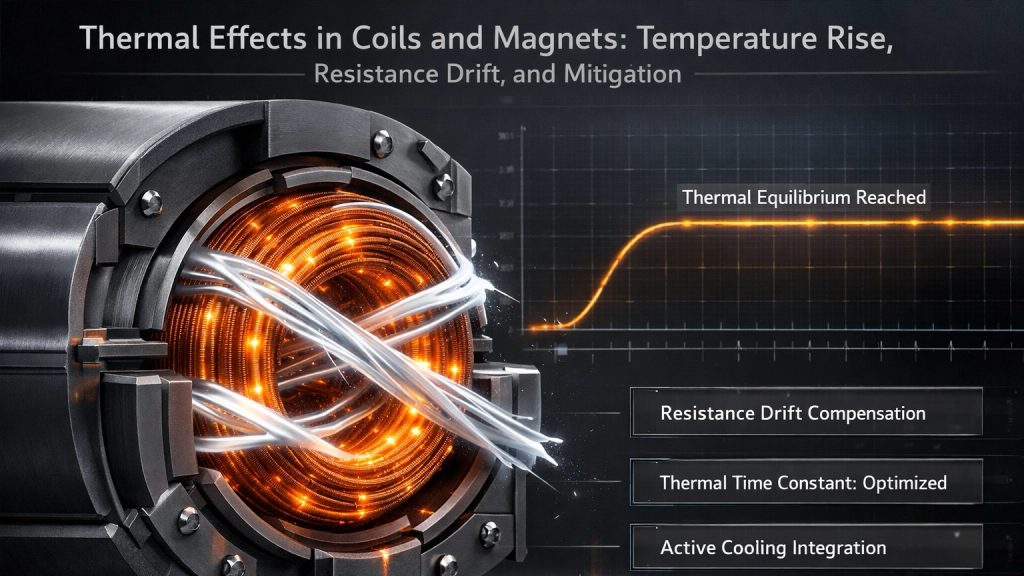
Magnetic field stability is often discussed in terms of current accuracy and control electronics.
In reality, thermal behavior inside coils and magnets frequently dominates long-term stability.
Temperature rise changes resistance, resistance changes current, and current changes magnetic field.
This article explains how thermal effects influence magnetic systems, including resistance vs temperature behavior, thermal time constants, preheating strategies, cooling design, and coordinated temperature control.
1. Why Temperature Is a Magnetic Variable
Magnetic field in resistive electromagnets follows:
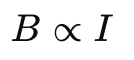
But current stability alone does not guarantee field stability.
Coil resistance varies with temperature:

For copper, the temperature coefficient α is approximately 0.0039 / °C.
This means:
- A 10 °C rise → ~4% resistance increase
- Voltage-controlled systems experience current drift
- Even current-controlled systems see increased thermal stress
According to basic principles summarized in Electrical Resistivity and Conductivity (Wikipedia):
https://en.wikipedia.org/wiki/Electrical_resistivity_and_conductivity
Resistance change with temperature is fundamental—not a secondary effect.
2. Temperature Rise in Coils
Joule Heating
Power dissipation:
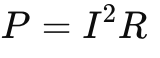
Higher current → exponential heat increase.
Consequences:
- Coil expansion
- Resistance drift
- Field constant variation
- Insulation aging
Temperature rise is not instantaneous. It follows a dynamic curve.
3. Thermal Time Constants: Why Stability Takes Time
Every magnet system has a thermal time constant τ\tauτ.
After current change:
- Electrical response is immediate
- Thermal equilibrium may take minutes or hours
This leads to:
- Gradual field drift after setpoint change
- Apparent “slow instability”
- Sweep-direction asymmetry
Ignoring thermal time constants leads to misinterpreted data.
4. Preheating: A Practical Stability Strategy
Many precision laboratories adopt a simple but effective approach:
- Drive the magnet to operating current
- Allow thermal equilibrium
- Begin measurement after stabilization
Preheating reduces:
- Early drift
- Reproducibility variation
- Short-term calibration shifts
It is a practical method often overlooked in system specification.
5. Cooling Design: Air vs Water
Air-Cooled Systems
- Simpler architecture
- Direct interaction with ambient temperature
- Larger temperature fluctuation range
Suitable for moderate duty cycles and flexible installations.
Water-Cooled Systems
- Higher thermal capacity
- Faster heat removal
- Improved continuous-duty performance
Water cooling reduces peak temperature but introduces:
- Flow dependency
- Pump and chiller stability considerations
Cooling is not just about removing heat—it defines field stability limits.
6. Coordinated Temperature Control
Thermal mitigation requires integration:
- Stable current excitation
- Predictable heat dissipation
- Controlled ambient environment
- Mechanical expansion awareness
In advanced setups:
- Temperature sensors are integrated into coil frames
- Control software compensates for drift
- Cooling loops are actively monitored
Thermal stability is a system-level property.
7. Long-Term Reliability Considerations
Excessive temperature cycling leads to:
- Insulation degradation
- Mechanical fatigue
- Connection loosening
- Calibration drift over months or years
Managing temperature improves not only short-term data quality but also long-term system reliability.
8. Engineering Stable Magnetic Systems
Cryomagtech designs magnetic systems with:
- Optimized air- or water-cooled coil structures
- Stable excitation compatibility
- Thermal-aware mechanical design
Field stability begins with thermal design, not post-processing correction.
Key Takeaways
- Coil resistance changes with temperature
- Thermal time constants drive long-term drift
- Preheating improves reproducibility
- Cooling design defines stability ceiling
- Temperature control is integral to magnetic system performance
If thermal behavior is ignored, magnetic stability becomes unpredictable.