

Magnetic field ramp rate is often treated as a convenience setting.
In reality, it is a critical experimental parameter.
Many “unexpected anomalies” in magnetic measurements are not material effects.
They are ramp-rate artifacts.
This article explains why field ramp rate matters, how it interacts with power supply control and magnet thermal response, and when fast sweeps can quietly invalidate your data.
1. What Is Field Ramp Rate?
Field ramp rate describes how quickly magnetic field changes over time:
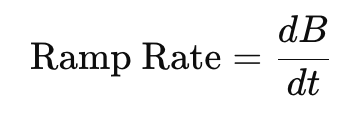
In practical systems, this is governed by:
- Current ramp rate:
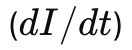
- Magnet inductance
- Power supply voltage compliance
Ramp rate is not just a speed setting. It defines system dynamics.
2. Inductance: The Hidden Constraint
All electromagnets and superconducting magnets exhibit inductance.
According to the basic principle described in Inductance (Wikipedia):
https://en.wikipedia.org/wiki/Inductance
Changing current in an inductive load requires voltage proportional to:
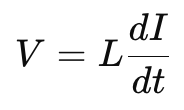
This means:
- Faster ramp → higher required voltage
- Insufficient voltage → distorted ramp profile
- Distorted ramp → inaccurate field vs time mapping
If the power supply cannot provide sufficient compliance voltage, the commanded ramp is not the actual ramp.
3. Thermal Lag: Why Fast Sweeps Create Drift
Joule Heating Scales with Current
Power dissipation in resistive magnets:
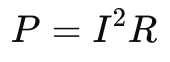
Fast ramps can cause:
- Rapid temperature rise
- Coil resistance increase
- Field nonlinearity during sweep
The magnetic field may not track current perfectly when thermal gradients develop.
Thermal Time Constants Matter
Magnets do not respond instantly to heating.
Fast sweep experiments often show:
- Apparent hysteresis
- Loop asymmetry
- Sweep-direction dependence
These effects may not originate from the sample—but from thermal dynamics.
4. Eddy Currents and Induced Artifacts
Rapid magnetic field changes induce:
- Eddy currents in nearby conductive structures
- Local heating
- Transient magnetic offsets
In precision measurements, especially at low frequencies, these induced artifacts can distort results significantly.
IEEE discussions on precision magnet control frequently emphasize controlling dynamic effects in ramped magnetic systems for accurate measurement interpretation.
5. Superconducting Magnets: Ramp Rate Has Different Risks
In superconducting systems:
- Excessive ramp rate can cause quench risk
- Flux motion may introduce transient instability
- Persistent mode transitions may be affected
Ramp rate is often limited not by convenience, but by magnet protection constraints.
6. When Fast Sweeps Are Appropriate
Fast ramps are useful when:
- Screening large parameter spaces
- Performing qualitative trend analysis
- Time-limited measurements
They are risky when:
- Extracting quantitative material parameters
- Studying hysteresis loops
- Measuring subtle phase transitions
In many precision experiments, slower ramps yield cleaner data—even if measurement time increases.
7. Power Supply Control Capability Matters
A high-quality excitation power supply must provide:
- Stable, programmable current ramp profiles
- Adequate compliance voltage
- Smooth transition between ramp segments
- Low current overshoot
Poor ramp control leads to:
- Overshoot-induced artifacts
- Dynamic oscillations
- Hidden measurement bias
Ramp rate specification is a system-level parameter—not just a UI setting.
8. Engineering for Controlled Ramp Behavior
Cryomagtech supports laboratories with excitation power supplies designed for:
- Precise ramp rate programming
- Stable current control under inductive loads
- Thermal-aware system integration
Controlling ramp rate properly often eliminates experimental artifacts that would otherwise be misinterpreted as material physics.
Key Takeaways
- Field ramp rate directly affects measurement validity
- Inductance limits how fast current can change accurately
- Thermal lag can create artificial hysteresis
- Fast sweeps may distort precision experiments
- Power supply ramp control capability is critical
If your data looks strange only during fast sweeps, the sample may be innocent.