
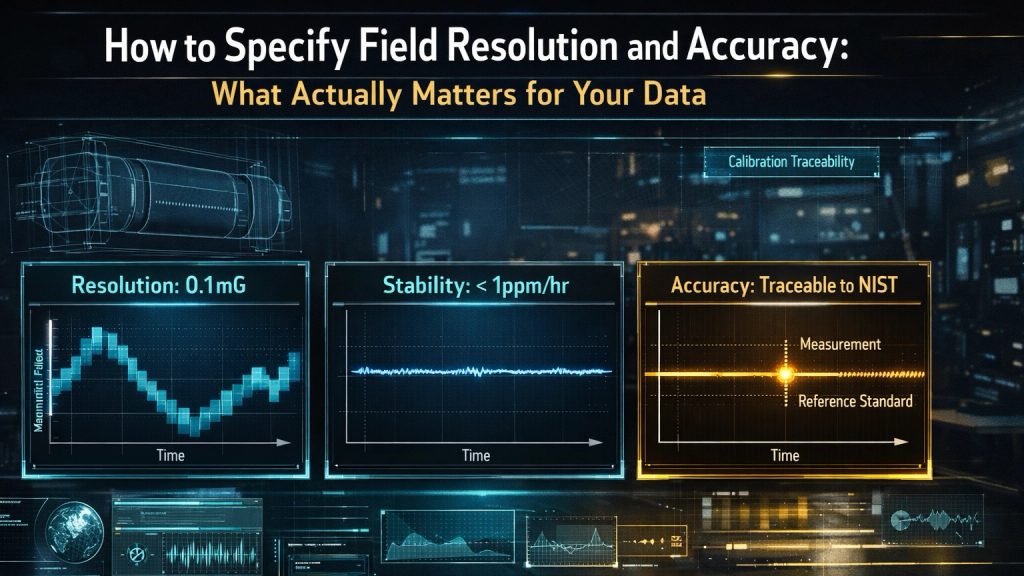
Field resolution, stability, and accuracy are often used interchangeably in magnetic system specifications.
They are not the same. Confusing them leads to overpaying for unnecessary features—or worse, under-specifying what truly affects your data.
This article explains how to define magnetic field performance correctly, focusing on short-term noise vs long-term drift, calibration traceability, and practical error budgeting.
1. Resolution Is Not Accuracy
Field Resolution
Resolution describes the smallest controllable or measurable field increment.
It is typically limited by:
- Current source step size
- DAC resolution
- Measurement electronics noise floor
Resolution answers the question:
“What is the smallest field step I can command or detect?”
It does not guarantee that the value is correct.
Field Accuracy
Accuracy refers to how close the generated field is to the true, traceable value.
Accuracy depends on:
- Calibration of current sensing
- Field constant characterization
- Geometry and coil factor uncertainty
Resolution can be extremely fine while accuracy remains poor.
2. Short-Term Noise vs Long-Term Drift
This is where most specifications become misleading.
Short-Term Noise (Stability Over Seconds)
Short-term stability is affected by:
- Power supply current noise
- Electrical interference
- Mechanical vibration
It determines repeatability within a short measurement window.
In frequency-domain measurements, this noise defines the effective field floor.
Long-Term Drift (Minutes to Hours)
Long-term drift originates from:
- Temperature variation
- Power supply reference drift
- Coil heating
- Mechanical relaxation
Drift determines whether your measurement remains consistent across time.
A system can be quiet over seconds and still wander over hours.
3. Why “Stability” Must Be Time-Defined
Saying:
“Field stability: 10 ppm”
is incomplete.
Stability must specify:
- Over what time interval
- Under what thermal conditions
- At what operating current
IEEE discussions on precision current sources emphasize the importance of time-dependent stability metrics in evaluating performance.
(Reference: IEEE Xplore – Precision current source stability analysis
https://ieeexplore.ieee.org/)
Without time context, stability numbers are marketing, not engineering.
4. Calibration Traceability: The Missing Link
Accuracy requires traceability.
Traceable calibration typically involves:
- Reference Hall probes
- NMR probes (for high precision systems)
- Certified current measurement standards
According to general metrology principles summarized in measurement traceability discussions
(Wikipedia – Measurement traceability
https://en.wikipedia.org/wiki/Measurement_traceability),
a measurement is only meaningful if it links back to recognized standards.
Without traceability:
- Your field value is relative
- Inter-lab comparisons become unreliable
- Published data may lack reproducibility
5. Building a Practical Error Budget
Instead of chasing a single “accuracy number,” build an error budget.
Typical contributors include:
- Current source calibration error
- Coil constant uncertainty
- Temperature coefficient of resistance
- Field mapping uncertainty
- Probe calibration uncertainty
Example conceptual budget:
| Error Source | Typical Contribution |
|---|---|
| Current accuracy | ±0.05% |
| Coil factor uncertainty | ±0.1% |
| Temperature drift | ±0.05% |
| Mapping uncertainty | ±0.03% |
Total accuracy must be estimated statistically, not guessed.
6. When Do You Actually Need Ultra-High Accuracy?
Not every experiment requires sub-ppm precision.
High accuracy is critical for:
- Fundamental material property measurements
- Calibration laboratories
- Inter-lab comparison experiments
Moderate accuracy may be sufficient for:
- Device characterization
- Comparative testing
- Educational laboratories
The key is aligning specifications with data sensitivity.
7. Specifying Magnetic Systems the Right Way
When requesting a magnetic system, define:
- Required field range
- Required resolution
- Required short-term stability (with time window)
- Required long-term drift limit
- Required traceability level
Cryomagtech supports laboratories in defining magnetic system specifications that align with real data requirements rather than ambiguous terminology.
Clear specifications prevent both over-engineering and underperformance.
Key Takeaways
- Resolution is the smallest step, not correctness
- Accuracy requires calibration traceability
- Short-term noise differs from long-term drift
- Stability must always include time context
- Error budgets provide clarity beyond marketing numbers
Specifying magnetic field performance correctly is not about chasing impressive numbers.
It is about matching system behavior to the sensitivity of your data.