
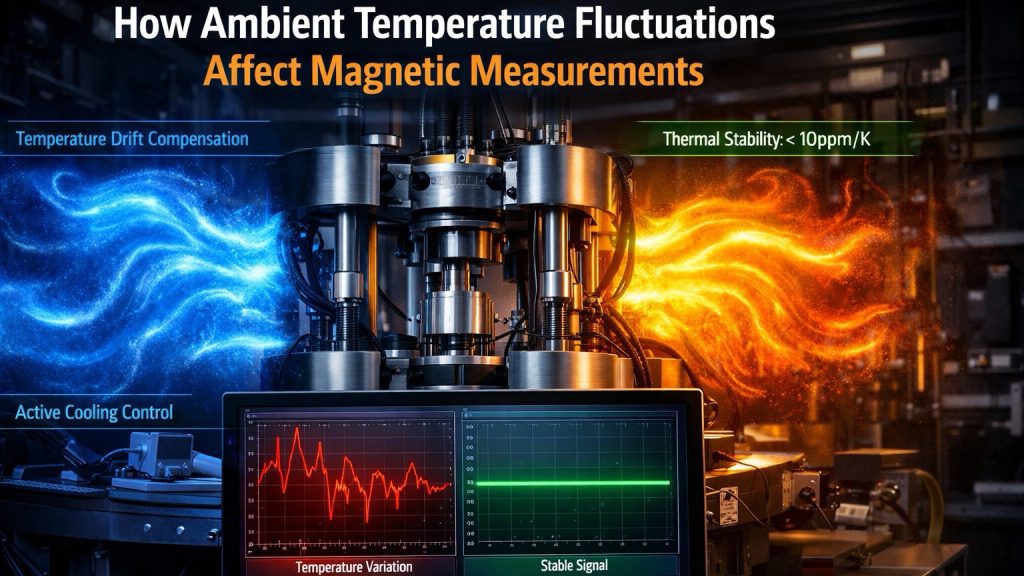
Ambient temperature is rarely listed as a key specification in magnetic measurements.
Yet in many laboratories, a simple change in air conditioning can shift results more than the sensor noise floor.
This article explains, from an engineering perspective, how ambient temperature fluctuations propagate through magnets, excitation power supplies, and thermal control systems, and why “room temperature” is never a constant.
1. The Classic Symptom: When the Air Conditioner Turns On
Many labs report the same phenomenon:
- Data is stable overnight
- Measurements drift during the day
- Step-like changes appear when HVAC cycles
The instinctive reaction is to blame the sensor.
In reality, ambient temperature affects the entire magnetic system, often in subtle but cumulative ways.
2. Magnetic Systems Are Thermo-Electrical Systems
Magnetic measurements are usually treated as purely electromagnetic.
From an engineering standpoint, they are always thermo-electrical-mechanical systems.
Ambient temperature variations influence:
- Coil resistance
- Power supply regulation accuracy
- Heat dissipation paths
- Mechanical alignment stability
Ignoring temperature is equivalent to ignoring half the system.
3. Coil Heating and Magnetic Field Drift
Resistance Is Temperature-Dependent
Copper coil resistance increases with temperature:
- Higher resistance → lower current at fixed voltage
- Lower current → reduced magnetic field
Even small ambient changes can shift coil temperature enough to cause measurable field drift, especially in long-duration experiments.
Thermal Time Constants Matter
Coils respond slowly:
- Air temperature changes quickly
- Coil temperature follows with delay
- Magnetic field drifts gradually
This creates the illusion of “random drift” when the cause is actually deterministic.
4. Excitation Power Supply Temperature Drift
Power Supplies Are Not Thermally Isolated
High-precision excitation power supplies contain:
- Current sensing resistors
- Reference voltage circuits
- Control electronics
All of these have finite temperature coefficients.
Ambient temperature fluctuations can cause:
- Reference drift
- Gain variation
- Long-term current instability
In high-resolution magnetic measurements, power supply temperature drift can dominate the error budget, even when the magnet itself appears stable.
5. The Interaction Between Magnet Cooling and Room Temperature
Cooling Design Is Not Independent of Ambient Conditions
Magnet cooling systems are often designed assuming:
“Room temperature is fixed.”
In reality:
- Air-cooled magnets exchange heat directly with room air
- Water-cooled systems depend on chiller stability
- HVAC airflow patterns affect convection paths
A poorly matched cooling design amplifies ambient fluctuations instead of suppressing them.
6. Mechanical and Alignment Effects
Temperature does not only affect electronics.
Ambient changes also lead to:
- Thermal expansion of magnet frames
- Fixture deformation
- Sensor position drift
For experiments sensitive to field homogeneity or alignment, mechanical thermal effects can translate directly into magnetic measurement error.
7. System-Level Mitigation Strategies
Effective mitigation requires thinking beyond a single component.
Practical Engineering Approaches
- Use excitation power supplies with low temperature coefficients
- Separate heat sources from sensing electronics
- Design magnet cooling for thermal inertia, not just peak power
- Monitor temperature alongside magnetic data
Temperature is not noise. It is a state variable.
8. Designing for Temperature Stability from the Start
Cryomagtech works with laboratories to design magnetic systems where:
- Excitation power supplies are specified for low thermal drift
- Magnet cooling is matched to operating duty cycle
- Thermal behavior is considered during system integration
👉 Product link placeholder: Cryomagtech High Precision Excitation Power Supplies & Magnet Systems
Stable magnetic measurements require thermal-aware system design, not post hoc data correction.
References
- Wikipedia – Electrical resistance and temperature
https://en.wikipedia.org/wiki/Electrical_resistance_and_conductance - IEEE – Temperature effects in precision current sources
https://ieeexplore.ieee.org/
Key Takeaways
- Ambient temperature fluctuations directly affect magnetic measurements
- Coil resistance and power supply drift are primary mechanisms
- Cooling design can amplify or suppress room-temperature effects
- Temperature should be treated as a controlled parameter, not background noise
If turning on the air conditioner changes your data, the system is telling you something. Ignoring it only makes the problem harder later.