
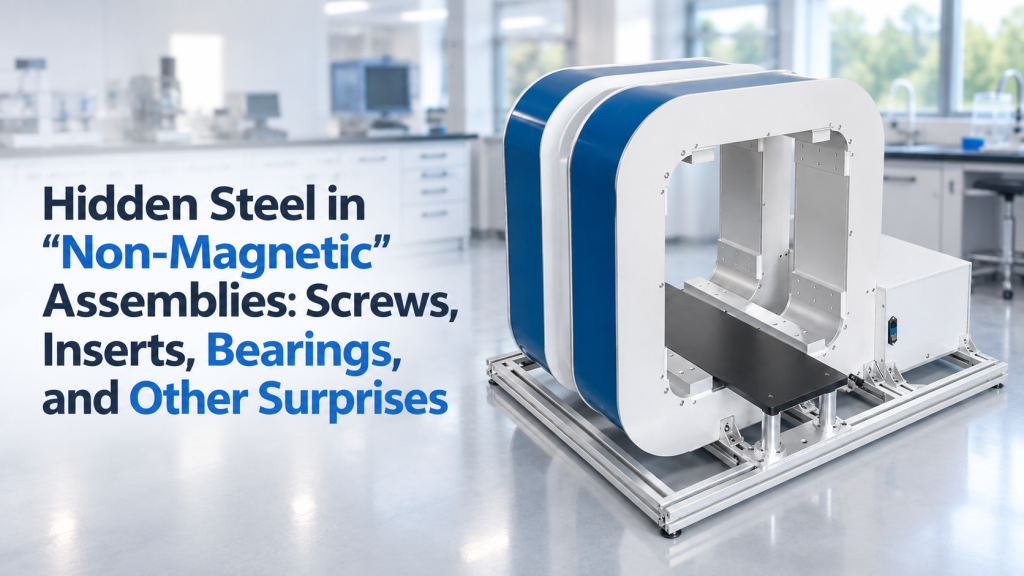
A fixture can be described as “non-magnetic” and still contain enough hidden steel to compromise a magnetic field measurement.
The main frame may be aluminum. The sample holder may be plastic. The drawing may even specify non-magnetic materials.
Then someone installs:
- Four stainless steel screws
- A threaded insert
- Two miniature bearings
- A spring washer
- A retaining ring
- A connector with a plated steel shell
Individually, these parts look insignificant.
Inside a Helmholtz coil calibration volume or close to an electromagnet pole gap, however, they can become part of the magnetic experiment.
For magnetic calibration systems, low-field measurements, sensor testing, and precision material characterization, non-magnetic assemblies should therefore be evaluated as complete assemblies—not simply judged by the material of the largest structural component.
1. “Stainless Steel” Does Not Automatically Mean “Non-Magnetic”
One of the most persistent laboratory assumptions is:
“It is stainless steel, so it should be non-magnetic.”
That is not reliable enough for precision magnetic work.
Different Stainless Steels Behave Differently
Stainless steel is a family of alloys, not one magnetic material.
Depending on grade and microstructure, stainless steels may be:
- Austenitic
- Ferritic
- Martensitic
- Duplex
- Precipitation hardened
Austenitic grades such as 304 and 316 are commonly chosen where low magnetic permeability is desirable.
But even these materials are not guaranteed to remain magnetically identical after manufacturing.
The British Stainless Steel Association notes that austenitic stainless steels are generally low-permeability in the annealed condition, but cold working can partially transform austenite into ferromagnetic martensite. Areas affected by machining, forming, shearing, or other deformation can therefore show increased magnetic response.
That distinction matters because many laboratory fasteners are manufactured by exactly these processes.
2. The Screw Is Often More Suspicious Than the Frame
Imagine an aluminum sensor fixture mounted at the center of a 3-axis Helmholtz coil.
The fixture body itself may be magnetically clean.
But the assembly contains six small screws.
That is where trouble begins.
Why Screws Can Become Magnetic
Commercial stainless fasteners may undergo:
- Cold heading
- Thread rolling
- Machining
- Forming
- Work hardening
These processes can change the magnetic behavior of some austenitic stainless steels.
The Nickel Institute specifically notes that austenitic stainless fasteners have low magnetic permeability in the annealed condition, while some become weakly magnetic after substantial cold working.
So a specification such as:
“M4 stainless steel screw”
does not tell you enough.
For sensitive magnetic applications, better questions are:
- What stainless steel grade is used?
- What is its manufacturing condition?
- Has magnetic permeability been specified?
- Has the actual finished fastener been tested?
This is why two visually identical stainless screws can behave differently near a magnet.
3. Threaded Inserts Are Easy to Forget
Threaded inserts are especially dangerous from a design-review perspective because they disappear inside another component.
A fixture drawing may identify the main body as:
6061 aluminum
and therefore appear magnetically suitable.
But the aluminum body may contain:
- Helical thread inserts
- Press-fit inserts
- Rivet nuts
- Threaded bushings
- Captive nuts
Once installed, these components may be almost invisible.
Why This Matters
If the insert is positioned close to:
- A magnetometer sensing element
- A Hall probe
- A DUT
- The center of a Helmholtz coil
- An electromagnet pole gap
even a small magnetic contribution can become part of the measurement background.
This is particularly important for fixtures that were originally designed for general mechanical use and later reused in precision magnetic experiments.
A mechanically excellent fixture is not automatically a magnetically clean fixture.
4. Bearings Are One of the Most Common Surprises
Rotating fixtures introduce an even more common hidden component: bearings.
A designer may carefully manufacture the rotation arm from aluminum or engineering plastic, then install standard stainless steel bearings.
The phrase “stainless steel bearing” sounds reassuring.
It should not be interpreted as equivalent to “low magnetic permeability bearing.”
Bearing Materials Are Selected for Mechanical Reasons
Bearings must provide:
- Hardness
- Wear resistance
- Dimensional stability
- Fatigue life
- Corrosion resistance
Those requirements often lead manufacturers toward stainless alloys whose magnetic properties are very different from annealed 304 or 316.
A bearing assembly may also contain several different materials:
- Inner race
- Outer race
- Balls
- Retainer or cage
- Shield
- Seal reinforcement
Therefore, checking only the outer appearance of the bearing is insufficient.
The Problem Gets Worse During Rotation
If a magnetic bearing rotates relative to a sensitive sensor, its magnetic signature may also rotate.
The result can appear as:
- Periodic offset
- Angle-dependent background
- Repeatable sinusoidal error
- Unexpected harmonics
- Apparent DUT anisotropy
This is particularly dangerous because the error can look like real experimental data.
5. Springs, Washers, Circlips, and Clips Deserve Attention Too
Some of the smallest components are easy to overlook during fixture design.
Examples include:
- Spring washers
- Wave washers
- Retaining rings
- Circlips
- Compression springs
- Tension springs
- Dowel pins
- Alignment pins
- Shaft collars
- Locking clips
These components often require high strength and elasticity.
The alloy selected for those mechanical properties may not be ideal for magnetic cleanliness.
The engineering lesson is simple:
Do not classify a complete assembly as non-magnetic based only on its structural frame.
Review the BOM down to the small hardware.
6. Connectors Can Hide Magnetic Materials Too
Electrical connectors are another source of surprises.
A connector may include:
- Steel mounting screws
- Nickel-containing shells
- Steel retaining clips
- Magnetic spring contacts
- Plated internal hardware
- Strain-relief components
From the outside, none of this may be obvious.
This becomes important in compact magnetometer calibration fixtures where the connector is sometimes only a few centimeters from the sensing element.
Move the Connector Away When Possible
A useful design strategy is often not to eliminate every questionable material, but to increase its distance from the sensitive measurement region.
Magnetic disturbance generally becomes much less important as the source is moved farther away.
Therefore, consider:
- Extending low-magnetic wiring from the DUT
- Moving connectors outside the homogeneous volume
- Locating motors farther from the sensor
- Moving conventional hardware toward the outer fixture structure
Magnetic cleanliness is partly a materials problem and partly a geometry problem.
7. Low-Field Systems Are Especially Sensitive
Hidden steel matters in almost any precision magnetic experiment, but it becomes particularly important as the target field decreases.
Consider a system intended to generate or measure:
- Millitesla-level fields
- Hundreds of microtesla
- Earth-field-level magnetic fields
- Tens of microtesla
- Microtesla calibration points
- Nanotesla-level disturbances
At these levels, the fixture itself can become a significant magnetic source.
Calibration Systems Have a Different Risk Profile
Suppose a magnetometer is being calibrated inside a 3-axis Helmholtz coil.
The coil may generate a highly predictable field.
But if a steel insert close to the sensor has acquired remanent magnetization, the sensor does not experience only the field generated by the coils.
It experiences:
Applied coil field + ambient field + fixture-generated field + DUT-related field
If the fixture contribution is not characterized, calibration accuracy can be degraded even though the coil itself is performing correctly.
NASA magnetic-cleanliness work has long treated material selection—including structural hardware such as nuts and bolts—as part of controlling magnetic contamination, rather than evaluating only the primary structure.
8. Electromagnet Fixtures Have a Different Failure Mode
Inside an electromagnet, the concern is not limited to low-level magnetic contamination.
A ferromagnetic component close to the pole gap may interact much more strongly with the applied field.
Possible consequences include:
- Local field distortion
- Attraction toward the pole
- Mechanical force on the fixture
- Changed flux distribution
- Hysteretic behavior after field cycling
- Position-dependent measurement errors
Position Matters
A steel screw located far behind a support structure may have little practical effect.
The same screw placed several millimeters from the DUT may be unacceptable.
Therefore, the correct engineering question is not simply:
“Is there any steel in the fixture?”
It is:
“What material is present, how magnetic is it, and where is it relative to the measurement region?”
That is a much more useful design criterion.
9. Why a Handheld Magnet Test Is Useful—but Not Enough
A small permanent magnet is an excellent first screening tool.
It can quickly identify:
- Carbon steel
- Strongly magnetic stainless steel
- Some bearings
- Hidden steel inserts
- Incorrect fasteners
For practical laboratory work, this simple check catches many problems.
But it has limitations.
“No Obvious Attraction” Does Not Equal Magnetic Cleanliness
A component may have relatively low permeability and show little obvious attraction to a handheld magnet while still being unsuitable for a high-accuracy low-field calibration setup.
This is why professional low-magnetic designs may specify a maximum relative permeability rather than simply writing:
“Non-magnetic stainless steel.”
For demanding applications, material certification or direct measurement of finished parts may be necessary.
10. Test the Finished Assembly, Not Only the Raw Materials
Even if every material certificate looks correct, the final assembly should still be checked.
Manufacturing can change the situation.
Potential sources include:
- Cold-worked fasteners
- Machined regions
- Welding
- Contaminated tooling
- Replacement hardware installed during assembly
- Magnetic debris
- Production substitutions
A Practical Magnetic Cleanliness Check
A useful acceptance procedure can include:
- Measure the background field without the fixture
- Install the empty fixture
- Repeat the measurement
- Rotate or reposition the fixture if applicable
- Compare different angular positions
- Reverse the applied magnetic field
- Check for residual offset after returning to zero field
- Repeat after several magnetic field cycles
For calibration fixtures, also consider measuring:
Fixture only → fixture + wiring → fixture + DUT
This can help identify which subsystem introduces the disturbance.
11. Rotation Can Reveal Hidden Magnetic Components
Static testing is not always sufficient.
A small magnetic part may generate a nearly constant offset when the fixture remains stationary.
Once the fixture rotates, that magnetic vector rotates relative to the sensor.
The result becomes much easier to observe.
Watch for Angle-Correlated Errors
During a 360° rotation, examine whether the measured magnetic signal contains:
- One-cycle periodic variation
- Two-cycle variation
- Repeating spikes
- Direction-dependent offset
- Different clockwise and counterclockwise results
Before concluding that these features belong to the DUT, test the fixture without the DUT.
This simple control experiment can prevent a great deal of incorrect interpretation.
12. “Non-Magnetic” Does Not Mean “Magnetically Invisible”
There is another important distinction.
Replacing steel with aluminum, copper, brass, or another low-permeability material does not automatically make a fixture electromagnetically invisible.
AC Magnetic Fields Introduce Eddy Current Effects
Conductive materials exposed to changing magnetic fields can develop eddy currents.
Therefore, in AC magnetic field systems, a large conductive fixture may:
- Modify field amplitude
- Introduce phase shift
- Create local field distortion
- Affect high-frequency performance
For DC measurements this may be negligible.
For time-varying magnetic field experiments, especially as frequency rises, both magnetic permeability and electrical conductivity should be considered.
This is why a fixture optimized for static magnetic calibration may not automatically be ideal for AC field testing.
13. Better Material Choices for Magnetic Fixtures
There is no single material that is best for every magnetic fixture.
Selection depends on:
- Mechanical load
- Temperature
- Vacuum compatibility
- Electrical conductivity
- Magnetic permeability
- Wear
- Required stiffness
- Cost
- Manufacturing method
Common Structural Options
Depending on the application, engineers may consider:
- Aluminum alloys
- Brass
- Copper
- Titanium alloys
- Engineering plastics
- Fiberglass-reinforced materials
- Ceramics
- Carefully specified low-permeability austenitic stainless steel
Each has trade-offs.
For example, aluminum is convenient for many fixtures, but it is conductive and may not be ideal for every AC magnetic field application.
Plastic eliminates many magnetic concerns but may lack stiffness, dimensional stability, temperature capability, or vacuum compatibility.
Material selection should therefore follow the experiment—not a generic rule.
14. How to Specify “Non-Magnetic” More Professionally
Instead of writing:
“All parts shall be non-magnetic.”
consider defining the requirement more precisely.
Depending on the measurement sensitivity, the specification might address:
- Maximum relative magnetic permeability
- Maximum residual magnetic field at a specified distance
- Restricted use of ferromagnetic materials
- Required magnetic screening of finished components
- Fixture background measurement before delivery
- Magnetic cleanliness verification after complete assembly
This converts a vague description into an engineering requirement.
For very sensitive systems, the specification should also identify a measurement method.
Otherwise, supplier and customer may interpret the word “non-magnetic” very differently.
15. A Practical Checklist Before Installing a Fixture
Before placing any fixture inside a Helmholtz coil or electromagnet, review the entire assembly.
Check the Main Structure
- Frame
- Base plate
- Sample holder
- Rotation arm
- Mounting brackets
Check the Hardware
- Screws
- Nuts
- Washers
- Threaded inserts
- Pins
- Springs
- Circlips
- Shaft collars
Check Moving Components
- Bearings
- Gearboxes
- Motors
- Encoders
- Linear guides
Check Electrical Components
- Connectors
- Cable shields
- Terminals
- Cable glands
- Strain reliefs
Check the Complete Assembly
- Measure magnetic background
- Test multiple orientations
- Test with and without the DUT
- Check field reversal
- Check residual field after exposure
The last step is critical.
A BOM review can reduce risk.
An assembled-system measurement confirms what actually happened.
16. How Cryomagtech Approaches Magnetic Fixtures and Calibration Systems
In a precision magnetic field system, the magnet or coil is only one part of the measurement environment.
For applications involving:
- 3-axis magnetometer calibration
- Magnetic sensor testing
- IMU and navigation sensor evaluation
- Angle-dependent measurements
- Material characterization
- Electromagnet sample positioning
- Low-field magnetic experiments
Cryomagtech can evaluate not only the magnetic field source, but also the relationship between the homogeneous region, DUT dimensions, mounting structure, fixture materials, rotation requirements, and measurement access.
A high-quality magnetic field system cannot compensate for a fixture that unknowingly carries its own magnetic signature.
The closer an experiment moves toward precision calibration and low-field measurement, the more important these “small” mechanical details become.
References
British Stainless Steel Association — Effect of Cold Work and Heat Treatment on the Magnetic Permeability of Austenitic Stainless Steels
Explains why normally low-permeability austenitic stainless steel can develop increased magnetic response after cold working due to martensitic transformation.
Source link: BSSA article on cold work and magnetic permeability
NASA — Techniques for Achieving Magnetic Cleanliness on Deep-Space Missions
Discusses magnetic-cleanliness design, structural material selection, component screening, and the need to consider items such as nuts and bolts when controlling magnetic contamination.
Source link: NASA Technical Report — Magnetic Cleanliness
Key Takeaways
- “Stainless steel” and “non-magnetic” are not interchangeable descriptions.
- Cold working can increase the magnetic response of some austenitic stainless steels.
- Screws, threaded inserts, bearings, springs, clips, and connectors are common hidden sources of magnetic contamination.
- Low-field calibration systems are particularly sensitive to small magnetic components near the DUT.
- In electromagnets, hidden ferromagnetic hardware can also distort the local field and experience mechanical forces.
- A handheld magnet is useful for screening, but demanding systems may require permeability specifications or direct measurements.
- Rotating a fixture can expose magnetic errors that remain hidden during static testing.
- For AC magnetic fields, low magnetic permeability alone is not enough—conductive fixtures can also produce eddy-current effects.
- The finished fixture should be magnetically evaluated as an assembly, not only as a collection of approved materials.