
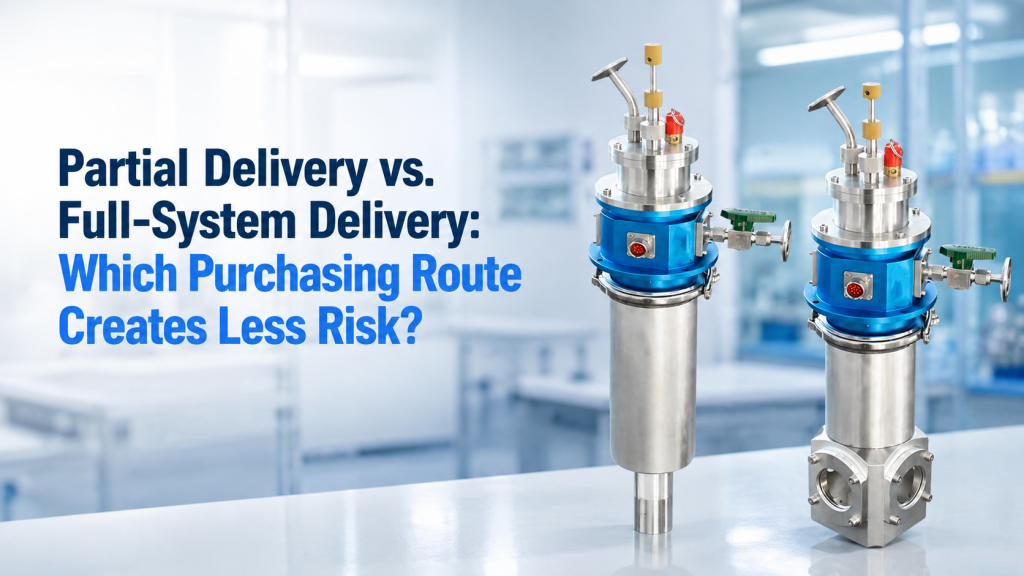
A research laboratory needs a complete measurement system.
The final configuration may include:
- Electromagnet or Helmholtz coil
- Magnet power supply
- Field measurement
- Hall measurement electronics
- Cryostat
- Temperature controller
- Vacuum pump
- Probe station
- Computer
- Measurement software
But the laboratory does not necessarily want to purchase everything at once.
Perhaps this year’s budget covers only the magnet and power supply.
Perhaps another department already owns the cryostat.
Perhaps a second grant will fund low-temperature capability next year.
Perhaps the buyer wants to verify the basic system before committing to the expensive expansion.
This creates an important procurement decision:
Partial delivery vs full-system delivery—which creates less risk?
There is no universal answer.
Partial delivery can reduce initial investment, fit annual funding structures, and allow a laboratory to build capability gradually. But it also transfers more integration responsibility to the buyer and creates additional interface, compatibility, commissioning, and acceptance risks.
Full-system delivery usually gives one supplier greater responsibility for integration and final performance. But it can require more upfront budget, reduce flexibility, and make the buyer more dependent on one system architecture.
NASA’s systems-engineering guidance provides a useful principle for understanding this trade-off: system interfaces need to be defined, controlled, integrated, verified, and validated rather than assumed. NASA specifically describes interface verification as a critical part of overall system verification.
That principle applies surprisingly well to scientific equipment procurement.
The purchasing question should therefore not simply be:
“Can we buy the system in two stages?”
It should be:
“If we divide the system into stages, which interfaces and performance responsibilities move from the supplier to us?”
This guide explains how buyers should make that decision.
1. First Define What “Partial Delivery” Actually Means
The phrase can describe several very different procurement models.
Model A: Staged Purchasing
The laboratory buys part of the system now and additional capability later.
Example:
Phase 1
- Electromagnet
- Power supply
- Gaussmeter
Phase 2
- Hall measurement electronics
- Sample fixture
- Automation software
Phase 3
- Cryostat
- Temperature controller
- Vacuum system
This is probably the most common form of partial procurement.
Model B: Multiple Suppliers
Different subsystems are purchased from different vendors.
For example:
- Magnet from Supplier A
- Power supply from Supplier B
- Cryostat from Supplier C
- Source-measure unit already owned by customer
- Software developed internally
Everything may arrive during the same project, but no single supplier owns the entire system.
Model C: Partial Shipment of One Contract
The entire system is ordered from one supplier but shipped in stages.
For example:
- Standard electronics ship first
- Custom magnet follows later
- Cryostat follows after final testing
This is primarily a logistics and schedule issue rather than a procurement-architecture decision.
Model D: Buyer-Supplied Equipment Integration
The supplier provides most of the system but integrates equipment already owned by the laboratory.
Examples:
- Customer-owned Keithley source meter
- Existing cryostat
- Existing optical table
- Existing temperature controller
Each model creates different risks.
Therefore, never write only:
“Partial delivery required.”
Define what is actually being divided.
2. Full-System Delivery Does Not Necessarily Mean One Physical Box
A full system may still contain many independent instruments.
For example, a Hall measurement platform could include:
- Electromagnet
- Magnet power supply
- Field sensor
- Current source
- Nanovoltmeter
- Switching matrix
- Sample holder
- Computer
- Software
The important distinction is not whether everything is physically integrated into one enclosure.
The important distinction is:
Who is responsible for making all of those elements work together as the quoted system?
Under a genuine full-system delivery model, the supplier normally takes more responsibility for:
- Component selection
- Interface matching
- System integration
- Functional testing
- Documentation
- Commissioning
- Final acceptance
That responsibility has value.
It should be considered when comparing prices.
3. Partial Purchasing Can Be Completely Rational
Staged procurement is not automatically a compromise.
For many laboratories, it is the correct purchasing strategy.
Typical reasons include:
- Annual budget limits
- Grant funding released in stages
- Need to demonstrate feasibility first
- Scientific requirements still evolving
- Existing equipment can be reused
- Low-temperature capability will not be needed immediately
- Different departments fund different subsystems
Example
A laboratory currently needs:
Room-temperature magnetotransport measurement.
Cryogenic experiments are planned two years later.
Buying a complete 4 K platform today may tie up budget in equipment that will sit unused.
A sensible strategy could be:
Phase 1
Build a strong room-temperature core.
Phase 2
Add cryogenic capability when the research program is funded.
That can be financially efficient.
But only if Phase 1 is designed with Phase 2 interfaces in mind.
4. The Biggest Partial-Delivery Risk Is Usually Not the Missing Hardware
It is the interface.
Suppose you purchase:
Electromagnet + power supply
this year.
Next year you add a cryostat.
The first question is not:
“Can we physically buy a cryostat later?”
Of course you can.
The real questions are:
- Will it fit between the magnet poles?
- What final pole gap will it require?
- What magnetic field remains at that gap?
- Is optical access preserved?
- Is the sample at the magnetic center?
- Can cables and vacuum lines exit correctly?
- Does the existing support structure provide enough space?
- Does software need to coordinate field and temperature?
The future subsystem changes the requirements of the subsystem you are buying today.
That is where staged procurement becomes a systems-engineering problem.
5. Interfaces Should Be Frozen Before Phase 1 Is Ordered
NASA describes interface management as closely connected with requirements definition, configuration management, integration, verification, and validation. Its guidance calls for checking interface compatibility during product integration rather than discovering mismatches only after assembly.
Research equipment buyers can apply the same logic.
Before buying Phase 1, define the critical Phase 2 interfaces.
These may include:
Mechanical Interfaces
- Mounting dimensions
- Hole patterns
- Sample height
- Optical axis
- Pole gap
- Working distance
- Load capacity
Electrical Interfaces
- Voltage
- Current
- Connector
- Analog control signal
- Trigger
- Grounding
Communication Interfaces
- Ethernet
- USB
- RS-232
- RS-485
- GPIB
- API commands
Thermal Interfaces
- Cooling capacity
- Heater power
- Temperature sensors
- Thermal anchor points
Vacuum Interfaces
- Flange type
- Pumping connection
- Feedthroughs
- Vacuum rating
Software Interfaces
- Command protocol
- Driver
- Data format
- Synchronization
If these interfaces remain undefined, “upgradeable later” is only a marketing phrase.
6. “Upgradeable” Should Be Converted Into an Interface Statement
Suppose a supplier says:
“The Hall system can be upgraded to cryogenic operation later.”
Ask:
“How?”
A useful answer should explain:
- Which components remain unchanged
- Which components must be replaced
- Which interfaces are already prepared
- What future cryostat architecture is assumed
- What magnetic field will remain at the future gap
- Whether software already supports temperature synchronization
Weak Upgrade Statement
“Cryogenic option can be added later.”
Stronger Statement
“The room-temperature magnet and bipolar power supply will be retained. The system frame is designed for a future cryostat requiring up to a 35 mm pole gap. At that gap, the expected field capability is X. The control software provides an interface for the future temperature controller. The room-temperature sample holder will be replaced by the cryogenic insert.”
Now the buyer can evaluate the upgrade path.
7. A Future Upgrade May Require Replacement, Not Addition
This is one of the biggest misconceptions in staged procurement.
Buyers often imagine:
Phase 1 + Phase 2 = Final System
Sometimes the actual equation is:
Phase 1 − incompatible components + Phase 2 = Final System
Example
Room-temperature system uses:
- 15 mm pole gap
- Short-working-distance optical objective
- Compact sample holder
Cryogenic upgrade requires:
- 45 mm gap
- Cryostat windows
- Long-working-distance objective
- Different sample stage
Now the laboratory may need to replace:
- Pole pieces
- Optical hardware
- Sample fixture
- Mechanical support
The upgrade is still technically possible.
But it is not simply additive.
The quotation should explain retained and replaced components.
8. Replaced Hardware Should Be Included in the Upgrade Economics
Suppose:
Phase 1
USD X
Phase 2
USD Y
The buyer may assume:
Total lifecycle cost = X + Y
But if Phase 2 replaces USD Z of Phase 1 hardware:
Effective lifecycle cost = X + Y + duplicated hardware cost
That does not automatically make the staged strategy wrong.
The laboratory may gain two years of useful room-temperature research before upgrading.
That benefit may justify the duplication.
But the buyer should know the trade-off before purchasing Phase 1.
9. Full-System Delivery Moves More Integration Risk to the Supplier
This is one of the strongest arguments for purchasing a complete system.
When one supplier is responsible for the full platform, it can normally test:
- Magnet with power supply
- Fixture inside magnet
- Cryostat inside working gap
- Temperature controller with sensors
- Electrical measurement with real cabling
- Software communication
- Full measurement sequence
NASA’s systems-engineering framework distinguishes verification of individual products from validation of the integrated product in its intended context, and its guidance explicitly includes further verification when an instrument is integrated with its external platform.
The same principle is useful for laboratory systems.
A component can work perfectly on its own and still fail at the system level.
10. Component Acceptance Is Not System Acceptance
This distinction becomes critical when equipment is bought in stages.
Suppose Phase 1 contains:
- Electromagnet
- Power supply
The Factory Acceptance Test may verify:
- Maximum field
- Field polarity
- Power-supply operation
- Cooling
Everything passes.
Next year, Phase 2 adds:
- Cryostat
- Probe stage
Now the full system fails to achieve the originally expected magnetic field because the cryostat forces a much larger pole gap.
Was Phase 1 defective?
No.
Was Phase 2 defective?
Not necessarily.
The problem is that the final system requirement was never allocated properly across the interfaces.
Therefore Define Two Levels
Subsystem Acceptance
Does each delivered phase meet its own specification?
Final System Acceptance
Does the fully integrated system meet the final scientific requirement?
They should not be confused.
11. The Final Acceptance Owner Must Be Identified
This is probably the most important commercial question in a multi-supplier project.
Imagine:
- Magnet supplied by A
- Cryostat supplied by B
- Electrical measurement supplied by C
The final Hall measurement does not work.
Who is responsible?
Supplier A says:
“The magnet meets specification.”
Supplier B says:
“The cryostat reaches temperature.”
Supplier C says:
“Our electronics measure correctly.”
All three statements might be true.
The integrated experiment may still fail.
Somebody Must Own System-Level Integration
Possible models include:
- Buyer owns integration
- Lead supplier owns integration
- External system integrator owns integration
- Responsibilities are divided by an interface matrix
Do not leave this decision until commissioning.
12. Multiple Suppliers Create the “Finger-Pointing Risk”
This risk deserves to be priced into the procurement decision.
When one supplier owns the system:
The problem is usually:
“Please diagnose the system.”
When four suppliers own different pieces:
The problem can become:
“Prove which subsystem is responsible before anyone will act.”
Typical disputes include:
- Cryostat too large vs magnet gap too small
- Sensor noise vs grounding problem
- Software bug vs communication protocol
- Probe contact vs measurement electronics
- Vibration from cryocooler vs optical instability
This does not mean multiple suppliers are a bad idea.
It means the buyer needs enough internal engineering capability to act as system integrator.
13. Ask Whether Your Laboratory Can Actually Be the Integrator
This question is often skipped.
A laboratory may have excellent scientists but limited integration resources.
System integration may require knowledge of:
- Mechanical design
- Electronics
- Software
- Vacuum
- Cryogenics
- Magnetic field
- Controls
- Safety
Partial Multi-Vendor Procurement Makes Sense When
The laboratory already has:
- Experienced technical staff
- Established equipment standards
- Good documentation
- Integration experience
- Time for commissioning
Full-System Delivery Becomes More Attractive When
The laboratory:
- Has limited technical manpower
- Needs rapid deployment
- Has strict acceptance deadlines
- Requires clear warranty responsibility
Integration capability should influence procurement architecture.
14. Partial Delivery Can Reduce Financial Risk
There is another side to the equation.
Buying everything at once puts more capital at risk before the scientific concept has been proven.
Staged Procurement Can Allow
- Purchase core equipment.
- Run initial experiments.
- Confirm scientific value.
- Expand only if justified.
For experimental research programs, this can be very rational.
Example
Phase 1:
Room-temperature MOKE.
Researchers establish:
- Signal quality
- Sample suitability
- Measurement workflow
Phase 2:
Cryogenic MOKE.
If the research direction changes before Phase 2, the laboratory has avoided purchasing an expensive cryostat that would never be used.
Partial delivery can therefore reduce scientific-program risk even while increasing integration risk.
15. There Are Several Different Types of Risk
This distinction helps buyers make better decisions.
Financial Risk
How much money must be committed before useful results appear?
Technical Risk
Will individual components achieve their specifications?
Integration Risk
Will all subsystems work together?
Schedule Risk
Will all parts arrive when needed?
Interface Risk
Will mechanical, electrical, software, and thermal connections remain compatible?
Acceptance Risk
Who decides whether the final system works?
Lifecycle Risk
Can the system be expanded and maintained later?
Partial delivery can reduce one category while increasing another.
That is why there is no universal winner.
16. Full-System Delivery Can Increase Upfront Financial Exposure
Suppose the complete platform costs substantially more than the core room-temperature system.
A full purchase requires the laboratory to commit:
- Magnet budget
- Cryogenic budget
- Vacuum budget
- Automation budget
immediately.
If the research program changes, some capability may never be used.
For projects with uncertain scientific direction, this matters.
Full-System Delivery Is Most Attractive When
- Scientific requirements are mature
- Funding is already approved
- Final configuration is known
- Integration risk is high
- Deadline matters
When requirements are still evolving, staged purchasing may preserve flexibility.
17. Partial Delivery Can Fit Grant and Budget Cycles Better
University funding often arrives in practical chunks rather than according to ideal engineering architecture.
A laboratory may have:
Year 1: capital equipment budget
Year 2: infrastructure funding
Year 3: research-project funding
Staged purchasing can align with that reality.
But the Future Phase Should Still Be Designed Now
You may not need to buy the future cryostat today.
You may still need to define its envelope today.
That difference is critical.
Planning future capability is inexpensive.
Redesigning incompatible hardware later is not.
18. Modular Systems Can Make Staged Procurement Safer
A modular architecture can reduce the cost of future changes when subsystem boundaries and interfaces are deliberately designed.
GAO’s analysis of modular systems notes that modular approaches can make systems easier to sustain and upgrade, but also reports that programs can encounter additional cost and time associated with the design work needed to implement modularity properly.
That trade-off applies to laboratory equipment too.
True Modularity Requires
- Defined mechanical interfaces
- Defined electrical interfaces
- Documented communication protocols
- Replaceable modules
- Clear performance boundaries
Simply assembling equipment from separate boxes does not automatically create a modular system.
19. Connector Compatibility Is Not System Compatibility
Two instruments may both have:
- BNC
- USB
- Ethernet
That does not prove they can work together.
BNC Example
One instrument may expect:
±10 V analog command.
Another outputs:
0–5 V.
Ethernet Example
Both instruments have RJ45 connectors.
One supports a documented TCP/IP command protocol.
The other only uses Ethernet for proprietary service software.
Mechanical Example
Both components use M6 mounting holes.
Their optical axes are still 30 mm apart.
The interface specification must describe behavior—not only connectors.
20. Software Is Often the Hidden Integration Cost
Hardware tends to receive most attention during quotation.
Software may become the real integration problem.
Suppose the final experiment requires:
- Set temperature
- Wait until stable
- Set magnetic field
- Wait until stable
- Apply current
- Read voltage
- Reverse magnetic field
- Repeat
- Save all data together
This requires coordination among:
- Temperature controller
- Magnet power supply
- Measurement electronics
- Computer
If these came from separate suppliers, who writes the software?
The Answer Might Be
- Buyer
- One supplier
- External integrator
Any choice can work.
It must be written into the scope.
21. “API Available” Does Not Mean “Integration Included”
A supplier may provide:
- Command manual
- DLL
- LabVIEW driver
- Python examples
That means integration is technically possible.
It does not mean the supplier will create your complete automation sequence.
Better Procurement Language
Supplier responsibility: Provide documented command interface and example communication functions.
Buyer responsibility: Develop final multi-instrument automation.
or:
Supplier responsibility: Deliver integrated software controlling all listed subsystems according to the agreed measurement sequence.
Those scopes have very different prices.
22. Third-Party Software Versions Can Become a Lifecycle Risk
Suppose Phase 1 is purchased in 2026.
Phase 2 follows in 2029.
Between those dates:
- Operating system may change
- Driver may change
- API may change
- Instrument may be discontinued
- Communication library may change
Therefore, long upgrade intervals increase interface uncertainty.
Buyers Should Ask
- How long is the interface expected to remain supported?
- Is the protocol documented?
- Is integration dependent on proprietary software?
- Can hardware be controlled independently?
Open, documented interfaces generally make staged expansion easier.
23. Hardware Obsolescence Can Affect Partial Procurement
The same issue exists physically.
The power supply you buy today may be discontinued before Phase 2.
The replacement model may:
- Use different dimensions
- Use different connectors
- Use different software
Again, this does not mean staged procurement is wrong.
It means a five-year upgrade plan should not be treated as guaranteed hardware identity.
Better Language
“Future expansion will maintain functional compatibility where available; exact future model numbers may change.”
That is more realistic than promising permanent availability of every component.
24. Warranty Timing Can Become Confusing
Partial deliveries create another practical issue:
When does the warranty begin?
Suppose:
- Magnet delivered January
- Electronics delivered March
- Cryostat delivered September
- Final system commissioned October
Possible warranty starts include:
- Each shipment date
- Each commissioning date
- Final system acceptance
These are very different.
Buyers Should Clarify
For staged procurement:
- Is warranty tracked by subsystem?
- Does unused equipment lose warranty while waiting for other parts?
- Is final integrated commissioning covered?
- Does later third-party integration affect warranty?
This belongs in the quotation or contract.
25. Storage Between Phases Also Creates Responsibility
Equipment may arrive months before it can be installed.
Storage conditions may matter for:
- Electronics
- Optical equipment
- Vacuum components
- Cryogenic hardware
- Sensors
The buyer should know:
- Storage temperature/humidity limits
- Whether protective packaging should remain sealed
- Whether periodic inspection is required
- Whether storage affects warranty
Partial shipment should not silently create long-term storage risk.
26. Shipping in Several Stages Can Increase Logistics Cost
Even when equipment price is unchanged, partial shipment can create:
- Multiple freight charges
- Multiple insurance charges
- Repeated customs clearance
- Repeated brokerage fees
- Additional handling
- Additional import administration
For international laboratory procurement, these costs may be meaningful.
Buyer Should Compare
One consolidated shipment
versus
Three smaller shipments
rather than comparing hardware price alone.
27. Partial Purchasing Can Also Increase Administrative Cost
Universities may need for each phase:
- New quotation
- New approval
- New PO
- New invoice
- New tender
- New import paperwork
When procurement processes are slow, the administrative cost can exceed the hardware savings.
Full-System Procurement May Be Attractive When
- Internal approvals are difficult
- Tendering takes months
- Funding is already available
- Final requirements are mature
Avoid creating three procurement projects when one would have been simpler.
28. But One Delayed Component Can Hold Up a Full-System Shipment
Full-system delivery has its own schedule risk.
Suppose:
- Magnet ready
- Electronics ready
- Software ready
- Custom cryostat delayed by eight weeks
If everything must ship together, the entire project may wait.
Partial Shipment Can Help
The laboratory could receive:
- Electronics early
- Magnet early
and begin:
- Site preparation
- Software familiarization
- Basic commissioning
while waiting for the cryostat.
This can improve schedule efficiency when managed carefully.
29. Partial Shipment and Partial Procurement Should Not Be Confused
These are different decisions.
Partial Shipment
One contract.
One final system responsibility.
Multiple logistics stages.
Partial Procurement
Different contracts or purchasing phases.
Potentially different responsibility structures.
A supplier may ship a complete-system order in several stages while remaining responsible for final integration.
That can combine schedule flexibility with centralized responsibility.
30. Factory Integration Can Be Lost With Staged Purchasing
One major advantage of complete-system procurement is the ability to assemble and test the full configuration before shipment.
Possible Factory Acceptance Testing may include:
- Field
- Temperature
- Vacuum
- Software
- Sample fixture
- Automated sequence
With partial procurement, some of those tests may not be possible until years later.
Example
Phase 1 magnet is factory tested.
Phase 2 cryostat does not yet exist.
The supplier cannot prove final cryostat/magnet compatibility experimentally during Phase 1 acceptance.
At best it can verify:
- Dimensions
- Interface drawings
- Calculated field at planned gap
That distinction should appear in the project documents.
31. Future Performance Guarantees Need Careful Wording
Suppose a buyer asks:
“If we buy Phase 1 now, can you guarantee the final Phase 2 system will achieve the future specification?”
Sometimes yes.
Sometimes not responsibly.
A guarantee may require:
- Future configuration already frozen
- Interfaces defined
- Future performance calculable
- No third-party changes
If important information remains unknown, the supplier should distinguish:
- Guaranteed current performance
- Designed future compatibility
- Estimated future performance
Never convert a future concept into a contractual promise without enough engineering information.
32. Buyer-Supplied Components Need Acceptance Criteria Too
Suppose the buyer already owns a cryostat.
The supplier provides a magnet around it.
Who confirms:
- Cryostat dimensions?
- Material compatibility?
- Magnetic center?
- Window position?
- Cable exit?
- Operating field?
The supplier cannot reasonably guarantee integration with an undefined component.
Before Quotation, Buyer Should Provide
- Model
- Drawings
- External dimensions
- Interface points
- Relevant specifications
Then the supplier can state what has and has not been verified.
33. “Compatible With Customer Equipment” Should Be Qualified
Weak:
Compatible with customer cryostat.
Better:
Mechanical compatibility has been evaluated against Customer Drawing ABC Rev. 2. Final integration assumes the outer dimensions, mounting interface, and optical-axis location remain unchanged.
This creates a controlled interface.
If the customer later changes cryostat models, the compatibility review must be repeated.
34. One Supplier Can Still Integrate Third-Party Equipment
Full-system delivery does not require every subsystem to be manufactured by the same company.
A lead supplier may provide a system containing third-party instruments.
The key difference is:
The lead supplier accepts integration responsibility.
That may include:
- Component selection
- Purchasing
- Mechanical integration
- Software integration
- Testing
- Documentation
- Support coordination
This model can offer the buyer flexibility without forcing the laboratory to become the integrator.
35. Lead-Integrator Responsibility Has a Cost
If one supplier accepts responsibility for third-party equipment, its price may include:
- Engineering
- Integration
- Testing
- Warranty coordination
- Project management
- Risk margin
Comparing that price with the sum of individual online component prices is therefore misleading.
You are purchasing more than hardware.
You are purchasing integration responsibility.
36. The Cheapest Component Combination May Not Be the Cheapest System
Imagine:
Supplier A magnet: cheaper
Supplier B power supply: cheaper
Supplier C controller: cheaper
Buying each separately appears economical.
But add:
- Engineering hours
- Adapter plates
- Custom cables
- Software work
- Commissioning
- Troubleshooting
The complete project may cost more.
Evaluate Total Cost of Integration
Not just:
Component purchase price
but:
Hardware + interfaces + integration + testing + project time + failure risk
For simple modular components, the difference may be small.
For tightly integrated systems, it can be substantial.
37. Partial Procurement Works Best at Natural System Boundaries
Some components have clean interfaces.
These are safer places to split procurement.
Good Boundary Example
Temperature controller communicates through a documented Ethernet protocol and drives a clearly specified heater.
Higher-Risk Boundary Example
Custom cryostat inserted inside a custom electromagnet with very limited mechanical clearance.
The second interface couples:
- Geometry
- Magnetic field
- thermal design
- cabling
- sample positioning
The more tightly coupled two subsystems are, the more cautious the buyer should be about splitting supplier responsibility.
38. A Practical Rule: Split Loosely Coupled Modules First
If staged procurement is necessary, delay subsystems that have relatively stable, well-defined interfaces.
Examples may include:
- Auxiliary temperature monitor
- Additional software license
- Extra sample fixture
- Additional sensor
- Second measurement channel
Be more cautious about delaying components that determine core architecture:
- Magnet
- Cryostat
- Main optical geometry
- Main probe station
- Primary system frame
Architecture-defining decisions should be made early even if purchase happens later.
39. Electromagnet Systems Are Often Suitable for Staged Expansion
A magnet system can often be divided into sensible stages.
Phase 1
- Electromagnet
- Bipolar power supply
- Gaussmeter
Phase 2
- Motorized gap control
- Automated field mapping
- Additional pole pieces
- Sample fixture
This can work well because many interfaces can be clearly defined.
However, if a future cryostat or optical system is planned, the magnet geometry should account for it from Phase 1.
Otherwise, the apparently independent upgrade may affect the original magnet specification.
40. Helmholtz Coil Systems Can Also Be Modular—but Geometry Matters
A Helmholtz coil platform may later add:
- Third axis
- Field sensor
- Automated control
- Larger sample fixture
- Optical access
But future hardware can change:
- Available clear aperture
- Coil spacing
- Uniform region
- Mechanical support
If three-axis operation is likely, purchasing a single-axis coil today without defining the future geometry may create unnecessary redesign later.
41. Hall Systems Can Be Staged Successfully
A practical route might be:
Phase 1
- Electromagnet
- Power supply
- Room-temperature van der Pauw fixture
- Hall electronics
Phase 2
- Hall-bar fixture
- Probe station
Phase 3
- Cryostat
- Temperature controller
- Vacuum system
This can be a very rational university procurement path.
But Phase 1 Should Define
- Future cryostat gap
- Future sample height
- Available electrical channels
- Software temperature interface
- Mechanical support
Then the expansion path is engineered rather than improvised.
42. MOKE Systems Need More Care With Partial Procurement
MOKE combines several tightly coupled domains:
- Magnet
- Optics
- Sample
- Detector
- Mechanical positioning
Adding a cryostat later may change:
- Optical working distance
- Magnet gap
- Windows
- Focus
- Sample alignment
Therefore, a room-temperature MOKE system should only be described as “cryogenic-ready” when those interfaces have genuinely been designed.
Staged procurement remains possible.
But the upgrade path needs stronger definition.
43. Cryogenic Systems Often Create the Highest Integration Risk
Cryogenic integration touches:
- Mechanical geometry
- Vacuum
- Sensor wiring
- Temperature control
- Heater
- Compressor
- Thermal anchoring
- Vibration
- Sample fixture
If the cryostat is the central architecture of the final experiment, delaying its selection may make other subsystem decisions harder.
Better Strategy
You may postpone purchasing the cryostat.
But define its:
- Envelope
- Temperature range
- Optical/electrical access
- Working distance
- Magnet gap requirement
- Control interface
before finalizing surrounding equipment.
44. VSM Expansion Should Consider Sample Environment Early
A room-temperature VSM may later require:
- Low-temperature insert
- High-temperature furnace
- Different sample holder
Those additions can change:
- Sample position
- Pole gap
- vibration mechanics
- calibration
- software
A future-temperature option should therefore be assessed as an architectural feature, not only as a future accessory.
45. Partial Delivery Can Be Useful for Technical Risk Reduction
Sometimes staging should be used deliberately as an engineering strategy.
Phase 1
Build and test the highest-risk subsystem.
Decision Gate
Confirm it meets the key performance requirement.
Phase 2
Commit to the complete integration.
This can be valuable for highly customized projects where one requirement is genuinely uncertain.
For example:
- Unusual field uniformity
- Unusual optical access
- Custom vacuum-compatible fixture
The first phase buys knowledge.
That can be a legitimate project objective.
46. Milestone-Based Procurement Is Different From Buying Random Pieces
A strong phased project has defined gates.
Example:
Phase 1 — Feasibility
Deliver:
- Design
- Simulation
- Prototype
Acceptance:
- Critical parameter demonstrated
Phase 2 — Subsystem
Deliver:
- Core hardware
Acceptance:
- Subsystem specification verified
Phase 3 — Integration
Deliver:
- Final system
Acceptance:
- End-to-end experimental workflow demonstrated
NASA’s systems-engineering framework similarly treats integration, verification, and validation as planned activities across system maturity rather than one final event.
This is much safer than purchasing equipment opportunistically without an integration plan.
47. Every Phase Should Have Its Own Deliverables
A phased contract should identify what the buyer actually receives.
For each phase, define:
Hardware
Which components?
Documentation
Which drawings, manuals, interface documents?
Software
Which version and functions?
Testing
What will be verified?
Training
Is any training included?
Acceptance
What allows the phase to close?
Without this, one side may view Phase 1 as complete while the other views it as incomplete.
48. Every Phase Should Also State What Is Not Yet Included
For example:
Phase 1 Exclusions
- Cryogenic capability
- Vacuum pump
- Temperature controller
- Automated temperature sweeps
- Final low-temperature acceptance
This prevents a buyer from accidentally interpreting Phase 1 as a low-cost version of the complete final system.
49. Use an Interface Control Document for Complex Phased Projects
The name sounds formal, but the concept can be simple.
An Interface Control Document can record:
- Mechanical drawings
- Connector types
- Signal levels
- Protocols
- Coordinate systems
- Temperature limits
- Pressure/vacuum interfaces
- Responsibility owner
NASA’s interface-management guidance specifically identifies interface control documentation as an input to integration, verification, validation, and test planning.
For a custom laboratory system, even a five-page interface document can save weeks of later discussion.
50. Freeze Interface Revisions
Suppose:
Cryostat Drawing Rev. A
is used to design the magnet.
Three months later:
Cryostat Drawing Rev. C
adds 15 mm to the outer diameter.
That could invalidate the interface.
Therefore Record
- Drawing number
- Revision
- Date
- Approval
The same principle applies to:
- Software protocol
- Cable pinout
- Mounting plate
- Sample height
Interfaces should be configuration-controlled once they become design inputs.
51. Acceptance Should Follow the Same Decomposition as Procurement
If the system is purchased in three phases, acceptance can also be layered.
Phase 1 Acceptance
Core subsystem.
Phase 2 Acceptance
Added subsystem.
Integration Acceptance
Interfaces.
Final System Acceptance
End-to-end performance.
This is much stronger than trying to use one vague acceptance certificate for everything.
52. Final Scientific Performance Should Not Be Lost Between Contracts
This is a serious risk in fragmented procurement.
Suppose all suppliers meet their individual contracts.
But nobody has a contractual obligation to achieve:
Hall mobility measurement from 10–300 K under ±1 T.
Then the laboratory may own every required component but have no supplier responsible for the final scientific function.
Therefore Write the End Goal Somewhere
Even if procurement is phased, define the intended final system:
- Final temperature range
- Final magnetic field
- Final sample type
- Final measurement function
- Final automation
Then allocate responsibility for achieving it.
53. Full-System Delivery Usually Makes Final Performance Easier to Contract
A turnkey-style system can be specified by end performance.
For example:
The delivered system shall perform automated room-temperature Hall measurements and calculate sheet resistance, carrier type, carrier concentration, and Hall mobility using the supplied reference sample.
The supplier controls more variables.
Therefore, it can reasonably accept more final-performance responsibility.
With multi-supplier partial procurement, the acceptance language may need to become more component-focused.
That is one of the trade-offs.
54. Full-System Delivery Can Reduce Internal Project Management
A complete system order can reduce the number of:
- Technical interfaces
- POs
- Delivery schedules
- Suppliers
- Warranty contacts
- Meetings
For a small research team, that has real value.
Researchers were funded to conduct science.
They may not want to become full-time project integrators.
55. Partial Procurement Can Preserve Supplier Flexibility
The opposite advantage is important too.
If the laboratory buys the entire architecture from one supplier today, future upgrades may depend heavily on that supplier’s ecosystem.
Staged procurement using well-documented interfaces can preserve the ability to:
- Change sensor vendor
- Change controller
- Add third-party measurement electronics
- Develop custom software
GAO’s discussion of modular open approaches highlights long-term sustainment and upgrade advantages from modular design and defined interfaces, while also emphasizing the planning effort required to implement that architecture effectively.
The useful lesson for laboratories is:
Flexibility is designed, not assumed.
56. Vendor Lock-In Is Not Always Bad
There is a tendency to treat vendor lock-in as automatically negative.
That is too simplistic.
If one supplier provides:
- Excellent integration
- Reliable support
- Stable software
- Long-term spare parts
a more integrated ecosystem may reduce operational risk.
The question is whether the dependence is:
understood and justified
rather than accidental.
57. Open Interfaces Are Especially Valuable for Long-Lived Research Systems
Research systems may remain in laboratories for:
- 10 years
- 15 years
- Longer
During that period, individual instruments may be replaced.
Useful long-term characteristics include:
- Standard mechanical interfaces
- Documented communication protocol
- Exportable data
- Replaceable sensors
- User-accessible calibration
- Independent subsystem operation
These can make both partial procurement and long-term maintenance easier.
58. Compare the Two Routes Across the Whole Project
Partial / Staged Delivery Tends to Be Stronger When
- Initial budget is limited
- Future requirements remain uncertain
- Laboratory already owns useful equipment
- Internal integration capability is strong
- Interfaces can be clearly defined
- Modular expansion is credible
Full-System Delivery Tends to Be Stronger When
- Final scientific requirement is known
- Deadline is important
- System interfaces are tightly coupled
- Buyer has limited integration resources
- One final performance guarantee is important
- Clear support responsibility is valuable
Neither route is inherently more professional.
The correct route depends on where you want the project risk to sit.
59. A Practical Risk Comparison
Partial Delivery
Advantages
- Lower initial investment
- Easier budget staging
- Scientific feasibility can be proven first
- Existing equipment can be reused
- Greater supplier flexibility
- Later technology can sometimes be adopted
Risks
- Interface mismatch
- More integration work
- More POs and shipments
- Multiple warranty timelines
- Final acceptance ambiguity
- Software compatibility
- Future obsolescence
- Supplier responsibility gaps
Full-System Delivery
Advantages
- One integration owner
- Easier end-to-end testing
- Clearer final acceptance
- Fewer interfaces managed by buyer
- Simpler support
- More complete factory testing
Risks
- Higher upfront budget
- Less flexibility
- Greater supplier dependence
- One delayed subsystem can affect total schedule
- Possible purchase of capability before it is actually needed
The buyer should compare these risk profiles rather than comparing only purchase price.
60. A Weak Phased-Purchase Request
A buyer writes:
“We only have budget for half the system now. Please sell us the magnet first and we will add low temperature later.”
Critical questions remain unanswered:
- Which cryostat?
- What future gap?
- What future field?
- Which sample position?
- What optical/electrical access?
- Which temperature controller?
- What software interface?
- Which Phase 1 components remain usable?
The supplier can quote the magnet.
But it cannot safely define the future system.
61. A Better Phased-Purchase Request
“We currently need room-temperature magnetic measurement, but we plan to add a closed-cycle cryogenic sample stage in Phase 2. Please configure Phase 1 so that the magnet, power supply, system frame, and software can be retained where practical. For Phase 2 planning, please define the assumed cryostat envelope, future working gap, expected magnetic field at that gap, sample-axis position, required interfaces, and which Phase 1 components would need replacement.”
Now the staged strategy is technically meaningful.
62. A Weak Full-System Request
“We want a complete system. Please include everything.”
This is also inadequate.
Complete according to whom?
The supplier still needs:
- Sample requirements
- Measurement range
- Environment
- Accessories
- Training
- Site conditions
- Acceptance criteria
Full-system delivery reduces integration ambiguity.
It does not eliminate the need for a proper specification.
63. What Should Be Written in a Partial-Delivery Quote?
A phased quotation should ideally contain:
Final Intended Architecture
What is the eventual system?
Current Phase Scope
Exactly what is included now?
Future Phase Concept
What is expected later?
Retained Components
Which current components remain?
Replaced Components
Which may be replaced?
Interfaces
Mechanical, electrical, software, thermal, vacuum.
Performance
What is guaranteed now?
What is expected later?
Integration Responsibility
Who will integrate the future phase?
Acceptance
What is tested now and later?
Warranty
When does each warranty begin?
Commercial Assumptions
What future pricing is or is not guaranteed?
This turns a staged purchase into a planned architecture.
64. What Should Be Written in a Full-System Quote?
A full-system quotation should define:
Included Subsystems
Every major component.
Integration
Who connects and configures them?
Software
Which elements are controlled together?
Installation
Supplier or buyer?
Commissioning
What functions are checked?
Training
Scope and method.
Acceptance
Subsystem tests plus final end-to-end performance.
Site Requirements
Power, cooling, space, network, etc.
Warranty
System-wide or subsystem-specific?
The phrase “complete system” should never be allowed to define itself.
65. How Cryomagtech Approaches Staged and Full-System Projects
Cryomagtech evaluates staged procurement according to both the current measurement requirement and the intended final system.
Depending on the project, the architecture may involve:
- Electromagnet or Helmholtz coil
- Bipolar or high-stability power supply
- Magnetic-field measurement
- Hall measurement system
- VSM
- MOKE
- Cryogenic temperature controller
- Cryostat
- Sample fixture
- Vacuum equipment
- Integrated software
For staged projects, it is particularly useful to identify before the first purchase:
- Final intended configuration
- Critical future interfaces
- Retained hardware
- Potential replacement hardware
- Integration owner
- Final acceptance responsibility
This allows budget to be divided without dividing the engineering logic of the final system.
66. Buyer Checklist: Partial Delivery vs Full-System Delivery
Before choosing a purchasing route, ask:
Scientific Requirement
- Is the final experiment already known?
- Could the research direction change?
Budget
- Is full funding available now?
- Are future funds credible?
Current Equipment
- What can be reused?
Interfaces
- Are future mechanical interfaces defined?
- Electrical interfaces?
- Software interfaces?
- Cryogenic/vacuum interfaces?
Integration
- Who will integrate the final system?
- Does the laboratory have the expertise?
Acceptance
- What is accepted at each phase?
- Who owns final system performance?
Warranty
- When does each warranty start?
- Does third-party integration affect it?
Schedule
- Will staged delivery accelerate useful research?
- Will repeated procurement create delays?
Logistics
- Multiple shipments?
- Multiple customs clearances?
- Multiple installation visits?
Lifecycle
- Are interfaces documented?
- Can modules be replaced?
- Is future expansion realistically supported?
If these questions are answered, the buyer can make the decision on risk rather than instinct.
67. Key Takeaways
- Partial delivery vs full-system delivery is primarily a decision about where integration risk, financial risk, and responsibility will sit.
- Partial procurement can reduce initial capital exposure and fit university funding cycles.
- Full-system delivery usually gives the supplier greater responsibility for system integration and end-to-end performance.
- Future upgradeability should be defined through mechanical, electrical, software, thermal, and vacuum interfaces—not merely promised.
- A later upgrade may require replacement of some Phase 1 components rather than simply adding new hardware.
- Subsystem acceptance and final system acceptance are different.
- In multi-supplier projects, someone must explicitly own final integration.
- Multiple suppliers can create responsibility gaps even when every subsystem individually meets specification.
- Modular purchasing works best when subsystem boundaries and interfaces are deliberately designed.
- Software integration is often one of the most underestimated costs in phased research systems.
- Warranty timing, storage, repeated shipping, customs, and procurement administration should be included in the comparison.
- Partial shipment of one full-system contract is different from purchasing the system in separate phases.
- Tightly coupled subsystems—especially magnet/cryostat/optics combinations—require more careful interface planning.
- A phased project should still define the intended final scientific capability before Phase 1 is ordered.
- Full-system procurement is most valuable when the final requirement is mature and integration responsibility matters more than flexibility.
- Staged procurement is most valuable when scientific or funding uncertainty is genuine and the interfaces can be controlled.
The wrong question is:
“Is it cheaper to buy the system in stages?”
The better question is:
“If we divide the purchase into stages, what integration responsibility, interface risk, duplicated hardware, and final acceptance responsibility are we taking back from the system supplier?”
That is the comparison that reveals the true cost of each purchasing route.
References
- NASA — Systems Engineering Handbook: Interface Management
NASA describes interface management as closely connected with integration, configuration management, verification, and validation, and identifies interface requirements verification as a critical part of overall system verification.
https://www.nasa.gov/reference/6-3-interface-management/ - U.S. Government Accountability Office — DOD Needs Better Planning to Attain Benefits of Modular Open Systems
GAO discusses how modular architectures and defined interfaces can support sustainment and future upgrades while also requiring deliberate upfront planning and design effort.
https://files.gao.gov/reports/GAO-25-106931/index.html