
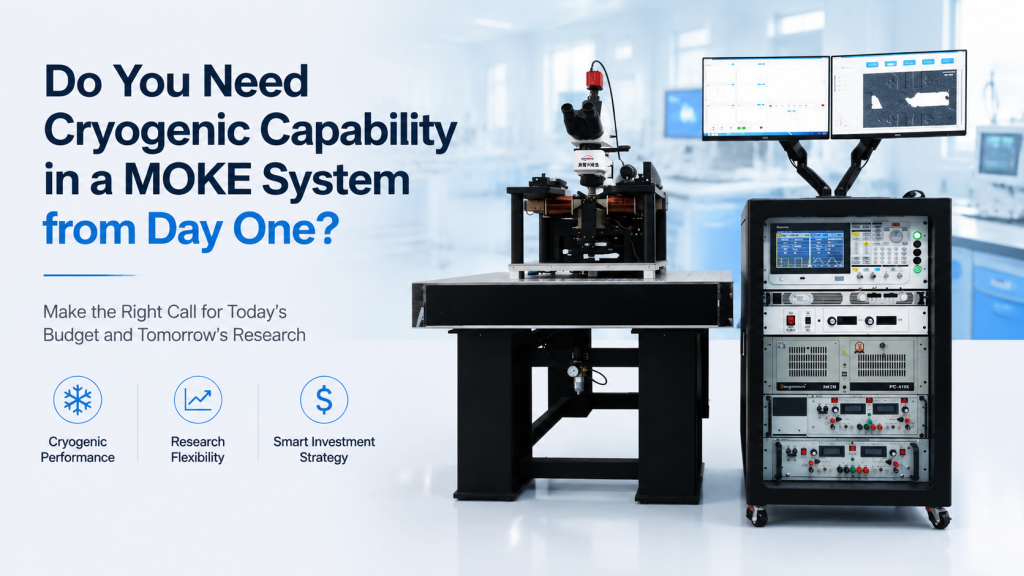
A cryogenic MOKE system can reveal magnetic behavior that is invisible at room temperature. However, adding low-temperature capability also changes the optical layout, magnet structure, sample mounting, installation requirements, operating time, and total project cost.
For laboratories with limited budgets, the real decision is not simply:
“Do we want low-temperature measurements?”
The better question is:
“Must we perform low-temperature MOKE measurements immediately, or should we purchase a room-temperature system designed around a realistic future upgrade path?”
Buying every possible option from day one can waste budget and increase complexity. But purchasing a room-temperature system with no defined cryogenic upgrade architecture may create an even more expensive problem later.
This guide explains how buyers should decide between:
- A room-temperature MOKE system
- A cryogenic-ready MOKE system
- A fully integrated cryogenic MOKE system
The goal is to match current research requirements with long-term technical planning—not to purchase the longest possible specification list.
1. What Cryogenic MOKE Capability Actually Adds
Magneto-Optical Kerr Effect measurements detect changes in reflected light associated with the magnetic state of a sample.
At room temperature, MOKE can be used to investigate:
- Magnetic hysteresis
- Coercivity
- Remanence
- Saturation behavior
- Magnetic anisotropy
- Domain nucleation
- Domain-wall motion
- Current-induced switching
- Spin-orbit torque effects
Cryogenic capability adds controlled temperature as another experimental variable.
This allows researchers to investigate how magnetic behavior changes as the sample is cooled, including changes in:
- Coercive field
- Saturation field
- Remanent magnetization
- Magnetic anisotropy
- Exchange coupling
- Domain structure
- Switching mechanisms
- Magnetic phase transitions
- Spin-reorientation behavior
- Magneto-optical response
Low-temperature MOKE has been important in research on ultrathin and two-dimensional magnetic materials. For example, scanning Kerr microscopy was used to identify temperature-dependent ferromagnetic order in atomically thin Cr₂Ge₂Te₆ crystals.
The scientific value can be significant. But that does not mean every laboratory needs cryogenic capability immediately.
2. Begin With the Research Question, Not the Upgrade List
Before adding a cryostat to a quotation, buyers should define what low temperature is expected to reveal.
Strong Scientific Reasons for Cryogenic MOKE
Cryogenic capability is justified when the research program directly involves:
- Curie or Néel temperature measurements
- Low-temperature magnetic phase transitions
- Two-dimensional or van der Waals magnets
- Magnetic topological materials
- Superconducting heterostructures
- Exchange-bias systems
- Ferrimagnetic compensation behavior
- Temperature-dependent spin reorientation
- Quantum materials
- Cryogenic spintronic devices
- Temperature-dependent domain-wall dynamics
- Magnetic behavior below room temperature
Surface MOKE studies have shown that magnetic ordering temperatures and critical behavior in ultrathin films can depend strongly on film thickness, substrate orientation, and dimensionality.
In these cases, temperature is not an optional environmental feature. It is part of the scientific measurement.
Weak Reasons for Buying Cryogenic Capability
The following statements are not, by themselves, strong technical justifications:
- “We might need it someday.”
- “It makes the system more complete.”
- “Another laboratory has a low-temperature option.”
- “The budget is currently available.”
- “We want to future-proof everything.”
- “Our samples may change in several years.”
Future planning matters, but speculative capability should not automatically control today’s system architecture.
3. When You Should Buy Cryogenic Capability from Day One
A fully integrated cryogenic MOKE system is usually the correct choice when low-temperature measurements are part of the funded project scope.
Low Temperature Is Required in the First Research Phase
Buy cryogenic capability immediately when the first planned experiments require temperature-dependent loops, domain images, or device measurements.
Examples include:
- Mapping coercivity from room temperature to cryogenic temperature
- Measuring a magnetic transition
- Studying a low-temperature ferromagnetic phase
- Characterizing a device that operates only below a specific temperature
- Comparing electrical transport and MOKE at the same temperature
- Observing temperature-dependent domain reversal
- Investigating coupling between magnetic and superconducting layers
In these cases, delaying the cryogenic option delays the main scientific objective.
Funding Is Specifically Assigned to a Complete System
Some grants, tenders, or capital-equipment budgets are approved for one integrated purchase.
A later upgrade may require:
- A new funding application
- A second tender
- Additional institutional approval
- New import procedures
- A separate installation project
If the research need is real and funding is already available, purchasing the integrated system may reduce administrative risk.
The Mechanical Architecture Must Be Designed Around the Cryostat
A cryostat is not simply another sample holder.
It may determine:
- Magnet pole gap
- Optical working distance
- Optical incidence angle
- Sample height
- Table layout
- Stage travel
- Objective position
- Cable routing
- Vacuum connections
- Cooling-line routing
When cryogenic integration fundamentally controls the system geometry, it should be included from the beginning.
You Need Guaranteed Integrated Performance
A fully integrated purchase allows the supplier to define acceptance conditions for the complete configuration, such as:
- Temperature range
- Temperature stability
- Maximum magnetic field at the cryogenic working gap
- MOKE signal at low temperature
- Optical alignment through the cryostat window
- Sample-position repeatability
- Vibration performance
- Field and temperature synchronization
This is usually safer than buying separate components and assuming they will work together.
4. When a Room-Temperature MOKE System Is the Better First Purchase
A room-temperature system can be the more disciplined choice when the initial research program does not yet require cryogenic measurements.
Current Samples Are Studied Only at Room Temperature
Many MOKE applications are conducted successfully at room temperature, including:
- Routine hysteresis-loop measurement
- Process comparison
- Thin-film screening
- Wafer mapping
- Magnetic anisotropy evaluation
- Domain imaging
- Current-induced switching
- Spin-orbit torque experiments
- Educational and training applications
Adding cryogenic hardware may not improve these measurements.
It may instead introduce:
- Longer setup time
- Reduced sample access
- More complicated alignment
- Additional vibration sources
- More maintenance
- More operator training
- A larger working gap
- Lower available magnetic field
The Material Program Is Still Changing
A laboratory may not yet know whether its future samples will require:
- Longitudinal or polar MOKE
- In-plane or out-of-plane fields
- 80 K or 4 K operation
- Optical microscopy or point MOKE
- Electrical probes
- Microwave probes
- Vacuum sample exchange
- Rotational control
Buying a cryogenic configuration too early may lock the laboratory into the wrong geometry.
The Budget Would Compromise the Core MOKE System
A cryostat should not consume so much of the budget that the buyer must accept weaker core performance.
For example, it may be more valuable initially to invest in:
- Better MOKE sensitivity
- A more suitable electromagnet
- Higher field at the required gap
- Better optical stability
- Motorized sample positioning
- Improved domain imaging
- A more rigid optical platform
- Better electrical measurement integration
A technically strong room-temperature system can be more useful than an underfunded cryogenic system.
5. The Three Main Procurement Strategies
Buyers should distinguish between three architectures.
Option A: Room-Temperature-Only MOKE System
This is designed for current room-temperature measurements without a defined cryogenic upgrade.
Advantages:
- Lowest initial cost
- Simplest operation
- Open sample access
- Easier alignment
- Faster sample exchange
- Maximum use of the available magnet gap
- Lower installation complexity
Limitations:
- Future cryogenic integration may require major redesign
- The magnet may not have enough gap
- The optics may not have enough working distance
- The sample stage may be incompatible
- Software and electrical interfaces may be missing
This option is suitable when low-temperature research is genuinely unlikely.
Option B: Cryogenic-Ready MOKE System
The initial system operates at room temperature but is designed around a defined future cryogenic upgrade.
Advantages:
- Lower initial investment than a fully integrated system
- Room-temperature measurements can begin immediately
- Core geometry can accommodate future low-temperature hardware
- Upgrade risk can be reduced
- Budget can be divided across project phases
Limitations:
- Some initial compromises may already be necessary
- The future upgrade must be defined precisely
- Cryogenic performance is not proven until the upgrade is installed
- The final magnet field may be lower than the initial room-temperature field
This is often the best option for laboratories with credible long-term plans but limited first-stage funding.
Option C: Fully Integrated Cryogenic MOKE System
The system is delivered with the cryostat, temperature control, vacuum hardware, sample mounting, optical access, and magnetic field system fully integrated.
Advantages:
- Complete performance can be tested before delivery
- Lower integration risk
- Defined temperature and field specifications
- Faster transition into low-temperature research
- One supplier can coordinate the system interfaces
Limitations:
- Highest initial cost
- More complex operation
- Longer installation and commissioning
- Greater maintenance burden
- Reduced sample accessibility
- Possible vibration and optical-window effects
This option is justified when low-temperature capability is essential from the beginning.
6. “Cryogenic-Ready” Must Be Defined Contractually
The phrase “cryogenic-ready” sounds reassuring, but it has no useful meaning unless the upgrade path is documented.
A supplier should not simply state:
“The cryostat can be added later.”
The buyer should ask exactly what will remain unchanged and what must be replaced.
Mechanical Compatibility
Confirm whether the future cryostat will fit without replacing:
- Electromagnet
- Magnet yoke
- Pole pieces
- Optical table
- Optical head
- Sample stage
- Support structure
- Enclosure
The quotation should define:
- Required future cryostat dimensions
- Reserved working space
- Optical-axis height
- Mounting interfaces
- Maximum supported weight
- Sample position relative to the magnetic-field center
Optical Compatibility
Confirm whether the future system will preserve:
- Laser access
- Reflected-beam access
- Objective working distance
- Longitudinal or polar geometry
- Spot-size capability
- Camera field of view
- Focusing range
- Detector alignment
The optical path must account for the cryostat window from the beginning.
Magnetic Compatibility
The key specification is not the magnet’s field at its smallest room-temperature gap.
It is the field available at the final cryogenic working gap.
The supplier should define:
- Expected cryostat outer dimensions
- Required pole gap
- Magnetic field at that gap
- Field uniformity
- Continuous operating condition
- Cooling requirement
- Field orientation
- Optical aperture restrictions
A magnet capable of a high field at a narrow gap may provide substantially less field after a cryostat is installed.
Electrical and Software Compatibility
A credible upgrade path may also require reserved interfaces for:
- Temperature controller
- Temperature sensors
- Heater output
- Vacuum gauges
- Pump controls
- Cryostat interlocks
- Motorized stages
- Field-temperature synchronization
- Data logging
- Electrical probes
Without these interfaces, a future upgrade may become a separate engineering project.
7. An 80 K System and a 4 K System Are Not the Same Upgrade
Buyers often use the general phrase “low-temperature MOKE” without defining the required temperature range.
This is dangerous because a system intended for approximately 80 K operation can differ substantially from one designed for temperatures near 4 K.
Liquid-Nitrogen-Class MOKE
A liquid-nitrogen or nitrogen-temperature system may be suitable for:
- Temperature-dependent magnetic anisotropy
- Exchange-bias studies
- Magnetic recording materials
- Conventional thin films
- Some spintronic devices
- Measurements that do not require helium temperatures
Potential advantages include:
- Lower initial cost
- Simpler cooling architecture
- Faster setup
- Lower operating complexity
- Reduced compressor vibration
- Less demanding thermal design
However, the exact operating temperature, hold time, refill method, and sample accessibility must still be defined.
Closed-Cycle Cryogenic MOKE
A closed-cycle system may reach much lower temperatures without requiring routine liquid-helium refilling.
It can be appropriate for:
- Quantum materials
- Two-dimensional magnets
- Superconducting heterostructures
- Low-temperature phase transitions
- Cryogenic spintronic devices
- Long-duration automated temperature sweeps
The engineering trade-offs may include:
- Cold-head vibration
- Compressor noise
- Longer cooldown and warmup
- More restricted sample access
- Greater working distance
- More complex vacuum hardware
- Higher cost
- More demanding alignment
A system designed for 80 K should not be assumed to support 4 K through a simple controller change.
8. How Cryogenic Integration Changes the MOKE Optical Path
MOKE is a polarization-sensitive optical measurement. Cryogenic integration adds one or more optical windows between the optical head and sample.
Window Birefringence
A cryostat window can alter the polarization state of the beam.
Potential causes include:
- Window material
- Mechanical stress
- Mounting pressure
- Temperature gradients
- Surface coatings
- Incident angle
- Window thickness
This can produce background signals that are unrelated to sample magnetization.
The system may require:
- Background subtraction
- Reference measurements
- Polarization compensation
- Careful window selection
- Stable window mounting
- Geometry-specific calibration
Reduced Optical Access
The cryostat may limit:
- Incident angle
- Reflected-beam angle
- Numerical aperture
- Objective diameter
- Sample rotation
- Camera field of view
- Probe access
This is especially important for longitudinal MOKE, where the beam is commonly incident at an angle.
Increased Working Distance
The optical system must focus through:
- An outer window
- Vacuum space
- Radiation shields
- An inner window or aperture
- The distance to the sample
A larger working distance may increase the laser spot size or reduce imaging resolution.
Focus Drift During Cooling
The sample position can move during cooldown because of thermal contraction.
The system may require:
- Motorized focus adjustment
- Z-axis sample control
- Position tracking
- Refocusing at each temperature
- A low-drift mechanical design
A room-temperature optical alignment should not be assumed to remain perfect at the lowest temperature.
9. How Cryogenic Integration Changes the Magnet System
Cryogenic capability and magnet design must be evaluated together.
The Pole Gap Usually Increases
The cryostat body, radiation shields, windows, and mounting hardware require physical space.
A larger gap normally affects:
- Maximum magnetic field
- Power consumption
- Coil temperature
- Field uniformity
- Pole-piece design
- Optical access
The correct procurement question is:
“What field can the system provide at the installed cryostat gap?”
Not:
“What is the maximum field of the bare electromagnet?”
Field Direction Must Match the Cryostat Geometry
The system may require:
- In-plane field for longitudinal MOKE
- Out-of-plane field for polar MOKE
- Two-axis field control
- Sample rotation
- Vector magnetic field capability
The cryostat must provide optical and mechanical access for the selected field direction.
Heating and Cooling Must Be Coordinated
A water-cooled electromagnet can introduce:
- Cooling-water vibration
- Hose forces
- Temperature gradients
- Condensation risks
- Chiller noise
A cryogenic MOKE system therefore requires coordinated planning for both the magnet cooling loop and the sample cooling system.
10. The Hidden Cost of Cryogenic MOKE
The cryostat itself is only one part of the total cost.
A complete low-temperature configuration may require:
- Cryostat
- Vacuum chamber
- Vacuum pump
- Pressure gauges
- Temperature controller
- Calibrated temperature sensors
- Heater
- Sample holder
- Thermal anchors
- Optical windows
- Radiation shields
- Compressor
- Water chiller
- Vacuum and gas lines
- Electrical feedthroughs
- Probe wiring
- Modified electromagnet
- Long-working-distance optics
- Motorized focusing
- Vibration isolation
- Installation and training
Buyers should also consider operating costs.
Measurement Time
Low-temperature experiments may include:
- Pump-down
- Cooldown
- Temperature stabilization
- Optical realignment
- Field-temperature sweeps
- Warmup
- Sample exchange
- Re-establishing vacuum
A room-temperature loop that takes minutes may become part of a multi-hour experimental cycle.
Maintenance
Maintenance may include:
- Vacuum-seal inspection
- Pump servicing
- Compressor servicing
- Cooling-water management
- Window cleaning
- Sensor verification
- Cable inspection
- Leak checking
Operator Training
Users may need to understand:
- Vacuum operation
- Temperature-controller setup
- Sensor selection
- Heater limits
- Thermal anchoring
- Condensation prevention
- Safe cooldown and warmup
- Cryogenic safety
- Optical recalibration
These costs are justified when low-temperature data are scientifically necessary. They are wasteful when the option remains unused.
11. Cryogenic Capability Can Reduce Room-Temperature Convenience
A fully integrated cryogenic configuration may not be the best platform for frequent room-temperature screening.
Potential disadvantages include:
- Slower sample exchange
- Restricted sample size
- Reduced probe access
- Smaller rotation range
- More difficult alignment
- A larger magnet gap
- Lower maximum field
- Additional optical-window background
- Longer preparation time
A laboratory processing many room-temperature samples may benefit from:
- A dedicated room-temperature holder
- A bypass configuration
- A removable cryostat
- Separate room-temperature and cryogenic sample stages
The buyer should ask whether switching between room-temperature and cryogenic operation requires:
- Removing the cryostat
- Replacing the optical head
- Realigning the beam
- Recalibrating the detector
- Changing magnet pole pieces
- Reconfiguring software
12. The Retrofit Trap
A common assumption is that low-temperature capability can always be added later.
In practice, retrofit difficulty depends on the original architecture.
A Simple Retrofit May Be Possible When
The original system already includes:
- Adequate magnet gap
- Sufficient optical working distance
- Reserved table space
- Compatible optical-axis height
- A modular sample stage
- Suitable software interfaces
- Spare electrical inputs
- A defined cryostat model
- Documented mounting points
A Major Redesign May Be Required When
The original system has:
- A narrow-gap electromagnet
- Short-working-distance optics
- An integrated sample stage with no removal path
- No optical access through a cryostat
- Insufficient table space
- No vacuum or temperature-control interfaces
- Incompatible optical height
- No allowance for thermal contraction
- No method to refocus at low temperature
The upgrade may then require replacing the magnet, optical head, stage, table, or control software.
That is not an upgrade. It is a partial repurchase.
13. A Better Staged Procurement Strategy
For budget-limited laboratories, a two-phase strategy can be effective.
Phase 1: Build a Strong Room-Temperature Core
The first-stage system may include:
- MOKE optical head
- Suitable longitudinal or polar geometry
- Electromagnet or Helmholtz coil
- Magnet power supply
- Room-temperature sample stage
- Optical table
- Control and acquisition software
- Reserved cryogenic interfaces
The room-temperature system should be fully functional and scientifically useful on its own.
Phase 2: Add a Defined Cryogenic Module
The later upgrade may include:
- Cryostat
- Vacuum system
- Temperature controller
- Sensors and heaters
- Cryogenic sample holder
- Modified optical components
- Additional stages
- Compressor or cooling hardware
- Cryogenic acceptance testing
The important word is defined.
Before Phase 1 is purchased, the supplier should provide at least a preliminary description of:
- Compatible cryostat type
- Expected temperature range
- Final magnet gap
- Expected magnetic field
- Optical geometry
- Parts to be retained
- Parts to be replaced
- Upgrade responsibilities
14. Questions to Ask About Future Upgradeability
Before accepting a “cryo-ready” proposal, buyers should ask the following questions.
Cryostat Architecture
- Which specific cryostat type can be added?
- What temperature range is expected?
- Is the cooling method liquid-based or closed-cycle?
- What is the approximate cooldown time?
- Is continuous operation possible?
- How is the sample exchanged?
Magnet Compatibility
- What pole gap will be required?
- What field will remain at the final gap?
- Is that field continuous or short-duration?
- Will new pole pieces be required?
- Will the magnet need to be replaced?
- Is the field direction compatible with the MOKE geometry?
Optical Compatibility
- Will the original optical head remain usable?
- Is a long-working-distance objective required?
- What happens to laser spot size?
- What happens to spatial resolution?
- Will the system require complete realignment?
- How will window birefringence be handled?
- Can focus be adjusted during cooling?
Mechanical Compatibility
- Will the original optical table remain suitable?
- Is enough table space reserved?
- Does the sample remain at the same optical-axis height?
- Will new stages be required?
- Can electrical probes still reach the sample?
- Is sample rotation preserved?
Control Compatibility
- Can the existing software record temperature?
- Can it synchronize field and temperature sweeps?
- Are temperature-controller drivers available?
- Can vacuum and cryostat alarms be integrated?
- Can electrical data be recorded with the MOKE signal?
Commercial Compatibility
- Which components are reusable?
- Which components must be replaced?
- Is the future upgrade price defined or only estimated?
- Who is responsible for integration?
- Will the upgraded system receive a new acceptance test?
- Does the upgrade affect the original warranty?
15. Define the Low-Temperature Acceptance Test
A low-temperature option should not be accepted merely because the cryostat reaches its minimum temperature.
The system-level acceptance test should consider:
- Minimum sample temperature
- Temperature stability
- Temperature-sensor location
- Cooldown time
- Sample-position stability
- Optical focus at low temperature
- MOKE baseline stability
- Signal-to-noise ratio
- Magnetic field at the operating gap
- Field sweep performance
- Window-related background
- Vibration during cooling
- Repeatability after thermal cycling
Temperature at the Sensor vs. Temperature at the Sample
The controller may display the temperature of a sensor mounted near the sample rather than the exact sample temperature.
Differences can arise from:
- Poor thermal contact
- Sample-holder design
- Heater position
- Sensor location
- Wiring heat load
- Optical heating
- Sweep rate
The quotation should state where temperature is measured and how the sample is thermally connected.
Test the Complete Operating Condition
If the real experiment requires simultaneous:
- Low temperature
- Magnetic field
- Optical measurement
- Electrical current
- Vacuum
- Sample positioning
Then acceptance should not test these functions only in isolation.
16. A Practical Buyer Decision Guide
Choose a room-temperature-only MOKE system when:
- Current research is entirely at room temperature
- Future cryogenic work is unlikely
- Fast sample exchange is important
- Maximum field at a narrow gap is required
- Budget should prioritize core MOKE performance
- The system is mainly for routine screening
Choose a cryogenic-ready MOKE system when:
- Current work is at room temperature
- Low-temperature research is realistically planned
- Funding will be divided into phases
- The future cryostat type can be defined now
- The magnet and optics can be designed around the future configuration
- The upgrade path can be documented
Choose a fully integrated cryogenic MOKE system when:
- Low-temperature measurements are required immediately
- The funded project depends on cryogenic data
- The sample physics occurs only at low temperature
- Integrated performance must be guaranteed
- Retrofit risk is unacceptable
- The laboratory has suitable infrastructure and trained users
17. The Most Important Budget Question
The correct comparison is not:
- Room-temperature system price
- Versus cryogenic system price
The correct comparison is:
- Cost of purchasing cryogenic capability now
- Versus cost and risk of adding it later
- Versus probability that the laboratory will actually use it
A low-temperature option purchased and never used is wasted capital.
A room-temperature platform that cannot be upgraded when the research program changes is also wasted capital.
The best decision balances:
- Current scientific need
- Credibility of future plans
- Available budget
- Upgrade complexity
- Expected system lifetime
- Institutional purchasing constraints
18. How Cryomagtech Supports MOKE and Cryogenic Planning
Cryomagtech evaluates MOKE projects as complete optical, magnetic, mechanical, thermal, and control systems.
The configuration review may consider:
- Longitudinal or polar MOKE geometry
- Point MOKE or domain imaging
- Room-temperature or cryogenic operation
- Required temperature range
- Electromagnet structure
- Magnetic field at the actual working gap
- Optical working distance
- Cryostat window configuration
- Sample mounting and thermal anchoring
- Electrical-probe integration
- Vacuum requirements
- Vibration control
- Temperature and field synchronization
- Future upgrade planning
👉 Product link placeholder: Cryomagtech MOKE Systems and Cryogenic Measurement Options
For budget-limited projects, the objective should not be to include every option.
The objective should be to build a useful first-stage system without blocking the laboratory’s most credible future research direction.
19. Key Takeaways
- A cryogenic MOKE system is justified when temperature is part of the scientific question.
- Low-temperature capability affects the optics, magnet gap, sample holder, vacuum hardware, vibration environment, and control system.
- Not every room-temperature MOKE system can be upgraded economically.
- “Cryogenic-ready” must refer to a documented mechanical, optical, magnetic, and software architecture.
- A system intended for approximately 80 K operation may be very different from one designed to approach 4 K.
- Buyers should evaluate magnetic field at the final cryostat gap—not at the bare magnet’s minimum gap.
- Cryostat windows can influence polarization-sensitive MOKE measurements.
- A fully integrated cryogenic system may reduce room-temperature convenience.
- A phased purchase can work well when the future cryostat and interfaces are defined before the first order.
- The acceptance test should verify low-temperature MOKE performance, not only minimum cryostat temperature.
The right question is not:
“Can we add a cryostat?”
The right question is:
“Can the complete MOKE system still deliver the required optical, magnetic, thermal, and sample-access performance after the cryostat is installed?”
References
- Nature — Discovery of Intrinsic Ferromagnetism in Two-Dimensional van der Waals Crystals
https://www.nature.com/articles/nature22060 - Physical Review B — Magnetism in the Few-Monolayers Limit: A Surface Magneto-Optic Kerr-Effect Study
https://journals.aps.org/prb/abstract/10.1103/PhysRevB.49.3962