
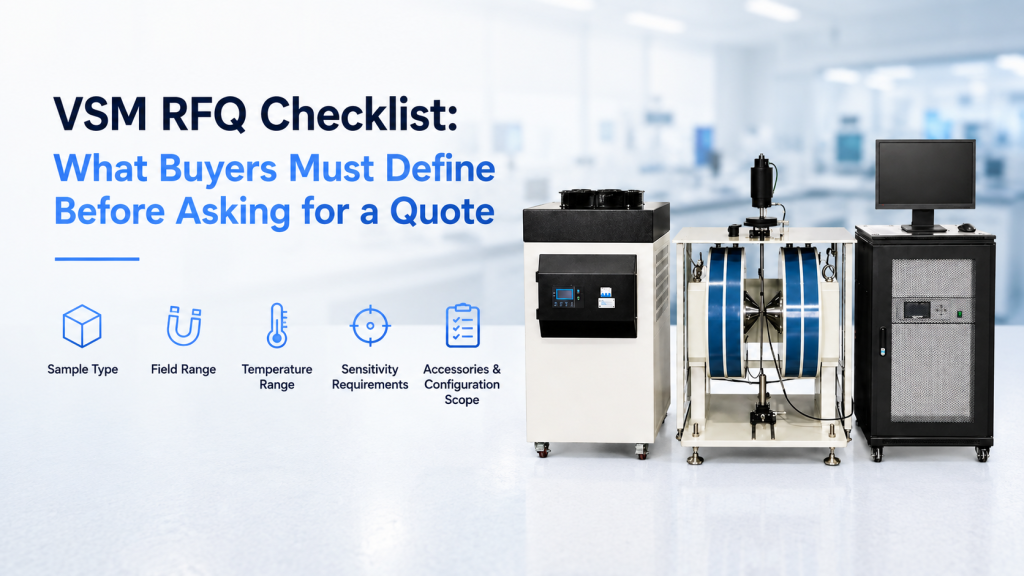
A buyer may begin a Vibrating Sample Magnetometer inquiry with one short request:
“We need a VSM. Please send your best price.”
But a meaningful VSM quotation cannot be prepared from the instrument name alone.
A VSM for room-temperature measurements of millimeter-sized permanent magnets is not the same system as a VSM for:
- Low-moment magnetic thin films
- nanoparticles and powders
- soft magnetic materials
- high-coercivity permanent magnets
- temperature-dependent magnetization
- cryogenic measurements
- high-temperature measurements
- angular anisotropy studies
- FORC analysis
- magnetic relaxation experiments
The required configuration depends on the sample, expected magnetic moment, field range, temperature range, measurement orientation, sensitivity, sample holder, software, and acceptance-test scope.
If these conditions are not defined, competing suppliers may quote technically different systems while all calling them “VSM systems.”
One supplier may quote only a room-temperature magnetometer.
Another may include:
- Higher-field electromagnet
- bipolar magnet power supply
- water chiller
- cryogenic insert
- high-temperature oven
- sample-rotation option
- low-moment pickup coils
- reference samples
- software and computer
- installation and training
The headline prices will not be comparable.
This VSM RFQ checklist helps universities, materials laboratories, semiconductor researchers, magnetic-material manufacturers, and procurement teams define the real measurement requirement before requesting a quotation.
1. What Does a VSM Measure?
A Vibrating Sample Magnetometer measures the magnetic moment of a sample while the sample vibrates relative to a set of detection coils in an applied magnetic field.
The primary measured output is normally magnetic moment as a function of:
- Magnetic field
- temperature
- time
- sample orientation
- another controlled experimental variable
The system may then calculate or display:
- Magnetic moment
- magnetization
- specific magnetization
- saturation magnetization
- remanent magnetization
- coercive field
- susceptibility
- hysteresis-loop parameters
But the VSM does not automatically know the sample’s:
- Mass
- volume
- thickness
- active magnetic volume
- substrate contribution
- density
These values must be supplied or measured correctly if the buyer wants normalized magnetization results rather than raw magnetic moment.
2. Start the VSM RFQ Checklist with the Scientific Objective
Before discussing field or sensitivity, define what the laboratory wants to learn.
Typical objectives include:
- Measuring a complete magnetic hysteresis loop
- determining saturation magnetization
- measuring remanence and coercivity
- comparing magnetic powder batches
- characterizing thin-film magnetic moment
- evaluating soft magnetic materials
- testing permanent magnets
- studying temperature-dependent magnetization
- identifying magnetic transitions
- measuring anisotropy at different angles
- studying exchange bias
- measuring minor loops
- measuring magnetic relaxation
- performing FORC analysis
- comparing zero-field-cooled and field-cooled behavior
A supplier cannot recommend the correct VSM configuration without understanding the intended measurement.
3. Identify the Sample Type
The first technical question should be:
What type of sample will be measured?
Possible sample types include:
- Bulk solid
- thin film
- multilayer film
- wafer coupon
- magnetic powder
- nanoparticle powder
- pressed pellet
- permanent magnet
- ferrite
- magnetic tape
- wire
- ribbon
- liquid suspension
- sealed capsule
- geological sample
- biological magnetic material
Each sample type creates different requirements for:
- Holder design
- background subtraction
- sample centering
- vibration stability
- maximum sample mass
- temperature compatibility
- contamination control
- measurement sensitivity
“Magnetic material” is not a sufficient sample description.
4. Provide Representative Sample Dimensions
The quotation should be based on the actual sample dimensions.
Specify:
- Length
- width
- thickness
- diameter
- mass
- shape
- permitted cutting or preparation
- dimensional variation between samples
For example:
“Thin-film samples are deposited on 10 mm × 10 mm × 0.5 mm substrates.”
This is more useful than:
“Small thin films.”
Sample dimensions affect:
- Holder selection
- pickup-coil response
- centering
- temperature-option compatibility
- magnetic-field uniformity
- background contribution
- allowed vibration amplitude
5. State the Maximum Sample Mass
A VSM sample stage has a mechanical load limit.
The buyer should define:
- Typical sample mass
- maximum sample mass
- holder mass
- whether the sample contains heavy fixtures
- whether multiple samples are mounted together
A commercial VSM configuration may support samples up to a stated mass while also offering different room-temperature, cryogenic, and high-temperature options. This demonstrates why sample mass and environmental options must be confirmed together rather than inferred from the instrument name.
A holder that is suitable for a lightweight thin film may not safely support a large permanent magnet.
6. Define Whether the Sample Is Isotropic or Anisotropic
Magnetic properties may depend on sample orientation.
Examples include:
- In-plane versus out-of-plane thin-film magnetization
- easy-axis versus hard-axis measurements
- rolling direction in magnetic sheet
- crystallographic orientation
- longitudinal versus transverse specimen direction
- aligned magnetic particles
The RFQ should state:
- Required field direction relative to the sample
- number of measurement orientations
- required angular range
- angular resolution
- whether rotation must be automated
- whether the sample can be removed and remounted
If orientation matters, a fixed holder may be insufficient.
7. Explain How the Sample Will Be Mounted
Possible mounting methods include:
- Mechanical clamp
- adhesive
- tape
- sample cup
- capsule
- quartz holder
- plastic straw
- ceramic holder
- threaded holder
- custom non-magnetic fixture
The buyer should identify:
- Permitted contact materials
- permitted adhesives
- temperature range
- chemical compatibility
- whether the sample can move
- whether the sample is fragile
- whether the sample must be recovered undamaged
The holder must secure the sample during vibration without adding excessive magnetic background.
8. Powders Require Special Attention
For powders and nanoparticles, define:
- Powder mass
- particle size
- loose or compacted condition
- packing method
- capsule material
- whether the powder is air-sensitive
- whether it is hazardous
- whether it can move during vibration
- whether density normalization is required
A powder that shifts inside a capsule may produce poor repeatability.
The supplier may need to provide:
- Sealed capsules
- compression tools
- low-background sample cups
- inert-atmosphere loading procedures
- disposable holders
9. Thin Films Need Substrate Information
For thin-film measurements, provide:
- Film material
- substrate material
- substrate dimensions
- film thickness
- number of magnetic layers
- expected magnetic area
- capping layers
- expected substrate background
- in-plane or out-of-plane requirement
The magnetic signal may be much smaller than the substrate or holder background.
A quotation for thin-film work should therefore address:
- Low-moment sensitivity
- blank-substrate measurement
- holder background
- sample-position reproducibility
- long averaging times
- background subtraction
- reference thin-film samples
10. Bulk Samples Create Different Challenges
Bulk magnetic samples may produce a large signal but require:
- Greater sample mass capacity
- stronger mechanical mounting
- larger sample space
- higher saturation field
- demagnetization correction
- wider pickup-coil dynamic range
Large samples may also violate the point-dipole assumption used in some VSM calibration models.
The supplier should confirm whether the stated accuracy applies to the buyer’s sample dimensions and geometry.
11. Estimate the Expected Magnetic Moment
Sensitivity should be selected from the expected sample signal.
Buyers should estimate the magnetic moment using available information such as:
- Magnetization × volume
- specific magnetization × mass
- published values for similar materials
- previous VSM or SQUID data
- supplier data for the material
- preliminary measurements
Useful units include:
- emu
- A·m²
- microemu
- nanoemu
The conversion commonly used is:
1 emu = 10⁻³ A·m²
The RFQ should state both the expected maximum and minimum moment where possible.
12. Define the Weakest Signal That Must Be Measured
The most important sensitivity question is not:
“What is the lowest number in the VSM brochure?”
It is:
What is the smallest sample signal that must be measured with acceptable confidence?
Define:
- Minimum expected magnetic moment
- required signal-to-noise ratio
- permitted measurement time
- field range where the weak signal occurs
- temperature where it occurs
- whether background subtraction is required
- whether the measurement must be repeatable after remounting
A very low quoted noise floor may require long averaging under ideal room-temperature conditions.
13. Do Not Confuse Sensitivity, Noise Floor, Resolution, and Repeatability
These terms are not interchangeable.
Sensitivity
The system’s ability to detect a small magnetic signal.
Noise Floor
The apparent signal variation measured under defined conditions when no meaningful sample signal is present.
Resolution
The smallest reported or distinguishable change in the measurement output.
Repeatability
How closely repeated measurements agree under the same conditions.
Reproducibility After Sample Replacement
How closely results agree after the sample is removed, remounted, and re-centered.
The quotation should define each value separately.
14. Ask Under What Conditions Sensitivity Is Specified
A sensitivity or noise-floor statement should identify:
- Averaging or integration time
- vibration amplitude
- vibration frequency
- sample position
- pickup-coil configuration
- temperature
- magnetic field
- field stability
- holder
- background-subtraction method
- bandwidth
- environmental conditions
For example, a commercial VSM may state a noise floor at a specified number of seconds per point rather than as a condition-independent value.
Compare sensitivity only when suppliers use equivalent conditions.
15. Sensitivity Should Be Matched to Measurement Time
Lower noise may require:
- Longer averaging
- slower field sweep
- more repeated measurements
- stronger vibration
- careful centering
- better environmental isolation
The buyer should state whether the priority is:
- Highest possible sensitivity
- rapid routine measurement
- balanced research performance
- automated overnight measurements
- high sample throughput
A system optimized for ultra-low-moment thin films may measure more slowly than a production screening platform.
16. Dynamic Range Matters
The VSM should measure both the weakest and strongest expected signals.
A laboratory may need to measure:
- Nanometer-thick films
- milligram powder samples
- large permanent magnets
These samples can have dramatically different magnetic moments.
Ask:
- How many gain ranges are available?
- Is range selection automatic?
- Can range changes occur during a loop?
- Do range changes affect continuity?
- What is the overload behavior?
- Is calibration valid across all ranges?
- Can one pickup-coil set cover the full requirement?
A system with exceptional low-moment sensitivity may still need a different configuration for very large magnetic moments.
17. Define the Required Magnetic Field Range
Specify:
- Maximum positive field
- maximum negative field
- continuous field
- short-duration peak field
- minimum useful field
- field step size
- field reversal requirement
Examples:
- ±0.5 T
- ±1 T
- ±2 T
- ±3 T
The highest available field is not automatically the best choice.
Higher field can increase:
- Magnet size
- power consumption
- cooling load
- system cost
- floor-space requirement
- site electrical requirements
Choose the field required by the actual sample.
18. Estimate the Saturation Field
If the goal is saturation magnetization, the available field must be high enough to approach saturation.
Provide:
- Expected saturation field
- previous hysteresis data
- coercivity
- material category
- whether complete saturation is essential
- whether high-field extrapolation is acceptable
Hard magnetic materials, antiferromagnetic materials, paramagnetic materials, and some thin films may require higher field than expected.
A VSM with insufficient field may still measure a loop, but it may not determine true saturation magnetization.
19. High-Coercivity Materials Need More Than a High Maximum Field
For hard magnets, define:
- Expected coercivity
- required reverse field
- saturation or polarization field
- maximum sample dimensions
- sample orientation
- demagnetizing-field correction
- required parameters
Possible parameters include:
- Coercive field
- remanence
- saturation moment
- hysteresis-loop squareness
- energy-product-related data
International comparison work has shown that VSM measurements are used to determine hard-magnet hysteresis parameters and that measurement uncertainty and interlaboratory agreement matter when comparing results.
The system field must exceed the measurement requirement with adequate margin.
20. Soft Magnetic Materials Need Better Low-Field Control
For soft magnetic materials, maximum field may be less important than:
- Low-field resolution
- field offset
- residual field
- demagnetization procedure
- zero-field repeatability
- field-sweep smoothness
- current noise
- probe accuracy near zero
The RFQ should state whether the buyer needs:
- Initial magnetization curves
- low-coercivity loops
- minor loops
- remanence near zero
- low-field susceptibility
An iron-core electromagnet with high remanence may require a controlled degaussing procedure.
21. Define the Field Measurement Method
Ask whether the applied field is determined by:
- Power-supply current
- fixed Hall probe
- moving field probe
- gaussmeter
- closed-loop field control
- calibrated field-current curve
- another reference sensor
Clarify:
- Probe position
- sample position
- probe-to-sample offset
- probe calibration
- field accuracy
- low-field performance
- field-polarity convention
- field readback rate
The magnetic field at the probe may not be identical to the field at the sample.
22. Separate Field Accuracy from Field Stability
Field Accuracy
How close the reported field is to the reference field.
Field Stability
How much the field changes with time under stated conditions.
Field Resolution
The smallest programmable or measurable field change.
Field Repeatability
How closely the magnet returns to the same field after repeated ramps.
The buyer should define which characteristics matter for the application.
A very fine field-setting resolution does not guarantee accurate or stable field.
23. Define the Field Sweep Protocol
A complete hysteresis-loop request should state:
- Starting field
- maximum positive field
- maximum negative field
- field-step size
- sweep rate
- branch sequence
- dwell time
- averaging time
- number of repeated loops
- demagnetization before measurement
- pre-saturation procedure
For example:
- Ramp to +1 T.
- measure from +1 T to −1 T.
- measure from −1 T to +1 T.
- return to zero.
- record one complete loop.
This is much clearer than:
“Measure an M–H loop.”
24. Field Sweep Rate Can Change Results
The selected field sweep rate affects:
- Total measurement time
- field settling
- eddy-current effects
- dynamic magnetic behavior
- instrument noise
- temperature stability
- apparent coercivity in time-dependent materials
The buyer should state whether measurements are intended to be:
- Quasi-static
- rapid screening
- rate-dependent
- time-resolved
If several sweep rates are needed, include them in the software and FAT requirements.
25. Ask About Field Settling
After a field step, the system may need time for:
- Magnet current to settle
- field probe to stabilize
- mechanical vibration to stabilize
- sample temperature to stabilize
- magnetic relaxation to occur
The quotation should describe:
- Fixed dwell time
- automatic stability criterion
- field tolerance
- maximum waiting time
- behavior when stability is not reached
Fast nominal ramping does not guarantee fast valid data acquisition.
26. Define the Temperature Range
Temperature options may include:
- Room temperature only
- liquid-nitrogen range
- 10–350 K
- 4.2–420 K
- room temperature to several hundred kelvins
- high-temperature operation above 1000 K
Commercial VSM platforms can offer distinctly different room-temperature, cryogenic, variable-temperature, and high-temperature configurations, showing why “temperature option required” is not a complete specification.
State the actual minimum and maximum temperature required.
27. Do Not Request the Widest Temperature Range Automatically
A wider range can require:
- Additional cryostat
- oven
- vacuum pump
- temperature controller
- sensors
- heaters
- gas handling
- specialized holders
- additional calibration
- longer sample exchange
- more complex maintenance
Ask:
- What scientific transition must be observed?
- Is 77 K sufficient?
- Is 20 K sufficient?
- Is 4.2 K truly necessary?
- What maximum temperature is required?
- Will the sample survive the temperature cycle?
The appropriate range is the one required by the research—not the largest number available.
28. Define Temperature-Dependent Measurement Sequences
A temperature-dependent VSM test may include:
- Hysteresis loop at each temperature
- magnetization versus temperature at fixed field
- zero-field-cooled measurement
- field-cooled measurement
- heating and cooling comparison
- temperature-dependent coercivity
- magnetic transition measurement
- magnetic relaxation at selected temperatures
Specify:
- Temperature points
- ramp rate
- stabilization criterion
- field applied during cooling
- field applied during heating
- measurement sequence
- maximum experiment duration
These requirements affect software, controller integration, and automation.
29. Distinguish ZFC and FC Requirements
If zero-field-cooled and field-cooled measurements are required, define:
Zero-Field-Cooled Sequence
- How close to zero must the field be?
- Is magnet degaussing required?
- What residual-field limit is acceptable?
- At what temperature is the field applied?
Field-Cooled Sequence
- What field is applied during cooling?
- Is the field constant?
- At which temperatures are measurements made?
- Is heating or cooling data required?
An iron-core electromagnet may retain residual field even when current is zero.
“Zero field” should therefore have a measurable definition.
30. Cryogenic Options Change the Complete System
A cryogenic VSM option may affect:
- Maximum sample dimensions
- holder design
- vibration amplitude
- magnetic field
- pole gap
- sensitivity
- sample exchange
- vacuum system
- temperature stability
- field uniformity
- installation requirements
The quotation should state performance with the cryogenic option installed—not only room-temperature specifications for the base VSM.
31. High-Temperature Options Need Atmosphere and Materials Planning
High-temperature VSM measurements may require:
- Vacuum
- inert gas
- controlled atmosphere
- oxidation protection
- high-temperature holders
- thermocouples
- heater elements
- thermal shields
- contamination control
The buyer should specify:
- Maximum temperature
- gas type
- gas purity
- vacuum level
- whether oxygen is permitted
- sample reactivity
- expected decomposition
- vapor or contamination risk
- acceptable holder materials
Some samples may chemically react with the holder or release material inside the oven.
32. Temperature Sensor Location Matters
The temperature sensor may be mounted on:
- Sample holder
- sample stage
- cryostat insert
- heater
- nearby support
The sample temperature may differ from the sensor reading because of:
- Poor thermal contact
- rapid temperature ramp
- vibration
- heater position
- radiative heating
- sample mass
- gas pressure
Ask the supplier to explain:
- Sensor location
- sample-to-sensor distance
- stabilization method
- estimated temperature difference
- temperature calibration procedure
33. Define Temperature Stability and Accuracy
State separately:
- Temperature range
- temperature accuracy
- temperature stability
- temperature resolution
- heating rate
- cooling rate
- stabilization time
A system that reaches 10 K may still require significant time to stabilize before a reliable magnetic loop is measured.
Temperature acceptance criteria should include a test duration and operating condition.
34. Define the Required Measurement Orientation
Possible requirements include:
- In-plane field
- out-of-plane field
- parallel to film surface
- perpendicular to film surface
- along crystal axis
- several defined angles
- full angular scan
The supplier should explain whether orientation changes require:
- A different holder
- manual sample remounting
- manual rotation
- automated rotation
- a different magnet gap
- recalibration
For thin films, in-plane and out-of-plane measurements may require substantially different mounting arrangements.
35. Ask About Rotation Options
If angular measurements are needed, define:
- Rotation axis
- angular range
- angular resolution
- angular accuracy
- repeatability
- operation at field
- operation at low or high temperature
- maximum sample dimensions
- cable or holder limitations
Also clarify whether:
- The sample rotates.
- the magnet rotates.
- the pickup coils rotate.
- the complete measurement head rotates.
“Rotation option” can describe several different architectures.
36. Sample Centering Is a Core VSM Requirement
The measured signal depends on the sample’s position relative to the pickup coils.
The system should provide a repeatable centering method.
Possible methods include:
- Automated vertical scan
- manual centering
- optical centering
- stored holder position
- reference-position stop
- software optimization
Ask:
- How is the center found?
- Is centering repeated for each sample?
- How long does it take?
- Does the procedure work with weak samples?
- Is the final position recorded?
- What is the repositioning repeatability?
A high-sensitivity instrument cannot compensate for badly positioned samples.
37. Define Reproducibility After Sample Replacement
For routine laboratories, reproducibility after remounting may matter more than the lowest possible noise floor.
Request an FAT test such as:
- Measure a reference sample.
- remove it.
- reinstall it.
- re-center it.
- repeat the loop.
- compare moment, coercivity, and remanence.
This tests:
- Holder repeatability
- operator workflow
- centering
- mounting
- calibration stability
It is especially useful when multiple students will use the system.
38. Holder Background Must Be Measured
A sample holder may contribute:
- Diamagnetic background
- paramagnetic background
- ferromagnetic contamination
- temperature-dependent background
- field-dependent background
Ask for:
- Empty-holder loop
- empty-capsule loop
- blank-substrate loop
- holder background versus temperature
- subtraction method
- raw background data
For weak samples, background may be larger than the sample signal.
39. Reference Samples Should Be Defined
A reference sample can support:
- Magnetic-moment calibration
- routine system checks
- sample-centering verification
- interlaboratory comparison
- FAT and SAT
NIST provides magnetic-moment and susceptibility reference materials intended for magnetometer calibration, including materials suitable for coarse and sensitive VSM ranges.
The RFQ should ask:
- Is a reference sample included?
- Is it certified or only characterized?
- What value is assigned?
- What temperature applies?
- What field applies?
- What uncertainty is documented?
- How should it be stored and handled?
40. Calibration Scope Must Be Clear
The quotation should distinguish:
Instrument Calibration
Establishes the VSM response using a reference sample or defined method.
Field Calibration
Verifies the applied magnetic field.
Temperature Calibration
Verifies the temperature measurement.
Functional Reference Check
Confirms that a known sample produces an expected result.
Accredited Calibration
Performed under a formal accredited scope with documented uncertainty.
These services are not equivalent.
41. Define the Required Output Units
The software may report:
- emu
- A·m²
- emu/g
- A·m²/kg
- emu/cm³
- A/m
- tesla-related polarization units
- Oe
- A/m
- gauss
- tesla
The buyer should specify preferred SI and legacy units.
Also define whether the software should normalize by:
- Mass
- volume
- magnetic layer volume
- sample area
- number of moles
The original raw moment should remain available.
42. Mass and Volume Normalization Require Reliable Inputs
Magnetization results may be wrong if the entered:
- Mass
- dimensions
- density
- film thickness
- magnetic volume
are inaccurate.
The RFQ should state whether the system includes:
- Balance
- thickness measurement
- density calculation
- dimensional measurement
- manual entry
- sample database
The VSM supplier normally does not control the accuracy of buyer-entered sample parameters.
43. Thin-Film Normalization Needs a Defined Magnetic Volume
For multilayer thin films, the buyer should define whether magnetization is calculated using:
- Total stack thickness
- magnetic-layer thickness only
- total substrate area
- patterned magnetic area
- nominal deposition thickness
- independently measured thickness
This choice can significantly change the reported magnetization.
The software should record the normalization basis with the result.
44. Demagnetization Corrections Should Be Discussed
The internal field in a magnetic sample can differ from the externally applied field because of sample shape and magnetization.
The effect is especially relevant for:
- Bulk samples
- plates
- cylinders
- elongated samples
- high-magnetization materials
Ask whether the software provides:
- Demagnetizing-factor entry
- internal-field correction
- shape selection
- user-defined correction
- raw uncorrected data
The calculation assumptions should be visible.
45. Define Which Magnetic Parameters Are Required
Possible outputs include:
- Saturation moment
- saturation magnetization
- remanent moment
- remanent magnetization
- coercive field
- intrinsic coercivity
- susceptibility
- loop area
- squareness
- exchange-bias field
- magnetic transition temperature
- anisotropy-related values
- FORC distribution
The supplier should confirm whether these values are:
- Calculated automatically
- calculated manually
- available through optional software
- left to the user’s own analysis
46. FORC Measurement Requires More Than a Checkbox
First-order reversal curve measurements may require:
- Large numbers of minor loops
- stable field control
- efficient measurement sequencing
- high sensitivity
- substantial data acquisition
- dedicated analysis software
- smoothing and processing settings
If FORC is required, define:
- Field range
- reversal-field spacing
- field-step spacing
- averaging
- measurement time
- software outputs
- raw-data access
Do not assume that every VSM software package includes complete FORC analysis.
47. Time-Dependent Measurements Need a Defined Protocol
Magnetic relaxation studies may require:
- Rapid transition to the target field
- precise time stamps
- fixed field stability
- repeated moment readings
- long-duration acquisition
- temperature control
- configurable sampling interval
Specify:
- Initial field
- target field
- field-change time
- total duration
- acquisition interval
- required moment stability
- required temperature stability
The field-transition and settling behavior may limit the first usable time point.
48. AC Susceptibility Is Not Automatically Included
A standard DC VSM does not necessarily provide:
- AC magnetic-field excitation
- phase-sensitive detection
- frequency-dependent susceptibility
- in-phase and out-of-phase components
If AC susceptibility is required, state:
- Frequency range
- AC field amplitude
- DC bias field
- temperature range
- sensitivity
- desired outputs
The supplier may need to offer a separate option or another measurement architecture.
49. Define Sample Throughput
Estimate:
- Samples per day
- samples per week
- measurement time per loop
- temperature cycles per sample
- required operator involvement
- maximum acceptable exchange time
A research VSM used for one detailed sample per week has different priorities from a quality-control VSM measuring many samples per day.
High-throughput requirements may favor:
- Quick-change holders
- automated centering
- stored recipes
- automatic reports
- multiple sample carriers
- barcode or sample database support
50. Ask About Sample Exchange Time
The relevant measure is:
Time from the final accepted result on Sample A to the first accepted result on Sample B.
Include:
- Warm-up, if required
- holder removal
- sample mounting
- centering
- chamber closure
- vacuum pump-down
- cooldown
- temperature stabilization
- reference check
Room-temperature and cryogenic exchange times should be stated separately.
51. Define Software Requirements
Ask whether the software supports:
- Automated hysteresis loops
- temperature-dependent loops
- ZFC and FC sequences
- angular measurements
- relaxation measurements
- minor loops
- FORC
- batch measurements
- custom field sequences
- data reprocessing
- background subtraction
- normalization
- report generation
- alarm logging
The quotation should name the included software modules.
52. Raw Data Access Is Essential
The software should preserve data such as:
- Time
- magnetic field
- field readback
- magnetic moment
- temperature
- sample position
- gain range
- averaging time
- holder background
- corrected result
- raw voltage, where available
Buyers should request:
- CSV export
- native file export
- metadata
- processing history
- software version
- calculation settings
A final PDF graph alone is not sufficient for research use.
53. Ask About Reprocessing
A good data system should allow users to reconsider:
- Background subtraction
- sample mass
- sample volume
- film thickness
- smoothing
- fitting range
- coercivity calculation
- saturation extrapolation
- demagnetization correction
Reprocessing should not require repeating the complete measurement when only a calculation input changes.
The original raw data should remain unchanged.
54. Define Remote-Control and API Requirements
Possible interfaces include:
- Ethernet
- USB
- serial communication
- SCPI
- Python API
- LabVIEW
- external trigger
- digital I/O
Ask whether the buyer can:
- Start measurements remotely
- read live data
- create custom sequences
- integrate third-party instruments
- export data automatically
- monitor alarms
- recover after communication loss
Custom API development should be separated from standard software functions.
55. Identify Third-Party Instruments
The VSM may need to work with:
- External temperature controller
- lock-in amplifier
- source-measure unit
- optical source
- cryostat
- gas controller
- vacuum system
- rotation stage
- external magnet power supply
Provide:
- Manufacturer
- model
- communication interface
- signal range
- required synchronization
- cable information
“Compatible with laboratory equipment” is too broad for a quotation.
56. Define the Complete Supplied Scope
A complete VSM quotation may include:
- Electromagnet
- pole pieces
- magnet power supply
- water chiller
- cooling hoses
- flow interlock
- VSM vibration head
- pickup coils
- signal electronics
- field probe
- gaussmeter
- sample holders
- sample-rotation stage
- temperature option
- vacuum pump
- gas-handling accessories
- software
- computer
- reference sample
- installation tools
- export packing
Each item should be marked:
- Included
- optional
- buyer-supplied
- excluded
- quoted later
57. Compare the Electromagnet and Power Supply Together
The magnet and supply should be evaluated as one subsystem.
Request:
- Magnet resistance
- magnet inductance
- maximum current
- maximum voltage
- field-current relationship
- continuous-duty point
- short-duration point
- field ramp rate
- current stability
- current ripple
- cooling requirements
- protection functions
- bipolar or four-quadrant operation
A high-field magnet is not useful if the quoted supply cannot drive it through the required loop efficiently.
58. Define Site Electrical Requirements
The quotation should state:
- Input voltage
- phase
- frequency
- maximum current
- breaker size
- power consumption
- protective grounding
- transformer requirement
- plug or hard-wiring requirement
The buyer should confirm whether the site has:
- Single-phase or three-phase power
- correct voltage
- sufficient capacity
- suitable protective earth
- local electrician support
Site electrical installation is usually separate from the VSM equipment price.
59. Define Cooling Requirements
For water-cooled electromagnet systems, ask for:
- Cooling capacity
- flow
- pressure
- inlet temperature
- outlet-temperature limit
- fluid
- filtration
- hose size
- fittings
- flow interlock
- condensation limit
Clarify whether the quotation includes:
- Chiller
- hoses
- fittings
- coolant
- filter
- flow sensor
- local plumbing
60. Consider Laboratory Space and Access
Request:
- Total footprint
- equipment height
- system weight
- service clearance
- magnet-center height
- rack dimensions
- chiller dimensions
- pump dimensions
- required table or foundation
Also confirm:
- Door width
- corridor access
- elevator capacity
- floor loading
- unloading and rigging
A VSM can fit in the room while its shipping crate cannot reach the room.
61. Ask About Magnetic and Vibration Environment
The site may contain:
- Nearby magnets
- steel structures
- elevators
- transformers
- high-current cables
- mechanical pumps
- building vibration
- cryocooler compressors
The supplier should state whether the system requires:
- Distance from magnetic materials
- vibration isolation
- dedicated foundation
- pump separation
- environmental survey
- magnetic safety boundary
These conditions may affect low-moment and low-field performance.
62. Define Safety Requirements
The VSM may require:
- Emergency stop
- cooling-flow interlock
- magnet overtemperature protection
- overcurrent protection
- cabinet interlock
- motion limit
- vacuum interlock
- high-temperature protection
- safe field ramp-down
- magnetic warning signs
The quotation should identify which safety functions are:
- Included
- integrated
- tested during FAT
- buyer-supplied
- site-dependent
63. Define the FAT Scope
A strong VSM FAT may include:
System Checks
- Visual inspection
- serial-number verification
- electrical checks
- cooling checks
- safety interlocks
- software communication
Magnetic Field Tests
- Positive and negative field
- maximum field
- field-current curve
- field stability
- field repeatability
- low-field behavior
VSM Tests
- Noise floor
- reference-sample calibration
- sample centering
- repeated loop
- sample replacement repeatability
- holder background
- dynamic range
Option Tests
- Cryogenic cooldown
- temperature stability
- high-temperature operation
- rotation
- FORC
- custom software
64. FAT Sensitivity Testing Must Use an Agreed Method
The buyer and supplier should agree on:
- Empty-holder or reference-sample method
- integration time
- bandwidth
- number of points
- field condition
- temperature
- vibration settings
- noise calculation
- pass/fail limit
A single quiet data point is not a robust sensitivity test.
Request the raw time series or repeated measurements used to calculate the result.
65. FAT Should Include a Reference Loop
A reference-sample FAT may verify:
- Moment scale
- field scale
- polarity
- coercivity
- remanence
- repeatability
- software calculations
The report should identify:
- Reference sample
- sample value
- sample orientation
- holder
- field range
- temperature
- subtraction method
- uncertainty or tolerance
- raw-data file
66. SAT and Installation Scope
Clarify whether the quotation includes:
- Remote site-readiness review
- unpacking supervision
- assembly
- cooling connection
- power connection review
- software installation
- initial startup
- reference-sample measurement
- cryogenic test
- operator training
- SAT report
Also define:
- Remote or on-site service
- number of engineering days
- travel expenses
- buyer-provided utilities
- local rigging
- local electrician
- additional-day charges
67. Training Scope
Training may cover:
- Startup and shutdown
- sample mounting
- sample centering
- hysteresis-loop measurement
- temperature sequence
- holder-background subtraction
- reference-sample checks
- data normalization
- software export
- basic maintenance
- troubleshooting
- safety
State:
- Number of trainees
- duration
- language
- remote or on-site format
- reusable training materials
- whether application development is included
68. Documentation and Handover Package
Request:
- Final configuration list
- equipment and serial-number register
- installation manual
- operating manual
- wiring diagrams
- connector pinouts
- cooling diagram
- mechanical interface drawings
- software installer
- software and firmware versions
- configuration backup
- calibration records
- FAT and SAT reports
- raw test data
- maintenance schedule
- consumables
- spare-parts list
- training records
- warranty procedure
Documentation requirements should be included in the RFQ, not added after delivery.
69. Warranty Scope
Ask:
- Warranty duration
- start date
- covered components
- third-party components
- consumables
- calibration boundaries
- remote support
- return-to-factory procedure
- on-site service
- international freight
- repaired-part coverage
- required maintenance
- operating-condition exclusions
A one-year VSM warranty may not automatically include:
- Reference-sample recalibration
- field-probe recalibration
- consumable holders
- engineer travel
- shipping and customs charges
70. Quote Exclusions
The VSM quotation should identify whether the price excludes:
- Freight
- insurance
- import duties
- taxes
- customs brokerage
- unloading
- rigging
- site electrical work
- cooling utilities
- gases and cryogens
- vacuum equipment
- installation
- commissioning
- training
- travel
- third-party calibration
- consumables
- spare parts
A “complete VSM system” should still have a detailed component and exclusion list.
71. Questions Buyers Should Answer Before Requesting a Quote
Sample Information
- Sample type:
- material:
- dimensions:
- mass:
- film thickness:
- substrate:
- powder or solid:
- hazardous or reactive:
- expected maximum moment:
- expected minimum moment:
Magnetic Requirements
- Maximum field:
- minimum field:
- continuous field:
- expected coercivity:
- expected saturation field:
- field sweep rate:
- field step:
- low-field requirement:
- minor loops:
- FORC:
Orientation
- In-plane:
- out-of-plane:
- angular measurements:
- automated rotation:
- rotation at temperature:
Temperature
- Room temperature only:
- minimum temperature:
- maximum temperature:
- ZFC/FC:
- vacuum:
- gas atmosphere:
- temperature points:
- stability:
Measurement Performance
- Required sensitivity:
- required signal-to-noise ratio:
- measurement time:
- reproducibility:
- sample throughput:
- holder-background requirement:
Supplied Scope
- Magnet:
- power supply:
- chiller:
- field probe:
- temperature option:
- vacuum pump:
- sample holders:
- software:
- computer:
- reference sample:
- FAT:
- SAT:
- training:
72. Weak RFQ Example
“We need a VSM for magnetic materials. Please quote your best price.”
This RFQ does not define:
- Sample signal
- field
- temperature
- orientation
- sensitivity
- holders
- software
- acceptance tests
- accessory scope
The supplier can only provide a catalogue recommendation or a broad price range.
73. Better VSM RFQ Example
“We require a Vibrating Sample Magnetometer for characterizing magnetic thin films, powders, and small bulk samples.
Thin-film samples are typically 10 mm × 10 mm substrates with magnetic-layer thicknesses from 20 nm to 1 μm. Powder samples are typically 10–100 mg. The expected magnetic moment range is approximately 10⁻⁶ to 10⁻² emu.
The system should provide bipolar magnetic field of at least ±2 T and support measurements in both in-plane and out-of-plane orientations. Please state the continuous-duty field, maximum field, field stability, low-field performance, ramp rate, and field-measurement method.
The required temperature range is 10–400 K. The system should support hysteresis loops at selected temperatures, magnetization-versus-temperature measurements, ZFC/FC sequences, and automated temperature stabilization.
Please quote the complete system, including electromagnet, four-quadrant power supply, chiller, VSM measurement head, pickup coils, field probe, gaussmeter, low-background sample holders, thin-film holder, powder capsules, cryogenic insert, temperature controller, sensors, vacuum equipment, software, computer, reference sample, FAT, export packing, commissioning, and training.
Please state the noise floor under defined averaging conditions, sample-replacement reproducibility, maximum sample mass, sample dimensions, holder background, sample exchange time, raw-data format, API availability, and included analysis functions.
FAT should include noise testing, a reference-sample hysteresis loop, empty-holder background, field verification, sample removal and replacement repeatability, cryogenic cooldown, temperature stability, and delivery of raw data.”
74. VSM Quote Comparison Matrix
Buyers can normalize competing quotations using a matrix like this:
| Category | Buyer Requirement | Supplier A | Supplier B | Supplier C |
|---|---|---|---|---|
| Sample types | Film, powder, bulk | Confirmed | Film only | Confirmed |
| Minimum moment | 10⁻⁶ emu | Confirmed at 10 s/point | Not stated | Estimated |
| Maximum field | ±2 T | Included | ±1.5 T | ±2 T peak |
| Continuous field | Required | ±2 T | ±1.5 T | ±1.6 T |
| Temperature | 10–400 K | Included | Optional | 20–400 K |
| Rotation | In/out-of-plane | Automated | Manual holder | Optional |
| Chiller | Included | Included | Excluded | Included |
| Vacuum pump | Included | Included | Buyer-supplied | Optional |
| Reference sample | Required | Certified | Check sample | Excluded |
| FAT raw data | Required | Included | PDF only | Optional |
| Installation | Remote or on-site | Remote | Excluded | On-site optional |
The lowest original price may not remain the lowest after missing options are added.
75. Common Buyer Mistakes
Mistake 1: Asking Only for the VSM Price
The supplier cannot define the correct configuration without the sample and measurement requirement.
Mistake 2: Selecting by Maximum Field Alone
Sensitivity, holders, low-field control, temperature, and software may matter more.
Mistake 3: Quoting Sensitivity Without Conditions
A noise floor should include integration time, field, holder, and temperature.
Mistake 4: Ignoring Expected Magnetic Moment
The system may be either under-specified or unnecessarily expensive.
Mistake 5: Forgetting Sample Orientation
In-plane and out-of-plane measurements may require different fixtures.
Mistake 6: Requesting Cryogenic Capability Without a Temperature Range
A liquid-nitrogen option and a 4.2 K option are very different systems.
Mistake 7: Ignoring Holder Background
Holder and substrate signals can dominate thin-film measurements.
Mistake 8: Assuming All Analysis Software Is Included
FORC, relaxation, angular analysis, and custom sequences may be optional.
Mistake 9: Failing to Define FAT
A supplier may perform only a simple reference loop.
Mistake 10: Comparing Incomplete System Prices
Chillers, pumps, holders, probes, computers, training, and commissioning may be excluded.
76. How Cryomagtech Supports VSM System Planning
Cryomagtech supplies VSM systems and related magnetic characterization solutions, including:
- Electromagnets
- bipolar excitation power supplies
- magnetic field probes
- gaussmeters
- water chillers
- room-temperature sample holders
- thin-film fixtures
- powder holders
- cryogenic temperature controllers
- temperature sensors
- low-temperature options
- high-temperature options
- software and data-acquisition solutions
- custom Magnet & Field Systems
For VSM projects, we help buyers define:
- Sample type and dimensions
- expected magnetic moment
- sensitivity and dynamic range
- magnetic field and coercivity
- field direction and sample rotation
- temperature range
- ZFC and FC sequences
- sample holders
- substrate and holder background
- measurement speed
- sample throughput
- reference samples
- software and analysis options
- magnet, power supply, and cooling
- FAT and SAT
- raw-data requirements
- training and documentation
- quotation inclusions and exclusions
A useful VSM quotation should not begin with the supplier choosing a model from one vague sentence.
It should begin with the buyer defining the samples, expected signals, fields, temperatures, orientations, measurement sequences, accessories, and acceptance requirements.
References
- NIST — Magnetic Moment and Susceptibility Standard Reference Materials
https://www.nist.gov/mml/materials-science-and-engineering-division/magnetic-moment-and-susceptibility-standard-reference - Lake Shore Cryotronics — MagRS Vibrating Sample Magnetometer Measurement Option
https://www.lakeshore.com/products/categories/specification/material-characterization-products/mag-rs/magrs-magnetic-research-system
Key Takeaways
- A VSM RFQ checklist should begin with the scientific objective and sample type.
- Buyers should provide sample dimensions, mass, geometry, substrate, orientation, and mounting requirements.
- Expected minimum and maximum magnetic moment should be estimated before selecting sensitivity and dynamic range.
- Sensitivity, noise floor, resolution, repeatability, and sample-replacement reproducibility are different specifications.
- Magnetic field should be defined by maximum field, continuous field, low-field behavior, sweep rate, and field accuracy.
- Hard and soft magnetic materials require different field and control priorities.
- Temperature requirements should specify the real minimum and maximum temperatures, atmosphere, stability, and measurement sequence.
- Cryogenic and high-temperature options can change sample space, holders, field, sensitivity, and sample-exchange time.
- Thin films require low-background holders, substrate subtraction, reliable centering, and clear magnetic-volume normalization.
- Powders need secure containment, known mass, low-background capsules, and contamination planning.
- Sample orientation and rotation requirements should be defined before selecting the holder and magnet geometry.
- Software requirements should cover automation, raw-data access, reprocessing, APIs, and optional analyses such as FORC.
- FAT should verify field, sensitivity, reference-sample performance, holder background, reproducibility, temperature options, and raw-data delivery.
- A complete quotation should identify magnets, power supplies, chillers, probes, holders, temperature options, pumps, software, computers, installation, training, and exclusions.
- Competing VSM quotations should be normalized to the same technical requirement and supplied scope.
For VSM procurement, the key question is not only:
“What is the price of your VSM?”
The better question is:
“What VSM configuration will reliably measure our actual samples over the required magnetic field, temperature, orientation, moment range, and measurement workflow—with all necessary holders, software, tests, and support included?”