
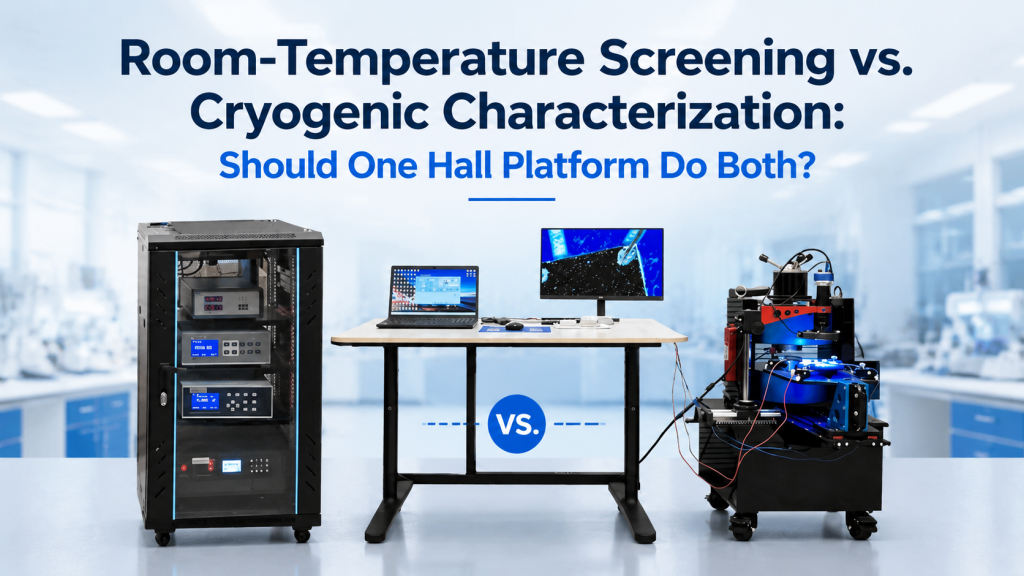
A laboratory may begin with a simple requirement:
“We need a Hall Effect Measurement System.”
But that request can describe two very different workflows.
The first is room-temperature screening:
- Measure samples quickly.
- identify carrier type.
- estimate carrier concentration and mobility.
- compare batches.
- reject poor samples.
- support routine quality control.
The second is cryogenic characterization:
- Measure transport properties across temperature.
- investigate carrier freeze-out.
- separate temperature-dependent conduction mechanisms.
- study mobility-limiting processes.
- identify transitions or parallel conduction.
- characterize advanced semiconductor materials under research conditions.
This creates an important system-planning question:
Should one Hall platform perform both room-temperature screening and cryogenic characterization, or should the laboratory use separate systems?
A combined platform can reduce duplicated hardware, create a consistent measurement workflow, and preserve room for future research. However, it may also increase purchase price, sample-loading time, system complexity, maintenance requirements, and the cost of every routine room-temperature measurement.
A two-platform strategy may provide faster screening and deeper cryogenic research, but it requires more floor space, equipment, training, and cross-system comparison.
This article explains how buyers can compare room temperature vs. cryogenic Hall measurements and choose between an all-in-one platform, a staged upgrade path, or separate Hall systems.
1. Start with the Measurement Objective
The correct platform architecture depends on what the laboratory needs to decide from the data.
Room-temperature screening may answer:
- Is the sample n-type or p-type?
- Is sheet resistance within the expected range?
- Is carrier concentration acceptable?
- Is mobility high enough to continue processing?
- Are different wafers or batches consistent?
- Should the sample proceed to more expensive testing?
Cryogenic characterization may answer:
- How does mobility change with temperature?
- Does carrier concentration decrease during cooldown?
- Is conduction dominated by one carrier population?
- Are trap states or impurity levels affecting transport?
- Does another conduction channel appear?
- Is a transport transition present?
- How stable are contacts during thermal cycling?
The system should be chosen according to the decisions the laboratory needs to make—not according to the longest list of available options.
2. What Hall Measurements Actually Provide
Hall measurements are commonly used to determine semiconductor carrier type, carrier concentration, resistivity, and Hall mobility.
NIST explains that Hall measurements allow carrier density and mobility to be separated, whereas conductivity alone gives only their combined effect. Hall data is normally interpreted together with resistivity measurements and accurate sample geometry information.
That principle applies at both room temperature and cryogenic temperature.
However, the experimental difficulty can change significantly when temperature becomes another controlled variable.
3. What Room-Temperature Screening Is Designed to Do
Room-temperature Hall screening emphasizes speed, repeatability, and simple sample handling.
A typical screening workflow may include:
- Load the sample.
- check electrical contacts.
- enter thickness and geometry.
- measure resistance.
- apply positive and negative magnetic field.
- reverse sample current, if required.
- calculate carrier concentration and mobility.
- export a report.
- remove the sample.
- load the next sample.
The system may be used for:
- Incoming wafer inspection
- thin-film process development
- batch comparison
- material selection
- production support
- rapid university sample screening
- preliminary device evaluation
In this workflow, turnaround time may matter more than a very wide temperature range.
4. What Cryogenic Characterization Is Designed to Do
Cryogenic Hall characterization adds controlled temperature to the transport measurement.
The laboratory may measure:
- Resistance versus temperature
- carrier concentration versus temperature
- mobility versus temperature
- Hall coefficient versus temperature
- magnetoresistance versus temperature
- field dependence at selected temperatures
- current dependence at selected temperatures
- heating and cooling hysteresis
Temperature-dependent Hall analysis is widely used to investigate changing carrier density and mobility. For example, published semiconductor studies have performed Hall analysis from cryogenic temperatures to room temperature to evaluate temperature-dependent transport behavior.
The cryogenic workflow is therefore not only a colder version of room-temperature screening.
It is a longer and more controlled characterization process.
5. Why Temperature-Dependent Hall Data Can Be More Informative
Carrier concentration and mobility can change with temperature.
Possible reasons include:
- Carrier freeze-out
- thermal activation
- phonon scattering
- impurity scattering
- trapping and detrapping
- interface effects
- multiple carrier populations
- parallel conduction layers
- structural or electronic transitions
The measured trend can reveal information that is invisible in one room-temperature data point.
A sample may appear acceptable at 300 K but show:
- Rapid mobility loss at lower temperature
- abnormal carrier-density variation
- contact failure during cooldown
- nonlinear Hall response
- more than one conduction channel
- unexpected resistance increase
Temperature-dependent characterization therefore answers a different class of research questions.
6. One Room-Temperature Result Does Not Predict the Full Temperature Behavior
Two samples can have similar room-temperature mobility and carrier concentration but behave differently during cooling.
Possible differences may appear in:
- Activation energy
- freeze-out temperature
- low-temperature mobility
- residual carrier density
- contact stability
- magnetoresistance
- Hall linearity
- thermal-cycle repeatability
Room-temperature screening is useful for fast selection.
It should not automatically be treated as a substitute for low-temperature characterization when the material’s application depends on cryogenic or variable-temperature performance.
7. Room Temperature vs. Cryogenic Hall Measurements: The Workflow Difference
Room-Temperature Screening
Usually prioritizes:
- Fast loading
- easy contact access
- short measurement cycles
- simple fixtures
- high sample throughput
- low operator workload
- low maintenance
- automated reports
Cryogenic Characterization
Usually prioritizes:
- Wide temperature range
- thermal stability
- controlled cooling and heating
- low-noise wiring
- vacuum integrity
- sensor calibration
- heater control
- long unattended sequences
- temperature-dependent data logging
The correct system must support the dominant workflow efficiently.
8. The Main Argument for One Combined Platform
One combined Hall platform can provide:
- One magnet
- one bipolar power supply
- one electrical measurement system
- one switching matrix
- one software environment
- one calculation method
- one report format
- one training workflow
- one data-management structure
This can make it easier to compare measurements across temperature.
The same sample can move from:
- Room-temperature contact check
- room-temperature Hall measurement
- cooldown
- low-temperature Hall measurement
- warm-up
- repeat room-temperature measurement
Using the same electrical and magnetic measurement chain can reduce some cross-platform differences.
9. The Main Argument Against One Combined Platform
A cryogenic-capable Hall system is generally more complex than a dedicated room-temperature station.
It may involve:
- Cryostat
- vacuum system
- cryocooler or cryogen
- compressor
- temperature controller
- calibrated sensors
- heaters
- vacuum feedthroughs
- thermal anchoring
- low-temperature sample holder
- longer sample exchange
- cooldown and warm-up time
- additional maintenance
If most samples require only a five-minute room-temperature decision, routing all of them through a cryogenic platform may be inefficient.
The laboratory may end up using expensive research infrastructure for routine screening.
10. Sample Throughput Is Often the Deciding Factor
Buyers should estimate the real sample volume.
Low Sample Volume
Examples:
- Two to five samples per week
- mostly research projects
- temperature sweeps are common
- one specialist operates the system
One combined platform may be practical.
Moderate Sample Volume
Examples:
- Several samples per day
- some need cryogenic testing
- others need only room-temperature results
A combined platform may work if it has a fast room-temperature fixture or bypass mode.
High Sample Volume
Examples:
- Dozens of screening samples per day
- production or process-control environment
- cryogenic tests performed only occasionally
Separate room-temperature and cryogenic systems may provide better productivity.
11. Calculate the Cost of Waiting, Not Only the Equipment Price
A combined platform may appear less expensive because it avoids buying two complete systems.
But the laboratory should also calculate:
- Sample-loading time
- vacuum pump-down time
- cooldown time
- warm-up time
- fixture-change time
- operator time
- cryogen or compressor use
- scheduling conflicts
- downtime impact
- queue for research samples
If a routine sample must wait behind a 12-hour cryogenic experiment, the combined system may become a workflow bottleneck.
Purchase price is only one part of total cost.
12. Cryogenic Sample Exchange Can Slow Routine Screening
A room-temperature holder may allow:
- Open access
- spring probes
- simple clips
- quick PCB installation
- rapid sample alignment
- immediate contact adjustment
A cryogenic holder may require:
- Wire bonding
- soldering
- conductive adhesive
- small screws
- vacuum-compatible wiring
- thermal anchoring
- cryostat insertion
- vacuum pump-down
- leak checking
Some cryogenic systems offer faster sample exchange than others, but the buyer should ask for the actual workflow.
“Room temperature is supported” does not automatically mean room-temperature testing is fast.
13. A Combined Platform Needs a Genuine Room-Temperature Mode
A useful combined system may include a dedicated room-temperature configuration.
Possible architectures include:
- Removable room-temperature sample fixture
- open-access room-temperature probe station
- cryostat that can be bypassed
- exchangeable sample stages
- quick-connect electrical interface
- common magnet with separate RT and cryogenic holders
- room-temperature insert for the cryostat
The quotation should state:
- How room-temperature samples are loaded
- whether vacuum is required
- how long sample exchange takes
- whether the cryocooler must operate
- whether the same contact method is used
- whether the same field range is available
- whether recalibration is required after fixture change
Without this information, “one system does both” may be more of a marketing statement than an operational advantage.
14. One Magnet with Two Measurement Stations
A practical hybrid architecture may use:
- One electromagnet and power supply
- one room-temperature fixture
- one cryogenic fixture
- shared measurement electronics
- shared software
- fixture-specific calibration files
This can reduce duplicated magnetic hardware while allowing different sample-handling methods.
However, the design must consider:
- Mechanical alignment
- magnetic center
- pole gap
- cryostat clearance
- fixture repeatability
- cable interfaces
- field-current calibration
- changeover time
The room-temperature and cryogenic fixtures should both place the sample at a defined field position.
15. One Electronics Platform with Two Magnets
Another strategy is:
- One electrical measurement rack
- one switching and software platform
- one small room-temperature electromagnet
- one separate cryogenic magnet or cryostat platform
This may provide:
- Fast room-temperature screening
- deeper cryogenic research
- consistent electrical measurement
- reduced duplication of source-measure electronics
- independent magnetic configurations
The limitation is that the two systems cannot normally be used simultaneously if they share the same electronics.
The laboratory must decide whether parallel operation is required.
16. Two Fully Independent Systems
A larger laboratory may prefer:
System A: Room-Temperature Screening
Optimized for:
- Speed
- open sample access
- automation
- repeatable fixtures
- batch reports
- lower operating cost
System B: Cryogenic Characterization
Optimized for:
- Temperature range
- low-noise signals
- high field
- long measurements
- complex transport analysis
- research flexibility
This architecture costs more initially but can reduce scheduling conflict and preserve research-system availability.
It is often the strongest option when both workflows are important and heavily used.
17. A Staged Upgrade Path
Some laboratories cannot fund a complete cryogenic Hall system immediately.
A staged plan may be more realistic.
Stage 1
Purchase:
- Room-temperature Hall platform
- suitable magnet
- bipolar power supply
- electrical measurement electronics
- software
- sample fixtures
Stage 2
Add:
- Cryostat
- temperature controller
- cryogenic sensors
- heater
- vacuum equipment
- cryogenic sample holder
- low-temperature wiring
- additional software sequences
This strategy works only if the original platform is genuinely upgradeable.
The buyer should ask what must be reserved in Stage 1.
18. What Must Be Reserved for Future Cryogenic Upgrades
A future cryogenic upgrade may require:
- Sufficient pole gap
- cryostat mounting points
- optical or mechanical clearance
- suitable field orientation
- additional power supply capacity
- temperature-control channels
- vacuum feedthrough support
- low-noise signal inputs
- software temperature sequencing
- fixture space
- site utilities
- compressor or cryogen access
A room-temperature magnet selected only for a small open fixture may not have enough gap for a future cryostat.
An upgrade path must be designed—not assumed.
19. Temperature Range Must Be Specific
“Cryogenic” can mean very different things.
Possible requirements include:
- 200–400 K
- 80–400 K
- 20–350 K
- 10–325 K
- 4.2–300 K
- below 4 K
These ranges may require different:
- Cooling methods
- cryostats
- sensors
- heaters
- vacuum systems
- cooldown times
- wiring
- costs
- maintenance
A liquid-nitrogen system and a 4 K cryocooler system should not be treated as equivalent options.
20. Choose the Lowest Temperature the Research Actually Needs
Lower temperature usually increases complexity and cost.
Before requesting 4 K operation, ask:
- Is 4 K scientifically necessary?
- Would 77 K answer the main question?
- Is 20 K sufficient?
- Does the material application involve cryogenic operation?
- Are important transport transitions expected below 77 K?
- Is low-temperature mobility the main target?
- Is the additional cost justified by the research plan?
The best temperature specification is not the lowest achievable number.
It is the lowest temperature required to answer the intended research question.
21. Temperature Stability and Temperature Accuracy Are Different
Buyers should define:
Temperature Range
The minimum and maximum achievable temperature.
Temperature Stability
How much the temperature changes during a measurement.
Temperature Accuracy
How close the reported temperature is to the actual sample temperature.
Temperature Uniformity
How much the temperature varies across the sample or stage.
A system may reach 10 K but still need time to stabilize sufficiently for Hall measurements.
The quotation should state the conditions under which temperature performance is specified.
22. The Sample May Not Be at the Sensor Temperature
The temperature sensor may be mounted on:
- Cold head
- sample stage
- cryostat block
- radiation shield
- sample holder
The sample itself may differ because of:
- Poor thermal contact
- measurement current
- heater operation
- wiring heat load
- optical heating
- vacuum radiation
- fast temperature ramping
For high-quality cryogenic Hall characterization, sensor placement and sample mounting should be defined.
A controller display alone does not prove the exact sample temperature.
23. Thermal Equilibrium Affects Measurement Time
A temperature sweep may use:
- Fixed temperature steps
- continuous ramp
- automated stabilization criteria
- heating-only sequence
- cooling-only sequence
- cooling and heating comparison
At each step, the software may need to wait until:
- Temperature enters a tolerance band.
- temperature drift falls below a limit.
- heater output stabilizes.
- sample resistance stabilizes.
- a minimum dwell time is completed.
The tighter the stability criterion, the longer the experiment may take.
System planning should include realistic measurement duration.
24. Low-Temperature Wiring Is a Major Difference
A cryogenic Hall platform requires wiring that balances:
- Low thermal conductivity
- electrical resistance
- current capacity
- shielding
- contact stability
- vacuum compatibility
- thermal contraction
- magnetic cleanliness
- serviceability
Typical channels may include:
- Sample-current leads
- Hall-voltage leads
- longitudinal-voltage leads
- temperature-sensor leads
- heater leads
- gate or bias lines
- spare wires
The cryogenic wiring architecture should be defined before purchase.
It cannot always be added easily later.
25. Electrical Contacts May Behave Differently During Cooldown
A contact that is ohmic and stable at room temperature may change at low temperature.
Possible issues include:
- Increased contact resistance
- nonlinear I–V behavior
- mechanical cracking
- wire-bond failure
- solder-joint stress
- thermal-contraction damage
- contact freeze-out
- intermittent connection
NIST’s Hall procedure emphasizes consistency checks that help evaluate repeatability, sample uniformity, and ohmic contact quality.
For cryogenic characterization, contact checks should be repeated at more than one temperature.
26. Contact Preparation Can Determine Whether One Platform Is Practical
Room-temperature screening may use:
- Spring probes
- temporary clips
- probe needles
- reusable fixtures
Cryogenic measurements may require:
- Wire bonding
- permanent soldered leads
- conductive epoxy
- custom sample carriers
- vacuum-compatible contacts
If the same sample must be moved from a room-temperature fixture into a cryostat, contact preparation may need to be repeated.
A combined platform is more attractive when both modes can use the same sample carrier and contact interface.
27. Magnetic Field Requirements May Differ
Room-temperature screening may need only a moderate field for routine materials.
Cryogenic characterization may require:
- Higher field
- smaller field steps
- better low-field resolution
- extended bipolar range
- slower controlled sweeps
- field-dependent fitting
- nonlinear Hall analysis
The buyer should define field requirements separately for each workflow.
Room-Temperature Requirement
- Maximum field:
- field reversal:
- measurement time:
- acceptable field stability:
Cryogenic Requirement
- Maximum field at low temperature:
- sweep range:
- field-step size:
- low-field resolution:
- maximum experiment duration:
- field uniformity at sample position:
One field number may not represent both applications.
28. Low-Temperature Measurements May Reveal Nonlinear Hall Behavior
A simple single-carrier model often assumes a linear Hall-voltage relationship with magnetic field.
At lower temperature, some materials may show:
- Nonlinear Hall resistance
- multiple carrier populations
- parallel conduction
- field-dependent mobility
- anomalous Hall contributions
NIST has published methods for extracting multiple carrier densities and mobilities from variable-field measurements, illustrating why broader field-dependent data may be necessary in multicarrier systems.
A cryogenic platform may therefore need more advanced field sweeps and analysis than a screening station.
29. Software Should Not Use One Analysis Model for Every Sample
A room-temperature screening workflow may use automated single-carrier calculations.
A cryogenic research workflow may need:
- Raw Hall-resistance curves
- nonlinear fitting
- two-carrier analysis
- temperature-dependent plots
- uncertainty review
- manual data selection
- background correction
- magnetoresistance analysis
Nature Electronics has highlighted the need for care in the reporting and interpretation of Hall mobility in emerging materials.
The software should preserve raw data and make its analysis assumptions visible.
30. Room-Temperature Screening Needs Efficient Automation
For routine screening, useful software functions may include:
- Sample ID entry
- barcode scanning
- stored sample geometries
- automatic contact checks
- current selection
- positive and negative field sequence
- current reversal
- automatic calculation
- pass/fail limits
- report generation
- database export
- batch comparison
These functions may create more practical value than advanced cryogenic analysis if the main task is quality screening.
31. Cryogenic Characterization Needs Sequence Control
For low-temperature research, useful automation may include:
- Cooldown monitoring
- temperature stabilization
- heater control
- temperature-step sequence
- field sweep at each temperature
- current sweep
- contact check at each stage
- automatic pause on instability
- warm-up sequence
- long-duration logging
- recovery after interruption
A cryogenic Hall experiment may run for many hours.
Software reliability and recovery behavior become important procurement criteria.
32. System Downtime Has Different Consequences
If one combined platform fails:
- Room-temperature screening stops.
- cryogenic research stops.
- all users share the same service delay.
With separate platforms:
- One workflow may continue while the other is serviced.
- routine screening does not consume cryogenic-system time.
- research measurements can remain undisturbed.
For high-utilization laboratories, operational resilience may justify separate systems.
33. Maintenance Requirements
A room-temperature platform may require:
- Probe maintenance
- fixture cleaning
- magnet inspection
- electrical calibration
- software updates
A cryogenic platform may additionally require:
- Vacuum maintenance
- compressor or pump service
- cryocooler maintenance
- sensor checks
- heater checks
- feedthrough inspection
- leak testing
- cryogen handling
- thermal-contact maintenance
The laboratory should consider whether it has staff capable of supporting the cryogenic infrastructure.
34. Facility Requirements
A combined cryogenic Hall platform may need:
- Electrical power
- cooling water
- compressed gas
- cryogen storage
- compressor space
- ventilation
- vacuum-pump exhaust
- floor space
- vibration isolation
- safe transfer routes
- suitable laboratory temperature
- magnetic-field safety area
Room-temperature platforms generally have fewer site requirements.
The facility plan should be reviewed before the system configuration is frozen.
35. Cryogen-Based vs. Cryogen-Free Cooling
Cryogen-Based System
May use liquid nitrogen or liquid helium.
Possible advantages:
- Familiar laboratory method
- potentially low vibration
- simpler cold-stage architecture in some designs
Possible limitations:
- Cryogen supply
- storage
- transfer
- safety procedures
- recurring operating cost
- refill interruptions
Cryogen-Free System
May use a closed-cycle cryocooler.
Possible advantages:
- No routine liquid-helium filling
- automated operation
- repeatable cooling cycles
- easier long-duration measurement
Possible limitations:
- Higher initial cost
- compressor maintenance
- vibration
- cooling time
- electrical and facility requirements
The cooling method should match the laboratory’s operating reality.
36. Vibration May Matter in Sensitive Measurements
Cryocoolers, pumps, and compressors may introduce vibration.
Possible effects include:
- Cable motion
- contact instability
- triboelectric noise
- sample movement
- optical alignment changes
- fluctuating signal background
The buyer should ask:
- Where is the compressor installed?
- Is vibration isolation included?
- How are wires fixed?
- Does measurement pause during high-vibration stages?
- Is low-noise data available from FAT?
- Is the cryogenic option compatible with optical measurements?
The importance depends on the sample signal level and measurement method.
37. A Combined Platform May Be Over-Specified for Screening
Suppose the laboratory measures:
- 500 room-temperature samples per year
- 10 cryogenic samples per year
Buying one premium cryogenic platform may technically satisfy both needs.
But every screening user may still face:
- More complex training
- more expensive fixtures
- slower sample change
- limited system access
- higher service risk
- competition with long cryogenic runs
A dedicated screening station plus access to a shared cryogenic platform may be more economical.
38. A Separate Screening System Does Not Need to Be Low Quality
Room-temperature screening should still control:
- Field accuracy
- current stability
- contact quality
- sample thickness
- temperature
- measurement repeatability
- data processing
- reference samples
The difference is optimization.
A screening system can be high quality while prioritizing speed and repeatable workflow rather than extreme temperature capability.
39. A Cryogenic System Should Not Be Judged by Screening Speed Alone
Cryogenic research systems are designed to produce controlled temperature-dependent data.
Their value may come from:
- Low-temperature stability
- low-noise wiring
- sample-environment control
- high-field sweeps
- long automated sequences
- temperature-dependent analysis
- specialized sample holders
A slower sample exchange may be acceptable if the platform supports measurements that a room-temperature system cannot perform.
The two platform types should be compared by intended purpose.
40. Budget Comparison Should Use Total System Scope
When comparing quotations, check whether the cryogenic price includes:
- Cryostat
- cryocooler or cryogen vessel
- compressor
- vacuum pump
- temperature controller
- temperature sensors
- heater
- sample holder
- cryogenic wiring
- vacuum feedthroughs
- installation accessories
- software
- shipping protection
- training
- FAT
- warranty
A low initial cryogenic quote may exclude important supporting equipment.
A higher quotation may include a more complete operating system.
41. Shared Components Can Reduce Cost
A combined or hybrid architecture may share:
- Electromagnet
- bipolar power supply
- gaussmeter
- electrical measurement rack
- switching matrix
- computer
- software license
- data format
- safety enclosure
But shared components also create scheduling dependency.
The buyer should decide which resources can be shared without slowing the laboratory.
42. When One Combined Hall Platform Makes Sense
One platform is often practical when:
- Sample volume is modest.
- most projects may eventually need temperature dependence.
- the laboratory values one consistent data workflow.
- one specialist operates the system.
- floor space is limited.
- room-temperature sample exchange is reasonably fast.
- the cryogenic range is scientifically justified.
- parallel operation is not required.
- the budget cannot support two complete platforms.
- future research flexibility is important.
In this case, the combined platform should include a clearly defined room-temperature operating mode.
43. When Separate Platforms Make More Sense
Separate systems are often better when:
- Room-temperature screening volume is high.
- Cryogenic characterization is slow and research-intensive.
- different teams use the systems.
- parallel operation is needed.
- routine samples require rapid loading.
- cryogenic downtime must not stop screening.
- screening and research field ranges differ significantly.
- different sample holders are required.
- the laboratory needs production-style reporting and research-style analysis.
Separate platforms cost more but may provide better operational efficiency.
44. When a Staged Configuration Makes More Sense
A staged system may be best when:
- Cryogenic research is planned but not yet funded.
- room-temperature screening is needed immediately.
- the future temperature range is known.
- the magnet can accommodate the future cryostat.
- software and electronics are upgradeable.
- site utilities can be added later.
- the supplier defines the upgrade boundary clearly.
The initial quotation should identify:
- What is included now
- what is reserved for later
- what components can be reused
- what must be replaced
- expected future upgrade cost
- whether the future performance is guaranteed
45. Define Sample Classes Before Selecting the Architecture
List the expected sample categories.
For each category, record:
- Sample dimensions
- thickness
- Hall-bar or van der Pauw geometry
- contact method
- resistance range
- expected mobility
- expected carrier concentration
- required magnetic field
- required temperature range
- samples per week
- test duration
- report type
This usually makes the platform decision much clearer.
46. Acceptance Criteria Should Be Separate for Both Modes
A combined system should have separate acceptance tests for room-temperature and cryogenic operation.
Room-Temperature FAT
May include:
- Reference sample measurement
- carrier type
- sheet resistance
- mobility
- carrier concentration
- contact check
- field reversal
- current reversal
- repeatability
- report export
Cryogenic FAT
May include:
- Cooldown curve
- base temperature
- temperature stability
- heater control
- sample continuity
- reference measurement at selected temperatures
- field sweep
- low-temperature noise
- warm-up
- thermal-cycle repeatability
Passing the room-temperature test does not verify cryogenic performance.
47. Reference Samples Should Match Each Workflow
A laboratory may use:
Room-Temperature Reference Sample
Selected for:
- Easy mounting
- stable contacts
- fast routine checks
- known room-temperature properties
Cryogenic Reference Sample
Selected for:
- Stable thermal cycling
- known temperature-dependent behavior
- durable low-temperature contacts
- measurable signal over the required range
One reference sample may support both modes, but this should be demonstrated rather than assumed.
48. Ask for Raw Data, Not Only Final Values
For both room-temperature and cryogenic Hall measurements, request:
- Raw current
- raw longitudinal voltage
- raw Hall voltage
- positive and negative field readings
- current-reversal readings
- sample temperature
- magnetic field
- time stamps
- contact-check data
- calculation settings
- sample geometry
- processed results
Raw data makes it easier to identify:
- Noise
- drift
- contact problems
- nonlinear Hall behavior
- temperature instability
- calculation errors
This is particularly important for research-grade cryogenic measurements.
49. Questions Buyers Should Answer Before Requesting a Quote
Workflow
- How many room-temperature samples per day?
- How many cryogenic samples per month?
- Is parallel operation required?
- Who will operate the system?
- Is routine QC or research the main purpose?
Samples
- Sample dimensions:
- thickness:
- Hall-bar or van der Pauw:
- contact method:
- resistance range:
- expected carrier concentration:
- expected mobility:
- fragile or reusable contacts:
Room-Temperature Mode
- Required field:
- sample-loading time:
- automation:
- batch reporting:
- pass/fail limits:
- reference sample:
- daily throughput:
Cryogenic Mode
- Minimum temperature:
- maximum temperature:
- cooling method:
- temperature stability:
- number of measurement temperatures:
- field sweeps:
- expected experiment duration:
- sample exchange method:
Electrical Measurement
- Sample current range:
- voltage sensitivity:
- current reversal:
- field reversal:
- low-current requirement:
- lock-in requirement:
- nonlinear Hall analysis:
- multiple-carrier analysis:
Site and Service
- Available floor space:
- power:
- cooling water:
- vacuum support:
- cryogen availability:
- compressor location:
- maintenance capability:
- installation support:
50. Better RFQ Examples
Combined Platform RFQ
“We require a Hall Effect Measurement System for both rapid room-temperature screening and variable-temperature characterization. Room-temperature throughput is approximately five samples per day, while cryogenic measurements will be performed on two to four samples per month.
Samples use van der Pauw and Hall-bar geometries and are typically 5–15 mm in size. The system should provide bipolar magnetic field up to ±1 T, current reversal, field reversal, raw-data export, and automated carrier concentration and mobility calculations.
Please propose a fast room-temperature sample fixture and a cryogenic configuration covering 20–350 K. State the sample-change procedure, typical room-temperature test time, cooldown time, temperature stability, cryogenic wiring, contact method, reference-sample FAT, and which hardware is shared between both modes.”
Separate Platform RFQ
“We require two coordinated Hall measurement workflows: a high-throughput room-temperature screening system for up to 20 samples per day and a research-grade cryogenic system for temperature-dependent Hall measurements from 10–350 K.
Please identify which electronics, software, calibration methods, and data formats can be standardized across both systems, while keeping the two platforms independently operable.”
These requests describe two different laboratory strategies.
51. Common Buyer Mistakes
Mistake 1: Asking for the Lowest Temperature Without a Scientific Reason
Lower temperature can substantially increase system cost and complexity.
Mistake 2: Assuming Cryogenic Capability Automatically Includes Fast Room-Temperature Screening
The sample-loading workflow must be checked.
Mistake 3: Comparing Only Hardware Price
Throughput, cooldown time, operating cost, and scheduling also matter.
Mistake 4: Forgetting Future Cryostat Clearance
A room-temperature magnet may not support a later cryogenic insert.
Mistake 5: Using One FAT Test for Both Modes
Room-temperature verification does not prove low-temperature performance.
Mistake 6: Ignoring Contact Behavior During Cooling
Contacts can change or fail during thermal cycling.
Mistake 7: Assuming One Analysis Model Works at Every Temperature
Low-temperature data may show nonlinear or multicarrier behavior.
Mistake 8: Overloading One Shared System
Long cryogenic runs can block routine screening.
Mistake 9: Buying Two Systems Without Standardizing Data
Different calculation methods can make cross-system comparisons difficult.
Mistake 10: Calling a Platform “Upgradeable” Without Defining the Upgrade
Future hardware, cost, and performance boundaries should be stated before PO.
52. How Cryomagtech Supports Hall Platform Planning
Cryomagtech supplies Hall Effect Measurement Systems, electromagnets, bipolar excitation power supplies, cryogenic temperature controllers, monitors, sensors, cryostats, sample holders, switching electronics, and custom Magnet & Field Systems.
For room-temperature and cryogenic Hall projects, we help evaluate:
- Screening vs. research workflows
- expected sample throughput
- Hall-bar and van der Pauw fixtures
- room-temperature sample access
- cryogenic sample holders
- magnetic field range
- current and voltage sensitivity
- temperature range and stability
- cryogenic wiring
- sensor and heater channels
- current and field reversal
- temperature-dependent sequencing
- raw-data and analysis requirements
- shared vs. independent hardware
- staged cryogenic upgrades
- FAT and SAT acceptance criteria
- total cost and workflow trade-offs
👉 [Product link placeholder: Cryomagtech Room-Temperature and Cryogenic Hall Effect Measurement System Solutions]
One Hall platform can perform both room-temperature screening and cryogenic characterization.
But that does not mean one platform is automatically the best operational choice for every laboratory.
The right architecture depends on sample throughput, research depth, temperature range, sample-change workflow, facility conditions, system utilization, and budget.
References
- NIST – Hall Effect Measurements Introduction
https://www.nist.gov/pml/nanoscale-device-characterization-division/popular-links/hall-effect/hall-effect-measurements-3 - NIST – Resistivity and Hall Measurements
https://www.nist.gov/pml/nanoscale-device-characterization-division/popular-links/hall-effect/resistivity-and-hall - Scientific Reports – Temperature-Dependent Charge-Carrier Transport Measured by Hall-Effect Analysis
https://www.nature.com/articles/s41598-020-69153-1 - Nature Electronics – Reporting Hall Effect Measurements of Charge Carrier Mobility in Emerging Materials
https://www.nature.com/articles/s41928-024-01198-w - NIST – Multicarrier Characterization Method for Extracting Mobilities and Carrier Densities
https://www.nist.gov/publications/multicarrier-characterization-method-extracting-mobilities-and-carrier-densities
Key Takeaways
- Room-temperature screening and cryogenic Hall characterization serve different laboratory goals.
- Room-temperature systems prioritize speed, simple sample loading, repeatability, batch comparison, and routine reports.
- Cryogenic systems prioritize temperature control, low-noise wiring, long measurement sequences, and temperature-dependent transport analysis.
- One combined platform can reduce duplicated hardware and provide a consistent measurement chain.
- A combined platform may become a bottleneck when screening volume is high or cryogenic experiments are long.
- A useful combined system needs a genuine fast room-temperature mode, not merely the ability to measure at 300 K inside a cryostat.
- Separate screening and cryogenic platforms may be more efficient when both workflows are heavily used.
- A staged upgrade can work when cryostat clearance, electronics, software, wiring, and site utilities are planned in advance.
- Room-temperature and cryogenic modes need separate FAT and acceptance criteria.
- Total cost should include throughput, cooldown time, maintenance, operating cost, downtime, and scheduling—not only purchase price.
For Hall system planning, the key question is not only:
“Can one platform measure at both room temperature and cryogenic temperature?”
The better question is:
“Can one platform perform both workflows efficiently enough, or would separate screening and characterization systems produce better data, throughput, and total value?”