
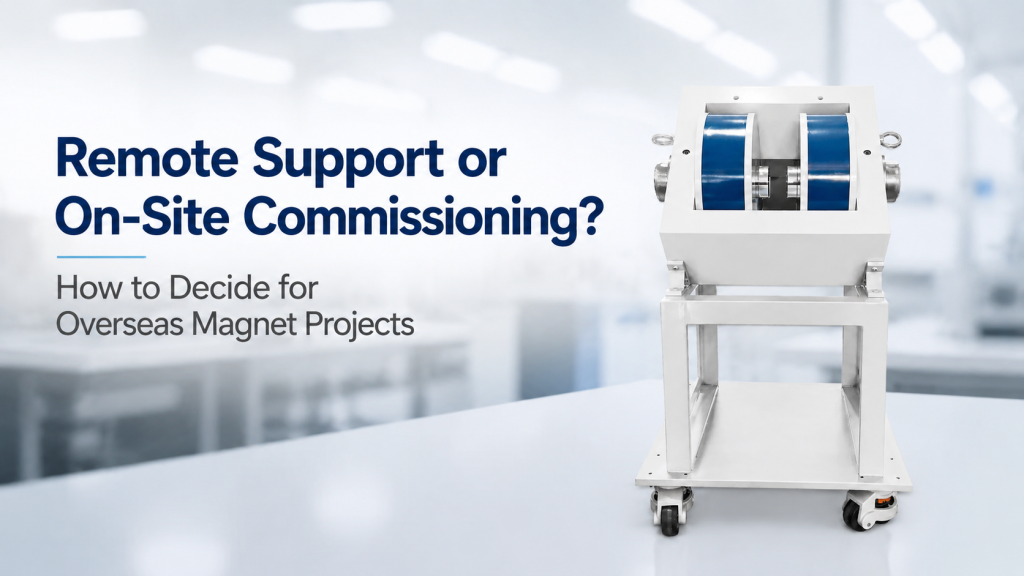
For overseas magnet projects, buyers often ask:
“Do we need on-site commissioning, or is remote support enough?”
The honest answer is:
It depends on the system, the site, the buyer’s technical team, and the acceptance requirements.
For a small Helmholtz coil, a compact electromagnet, or a basic excitation power supply, remote support may be enough if the buyer has qualified lab staff and clear installation documents.
For a large electromagnet, three-axis Helmholtz coil, cryogenic integration system, Hall platform, VSM-related magnetic system, MOKE setup, or custom field rig, on-site commissioning may be worth considering—especially when mechanical alignment, high current, cooling, safety interlocks, field verification, and user training are involved.
This article explains how buyers can decide between remote support and on-site commissioning before placing an overseas order.
1. Why Support Planning Matters Before Purchase
Support planning is often discussed too late.
A buyer may first focus on:
- Magnetic field strength
- coil size
- pole gap
- power supply rating
- price
- lead time
- warranty
- shipping cost
But after delivery, the real question becomes:
“Who will install, check, power up, test, and hand over the system?”
If this is not clear before purchase, the project may face:
- delayed installation
- wiring mistakes
- cooling problems
- unclear responsibility
- failed site acceptance
- unsafe startup
- missing test data
- user training gaps
- disagreement over what is included
For overseas magnet projects, service scope should be defined before PO, not after the crate arrives.
2. Remote Support Is Not a Low-Quality Option
Remote support is sometimes misunderstood as “less professional.”
That is not always true.
Remote support can work very well when the system is clearly documented, the buyer has capable technical staff, and the installation risk is moderate.
Remote support may include:
- Email guidance
- video meeting support
- installation checklist
- wiring diagram review
- software installation support
- remote training
- field verification guidance
- troubleshooting by photos and videos
- startup sequence review
- acceptance document support
- operator training materials
For many laboratory systems, remote support is efficient, practical, and cost-effective.
The key is not whether support is remote.
The key is whether the remote support scope matches the system risk.
3. On-Site Commissioning Is Not Always Necessary
On-site commissioning sounds reassuring.
But it is not automatically required for every project.
It adds:
- travel cost
- visa and scheduling complexity
- site coordination
- insurance and safety requirements
- local access arrangements
- longer project planning
- higher total cost
For simple systems, on-site commissioning may not add enough value.
A compact Helmholtz coil system with a matched power supply and clear user manual may be installed by the buyer’s lab team with remote support.
A small electromagnet may only need:
- mechanical placement
- power connection
- cooling check, if applicable
- software setup
- basic field verification
- remote startup guidance
In these cases, remote support may be the better choice.
4. Start with System Complexity
The first decision factor is system complexity.
Remote Support Is Usually Suitable For
- Basic excitation power supplies
- compact Helmholtz coils
- small electromagnets
- simple single-axis magnetic field systems
- standard sensors and monitors
- systems with plug-and-play wiring
- low-risk manual operation
- systems with clear factory test reports
- buyers with experienced lab engineers
On-Site Commissioning May Be Better For
- Large electromagnets
- high-current water-cooled systems
- multi-axis Helmholtz coil systems
- field mapping rigs
- cryostat-integrated magnet systems
- optical-access magnetic systems
- Hall measurement platforms with complex wiring
- VSM or MOKE-related integrated platforms
- systems requiring formal SAT
- projects with strict acceptance criteria
The more integrated the system is, the more useful on-site commissioning becomes.
5. Mechanical Installation Risk
Magnet systems are physical systems, not only electrical instruments.
Mechanical installation may involve:
- heavy structures
- lifting equipment
- alignment
- pole gap setting
- coil frame leveling
- vibration control
- optical table mounting
- cryostat clearance
- sample center alignment
- safety spacing
- cable routing
- cooling hose routing
If the buyer has no experience installing heavy laboratory systems, remote support may not be enough.
On-Site Commissioning Is More Valuable When
- The magnet is heavy
- alignment is critical
- the system must integrate with a cryostat
- optical access must be aligned
- the field center must match sample position
- site layout is crowded
- local lifting and positioning are difficult
- mechanical tolerance is tight
For large systems, physical installation is often the highest-risk step.
6. Electrical and Power Requirements
Magnet systems may require high current, high voltage, water cooling, and safety interlocks.
The installation team must understand:
- input power
- grounding
- cable rating
- connector polarity
- cooling interlock
- emergency stop
- output enable sequence
- current ramping
- fault reset
- safe shutdown
- inductive load behavior
NIST SP 800-82 explains that operational technology systems interact with the physical environment and must address performance, reliability, and safety requirements.
Reference link: https://csrc.nist.gov/pubs/sp/800/82/r3/final
That point applies directly to magnet systems.
A programmable magnet power supply is not just a computer-controlled device. It drives real current through real coils and creates real magnetic fields.
If the electrical installation is simple, remote support may be enough.
If the electrical installation is high-power or safety-critical, on-site commissioning deserves serious consideration.
7. Cooling and Thermal Management
Many magnet systems require cooling.
Cooling may include:
- air cooling
- water cooling
- chiller connection
- cooling-water flow monitoring
- coil temperature monitoring
- power supply ventilation
- cryogenic cooling
- compressor lines
- thermal sensors
- overtemperature protection
Cooling errors can cause serious problems.
Examples include:
- wrong hose connection
- poor water flow
- clogged filter
- air bubbles
- condensation
- insufficient chiller capacity
- overheating coil
- power supply airflow blockage
- missing flow interlock
Remote support can guide the buyer through checks, but the buyer must be capable of performing them.
For high-current systems, cooling should be verified before full-power operation.
8. Software and Control Interface Complexity
If the system only needs manual current control, remote support is usually easier.
If the system requires automation, the support requirement increases.
Complex software support may involve:
- driver installation
- SCPI commands
- API integration
- USB or LAN communication
- LabVIEW / Python / MATLAB control
- sequence programming
- data logging
- trigger input/output
- safety signal monitoring
- field sweep setup
- multi-axis control
The ISA/IEC 62443 series addresses secure industrial automation and control systems and emphasizes the connection between operational technology and cybersecurity.
Reference link: https://www.isa.org/standards-and-publications/isa-standards/isa-iec-62443-series-of-standards
For overseas projects, remote software support should also consider IT restrictions:
- Can the lab install drivers?
- Is remote desktop allowed?
- Can the PC connect to the internet?
- Is LAN control permitted?
- Does the university block unknown software?
- Are admin rights available?
- Is offline operation required?
Software support is not only a technical issue.
It is also an IT policy issue.
9. Remote Access and Cybersecurity
Remote support may require online meetings, screen sharing, or remote desktop access.
Some buyers allow this.
Some do not.
For universities and corporate labs, cybersecurity policies may restrict:
- remote desktop tools
- cloud software
- VPN access
- external network connections
- USB driver installation
- file transfer
- supplier access to lab PCs
- camera access inside labs
CISA’s practice guide on managing remote access for industrial control systems notes that no single secure remote access solution applies to all control systems.
Reference link: https://www.cisa.gov/sites/default/files/2023-01/RP_Managing_Remote_Access_S508NC.pdf
For magnet projects, this means remote support must be planned realistically.
If the buyer cannot allow screen sharing or remote access, support may need to rely on:
- screenshots
- offline logs
- recorded videos
- step-by-step manuals
- email-based troubleshooting
- scheduled video calls without direct control
Remote support can still work, but the workflow must be clear.
10. Acceptance Requirements: FAT vs SAT
Support decisions should also depend on acceptance requirements.
FAT: Factory Acceptance Test
FAT is performed before shipment.
It may verify:
- system configuration
- field-current curve
- power supply function
- software communication
- cooling operation
- basic safety checks
- documentation package
- packing inspection
SAT: Site Acceptance Test
SAT is performed after installation at the buyer’s site.
It may verify:
- shipment condition
- site installation
- local power and cooling
- software operation on site
- basic field output
- user handover
- site-specific checks
Factory tests and site tests are not the same.
A system may pass FAT but still need site checks because the site environment is different.
Before PO, the buyer and supplier should define which items are verified remotely, which are verified at factory, and which require on-site commissioning.
11. When Remote Support Is Usually Enough
Remote support is usually enough when the system has low installation complexity.
Good Conditions for Remote Support
- System is small or medium size
- buyer has experienced technical staff
- wiring is simple
- power input is standard
- cooling is not required or is simple
- software is standard
- no third-party integration is needed
- no strict SAT is required
- field verification can be performed by buyer
- installation area is already prepared
- documentation is clear
- buyer can share photos, videos, and logs
Typical Remote Support Tasks
Remote support can cover:
- unpacking guidance
- visual inspection
- wiring confirmation
- power-up sequence
- software setup
- current output test
- field probe reading guidance
- troubleshooting
- user training
- acceptance document review
For many overseas projects, this is enough.
12. When On-Site Commissioning Is Worth Considering
On-site commissioning becomes more valuable when the system is large, integrated, or high-risk.
Strong Reasons for On-Site Commissioning
- Heavy magnet installation
- high-current power supply
- water-cooled electromagnet
- multi-axis field system
- cryostat integration
- optical alignment
- complex Hall, VSM, or MOKE workflow
- field mapping acceptance
- third-party instrument integration
- buyer has limited technical staff
- strict institutional acceptance
- safety interlock verification
- formal training requirement
- urgent project timeline
- high-value project with low tolerance for delay
On-site commissioning is most useful when the risk is not only product operation, but system integration.
13. Buyer Site Readiness Is More Important Than Support Type
Even on-site commissioning can fail if the site is not ready.
Before installation, buyers should prepare:
- Space
- table or floor support
- input power
- grounding
- cooling water or chiller
- ventilation
- computer
- software permission
- internet or offline support method
- lifting tools
- unpacking tools
- safety access
- sample holder
- field probe, if buyer-provided
- cryostat, if integrated
- optical table, if needed
- trained local contact person
If the site is not ready, the engineer’s visit may become wasted time.
Remote or on-site support only works when preparation is real.
14. Who Is Responsible for What?
Service boundaries must be clear.
For overseas magnet projects, responsibility may be divided among:
- Magnet supplier
- buyer’s lab team
- university facility team
- electrical contractor
- chiller supplier
- cryostat supplier
- optical table supplier
- local logistics provider
- customs broker
- safety officer
Responsibilities to Define
Before PO, define who handles:
- Unpacking
- lifting
- positioning
- power wiring
- grounding
- cooling connection
- water quality
- software installation
- computer preparation
- internet access
- cryostat mounting
- optical alignment
- field verification
- user training
- SAT documentation
- local safety approval
A supplier cannot reasonably be responsible for site conditions they do not control.
But the supplier can help the buyer define what must be prepared.
15. Remote Support Requires Better Documentation
If remote support is planned, documentation becomes more important.
Useful documents include:
- Unpacking guide
- installation checklist
- wiring diagram
- power requirement sheet
- cooling requirement sheet
- software installation guide
- startup procedure
- shutdown procedure
- troubleshooting guide
- acceptance checklist
- training slides or videos
- packing list
- spare parts list
- safety notes
Remote support works best when the buyer can follow clear steps and provide evidence.
For example:
- Photo of wiring before power-up
- video of water flow check
- screenshot of software connection
- field probe reading at known current
- fault log export
- photo of final installation
Remote support is not just talking.
It is a structured workflow.
16. On-Site Commissioning Requires a Written Scope
If on-site commissioning is included, the scope should be written.
On-Site Scope May Include
- Unpacking inspection
- mechanical positioning guidance
- cable connection review
- cooling check
- software startup
- output test
- field verification
- safety interlock check
- basic user training
- SAT checklist support
On-Site Scope May Exclude
- Local electrical construction
- building power modification
- water line installation
- crane or forklift service
- customs clearance
- room renovation
- cryostat repair
- third-party equipment warranty
- customer sample preparation
- full application method development
- long-term experimental service
Written scope prevents misunderstanding.
On-site commissioning is not the same as taking over the buyer’s entire laboratory project.
17. Training Scope Should Be Defined
Training can mean different things.
Basic Operation Training
This may include:
- Startup and shutdown
- current setting
- field setting
- software operation
- safety warnings
- basic troubleshooting
- data export
Maintenance Training
This may include:
- checking cables
- cooling system checks
- connector inspection
- cleaning
- storage
- replacement of basic accessories
Application Training
This may include:
- Hall measurement workflow
- magnetic field calibration
- field mapping
- MOKE measurement logic
- low-temperature operation
- sample holder usage
Application training is usually deeper and may need separate scope.
Before PO, buyers should ask:
“What training is included, and what training is not included?”
18. Cost Comparison: Remote vs On-Site
Remote support is usually lower cost.
On-site commissioning may include:
- engineer travel
- airfare
- hotel
- local transport
- visa
- insurance
- daily service fee
- translation support
- schedule buffer
- local safety requirements
For small systems, this may be disproportionate.
For large systems, it may be justified.
The cost decision should be based on risk.
Practical Rule
If the risk of failed installation is low, remote support is usually enough.
If failed installation would delay a major project, damage equipment, or create safety risk, on-site commissioning may be worth the cost.
19. Time Zone and Communication Planning
For overseas support, time zone matters.
Remote support should define:
- contact person
- support language
- available support hours
- response time expectation
- preferred communication method
- file sharing method
- video meeting platform
- emergency contact method
- escalation path
A time zone difference does not prevent support.
But it requires planning.
If the buyer expects real-time support during local working hours, that should be discussed before the order.
20. Spare Parts and Tools
Support is easier when basic spare parts and tools are available.
Depending on the system, buyers may need:
- spare fuses
- spare connectors
- communication cable
- field probe holder
- water hose fittings
- non-magnetic tools
- sample holder accessories
- USB drive with software
- spare sensors
- labels
- cable ties
- basic multimeter
- gaussmeter or teslameter, if required
Remote support is much harder when the buyer lacks basic tools.
For important projects, a small spare parts and tools checklist can reduce downtime.
21. What Buyers Should Ask Before PO
Before choosing remote support or on-site commissioning, buyers should ask the supplier:
System Questions
- How complex is installation?
- What can be done by the buyer?
- What requires supplier guidance?
- What risks exist during startup?
- Is field verification needed?
- Is cooling required?
- Is software integration required?
- Are safety interlocks included?
Site Questions
- What power input is required?
- What grounding is required?
- What cooling water or chiller is required?
- What space is required?
- What lifting tools are required?
- What computer and software permissions are required?
- What internet access is needed for support?
- What local safety checks are needed?
Support Questions
- What remote support is included?
- Is video support included?
- Is remote desktop support available?
- Is on-site commissioning optional?
- What does on-site commissioning include?
- What costs are excluded?
- What training is included?
- What documents are provided?
- What acceptance checks are supported?
These questions make support scope practical instead of vague.
22. Decision Guide
Choose Remote Support When
- The system is standard or moderately simple
- buyer has capable technical staff
- installation conditions are ready
- field verification is simple
- software is standard
- no heavy mechanical alignment is needed
- no complex third-party integration is involved
- budget is limited
- documentation is sufficient
Choose On-Site Commissioning When
- The system is large or heavy
- alignment is critical
- high current or cooling creates safety risk
- cryostat or optical integration is involved
- multi-axis calibration is required
- formal SAT is required
- buyer lacks experienced technicians
- system downtime would be costly
- the project value justifies service cost
Choose Hybrid Support When
Many projects are best served by a hybrid model:
- FAT before shipment
- detailed installation documents
- remote unpacking and wiring check
- video-guided startup
- remote software training
- optional on-site commissioning if problems arise or formal SAT is needed
Hybrid support balances cost and risk.
23. How Cryomagtech Supports Overseas Magnet Projects
Cryomagtech supplies Magnet & Field Systems and related research equipment for overseas university, laboratory, and industrial customers, including electromagnets, Helmholtz coils, magnetic field drivers, Hall-related systems, cryogenic instruments, VSM/MOKE-related magnetic platforms, and custom integrated solutions.
For overseas projects, we can support:
- Pre-shipment FAT planning
- installation documents
- wiring and interface guidance
- cooling and power requirement clarification
- remote startup support
- video-based troubleshooting
- software setup support
- field verification guidance
- training scope discussion
- SAT checklist support
- optional on-site commissioning evaluation for suitable projects
- clear service boundary definition before PO
Remote support and on-site commissioning are not competing ideas.
They are two service models.
The right choice depends on system complexity, site readiness, safety risk, buyer capability, and acceptance requirements.
References
- NIST – SP 800-82 Rev. 3: Guide to Operational Technology Security
https://csrc.nist.gov/pubs/sp/800/82/r3/final - ISA – ISA/IEC 62443 Series of Standards
https://www.isa.org/standards-and-publications/isa-standards/isa-iec-62443-series-of-standards - CISA – Managing Remote Access for Industrial Control Systems
https://www.cisa.gov/sites/default/files/2023-01/RP_Managing_Remote_Access_S508NC.pdf - Wikipedia – Commissioning
https://en.wikipedia.org/wiki/Commissioning
Key Takeaways
- Remote support can be enough for many overseas magnet projects when the system is standard, documentation is clear, and the buyer has capable technical staff.
- On-site commissioning is more valuable for large, high-current, water-cooled, multi-axis, cryogenic, optical, or formally accepted systems.
- The support model should be decided before PO, because it affects price, schedule, service scope, acceptance, and responsibility boundaries.
- Site readiness is critical. Even on-site commissioning can fail if power, cooling, space, lifting tools, software permissions, or local staff are not prepared.
- Remote support works best when supported by installation checklists, wiring diagrams, videos, photos, logs, and clear startup procedures.
- On-site commissioning should have a written scope, including what is included and what is excluded.
- Cybersecurity and IT restrictions should be considered when remote access, screen sharing, or remote desktop support is expected.
- A hybrid model often works well: FAT before shipment, remote startup support, and optional on-site commissioning for complex acceptance or integration needs.
For overseas magnet projects, the key question is not only:
“Can the supplier provide support?”
The better question is:
“Which support model matches the real installation risk, site readiness, safety requirements, and acceptance scope?”