
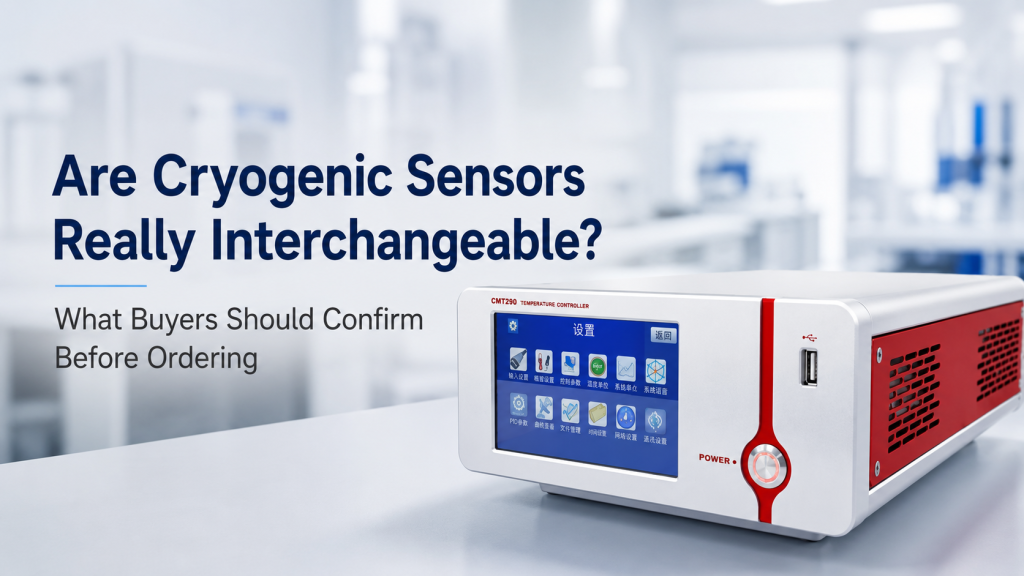
Cryogenic temperature sensors may look easy to replace.
A buyer may think:
“The controller already has a sensor input.”
“The connector looks similar.”
“The old sensor is broken, so we can just buy another one.”
“Cernox, diode, Pt100, RTD—they are all temperature sensors.”
This is a risky assumption.
Cryogenic sensors are not always interchangeable.
A Cernox sensor, silicon diode, Pt100 / Pt1000 RTD, ruthenium oxide sensor, germanium sensor, or thermocouple may require different excitation, wiring, calibration curves, temperature ranges, magnetic-field behavior, and controller input settings.
In cryogenic measurement and control, the sensor is not only a replaceable accessory.
It is part of the measurement chain.
This article explains what buyers should confirm before ordering cryogenic temperature sensors, temperature controllers, monitors, or replacement probes.
1. Why Cryogenic Sensors Are Easy to Misunderstand
At room temperature, many users are familiar with standard sensors such as thermocouples, Pt100 RTDs, or digital temperature sensors.
Cryogenic temperature measurement is different.
Low-temperature sensors are selected based on:
- Temperature range
- sensor type
- sensitivity
- calibration curve
- excitation current or voltage
- self-heating
- magnetic-field environment
- thermal anchoring
- wiring method
- controller compatibility
- required accuracy
- mechanical package
- installation location
The same controller may support one sensor type but not another.
The same sensor type may also behave differently depending on calibration grade, package type, and operating environment.
2. Sensor Type Comes First
Before asking whether a sensor is interchangeable, identify the sensor type.
Common cryogenic temperature sensors include:
- Cernox resistance temperature sensors
- silicon diode sensors
- platinum RTDs such as Pt100 or Pt1000
- ruthenium oxide sensors
- germanium sensors
- thermocouples
- carbon-glass sensors
- calibrated resistance thermometers
Each type has different electrical behavior.
Example
A silicon diode temperature sensor is usually read by measuring voltage under a defined excitation current.
A Cernox sensor is a resistive sensor and is usually read by resistance measurement.
A Pt100 is also resistive, but its useful range, resistance curve, sensitivity, and calibration assumptions are different from many cryogenic RTDs.
If the controller input mode does not match the sensor type, the reading can be wrong or impossible.
3. Same Connector Does Not Mean Same Sensor
A connector can be misleading.
Two sensors may use similar-looking plugs or wires, but that does not mean they are interchangeable.
The buyer must confirm:
- Sensor model
- sensor type
- wiring configuration
- pinout
- connector type
- controller input mode
- excitation method
- calibration curve
- temperature range
- sensor serial number, if calibrated
A cryogenic sensor should never be replaced only by matching the connector.
That is how bad temperature data begins.
4. Temperature Range Must Match the Real Experiment
Different cryogenic sensors are designed for different temperature ranges.
Some are excellent below 4 K.
Some are better around 77 K.
Some are useful from liquid nitrogen temperature to room temperature.
Some are not suitable below a certain temperature.
Lake Shore describes Cernox cryogenic temperature sensors as offering high sensitivity, low magnetic field-induced errors, and stability over a broad range from 100 mK to 420 K. (lakeshore.com)
This does not mean every sensor should be replaced with Cernox.
It means the buyer should match sensor type to temperature range and application.
Practical Question
Do you need measurement at:
- 300 K?
- 77 K?
- 20 K?
- 4.2 K?
- 1.6 K?
- below 1 K?
The answer changes the sensor choice.
5. Controller Compatibility Is Not Automatic
A cryogenic temperature controller must support the sensor electrically and mathematically.
Buyers should confirm whether the controller supports:
- Sensor type
- excitation current
- excitation voltage
- resistance range
- voltage range
- curve input
- sensor calibration table
- two-wire, three-wire, or four-wire measurement
- temperature display range
- control-loop compatibility
- alarm and monitor functions
A controller that supports silicon diode sensors may not automatically support Cernox.
A controller that supports Pt100 may not automatically support low-temperature calibrated RTDs.
A monitor that can display temperature may not be suitable for precise temperature control.
6. Calibration Curves Are Not Optional Details
A cryogenic sensor often requires a calibration curve or standard curve.
The controller converts a measured electrical signal into temperature.
That conversion depends on the correct curve.
If the Wrong Curve Is Used
The system may show:
- wrong temperature
- nonlinear error
- incorrect low-temperature reading
- wrong control behavior
- unstable temperature regulation
- misleading calibration data
For calibrated sensors, the calibration curve may be tied to the sensor’s serial number.
Using the wrong curve can destroy the value of a calibrated sensor.
7. Standard Curve vs. Individual Calibration
Some sensors are used with a standard curve.
Others are individually calibrated.
Standard Curve
A standard curve may be acceptable when:
- accuracy requirement is moderate
- temperature range is not extremely demanding
- the sensor type is consistent
- the application is monitoring rather than precision control
Individual Calibration
Individual calibration may be needed when:
- high accuracy is required
- low-temperature performance is critical
- the sensor is used for research data
- traceability is required
- the sensor is used as a reference
- the temperature range is very low
- the control process is sensitive
NIST states that its Low Temperature Calibration Facility can calibrate many capsule and miniature resistance thermometers in vacuum from 0.65 K to 83.8 K, with special tests possible as high as 165 K, and that these calibrations are traceable to ITS-90 through NIST standard check thermometers. (nist.gov)
For most laboratory equipment buyers, this does not mean they need NIST calibration for every sensor.
It means calibration status and traceability should be understood before ordering.
8. Excitation Current Can Change the Result
Resistance sensors need excitation.
But excitation current causes power dissipation.
Power dissipation can heat the sensor slightly above the object being measured.
This is called self-heating.
At cryogenic temperatures, self-heating can become important because cooling power is limited and thermal links may be weak.
Buyers Should Confirm
- Recommended excitation current
- controller excitation settings
- sensor resistance range
- self-heating risk
- thermal anchoring method
- measurement speed
- control stability
A sensor may be technically compatible with the controller but still perform poorly if excitation is too high or thermal contact is poor.
9. Two-Wire, Three-Wire, and Four-Wire Measurement
Wiring configuration matters.
Two-Wire
Simple, but lead resistance is included in the measurement.
This may be acceptable for rough monitoring but can create error for resistance sensors.
Three-Wire
Often used to reduce lead resistance effects for RTD measurement when wires are matched.
Four-Wire
Preferred for precision resistance measurement because it separates current and voltage leads.
For cryogenic resistance sensors, four-wire measurement is often important when accuracy matters.
Before replacing a sensor, confirm the wiring method used by the controller and the existing installation.
10. Lead Wire Material and Thermal Anchoring Matter
The sensor itself is not the whole temperature measurement.
The wires also matter.
Lead wires can introduce:
- heat leak
- voltage error
- thermal EMF
- mechanical strain
- vibration transfer
- poor thermal anchoring
- electrical noise
In low-temperature systems, wires should often be thermally anchored at intermediate stages to reduce heat flow to the cold point.
A good sensor with poor wiring can still give poor temperature data.
11. Sensor Mounting Can Create Bigger Error Than Sensor Type
The sensor must be thermally connected to the object being measured.
A poorly mounted sensor may read its own temperature, wire temperature, or nearby structure temperature—not the actual sample temperature.
Mounting problems include:
- weak thermal contact
- too much adhesive
- poor surface contact
- loose clamp
- sensor far from sample
- large thermal gradient
- poor heat sinking of wires
- sensor exposed to radiation
- sensor mounted on a different thermal mass
A sensor replacement should not only ask “which model?”
It should also ask “where and how will it be mounted?”
12. Magnetic Field Environment Must Be Confirmed
Cryogenic sensors are often used inside magnetic systems.
This includes:
- superconducting magnets
- electromagnets
- Helmholtz coils
- Hall measurement systems
- VSM systems
- MOKE systems
- cryogenic transport platforms
- low-temperature sample stages
Magnetic field can affect some sensors more than others.
This is one reason Cernox sensors are often selected for cryogenic environments involving magnetic fields. Lake Shore highlights low magnetic field-induced errors as one feature of Cernox sensors. (lakeshore.com)
Practical Question
Will the sensor operate in:
- zero field?
- low magnetic field?
- strong DC field?
- sweeping field?
- field reversal?
- high-field superconducting magnet?
- near an electromagnet pole gap?
If yes, sensor magnetic-field behavior should be considered.
13. Sensor Package Type Matters
The same sensor family may come in different packages.
Package choices may affect:
- thermal response time
- mounting method
- mechanical strength
- electrical insulation
- vacuum compatibility
- cryogenic cycling reliability
- sample-space compatibility
- magnetic-field placement
- ease of replacement
Common package considerations include:
- Bare chip vs mounted package
- screw-mount package
- epoxy-mounted package
- capsule package
- surface-mount package
- connectorized probe
- custom probe assembly
A replacement sensor must fit the mechanical and thermal installation, not just the controller input.
14. Response Time Is Not the Same as Accuracy
Some applications need fast temperature response.
Others need stable long-term control.
A small sensor with good thermal contact may respond quickly.
A larger mounted package may respond more slowly but be mechanically easier to install.
Fast Response Matters For
- Rapid cooldown monitoring
- pulsed heat experiments
- AC calorimetry
- temperature sweep experiments
- small sample stages
- control near thermal transitions
Stability Matters For
- Long transport measurements
- Hall measurements
- optical low-temperature experiments
- magnetic property measurement
- overnight stability tests
Do not choose a sensor only by nominal accuracy.
Response behavior matters.
15. Sensor Location: Stage Temperature Is Not Always Sample Temperature
A common mistake is assuming:
“The controller reads 4.2 K, so the sample is 4.2 K.”
Not always.
The sensor may be mounted on:
- Cold finger
- sample stage
- heater block
- thermal shield
- cryostat wall
- sensor holder
- near the sample but not on the sample
- a different thermal mass
If the sample has poor thermal contact, the sensor reading may not represent the sample temperature.
This is especially important for:
- Hall measurements
- optical measurements
- high-current samples
- laser-heated samples
- low-temperature transport
- cryogenic sensor calibration
- vacuum systems
For serious experiments, sensor location should be documented.
16. Replacement Sensors Must Match the Control Loop
If the sensor is used only for monitoring, replacement is simpler.
If the sensor is used for active temperature control, compatibility becomes more critical.
The controller’s PID behavior depends on:
- sensor response
- sensor noise
- sensor location
- heater location
- thermal mass
- heat leak
- mounting method
- excitation settings
- sampling rate
Replacing a sensor with a different type may change the control loop.
The system may become slower, noisier, or unstable.
For temperature control systems, the sensor and controller should be treated as one control chain.
17. Sensor Monitors and Temperature Controllers Are Different
A temperature monitor displays temperature.
A temperature controller uses sensor feedback to control a heater or cooling process.
They may have different requirements.
Temperature Monitor
Usually needs:
- correct sensor input
- correct curve
- stable reading
- alarm output, if required
- data logging, if required
Temperature Controller
Also needs:
- control output
- heater drive
- PID settings
- stability
- safety limits
- sensor feedback reliability
- control-loop tuning
A sensor that is acceptable for monitoring may not be ideal for control.
Before ordering, confirm whether the sensor will be used for monitoring, control, or both.
18. Multi-Sensor Systems Need Channel Matching
Many cryogenic systems use more than one sensor.
For example:
- Sensor 1: sample stage
- Sensor 2: cold head
- Sensor 3: thermal shield
- Sensor 4: magnet coil
- Sensor 5: sample holder
- Sensor 6: heater block
In multi-sensor systems, buyers should confirm:
- which sensor type is used on each channel
- whether all channels support the same sensor type
- whether curves can be uploaded per channel
- whether each sensor is calibrated
- whether sensor labels match the controller channels
- whether wiring and connectors are clearly documented
A multi-channel monitor may support different sensor inputs, but this must be verified before ordering.
19. Common Mistakes Buyers Make
Mistake 1: Replacing by Shape or Connector
Same appearance does not mean same sensor type or curve.
Mistake 2: Ignoring Controller Input Compatibility
The controller must support the sensor electrically and mathematically.
Mistake 3: Forgetting Calibration Curve
Without the correct curve, temperature conversion may be wrong.
Mistake 4: Assuming Pt100 Works for All Low-Temperature Ranges
Pt100 sensors are useful in many applications, but they are not automatically suitable for every cryogenic range.
Mistake 5: Ignoring Magnetic Field Effects
Some sensors are more suitable than others in magnetic fields.
Mistake 6: Overlooking Self-Heating
Excitation current can heat the sensor, especially at low temperature.
Mistake 7: Mounting the Sensor Poorly
Thermal contact and location can dominate measurement error.
Mistake 8: Treating Monitoring and Control as the Same
Control applications need stable feedback, not only a readable temperature.
20. What Buyers Should Confirm Before Ordering
Before buying a cryogenic sensor or replacement sensor, confirm the following.
Sensor Information
- Sensor type:
- manufacturer and model:
- package type:
- temperature range:
- calibrated or standard curve:
- serial number, if calibrated:
- magnetic field environment:
- accuracy requirement:
- response time requirement:
Controller Compatibility
- Controller model:
- supported sensor type:
- supported excitation:
- resistance or voltage range:
- curve input supported:
- number of channels:
- monitor or control use:
- alarm or safety functions:
- heater control requirement:
Installation Information
- Mounting location:
- mounting method:
- thermal contact method:
- wire length:
- wire material:
- two-wire, three-wire, or four-wire:
- connector type:
- vacuum or cryogenic cycling requirement:
- sample-space limits:
Application Information
- Monitoring or active control:
- temperature range:
- magnetic field range:
- sample heat load:
- required stability:
- required accuracy:
- data logging requirement:
- calibration traceability requirement:
This information helps avoid ordering a sensor that fits physically but fails technically.
21. When Sensors Are Interchangeable
Cryogenic sensors may be interchangeable when all important conditions match.
A replacement may work when:
- sensor type is the same
- controller supports the sensor
- calibration curve is correct
- excitation settings match
- wiring configuration matches
- package fits mechanically
- temperature range is suitable
- magnetic-field behavior is acceptable
- mounting method is compatible
- required accuracy is not higher than the replacement can support
In this case, replacement may be straightforward.
But the word “same” must be checked carefully.
Same family does not always mean same calibration.
Same connector does not mean same curve.
Same resistance at room temperature does not mean same cryogenic behavior.
22. When Sensors Are Not Interchangeable
Sensors are usually not interchangeable when:
- sensor types are different
- controller input mode is different
- curve cannot be uploaded
- excitation method is wrong
- resistance range is outside controller capability
- temperature range is unsuitable
- magnetic field affects the reading
- package cannot be mounted properly
- wiring configuration is different
- calibration accuracy is required but unavailable
- the sensor is part of a control loop
- the application is near the lower limit of the sensor range
If any of these conditions apply, do not treat the sensor as a plug-and-play replacement.
23. How Cryomagtech Supports Cryogenic Sensor and Controller Selection
Cryomagtech supplies cryogenic temperature controllers, temperature monitors, cryogenic sensors, magnetic field systems, Hall-related systems, and low-temperature measurement support for research and laboratory applications.
For cryogenic sensor selection and replacement projects, we help evaluate:
- Cernox, diode, Pt100 / RTD, and other sensor compatibility
- controller input type
- sensor excitation requirements
- calibration curve support
- temperature range
- magnetic-field environment
- monitoring vs control use
- wiring configuration
- sensor mounting method
- thermal anchoring needs
- multi-channel monitor requirements
- replacement sensor feasibility
- documentation and setup guidance
Cryogenic sensors are not automatically interchangeable.
The correct choice depends on the full measurement chain: sensor, controller, curve, wiring, mounting, field environment, and real temperature requirement.
References
- Lake Shore Cryotronics – Cernox Cryogenic Temperature Sensors
https://www.lakeshore.com/products/categories/overview/temperature-products/cryogenic-temperature-sensors/cernox - Lake Shore Cryotronics – Cryogenic Temperature Sensors
https://www.lakeshore.com/products/categories/temperature-products/cryogenic-temperature-sensors - NIST – Calibration of Cryogenic Resistance Thermometers Between 0.65 K and 165 K
https://www.nist.gov/publications/calibration-cryogenic-resistance-thermometers-between-065-k-and-165-k-international - NIST – Cryogenics
https://www.nist.gov/programs-projects/cryogenics
Key Takeaways
- Cryogenic sensors are not always interchangeable, even if connectors or packages look similar.
- Sensor type must match the controller input mode, excitation method, calibration curve, and temperature range.
- Cernox, silicon diode, Pt100 / RTD, and other sensors have different electrical behavior and use cases.
- Calibration curves are critical for accurate temperature conversion, especially for calibrated cryogenic sensors.
- Magnetic field environment, self-heating, wiring method, and thermal mounting can strongly affect the reading.
- Monitoring and active temperature control have different sensor requirements.
- A replacement sensor should be checked as part of the full measurement chain, not as an isolated part.
For cryogenic temperature measurement, the key question is not only:
“Can this sensor be connected?”
The better question is:
“Can this sensor, controller, calibration curve, wiring, mounting method, and operating environment produce the temperature data we actually need?”