
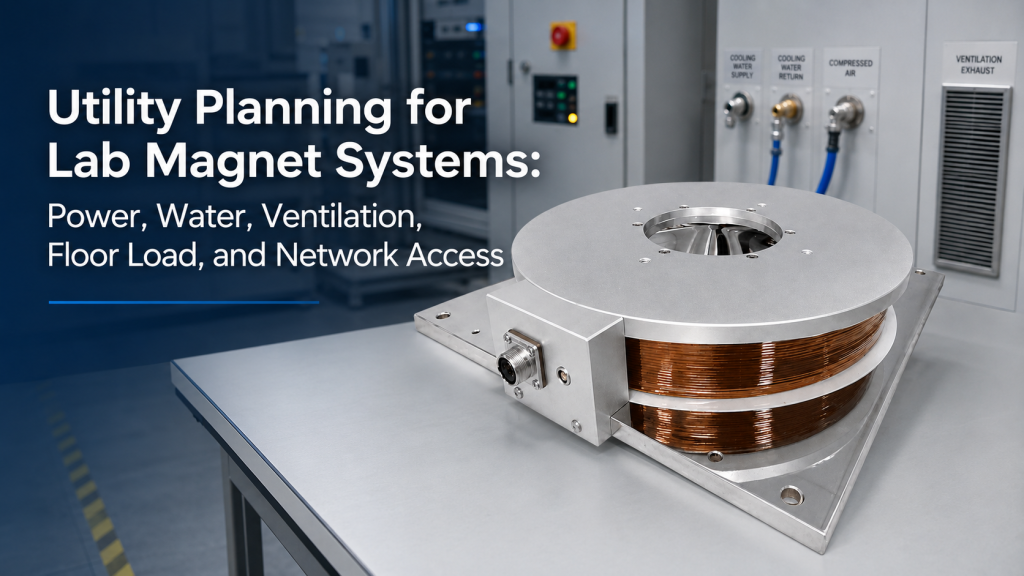
When laboratories purchase a magnet system, the first focus is usually the equipment itself:
“How strong is the magnetic field?”
“What is the pole gap?”
“What is the uniformity?”
“What power supply is included?”
“What is the delivery time?”
These are important questions.
But they are not the whole project.
For large electromagnets, Helmholtz coil systems, water-cooled coils, excitation power supplies, control cabinets, and custom magnetic field systems, the final success often depends on the laboratory’s site conditions.
Power supply, cooling water, ventilation, floor load, cable routing, and network access can all affect whether the system can be installed and operated smoothly.
This article explains the key utility conditions laboratories should check before ordering a magnet system.
1. Why Utility Planning Matters Before Purchase
A lab magnet system is not always a simple plug-and-play device.
Depending on size and field level, it may require:
- High-current electrical input
- Dedicated power line
- Water cooling or external chiller
- Ventilation for heat removal
- Strong bench or floor support
- Enough clearance for installation and maintenance
- Safe cable and hose routing
- Computer and network access for control software
- Local electrical and facility approval
If these conditions are not checked early, the equipment may arrive before the lab is ready.
This can lead to installation delays, extra cost, internal safety review problems, or even the need to redesign part of the system.
Laboratory design guidance often emphasizes that safety, use practices, and facility conditions should be considered during planning because they directly influence laboratory design and operation. Stanford’s Laboratory Standard & Design Guidelines, for example, state that laboratory design should consider use practices and that environmental health and safety consultation is important during planning.
2. Electrical Power: More Than Voltage and Plug Type
Power planning is the first utility issue to check.
For magnet systems, laboratories should confirm:
- Input voltage
- Frequency
- Single-phase or three-phase supply
- Maximum current capacity
- Breaker rating
- Grounding condition
- Plug and socket type
- Dedicated line availability
- Local electrical safety requirements
- Distance between power supply and magnet
A small Helmholtz coil may only need a standard lab power outlet.
A large electromagnet or high-current power supply may require a dedicated electrical line.
The most common mistake is only checking voltage.
For example, saying “we have 230 V AC” is not enough. The supplier also needs to know available current, phase type, breaker capacity, and whether the circuit can support continuous operation.
For high-power systems, the laboratory’s electrician or facilities team should be involved before the order is finalized.
3. Current, Voltage Compliance, and Cable Distance
For coil systems, the power supply must match the coil load.
Important factors include:
- Required current
- Required voltage compliance
- Coil resistance
- Coil inductance
- Cable length
- Connector type
- Voltage drop
- Heating
- Noise pickup
- Safety protection
A power supply located far away from the magnet may require longer high-current cables.
Longer cables can increase resistance, voltage drop, heating, and electromagnetic noise.
This matters for:
- Helmholtz coils
- Electromagnets
- AC field coils
- High-current excitation power supplies
- Multi-axis magnetic field systems
A clean installation plan should define where the power supply or control cabinet will be placed before shipment.
4. Cooling Water and Chiller Requirements
Large or high-duty-cycle magnet systems often generate significant heat.
Water cooling may be required for:
- High-field electromagnets
- Continuous-duty coil systems
- Large Helmholtz coils
- High-current power supplies
- Long-duration testing
- Industrial calibration systems
The laboratory should confirm:
- Whether facility cooling water is available
- Whether an external chiller is needed
- Required flow rate
- Inlet and outlet temperature range
- Water pressure
- Hose size and connector type
- Water quality requirements
- Drainage availability
- Leak monitoring or protection needs
- Space for chiller placement
A magnet system may meet the magnetic field requirement only if the cooling condition is adequate.
If cooling water is not available, the quotation may need to include a chiller. If the chiller is placed in the same room, its heat and noise must also be considered.
This is why cooling should be treated as part of the system, not as an afterthought.
5. Ventilation and Heat Removal
Even water-cooled systems can add heat to the lab environment.
Heat may come from:
- Power supplies
- Control cabinets
- Chillers
- Air-cooled coils
- Fans
- Transformers
- Electronic loads
- Computer workstations
If heat is not removed properly, the room temperature may rise. This can affect user comfort, measurement stability, and long-term equipment reliability.
Ventilation planning should consider:
- Room size
- HVAC capacity
- Heat output from equipment
- Airflow direction
- Chiller exhaust
- Fan noise
- Hot air recirculation
- Clearance around cabinets
- Dust and filter maintenance
Laboratory HVAC and ventilation planning is a major part of laboratory design, not a minor detail. The ASHRAE Laboratory Design Guide and similar laboratory planning references focus heavily on laboratory HVAC, ventilation, control, and safety concepts for lab environments.
6. Floor Load and Mechanical Support
Large electromagnets, frames, control cabinets, chillers, and test fixtures can be heavy.
Before ordering, the customer should check:
- Equipment weight
- Footprint
- Point load
- Floor load rating
- Bench load capacity
- Elevator capacity
- Door width
- Corridor width
- Lifting access
- Installation path
- Vibration sensitivity
A magnet system that fits technically may still fail practically if it cannot be moved into the laboratory or supported safely.
This is especially important for:
- Large C-frame electromagnets
- Heavy water-cooled magnet assemblies
- Large-diameter Helmholtz coils
- Multi-axis field systems
- Systems mounted on optical tables
- Systems installed in upper-floor laboratories
For overseas deliveries, it is better to confirm the installation path before shipment, not after the crate arrives.
7. Space, Clearance, and Maintenance Access
The magnet itself is only part of the footprint.
The lab must also reserve space for:
- Power supply
- Chiller
- Control cabinet
- Computer
- Cables
- Cooling hoses
- Sample loading
- Operator movement
- Maintenance access
- Emergency access
Clearance is particularly important around:
- Magnet pole gaps
- Coil openings
- Water connectors
- Cooling fans
- Rear panels
- Electrical cabinets
- Emergency stop buttons
A system may fit on paper but become difficult to operate if there is not enough access for sample loading or maintenance.
For custom systems, a simple top-view and side-view layout drawing can prevent many problems.
8. Network Access and Software Control
Many modern lab magnet systems include software control or communication interfaces.
These may involve:
- USB
- RS-232
- RS-485
- Ethernet
- LAN control
- Remote desktop support
- Data export
- Software licensing
- Driver installation
- Lab computer permissions
- IT firewall restrictions
Network and computer access should be checked early.
In many universities and corporate labs, users may not have administrator rights on laboratory computers. Network access may also require IT approval.
For remote installation or online support, the supplier may need:
- Video meeting access
- Screen sharing permission
- Software installation permission
- Remote troubleshooting method
- Communication port availability
- Data export path
If these are not prepared, online installation and training can be delayed even when the hardware is ready.
9. Grounding, Noise, and Sensitive Measurements
Magnet systems often work with sensitive measurement instruments.
Poor grounding or noisy electrical environments can affect:
- Hall voltage measurement
- Magnetoresistance data
- Sensor calibration
- Low-level signal measurement
- Field stability
- Communication reliability
- Power supply noise performance
Laboratories should consider:
- Grounding quality
- Shared circuits with noisy equipment
- Nearby motors or compressors
- Large switching power supplies
- Cable shielding
- Signal cable separation
- Earth loop risks
- Electromagnetic interference
This is especially important when a magnet system is used with Hall measurement, MOKE, VSM, cryogenic transport, or sensitive sensor testing.
A strong magnet system cannot fully compensate for a poor measurement environment.
10. Safety and Local Facility Approval
Large laboratory equipment often needs internal approval before operation.
Depending on the institution, approval may involve:
- Facilities department
- Electrical safety officer
- Laboratory manager
- Environmental health and safety t
eam
- Building manager
- IT department
- Procurement team
Topics may include:
- Electrical safety
- Cooling water leakage
- Heat load
- Floor load
- Emergency stop access
- Mechanical stability
- Cable trip hazards
- Magnetic field exposure area
- Warning signs
- Operator training
This is especially relevant for universities, government labs, and corporate R&D facilities.
A professional procurement process should clarify these issues before the system is shipped.
11. A Practical Utility Checklist Before Ordering
Before requesting a final quotation or issuing a purchase order, laboratories should prepare the following information:
Electrical Power
- Available voltage and frequency
- Single-phase or three-phase supply
- Maximum current or breaker rating
- Grounding condition
- Plug/socket requirements
- Distance from power source to equipment
Cooling
- Facility water availability
- Chiller requirement
- Flow rate and temperature conditions
- Hose and connector preferences
- Drainage and leak protection needs
Ventilation
- Room size
- HVAC capacity
- Heat-sensitive experiments nearby
- Chiller placement
- Cabinet and fan clearance
Mechanical Site Conditions
- Floor load rating
- Table or bench capacity
- Door and elevator dimensions
- Installation path
- Available footprint
- Maintenance clearance
Control and Network
- Computer availability
- Software installation permission
- Interface type
- Network restrictions
- Remote support access
- Data export requirements
Preparing this information early can reduce quotation revisions and prevent installation delays.
12. How Cryomagtech Supports Utility Planning
Cryomagtech supplies magnet and field systems for overseas research and industrial laboratories, including electromagnets, Helmholtz coil systems, excitation power supplies, and related control configurations.
For suitable projects, we help customers clarify:
- Required electrical input
- Cooling and chiller requirements
- Power supply and control cabinet placement
- Cable and hose routing
- Basic installation space
- Remote installation and training scope
- Utility-related risks before shipment
Our goal is not only to quote the magnet itself.
Our goal is to help customers confirm whether the laboratory site is ready for the system they want to install.
A successful magnet system project depends on both equipment performance and site readiness.
References
- Stanford Environmental Health & Safety – Laboratory Standard & Design Guidelines
Stanford’s guide states that laboratory design should consider use practices during the planning process and that EH&S consultation is important for health, safety, and environmental questions. - ASHRAE Laboratory Design Guide / Laboratory Design Handbook
Laboratory design references emphasize HVAC, ventilation, controls, and safety planning as important parts of laboratory environments.
Key Takeaways
- Magnet system planning should include both equipment specifications and site utilities.
- Power supply conditions must include current capacity, phase type, grounding, and circuit limits.
- Water cooling and ventilation can affect continuous operation and room stability.
- Floor load, installation path, and maintenance clearance should be checked before shipment.
- Network access and software permissions can affect remote installation and training.
- Utility planning helps prevent late-stage delays, extra cost, and installation problems.
A magnet system does not operate in a datasheet.
It operates inside a real laboratory, with real power, cooling, space, safety, and facility constraints.