
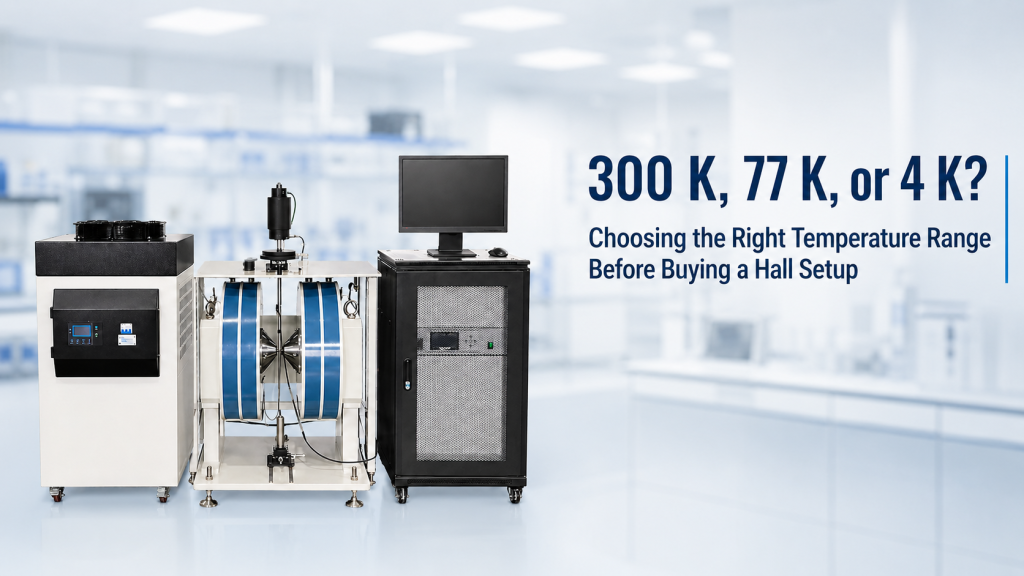
When purchasing a Hall effect measurement system, one of the first specifications discussed is temperature range.
Typical requests include:
- Room temperature (300 K)
- Liquid nitrogen temperature (77 K)
- Liquid helium or cryocooler temperature (4 K)
At first glance, lower temperature may seem “better.”
But in practice:
👉 Choosing the wrong temperature range can dramatically increase cost and system complexity without improving experimental value.
This article explains how to determine whether your application truly requires:
- 300 K
- 77 K
- or 4 K operation
1. Why Temperature Matters in Hall Measurements
Hall measurements are strongly affected by temperature because carrier behavior changes with thermal energy.
According to Wikipedia:
https://en.wikipedia.org/wiki/Hall_effect
Temperature influences:
- Carrier mobility
- Carrier concentration
- Resistivity
- Scattering mechanisms
👉 Some material properties only become visible at low temperature.
2. 300 K Systems: Simple, Stable, and Cost-Effective
Typical Applications
- General semiconductor characterization
- Educational labs
- Routine Hall measurements
Advantages
- Lowest system complexity
- No cryogenic infrastructure
- Lower operating cost
- Faster setup and maintenance
Limitations
- Limited access to low-temperature transport physics
- Reduced sensitivity for some advanced materials
👉 For many industrial and teaching applications, 300 K is fully sufficient.
3. 77 K Systems: The Practical Cryogenic Entry Point
77 K corresponds to liquid nitrogen temperature.
Typical Applications
- Semiconductor research
- Mobility improvement studies
- Intermediate cryogenic characterization
Why Researchers Choose 77 K
At lower temperatures:
- Phonon scattering decreases
- Carrier mobility often improves
- Material behavior becomes clearer
Advantages
- Much lower cost than 4 K systems
- Easier cryogenic operation
- Widely available cooling medium
Trade-Off
👉 More complexity than room temperature systems
👉 But still manageable for most labs
4. 4 K Systems: Advanced Research Territory
4 K systems typically use:
- Liquid helium
- Closed-cycle cryocoolers
Typical Applications
- Quantum materials
- 2DEG and high-mobility structures
- Superconducting materials
- Spintronics research
Why 4 K Matters
Some physical phenomena only emerge near liquid helium temperature.
Examples include:
- Quantum oscillations
- Superconductivity
- Ultra-high mobility transport behavior
According to Nature studies, low-temperature transport measurements are essential for investigating quantum electronic behavior.
5. The Real Cost Difference Between 77 K and 4 K
This is where many projects underestimate complexity.
Moving from 77 K to 4 K Often Changes
- Cooling architecture
- Vibration management
- Temperature control requirements
- Cryostat complexity
- Maintenance demands
Result
👉 Cost increase is often dramatic—not incremental
6. Infrastructure Requirements
300 K
- Minimal infrastructure
- Standard laboratory environment
77 K
- Liquid nitrogen handling
- Ventilation considerations
4 K
- Helium or cryocooler infrastructure
- Advanced thermal management
- More demanding installation conditions
👉 The lab environment itself may become a limiting factor.
7. Maintenance and Operational Complexity
300 K Systems
- Simplest maintenance
- Fast startup
77 K Systems
- Moderate operational complexity
- Regular cryogen handling
4 K Systems
- High maintenance sensitivity
- Longer cooldown cycles
- More operational expertise required
👉 Lower temperature means higher operational commitment.
8. When 4 K Is Actually Necessary
Many users request 4 K because:
- It sounds more advanced
- It appears future-proof
But the real question is:
👉 Does your experiment require physics only observable near 4 K?
If Not
- 77 K may be sufficient
- Or even room temperature may fully meet requirements
9. A Practical Selection Framework
Choose 300 K If You Need
- Routine Hall characterization
- Educational or industrial measurements
- Low operating complexity
Choose 77 K If You Need
- Improved mobility analysis
- Intermediate cryogenic research
- Lower-cost cryogenic capability
Choose 4 K If You Need
- Quantum transport studies
- Superconductivity research
- Ultra-high mobility measurements
👉 Temperature should follow experimental goals—not assumptions.
10. How Cryomagtech Supports Hall System Temperature Selection
At Cryomagtech, Hall systems are configured based on actual research requirements.
We help evaluate:
- Required temperature range
- Material and mobility targets
- Budget and infrastructure constraints
- Long-term operational practicality
👉 Product link placeholder: Cryomagtech Hall Measurement & Cryogenic Temperature Solutions
Our goal is to ensure that:
- The system matches the experiment
- Complexity remains justified
- Resources are used efficiently
References
- Wikipedia – Hall Effect
https://en.wikipedia.org/wiki/Hall_effect - Nature – Low-temperature transport and quantum materials research
https://www.nature.com/
Key Takeaways
- Temperature strongly affects Hall measurement behavior
- 300 K systems are simple and cost-effective
- 77 K systems provide practical cryogenic capability
- 4 K systems enable advanced quantum and superconducting research
- Lower temperature significantly increases complexity and cost
- The correct temperature range depends on the actual physics being studied
Lower temperature is not automatically better.
👉 The right temperature is the one your experiment truly requires.