
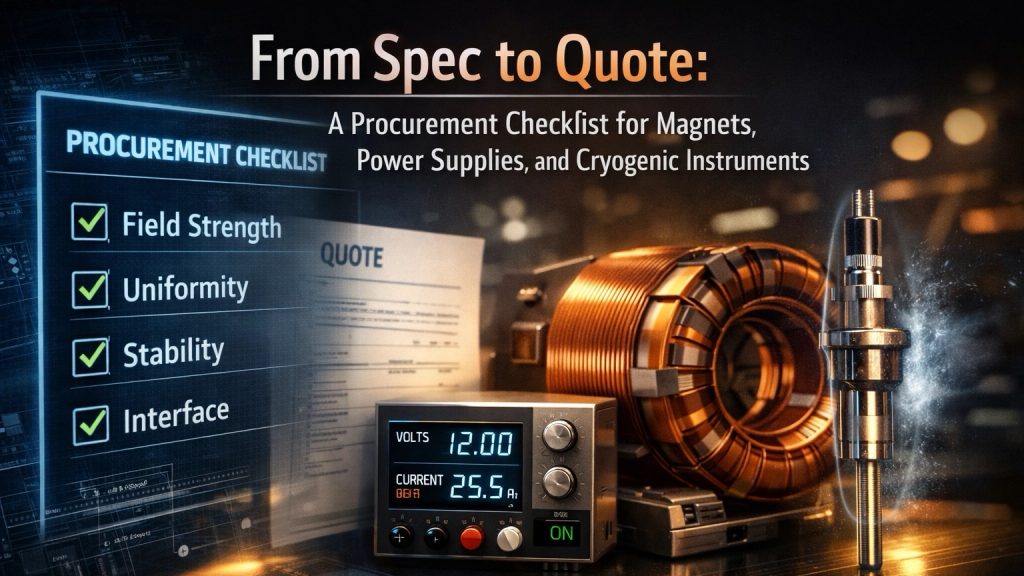
In advanced physics and materials research, poor specifications are the number one reason projects get delayed, over-budget, or redesigned.
Vague requirements lead to vague quotations.
Clear specifications lead to accurate pricing, realistic lead times, and systems that actually work.
This article provides a practical, copy-ready procurement checklist for laboratories purchasing:
- Magnetic field systems
- Excitation power supplies
- Cryogenic temperature instruments
- Magnetic and material characterization systems
1. Why Most Quotations Miss the Real Requirement
Many inquiries begin with:
- “We need a magnet around 1 Tesla.”
- “We need a stable current source.”
- “We need a cryogenic controller.”
These statements are not specifications.
They are starting points.
Without clear technical boundaries, suppliers are forced to guess.
Guessing increases risk for both sides.
2. Magnetic Field Systems: What You Must Specify
Applicable to Electromagnets and Helmholtz Coils.
Mandatory Parameters
- Target field strength (mT / T)
- Required uniform field volume (dimensions + tolerance)
- Pole gap or coil aperture
- Field stability or drift requirement
- Continuous operation time (duty cycle)
Strongly Recommended
- Sample size and fixtures
- Probe or cryostat access
- Background field compensation needs
- Mapping or acceptance test requirements
👉 Product link placeholder: Cryomagtech Magnet & Field Systems
3. Excitation Power Supplies: Precision Is Not Optional
Applicable to High Precision Excitation Power Supplies and Superconducting Magnet Power Supplies.
Mandatory Parameters
- Output current and voltage range
- Resolution and noise requirements
- Long-term stability or drift limits
- Ramp rate and current reversal needs
Interface and Control
- Communication protocol (Ethernet, RS-232, SCPI)
- Software integration or automation scripts
- Safety interlocks and protection logic
👉 Product link placeholder: Cryomagtech Excitation Power Supplies
4. Cryogenic Temperature Instruments: Stability vs. Accuracy
Applicable to Cryogenic Controllers, Monitors, and Sensors.
Mandatory Parameters
- Operating temperature range
- Required temperature stability
- Acceptable absolute accuracy
- Sensor type compatibility (Cernox, diode, Pt100, etc.)
Practical Considerations
- Sensor excitation current limits
- Wiring configuration (2-wire vs 4-wire)
- Filtering and noise environment
- Long-duration measurement needs
👉 Product link placeholder: Cryomagtech Cryogenic Temperature Instruments
5. Material Characterization Systems: Define the Measurement, Not the Tool
Applicable to Hall Effect Measurement Systems and VSM.
Hall Measurements
- Sample geometry and size
- Target carrier density or mobility range
- Low-field or high-field operation
- Current reversal or offset cancellation needs
Magnetization Measurements (VSM)
- Sensitivity requirement
- Sample moment range
- Temperature and field sweep conditions
👉 Product link placeholder: Cryomagtech Characterization Instruments
6. A Copy-Ready Procurement Template
You can copy this directly into your inquiry email:
We are requesting a quotation for the following system:
– Application and measurement goal
– Target field or current or temperature range
– Required stability and uniformity
– Sample size and access constraints
– Measurement duration and duty cycle
– Control interfaces and automation needs
– Installation environment and constraints
This template alone filters out 80% of future misunderstandings.
7. How Cryomagtech Supports the Full Specification-to-Quote Process
Cryomagtech does not quote from a catalog alone.
We work from application-driven specifications, covering:
- Magnet systems
- Precision power supplies
- Cryogenic temperature control
- Integrated measurement solutions
Clear inputs produce predictable outputs.
References
- Wikipedia – Laboratory magnet systems
https://en.wikipedia.org/wiki/Electromagnet - IEEE – Instrumentation and measurement standards
https://ieeexplore.ieee.org/
Key Takeaways
- Vague specs lead to poor quotations
- Each subsystem has non-negotiable parameters
- Writing clear requirements saves time and money
- A good supplier helps refine the specification
Good procurement starts before the quotation.