
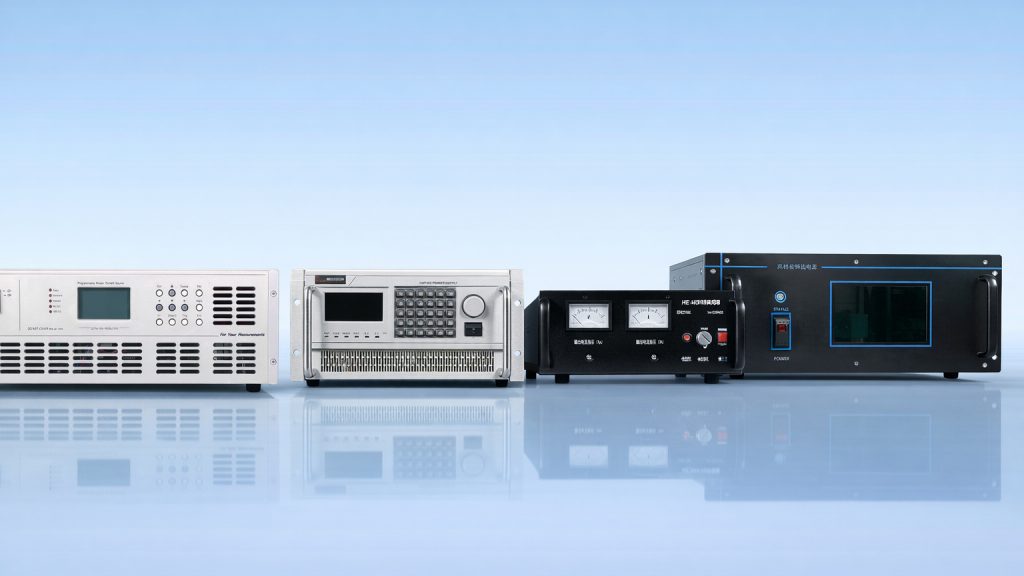
Why “Just a Power Supply” Is Often Not Enough
At first glance, a power supply seems simple.
It delivers current or voltage. The number looks correct. The system turns on.
However, in precision experiments, how current is delivered matters as much as how much current is delivered.
Researchers often discover this problem too late.
The data looks noisy. Results drift over time. Reproducibility becomes difficult.
In many cases, the root cause is the same:
a standard power supply is being used where a high-precision current source is required.
What Defines a High Precision Current Source?
A high precision current source is not defined by output power alone.
It is defined by several tightly controlled parameters:
- Output noise and ripple
- Current resolution
- Temperature coefficient
- Long-term stability
- Load regulation
Each of these factors directly affects experimental accuracy.
Noise and Ripple: The Hidden Error Source
Standard power supplies often specify output accuracy at steady state.
They rarely emphasize noise spectral density or low-frequency ripple.
In sensitive measurements, even small current noise can cause:
- Magnetic field fluctuation
- Voltage measurement noise
- Artificial signal broadening
This is especially critical in:
- Hall effect measurements
- Magneto-transport experiments
- Low-field magnetic characterization
A high precision current source minimizes both broadband noise and low-frequency ripple.
Resolution and Control: Small Steps Matter
Current resolution determines the smallest controllable change in output.
Standard supplies are designed for general use.
Their digital-to-analog resolution is often coarse.
High precision current sources provide:
- Fine current step size
- Smooth ramping behavior
- Repeatable setpoints
This enables controlled sweeps and precise field or bias tuning.
Temperature Coefficient and Drift
Temperature changes are unavoidable in real laboratories.
As temperature changes:
- Internal reference voltages drift
- Output stages shift operating points
In standard supplies, this drift can be significant over hours.
High precision current sources are designed with:
- Low temperature coefficient references
- Thermal compensation strategies
- Long warm-up stability
This is critical for overnight or multi-day experiments.
Long-Term Stability and Reproducibility
Short-term accuracy does not guarantee long-term stability.
Many experiments require:
- Constant current over hours or days
- Reproducible conditions across measurement sessions
Precision current sources are designed to maintain output stability over time, not just at power-up.
This directly improves:
- Data repeatability
- Cross-lab comparison
- Publication reliability
When a High Precision Current Source Is Essential
You should consider a high precision current source if:
- Your measurement is noise-limited
- You require long-term stability
- Your experiment involves magnetic field generation
- You perform sensitive transport or calibration measurements
👉 Product link placeholder: Cryomagtech High Precision Excitation Power Supply
Cryomagtech high precision excitation power supplies are designed specifically for laboratory environments where noise, drift, and resolution directly impact results.
References
- Wikipedia – Current source
https://en.wikipedia.org/wiki/Current_source - IEEE – Precision current source design and stability
https://ieeexplore.ieee.org/
Final Takeaway
Precision is not a marketing term.
It is a measurable performance difference.
A standard power supply delivers power.
A high precision current source delivers confidence in your data.