
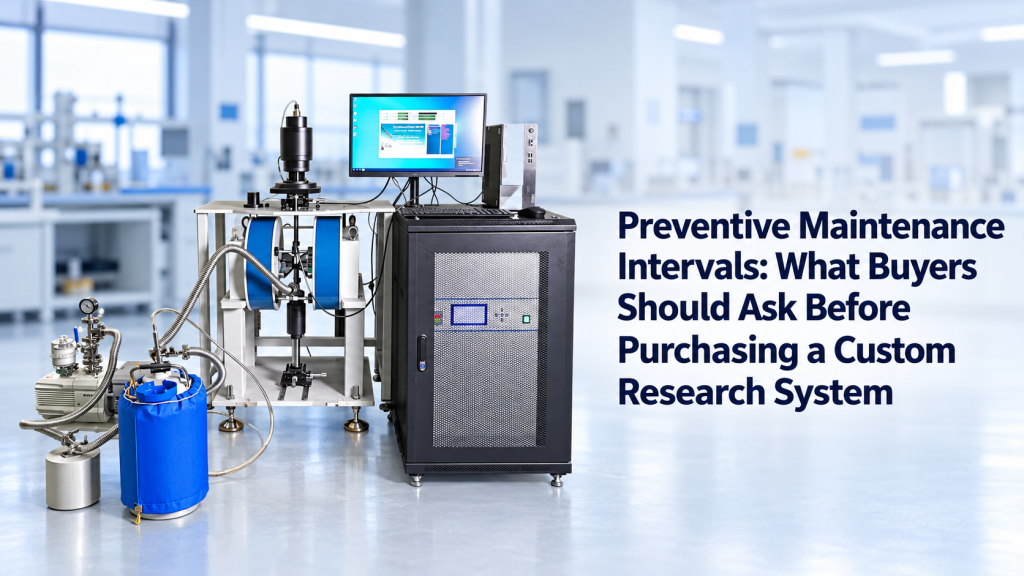
When laboratories purchase a custom electromagnet, Helmholtz coil, Hall effect measurement system, VSM, MOKE platform, or cryogenic measurement system, maintenance is rarely the first topic discussed.
Most technical conversations focus on:
- Magnetic field
- Sensitivity
- Temperature range
- Measurement accuracy
- Automation
- Delivery time
- Purchase price
Then, somewhere near the end of the project, someone asks:
“How often does this system need maintenance?”
That question should be asked much earlier.
For a custom research system, preventive maintenance affects far more than service cost. It determines:
- System uptime
- Measurement repeatability
- Calibration confidence
- Unexpected downtime
- Spare-parts planning
- Long-term operating cost
- Whether laboratory staff can maintain the system locally
The difficult part is that there is rarely one universal answer such as:
“Service every 12 months.”
A water-cooled electromagnet running eight hours every day should not necessarily follow the same maintenance schedule as an intermittently used Helmholtz coil. A VSM used by a shared facility may require different checks from a MOKE system used twice per month.
NIST specifically notes that recalibration intervals depend on factors such as accuracy requirements, instrument stability, environmental conditions, and measurement history rather than one universal fixed interval. NIST
The same engineering principle should be applied to preventive maintenance.
The better purchasing question is therefore:
What needs to be checked, how often should it initially be checked, what conditions trigger earlier maintenance, and which tasks can our laboratory perform ourselves?
1. Preventive Maintenance Is Part of the Equipment Specification
For custom research equipment, maintenance should not be treated only as an after-sales topic.
It should be part of the procurement specification.
Why?
Because two systems with similar technical performance can have very different long-term operating requirements.
System A
- Lower purchase price
- Proprietary consumables
- Difficult internal access
- Long replacement-part lead times
- Frequent factory service
- No remote diagnostics
System B
- Slightly higher initial price
- Standard filters and connectors
- Accessible service points
- Clear maintenance documentation
- Replaceable modules
- Remote troubleshooting
Over five or ten years, System B may be easier and cheaper to operate.
This is why experienced buyers evaluate not only:
CAPEX — Capital Expenditure
but also:
OPEX — Operating Expenditure
and:
downtime risk.
2. There Is No Universal “Correct” Maintenance Interval
A common purchasing request is:
“Please specify the preventive maintenance interval.”
That is reasonable.
But buyers should be careful with answers such as:
“Once every year.”
Annual maintenance may be a useful starting schedule, but it should not automatically become a universal engineering rule.
NIST states that it does not prescribe one recalibration interval for all measuring instruments. Appropriate intervals depend on factors including required accuracy, contractual requirements, inherent instrument stability, and environmental influences. Historical measurement data can then be used to refine the interval. NIST
A similar logic applies to research-system maintenance.
Maintenance Frequency Can Depend On
- Operating hours
- Number of measurement cycles
- Current level
- Thermal cycling
- Water quality
- Laboratory dust
- Humidity
- Sample contamination
- Number of users
- Required measurement uncertainty
- Frequency of cryogenic cycling
- History of previous failures
The maintenance plan should therefore evolve as the laboratory gains operating experience.
3. Think in Three Types of Maintenance
A useful research-equipment maintenance strategy separates three categories.
Routine Inspection
Frequent, simple checks performed by laboratory users.
Examples:
- Look for leaks
- Check abnormal sounds
- Verify cooling flow
- Check connector condition
- Review alarm messages
Scheduled Preventive Maintenance
Tasks performed at planned intervals.
Examples:
- Clean or replace filters
- Inspect cooling hoses
- Check electrical terminals
- Verify sensor performance
- Clean optical components
- Service mechanical positioning systems
Condition-Based Maintenance
Maintenance triggered by measured deterioration rather than the calendar alone.
Examples:
- Cooling flow gradually decreasing
- Water pressure drop increasing
- Field calibration drifting
- Vacuum pump-down becoming slower
- Temperature stability worsening
- Motor positioning error increasing
This third category is especially useful for sophisticated research systems.
4. A Maintenance Interval Should Sometimes Be Measured in Hours, Not Months
Calendar time alone may be misleading.
Consider two identical water-cooled electromagnets.
Magnet A
Used:
2 hours per week
Magnet B
Used:
10 hours per day, 6 days per week
After one year, their operating histories are completely different.
For components affected by actual use, a better maintenance trigger may include:
- Operating hours
- Current-hours
- Pump hours
- Number of field cycles
- Number of thermal cycles
- Number of positioning cycles
Industrial equipment routinely uses such counters.
Custom laboratory systems can benefit from the same principle.
5. Water-Cooled Magnets Need More Than “Check the Chiller”
Cooling systems are one of the most important maintenance areas for high-power electromagnets.
A typical water circuit may contain:
- Chiller
- Pump
- Reservoir
- Filters
- Flow sensor
- Temperature sensor
- Hoses
- Fittings
- Cooling channels inside the magnet
Cooling performance can deteriorate gradually rather than fail suddenly.
Potential Problems Include
- Filter blockage
- Sediment
- Biological growth
- Incorrect coolant concentration
- Reduced flow
- Pump wear
- Hose aging
- Loose fittings
- Scale inside cooling channels
- Sensor drift
SLAC documentation for accelerator magnets explicitly states that regular preventive maintenance is necessary for high equipment uptime and describes magnet systems operating with cooling water and temperature-related protection. SLAC Group
For laboratory electromagnets, the scale is smaller, but the principle remains relevant.
6. Ask About Filter Type and Replacement Strategy
A quotation may simply state:
“Water cooling required.”
That is not enough for long-term maintenance planning.
Buyers should ask:
- Is there a water filter?
- What type?
- What micron rating?
- Is it washable or disposable?
- Is it commercially available?
- How is blockage detected?
- Is differential pressure monitored?
- What initial inspection interval is recommended?
- Can the laboratory replace it?
The most important question may be:
Is the filter a standard consumable that we can buy locally?
For international customers, this can significantly reduce future downtime.
7. Water Quality Should Be Part of the Maintenance Plan
Not all cooling water is equally suitable for a magnet.
Depending on the design, manufacturers may specify:
- Deionized water
- Low-conductivity water
- Treated water
- Water/glycol mixture
- Specific conductivity or pH limits
Poor water quality can contribute to:
- Corrosion
- Scaling
- Blocked channels
- Reduced heat transfer
- Electrical leakage problems
Therefore, buyers should ask whether periodic water-quality checks are required.
If yes:
- What parameter is measured?
- What acceptable range applies?
- How often should it initially be checked?
- When should coolant be replaced?
These requirements should be documented rather than discovered after a cooling problem occurs.
8. Cooling Hoses and Fittings Are Maintenance Items Too
Flexible hoses do not last forever.
They experience:
- Pressure
- Temperature
- Mechanical bending
- Aging
- Repeated connection and disconnection
A preventive inspection should look for:
- Cracks
- Hardening
- Discoloration
- Leakage
- Loose fittings
- Abrasion
For equipment installed overseas, buyers should also ask:
Are the fittings internationally standard sizes?
A custom fitting that requires international shipment can turn a minor leak into a long equipment shutdown.
9. Electrical Cables Should Be Inspected Before They Become a Failure
High-current magnet systems may use substantial power cables.
Hall, VSM, and MOKE platforms also contain:
- Signal cables
- Sensor cables
- Motor cables
- Thermocouple or cryogenic sensor wiring
- Communication cables
Potential problems include:
- Loose connections
- Oxidized contacts
- Damaged insulation
- Repeated bending
- Connector wear
- Thermal damage
High-Current Connections Deserve Special Attention
A poor high-current connection can create:
- Additional resistance
- Local heating
- Voltage drop
- Instability
Therefore, buyers should ask whether high-current terminals require periodic visual inspection or electrical verification.
The exact procedure should follow the manufacturer’s service documentation.
10. Cable Maintenance Becomes More Important in Moving Systems
Static cables usually have an easier life.
But systems containing:
- Motorized stages
- Probe stations
- Rotating sample holders
- VSM sample motion
- MOKE XY stages
may repeatedly flex certain cables.
In these systems, ask whether:
- Flexible cable carriers are used
- Motion-rated cables are used
- Cable cycles are monitored
- Replacement cables are standard or proprietary
A low-cost cable can become a high-cost failure if replacing it requires major system disassembly.
11. Sensors Need Verification, Not Just Replacement
Research systems may contain many sensors:
- Hall probes
- Gaussmeter probes
- Temperature sensors
- Flow sensors
- Pressure sensors
- Vacuum gauges
- Position sensors
Sensors do not always fail completely.
Some gradually drift.
That creates a more dangerous situation because the system may continue operating while reporting incorrect values.
Example
Suppose a flow sensor slowly drifts high.
Actual cooling flow:
4 L/min
Displayed flow:
6 L/min
The system appears healthy.
But the magnet may actually be receiving insufficient cooling.
This is why important sensors should sometimes be verified against an independent reference, rather than simply checked to confirm that they still produce a number.
12. Calibration and Preventive Maintenance Are Related—but Not the Same
These terms are often mixed together.
Maintenance
Keeps the equipment functioning correctly.
Examples:
- Replacing a filter
- Cleaning optics
- Checking cables
- Lubricating a stage where specified
Calibration
Establishes or verifies the relationship between an instrument indication and a reference value.
Examples:
- Checking a gaussmeter against a magnetic reference
- Verifying temperature sensor accuracy
- Verifying power-supply current readback
An instrument can be mechanically healthy but out of calibration.
It can also be correctly calibrated today while having an approaching mechanical problem.
Both systems are necessary.
13. Calibration Intervals Should Be Evidence-Based
It is tempting to write:
“All sensors shall be calibrated every 12 months.”
That can be a reasonable contract requirement in some projects.
But technically, it is not automatically optimal.
NIST recommends considering factors such as:
- Required accuracy
- Stability of the device
- Environmental conditions
- Historical calibration results
and using measurement history to refine recalibration intervals. NIST
A Better Long-Term Strategy
Start with a conservative interval.
Then record:
- As-found error
- Calibration adjustment
- Measurement drift
- Environmental history
- Usage level
If a sensor remains extremely stable over several calibration cycles, the laboratory may have evidence for extending the interval where permitted.
If drift repeatedly approaches tolerance limits, the interval should become shorter.
14. Field Calibration Deserves Special Attention
Magnetic systems often assume:
Current = known magnetic field
But the relationship can be affected by:
- Pole gap
- Magnet geometry
- Hysteresis
- Temperature
- Magnetic history
- Probe position
For precision systems, preventive maintenance may therefore include checking:
- Magnet current
- Actual magnetic field
- Field probe
- Field calibration table
- Field uniformity where relevant
A Hall probe or gaussmeter itself may also need periodic calibration or verification.
The required frequency depends on the measurement uncertainty required by the experiment.
15. Helmholtz Coil Systems Need Geometry Checks as Well as Electronics Checks
A Helmholtz coil has relatively few moving parts.
That does not mean it is maintenance-free.
For precision field generation, check:
- Coil mounting
- Coil separation
- Mechanical alignment
- Electrical connections
- Current-source performance
- Field sensor calibration
For 3-axis systems, additional considerations include:
- Orthogonality between axes
- Cross-axis coupling
- Calibration matrix
If the coil structure is never moved, mechanical geometry may remain stable for a long time.
If the system is frequently relocated or reconfigured, verification may need to be more frequent.
16. Cryogenic Systems Have Their Own Maintenance Clock
Cryogenic equipment introduces additional components:
- Vacuum chamber
- Seals
- Pumps
- Cryocooler
- Compressor
- Temperature sensors
- Heater
- Transfer lines
- Valves
Their maintenance schedules may be very different.
Vacuum Performance Can Be a Useful Health Indicator
Instead of replacing components on a fixed date alone, laboratories can monitor:
- Pump-down time
- Base pressure
- Pressure rise
- Leak rate
If pump-down time gradually increases, the system may need:
- Seal inspection
- Vacuum-pump service
- Leak checking
- Cleaning
This is a classic example of condition-based maintenance.
17. O-Rings and Vacuum Seals Should Be Considered Consumables
Elastomer seals can degrade because of:
- Time
- Repeated assembly
- Temperature
- Chemicals
- Compression
A small O-ring may cost very little.
But if the correct size or material is unavailable locally, the system can remain unusable.
Before purchasing a cryogenic system, ask:
- Which O-rings are user-replaceable?
- What material is used?
- What dimensions?
- Can spares be supplied?
- Are they standard parts?
Including a small spare-seal kit with the original shipment can be much cheaper than emergency international shipping later.
18. Cryocooler Maintenance Must Follow the Actual Manufacturer
For 4 K closed-cycle systems, do not assume one universal cryocooler service interval.
Maintenance can depend on:
- Cryocooler technology
- Compressor model
- Operating hours
- Ambient conditions
- Manufacturer requirements
Buyers should ask before purchase:
- Is service based on calendar time or operating hours?
- Which parts are replaced?
- Can service be performed on-site?
- Must the cold head return to the factory?
- Is a local service partner available?
- What is the expected downtime?
This information can materially affect the total lifecycle cost of a 4 K system.
19. VSM Maintenance Is Mostly About Repeatability
A VSM contains a mechanical measurement chain.
Preventive checks may include:
- Sample holder condition
- Sample rod
- Centering repeatability
- Mechanical vibration
- Positioning mechanism
- Pickup system
- Reference sample measurement
- Magnet calibration
A useful maintenance check is not merely:
“Does the VSM still run?”
A better question is:
“Does the same reference sample still give the expected result?”
That turns preventive maintenance into measurement assurance.
20. Use Reference Samples to Detect Slow Performance Drift
A known reference material can be extremely valuable.
Measure it periodically using a standardized procedure.
Track parameters such as:
- Magnetic moment
- Coercivity
- Saturation response
- Noise
- Repeatability
If the result gradually changes, the laboratory has early evidence that something may be changing in:
- Calibration
- Sample positioning
- Magnet field
- Detection electronics
- Mechanical vibration
This can identify deterioration before users begin reporting inconsistent scientific results.
21. MOKE Systems Need an Optical Maintenance Plan
MOKE systems add optical components such as:
- Laser source
- Polarizers
- Analyzer
- Mirrors
- Objectives
- Camera
- Photodetector
Potential long-term issues include:
- Dust
- Optical contamination
- Alignment drift
- Laser power changes
- Stage positioning error
Preventive maintenance can include:
- Visual optical inspection
- Controlled optics cleaning
- Alignment verification
- Reference-sample measurement
- Camera or detector checks
- Field calibration
Optical cleaning should always follow the recommended procedure.
Cleaning too aggressively can damage coatings and create a problem that did not previously exist.
22. Motorized Stages Should Be Maintained Based on Their Design
Probe stations, MOKE systems, and automated sample platforms often use:
- Linear stages
- Rotary stages
- Stepper motors
- Encoders
Do not automatically lubricate them.
Some stages:
- Require specific lubrication
- Use sealed bearings
- Use dry-running components
- Should not be lubricated by the user
The maintenance manual should state:
- What can be cleaned
- What can be lubricated
- Which lubricant is permitted
- Whether recalibration is required after service
A vague instruction such as “maintain moving parts regularly” is not enough.
23. Power Supplies Also Require Preventive Maintenance
Precision magnet power supplies are often expected to operate for many years.
Potential service items include:
- Cooling fans
- Air filters
- Water cooling, where applicable
- Connectors
- High-current terminals
- Internal temperatures
- Current measurement circuitry
- Communication interfaces
For superconducting magnet power supplies, additional checks may include:
- Interlocks
- Quench signals
- Emergency shutdown logic
- Ramp functions
A protection circuit that has never been tested is not necessarily a protection circuit that will work when needed.
24. Interlocks Should Be Tested, Not Merely Observed
Research systems can contain interlocks for:
- Overtemperature
- Low cooling flow
- Cooling-water failure
- Door access
- Emergency stop
- Vacuum
- Quench detection
These systems may remain inactive for years.
That creates a paradox:
The safety function you use least may be the function you most need to verify periodically.
A preventive-maintenance plan should therefore define whether interlocks are:
- Automatically self-tested
- Functionally tested
- Checked during annual service
- Checked after system modifications
SLAC’s magnet documentation illustrates the importance of overheating interlocks and cooling-water integration within magnet operation. SLAC Group
25. Software Maintenance Should Not Be Ignored
Research systems increasingly depend on software.
Long-term maintenance may include:
- Backing up configuration files
- Backing up calibration files
- Saving measurement recipes
- Exporting event logs
- Recording firmware versions
- Recording software versions
Before updating software, laboratories should know:
- Whether old recipes remain compatible
- Whether calibration information is preserved
- Whether a rollback is possible
- Whether the control PC can be replaced
A system that works mechanically for 15 years is less useful if its only control computer cannot be replaced after five.
26. Event Logs Can Turn Maintenance From Reactive Into Predictive
Modern equipment may record:
- Overtemperature alarms
- Low-flow warnings
- Communication errors
- Motor errors
- Vacuum alarms
- Interlock events
Do not ignore these logs until the equipment fails.
Example
Suppose low-flow warnings occur:
- Month 1: once
- Month 2: twice
- Month 3: six times
The magnet may still be operating normally.
But the trend could indicate:
- Filter blockage
- Pump deterioration
- Sensor problems
This is exactly the kind of information that supports condition-based maintenance.
27. What Should Be Checked Daily, Monthly, or Annually?
There is no universal schedule.
However, buyers can use the following framework when discussing maintenance with a supplier.
Important: the intervals below are planning examples, not universal manufacturer requirements. Final intervals should follow the actual equipment design, usage, risk level, historical data, and manufacturer instructions.
Before Use / Daily When Operating
Possible checks:
- Visual inspection
- Cooling flow
- Abnormal noise
- Water leakage
- Vacuum status
- Alarm status
- Cable damage
- Sensor plausibility
Monthly or Quarterly
Depending on usage:
- Inspect filters
- Inspect hoses
- Inspect connectors
- Review event logs
- Clean accessible dust filters
- Check stage repeatability
- Check pump performance
- Run reference measurements
Every 6–12 Months
Depending on system and requirements:
- Field verification
- Sensor verification
- Temperature verification
- Power-supply output verification
- Interlock functional testing
- Cooling-system inspection
- Water-quality check
- Mechanical alignment verification
Based on Operating Hours
Potential examples:
- Cryocooler service
- Pump service
- Fan replacement
- Mechanical-stage maintenance
Again, the manufacturer should define the actual requirements for the specific system.
28. Maintenance Intervals Should Become Smarter Over Time
The first year of ownership provides valuable information.
Track:
- Equipment operating hours
- Failure history
- Calibration drift
- Reference-sample results
- Filter condition
- Cooling performance
- Vacuum performance
Then adjust the maintenance program.
This follows the same logic NIST recommends for calibration intervals: use historical performance data rather than assuming that one arbitrary interval remains correct forever. NIST
A mature laboratory may eventually discover:
- One component needs attention every three months
- Another remains stable for two years
- A third should be checked after every 1,000 operating hours
That is better than servicing every component on the same calendar date.
29. Ask Which Maintenance Tasks the User Can Perform
This is especially important for international customers.
Divide maintenance into:
User-Level Maintenance
Examples:
- Replace filter
- Replace hose
- Clean sample holder
- Replace O-ring
- Back up software
- Perform reference measurement
Trained Technical Maintenance
Examples:
- Adjust stage
- Replace pump components
- Verify power-supply output
- Test interlocks
Factory-Level Service
Examples may include:
- Internal electronics repair
- Cryocooler overhaul
- Specialized optical realignment
- Major magnet repair
Buyers should know this division before purchasing.
30. Ask Whether Special Tools Are Required
A maintenance procedure may technically be user-serviceable but still require:
- Special vacuum equipment
- Calibration standard
- Torque tools
- Proprietary software
- Custom diagnostic cable
Ask:
- What tools are required?
- Are they included?
- Are they commercially available?
- Is special training required?
Otherwise, “user maintainable” may exist only on paper.
31. Spare Parts Strategy Matters for Overseas Customers
For international research equipment, spare-parts logistics can dominate downtime.
A failed:
- Hose
- Fuse
- Fan
- Connector
- O-ring
- Filter
may cost only a few dollars.
But international shipping and customs can take much longer than the repair itself.
Consider Ordering a Startup Spare Kit
Possible contents:
- Filters
- Fuses
- O-rings
- Common connectors
- Tubing
- Sensors where justified
The exact contents should depend on the system.
For critical laboratories, a spare-parts strategy should be part of procurement.
32. Ask About Spare-Part Availability Five Years From Now
This is an uncomfortable but important procurement question.
Ask the supplier:
- Which parts are proprietary?
- Which parts are commercially available?
- How long will spare parts be supported?
- Are equivalent replacements possible?
- Can obsolete electronics be substituted?
Custom research systems often stay in service much longer than consumer electronics.
Long-term support matters.
33. Remote Diagnostics Can Dramatically Reduce International Downtime
Not every fault requires a service engineer to travel internationally.
If the system supports remote diagnostics, the supplier may be able to review:
- Error logs
- Sensor values
- Power-supply status
- Software configuration
- Interlock status
This can help determine whether the problem is:
- Software
- Sensor
- Cable
- Cooling
- Mechanical
- Power electronics
Before purchase, ask whether remote support is possible and what data can be exported for diagnosis.
34. Ask How Long a Typical Maintenance Shutdown Takes
Maintenance frequency is only half the question.
The other half is:
How long is the equipment unavailable?
Compare:
System A
Maintenance every six months
Duration: 30 minutes
System B
Maintenance once per year
Duration: 3 days
The annual system may actually create more operational disruption.
For shared laboratories, buyers should ask about:
- Typical preventive-maintenance duration
- Cooldown or warm-up time
- Recalibration time
- Time required before experiments can restart
This allows laboratories to schedule service around research activity.
35. Preventive Maintenance Is Especially Important for Shared Facilities
A single research group often has one experienced operator.
Shared facilities may have:
- Dozens of users
- Different skill levels
- High sample volume
- Long operating hours
That increases:
- Connector wear
- Sample-holder damage
- Incorrect operation
- Contamination
- Unnoticed performance drift
Shared systems should therefore consider:
- User checklists
- Automated logs
- Standard reference measurements
- Defined service responsibility
The more users a system has, the more important standardized maintenance becomes.
36. Example: Water-Cooled Electromagnet
Before purchasing, ask about:
- Coolant specification
- Water flow
- Water pressure
- Filter type
- Filter inspection
- Hose inspection
- Leak detection
- Flow interlock
- Coil temperature monitoring
- Field verification
- Power-cable inspection
The cooling circuit is part of the magnet system.
Maintaining only the power supply while ignoring cooling is not sufficient.
37. Example: 3-Axis Helmholtz Coil System
Ask about:
- Coil geometry verification
- Current-source calibration
- Field sensor calibration
- Axis orthogonality
- Cable connections
- Fan or water cooling
- Field calibration matrix
- Background-field compensation verification
A mechanically simple system may require very little routine maintenance—but precision performance may still require periodic verification.
38. Example: Cryogenic Hall Measurement System
Ask about:
- Vacuum integrity
- Pump maintenance
- O-rings
- Temperature sensors
- Heater performance
- Electrical feedthroughs
- Cryocooler service
- Sample wiring
- Magnet field calibration
- Reference sample measurement
The maintenance schedule should distinguish the Hall measurement electronics from the cryogenic subsystem.
They may have completely different service intervals.
39. Example: VSM
Ask about:
- Sample holder
- Sample rod
- Mechanical positioning
- Centering
- Reference sample
- Magnet calibration
- Detection stability
- Cooling system, if applicable
- Vacuum or temperature accessories
For VSM, periodic reference measurements can often reveal performance drift earlier than waiting for a component to fail.
40. Example: MOKE System
Ask about:
- Optical cleaning
- Laser performance
- Optical alignment
- Camera
- Motorized stage
- Reference sample
- Magnetic field sensor
- Electromagnet cooling
Because MOKE combines optical, magnetic, and mechanical subsystems, the maintenance plan should cover all three.
41. How Cryomagtech Approaches Long-Term Research System Maintenance
Cryomagtech supplies research systems across magnetic field generation, low-temperature instrumentation, and magnetic characterization, including:
- Electromagnets
- Helmholtz coil systems
- Cryogenic temperature instruments
- Hall Effect Measurement Systems
- Vibrating Sample Magnetometers
- MOKE systems
- Magnet power supplies
For these systems, preventive maintenance should be matched to the actual configuration rather than treated as one generic annual service requirement.
Relevant maintenance planning may include:
- Cooling-water inspection
- Filter and hose management
- Power and signal cable inspection
- Sensor verification
- Magnetic field calibration
- Cryogenic and vacuum maintenance
- Mechanical positioning checks
- Reference-sample verification
- Software and event-log review
👉 Product link placeholder: Cryomagtech Magnet, Cryogenic, Hall, VSM & MOKE Research Systems
For overseas customers in particular, a good system design should consider not only how the equipment performs when new, but also how easily the laboratory can keep it performing correctly several years after installation.
42. The Questions Every Buyer Should Ask Before Purchase
Before issuing a purchase order for a custom research system, ask the supplier:
Maintenance Schedule
- What routine maintenance is required?
- What initial interval is recommended?
- Which intervals depend on operating hours?
- Which intervals depend on system condition?
Consumables
- Which components are consumables?
- What are their part numbers?
- Can they be sourced locally?
- What is their expected replacement frequency?
Cooling System
- Does the system contain filters?
- What coolant is required?
- How often should water quality be checked?
- How are low-flow conditions detected?
Sensors and Calibration
- Which sensors require calibration?
- Which only require functional verification?
- What initial calibration interval is recommended?
- Can calibration be performed locally?
Mechanical Components
- Which components require cleaning or lubrication?
- Which must never be lubricated?
- Are operating-cycle limits specified?
Cryogenic Components
- What maintenance does the pump require?
- What is the cryocooler service requirement?
- Which vacuum seals are replaceable by the user?
Serviceability
- Which tasks can the customer perform?
- Which require trained technicians?
- Which require return-to-factory service?
Spare Parts
- What startup spare kit is recommended?
- Which parts are proprietary?
- How long will spares remain available?
Downtime
- How long does routine service take?
- Does the system need recalibration afterward?
- Is another cooldown required?
Support
- Is remote diagnostics available?
- Can alarm and maintenance logs be exported?
- Is remote software support available?
These questions reveal much more about lifecycle cost than simply asking:
“What is the warranty period?”
43. A Practical Preventive Maintenance Table
| System Area | Typical Items to Monitor | Maintenance Approach |
|---|---|---|
| Cooling water | Flow, pressure, filter, water quality, leaks | Time + condition based |
| Hoses & fittings | Aging, cracks, leakage | Inspection based |
| High-current cables | Connections, insulation, heating | Inspection + verification |
| Sensors | Drift, plausibility, calibration | Performance based |
| Magnetic field | Field accuracy, hysteresis, probe calibration | Measurement based |
| Vacuum system | Pump-down time, pressure, seals | Condition + service-hours |
| Cryocooler | Compressor/cold-head performance | Manufacturer interval |
| VSM mechanics | Centering, holder, vibration | Usage + reference measurement |
| MOKE optics | Cleanliness, alignment, laser stability | Condition based |
| Positioning stages | Repeatability, cable flex, motion | Cycle + condition based |
| Power supply | Cooling, current accuracy, interlocks | Time + performance based |
| Software | Backup, versions, logs, configurations | Change + time based |
The table is a planning framework.
The actual maintenance schedule must be defined for the specific product and application.
44. Key Takeaways
- Preventive maintenance should be discussed before purchasing a custom research system, not only after installation.
- There is no universal maintenance or calibration interval that applies to every instrument.
- Maintenance frequency should consider usage, environmental conditions, measurement requirements, historical performance, and manufacturer recommendations.
- NIST specifically recommends adjusting calibration intervals based on factors such as instrument stability, accuracy requirements, environmental influences, and historical calibration results. NIST
- Water-cooled magnets require attention to filters, water quality, hoses, fittings, flow, and temperature.
- Sensors should be periodically verified because gradual drift can be more difficult to detect than complete failure.
- Calibration and maintenance are related but serve different purposes.
- Vacuum performance, reference-sample results, cooling flow, and event logs can support condition-based maintenance.
- VSM and MOKE systems need mechanical and measurement verification, not only electronic servicing.
- Cryogenic-system maintenance may depend strongly on operating hours and the specific cryocooler or pump manufacturer.
- Interlocks should be functionally tested rather than assumed to work indefinitely.
- Standard consumables and locally available parts can substantially reduce downtime for overseas customers.
- Spare-part availability, remote diagnostics, and service time should be evaluated alongside purchase price.
- SLAC magnet documentation explicitly recognizes regular preventive maintenance as important for maintaining high equipment uptime. SLAC Group
The best procurement question is therefore not:
“How often do we need to maintain this system?”
It is:
“What can deteriorate, how will we detect that deterioration, what action should we take, and can our laboratory restore the system quickly without unnecessary downtime?”
That is the difference between buying a piece of equipment and planning a research platform for long-term operation.
References
NIST – Recommended Calibration Interval
NIST explains that there is no universal recalibration interval for measurement instruments. Intervals should reflect accuracy requirements, instrument stability, environmental factors, and historical performance, and can be refined using measurement-assurance data. NIST
NIST – Recommended Calibration Interval
SLAC – Magnet Operating and Service Manual
This magnet service manual hosted by SLAC explicitly states that regular preventive maintenance is necessary to achieve high equipment uptime and discusses cooling-water and overtemperature protection as parts of magnet operation. SLAC Group