
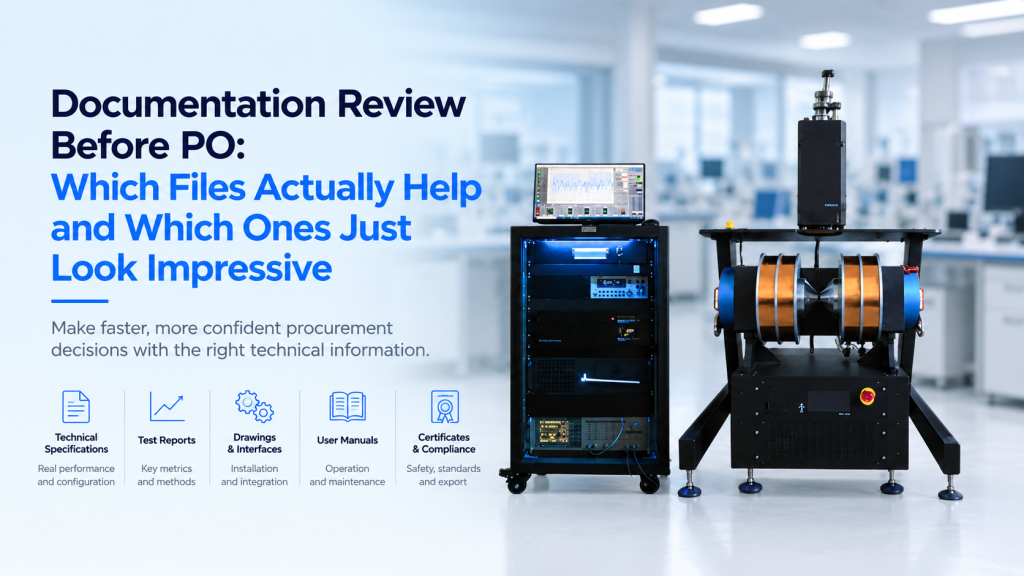
Before issuing a purchase order for a VSM, MOKE system, Hall measurement platform, cryogenic system, or customized magnet system, buyers often request a large documentation package.
The supplier may respond with:
- Brochures
- Technical datasheets
- User manuals
- Drawings
- Certificates
- Test reports
- Application photos
- Software screenshots
- Installation guides
- Company presentations
A 100-page package can look reassuring.
But document quantity is not the same as procurement confidence.
The real purpose of a documentation review before PO is much more practical:
Can the available documents prove what will be delivered, what performance is expected, how the system connects to the laboratory, and how the buyer will determine whether the delivered system meets the agreed requirements?
Some documents answer those questions directly.
Others mainly make the proposal look more complete.
This article explains which files deserve the most attention before a scientific instrument purchase order is released—and which documents should be treated as supporting material rather than technical proof.
1. The Goal of Documentation Review Is Risk Reduction
Before a PO, technical documents should reduce uncertainty in several areas:
- What exactly is being purchased?
- Which specifications are guaranteed?
- Under what conditions do those specifications apply?
- Which accessories are included?
- What must the customer provide?
- Will the customer’s samples fit?
- Will existing instruments be compatible?
- How will acceptance be performed?
- What data will the system produce?
- What happens if a requirement is not achieved?
Good documentation turns a sales conversation into an engineering agreement.
Poor documentation leaves critical assumptions unresolved until after the order is placed.
That is when misunderstandings become expensive.
2. More Documents Do Not Automatically Mean a Better Supplier
A polished documentation package can create confidence.
But buyers should distinguish between:
presentation documents
and
decision documents.
Presentation documents explain what a company or product generally does.
Decision documents define what this specific configuration will do for this specific project.
Both have value.
But they should not be confused.
A 30-page corporate brochure cannot replace a one-page specification table that clearly confirms the required magnetic field at the customer’s actual pole gap.
3. Requirements Should Be Clear Enough to Verify Later
One useful principle comes from formal requirements engineering.
ISO/IEC/IEEE 29148 covers requirements-engineering processes and the information items used to define and manage requirements across a system life cycle. The core procurement lesson is highly relevant to scientific equipment: important requirements should be defined clearly enough that they can later be interpreted, managed, and verified consistently.
This matters particularly for customized laboratory systems.
Statements such as:
- “high field”
- “high stability”
- “automatic measurement”
- “low temperature”
- “optical access”
- “research-grade software”
sound positive but are not sufficiently precise for procurement.
Useful documentation converts them into measurable requirements.
4. The Compliance Matrix Is One of the Most Useful Pre-PO Documents
For a formal scientific equipment purchase, one of the highest-value documents is often a simple requirement compliance matrix.
It might contain columns such as:
- Customer requirement
- Required value
- Proposed value
- Comply / partial / optional
- Test or verification method
- Notes
For example:
| Requirement | Customer Need | Proposed Configuration | Status |
|---|---|---|---|
| Magnetic field | ≥1 T | 1.05 T at 20 mm gap | Comply |
| Field direction | Bipolar | ±B electronic control | Comply |
| Sample temperature | 80–500 K | 80–500 K | Comply |
| Optical access | 532–1064 nm | Window configuration confirmed | Comply |
| Python control | Required | Not standard | Optional/custom |
This table is more useful than repeatedly searching through brochures, emails, and manuals.
It forces both buyer and supplier to identify exceptions before the PO.
5. A Project-Specific Technical Specification Is More Valuable Than a Generic Datasheet
A generic datasheet explains the standard product.
A project-specific specification explains what the buyer is actually purchasing.
This distinction matters when the system includes custom elements such as:
- Different pole gap
- Larger sample holder
- Different temperature range
- Optical access
- Special sensors
- Higher-stability power supply
- Custom software
- Vacuum integration
Suppose a standard electromagnet datasheet states:
Maximum field: 1.5 T
But the customer’s cryostat requires a larger working gap.
The relevant pre-PO document should state:
Maximum field at the customer’s actual working gap.
The generic 1.5 T value may still be useful background information, but it should not be mistaken for the project specification.
6. Test Conditions Should Appear Next to Performance Claims
A performance number without test conditions can be misleading.
For magnet systems, ask:
- At what pole gap?
- At what current?
- At what coil temperature?
- Continuous or short-duration operation?
For VSM:
- Under what measurement configuration?
- Which sample holder?
- At what field?
- Under what averaging conditions?
For cryogenic systems:
- What base temperature?
- With what sample load?
- Under what vacuum?
- With what cooling configuration?
For Hall systems:
- What sample resistance range?
- What current?
- What field?
- What measurement geometry?
The more important the number, the more important its operating conditions.
7. Scope of Supply Is a Critical Commercial-Technical Document
Many disputes do not come from incorrect specifications.
They come from unclear scope.
The pre-PO documentation should identify what is included.
For example:
- Magnet
- Power supply
- Field probe
- Gaussmeter
- Sample stage
- Chiller
- Cryostat
- Temperature controller
- Vacuum pump
- Computer
- Software
- Cables
- Sample holders
- Installation tools
It should also identify what is not included.
For example:
- Customer optical laser
- External vacuum pump
- Compressed gas
- Water supply
- Local transformer
- Installation crane
- Import duties
A clear exclusion can be more valuable than another page of product advantages.
8. Options Should Be Separated from the Base Configuration
Another common documentation problem is combining standard and optional capabilities into one brochure.
The brochure may show:
- Cryogenic operation
- High-temperature option
- Optical access
- Rotation
- Automated sample changer
- Advanced software
But the quotation may include only some of them.
Before PO, the buyer should be able to identify:
Included
Already part of the quoted system.
Optional
Available at additional cost.
Future Upgrade
Can be added later, subject to compatibility.
Not Supported
Not available in the proposed configuration.
This prevents a brochure image from accidentally becoming an assumed contractual requirement.
9. General Arrangement Drawings Answer Questions That Datasheets Cannot
For integrated systems, a GA drawing or dimensional drawing can be one of the most useful files before PO.
It can show:
- Overall dimensions
- Sample position
- Pole gap
- Working height
- Optical access
- Cryostat location
- Cable direction
- Chiller location
- Cabinet footprint
This is particularly useful for:
- Large electromagnets
- Helmholtz coil systems
- MOKE
- Cryogenic Hall platforms
- Large VSM installations
A drawing often reveals an incompatibility faster than several pages of technical description.
10. Interface Drawings Matter Whenever Existing Equipment Will Be Reused
If the buyer plans to integrate an existing:
- Cryostat
- Laser
- Vacuum pump
- Temperature controller
- Power supply
- Probe
- Optical table
then interfaces should be documented.
Important details may include:
- Mechanical dimensions
- Mounting holes
- Flange type
- Connector type
- Electrical signals
- Communication protocol
- Hose connections
- Optical working distance
“Compatible with your equipment” is not a technical interface definition.
Whenever possible, compatibility should be tied to actual model numbers, dimensions, or interface drawings.
11. Sample Drawings Can Be More Important Than Instrument Drawings
For Hall, VSM, MOKE, and cryogenic systems, the sample itself should be part of the documentation review.
Useful information includes:
- Sample dimensions
- Thickness
- Weight
- Substrate
- Contact positions
- Orientation
- Sample holder
- Optical surface
- Expected resistance
- Magnetic moment range
Many system problems begin because the instrument was specified correctly but the real sample was never fully defined.
A simple sample sketch can prevent expensive holder redesign later.
12. Site Requirements Should Be Reviewed Before the PO, Not Before Installation
Another high-value document is the site-preparation sheet.
It should define requirements such as:
- AC voltage
- Frequency
- Phase
- Maximum power
- Cooling water
- Flow
- Water temperature
- Ventilation
- Room temperature
- Humidity
- Floor space
- Equipment weight
- Vacuum requirements
This matters particularly for international projects.
A technically suitable system can still become difficult to install if the laboratory later discovers that it lacks:
- The required three-phase power
- Enough cooling capacity
- Sufficient floor space
- Suitable ventilation
- Adequate doorway access
These are procurement issues because they affect the feasibility and total project cost.
13. Acceptance Criteria May Be More Important Than the Brochure
One of the strongest pre-PO documents is an agreed acceptance specification.
It answers:
How will we know that the delivered equipment is acceptable?
Possible VSM acceptance items:
- Maximum field
- Field repeatability
- Sensitivity verification
- Reference-sample measurement
- Software operation
Possible Hall-system items:
- Field range
- Temperature range
- Known reference sample
- Resistivity measurement
- Carrier concentration calculation
Possible magnet-system items:
- Field at defined gap
- Field uniformity
- Current stability
- Coil temperature
Possible cryogenic-system items:
- Base temperature
- Cooldown
- Temperature stability
- Vacuum integrity
A clear acceptance test aligns supplier and customer expectations before manufacturing begins.
14. FAT and SAT Should Be Distinguished
Two common terms are:
FAT — Factory Acceptance Test
Performed before shipment.
Useful for verifying:
- Core specifications
- System functionality
- Safety checks
- Software
- Representative measurements
SAT — Site Acceptance Test
Performed after installation.
Useful for verifying:
- Installation
- Site utilities
- Final interfaces
- Local performance
- Integrated operation
Not every project needs a complex formal FAT/SAT program.
But for high-value customized equipment, buyers should at least understand what will be tested before shipment and what will be checked after installation.
15. Ask for Evidence for the Specifications That Actually Matter
Not every specification needs a separate certificate.
Focus evidence on project-critical requirements.
If the buyer’s decision depends on:
50 mT over a 100 mm uniform region
then field mapping is valuable.
If the decision depends on:
80 K minimum sample temperature
then temperature-test evidence is valuable.
If the critical requirement is:
5 × 10⁻⁵ emu VSM sensitivity
then relevant verification or reference data matter.
The principle is:
Evidence should follow risk.
Do not demand documentation equally for every minor characteristic.
16. Calibration Certificates Are Useful—but Their Meaning Should Be Understood
Calibration documentation is important for instruments such as:
- Gaussmeters
- Field probes
- Temperature sensors
- Measurement electronics
But a calibration certificate should not be treated as a universal guarantee of total system performance.
NIST defines metrological traceability as a property of a measurement result connected to specified references through a documented, unbroken calibration chain, with uncertainty considered at each step. NIST also emphasizes that merely having an instrument calibrated is not sufficient by itself to establish the traceability or fitness for purpose of every later measurement made with that instrument.
This is a useful procurement distinction.
A calibrated Hall probe does not automatically prove that:
- The magnet uniformity meets specification
- The sample is correctly positioned
- The full Hall system meets its accuracy requirement
The complete measurement context matters.
17. A Real Test Report Is More Valuable Than a Blank Certificate Template
Sometimes suppliers provide an example certificate showing what documentation will eventually look like.
That can help explain the format.
But buyers should distinguish between:
- Sample certificate
- Generic test-report template
- Previous system report
- Actual serial-number-specific final report
Before PO, examples may be reasonable.
Before shipment, project-specific evidence is more important.
The document should clearly state which category it belongs to.
18. Software Capability Needs Documentation Too
Modern VSM, Hall, MOKE, and cryogenic platforms are heavily software-dependent.
A brochure saying:
“Fully automatic software included”
is not enough for a sophisticated project.
Useful software documentation should clarify:
- Field sweep control
- Temperature sequencing
- Data acquisition
- Sample database
- User-defined sequences
- Raw-data access
- Data export
- Remote control
- Scripting
- API
- Error handling
If a feature is important, request evidence such as:
- User manual section
- Workflow description
- Software screenshot
- Example exported file
- Command documentation
The evidence should match the requirement.
19. Example Data Files Can Be Surprisingly Valuable
A five-kilobyte CSV file may tell a buyer more about the real system than a 20-page software brochure.
Before PO, buyers may ask to see an example export.
Check whether it contains:
- Raw data
- Processed data
- Field
- Temperature
- Time
- Sample ID
- Units
- Measurement parameters
This immediately reveals whether the system’s data workflow fits the laboratory.
For research laboratories planning Python, MATLAB, Origin, or custom analysis, this can be particularly important.
20. User Manuals Are Useful—but Do Not Read Them as Product Specifications
A user manual can answer:
- How is the system operated?
- How are samples installed?
- What safety procedures exist?
- How does the software work?
- What routine maintenance is needed?
But manuals often cover:
- Multiple product variants
- Optional functions
- Older revisions
- Future-compatible accessories
Therefore:
User manual ≠ project-specific quotation.
If the manual conflicts with the quotation or agreed project specification, the difference should be clarified before the PO.
21. Manual Excerpts May Be Better Than Sending 300 Pages
During procurement, the customer may not need the entire manual immediately.
For a specific requirement, a relevant excerpt can be much more useful.
Example:
Customer requirement:
“Software must export CSV.”
Useful evidence:
- Software manual page showing CSV export
Less useful:
- Complete 350-page instrument manual with no indication where CSV functionality appears
Documentation quality includes making evidence easy to find.
22. VSM Projects Need Sample-Holder Documentation
For VSM procurement, buyers often focus on the main instrument.
But documentation should also identify:
- Powder holder
- Film holder
- Bulk sample holder
- Liquid holder
- Maximum sample size
- Sample weight
- Measurement orientation
If the VSM specification is excellent but the customer’s real samples cannot be mounted correctly, the system is incomplete.
Sample-holder drawings and photographs can therefore be highly valuable.
23. MOKE Projects Need Geometry Documentation
For MOKE, useful project documentation should clarify:
- Longitudinal / polar / transverse geometry
- Magnetic-field direction
- Laser incidence
- Reflection path
- Pole gap
- Sample stage
- Optical working distance
A photograph of a beautiful optical table is not enough.
The buyer needs to know whether their magnetic geometry and sample actually fit the optical path.
For customized systems, a simple geometry drawing can be far more useful than a complete marketing brochure.
24. Hall Systems Need Measurement-Method Documentation
Hall-system buyers should understand:
- Van der Pauw or Hall bar
- +B/−B sequence
- Current reversal
- Sample contact configuration
- Temperature capability
- Field control
- Output parameters
If automation is included, it is also useful to know exactly what the measurement sequence does.
A statement such as:
“automatic Hall measurement”
does not define whether the software automatically performs:
- Current reversal
- Field reversal
- Contact switching
- Resistivity calculations
- Carrier concentration calculations
- Mobility calculations
Those capabilities should be separated.
25. Cryogenic Projects Need Interface and Utility Documents Early
Cryogenic projects often fail at interfaces rather than at the cryocooler itself.
Before PO, buyers may need:
- Cryostat dimensions
- Sample space
- Vacuum flange information
- Temperature-sensor configuration
- Electrical feedthroughs
- Optical access
- Pump requirements
- Cooling requirements
If the cryostat must enter an electromagnet gap, the mechanical interface should be confirmed before production.
Waiting until installation is too late.
26. Delivery Scope Should Include Documentation Deliverables
Documentation itself can be part of the scope of supply.
For formal university or industrial projects, the buyer may require:
- Final technical specification
- User manual
- Test report
- Calibration certificates
- Packing list
- Installation guide
- Software manual
- Electrical drawing
- Declaration documents
These should be discussed before PO if they are mandatory for institutional acceptance.
Some files may require engineering time to prepare and may not exist automatically for every customized product.
27. Revision Numbers Matter More Than Buyers Expect
Customized projects evolve.
Version 1 may specify:
- 20 mm pole gap
Version 3 may specify:
- 30 mm pole gap
Version 5 may include:
- A cryostat
- New sample holder
- Different power supply
If documents do not contain:
- Revision number
- Date
- Project reference
then teams can easily review the wrong version.
This becomes particularly risky when:
- Procurement
- Engineering
- Supplier
- Principal investigator
are all reviewing documents separately.
28. The Final Pre-PO Package Should Have One Configuration Baseline
Before issuing the PO, there should ideally be one clearly identified configuration baseline.
For example:
Technical Proposal Rev. 4 — Approved for PO
Supporting documents can then reference this configuration.
This is far safer than treating fifty separate email attachments as the final technical agreement.
29. Which Files Often Look Impressive but Provide Limited Proof?
Some documents are useful for context but weak as technical evidence.
Examples include:
- Glossy brochures
- Corporate presentations
- Factory photos
- Exhibition photos
- Generic product videos
- Long customer lists
- Marketing case studies
None of these are inherently bad.
They can help buyers judge:
- Supplier experience
- Product maturity
- Manufacturing capability
But they do not replace project-specific technical documents.
30. Factory Photos Do Not Prove Performance
A photograph may show:
- Large magnets
- Test equipment
- Clean assembly
- Professional production
That can increase confidence.
But it cannot prove:
- Field uniformity
- Temperature stability
- Measurement sensitivity
- Data accuracy
Photographs answer:
“Does this hardware appear to exist?”
Test data answer:
“Does it perform as required?”
These are different questions.
31. Customer Lists Should Not Replace Technical Evidence
A supplier may state that equipment has been delivered to:
- Famous universities
- National laboratories
- Major companies
This may indicate experience.
But another university’s purchase does not prove that your configuration meets your requirement.
The correct decision order is:
Technical fit first → supplier experience second.
Not the reverse.
32. Generic Certificates Can Create False Confidence
A supplier may send many certificates:
- ISO certificates
- CE-related documents
- RoHS documents
- Company registrations
- Patent certificates
Some may be relevant.
Some may have little connection to the performance requirement under review.
Buyers should ask:
What question does this certificate answer?
If nobody can answer that clearly, it probably should not drive the purchasing decision.
33. Software Screenshots Without Workflow Context Have Limited Value
A screenshot showing a professional interface can look impressive.
But it may not answer:
- Can measurements be automated?
- Can data be exported?
- Can sequences be customized?
- Is raw data available?
- Can external instruments communicate?
A useful screenshot should be connected to a specific function.
For example:
“Here is the field-sequence editor.”
That is evidence.
“Here are ten random software windows.”
That is decoration.
34. Be Careful with Undefined Words Such as “Research Grade”
Common phrases include:
- Research grade
- High precision
- Ultra stable
- Fully automatic
- High sensitivity
- High uniformity
These are useful descriptions in marketing copy.
They should not be the final procurement specification.
Replace them with numbers or functions whenever they affect the purchase decision.
For example:
Instead of:
High field stability
write:
≤25 ppm/h under defined operating conditions.
Instead of:
Fully automated
write:
Automatic ±B sweep, temperature sequence, measurement, and CSV export.
35. The Best Documentation Package Is Not Necessarily the Largest
For many projects, a strong pre-PO package may consist of only:
- Formal quotation
- Project-specific technical specification
- Compliance matrix
- Scope of supply
- GA / interface drawing
- Acceptance criteria
- Relevant supporting test evidence
- Site requirements
- Relevant manual excerpts
That may be only 20–30 useful pages.
A weaker package may contain 150 pages but still fail to answer:
What exactly are we buying?
Document quality should be judged by resolved uncertainty, not page count.
36. A Practical Three-Level Documentation Model
Buyers can classify documentation into three levels.
Level 1 — Decision Documents
These should directly influence whether the PO can be issued.
Examples:
- Technical specification
- Compliance matrix
- Scope
- Acceptance criteria
- Interface drawing
Level 2 — Evidence Documents
These support important technical claims.
Examples:
- Test report
- Field map
- Calibration certificate
- Reference-sample result
- Software manual excerpt
Level 3 — Confidence Documents
These help evaluate supplier experience and professionalism.
Examples:
- Brochure
- Customer cases
- Factory photographs
- Company profile
- Product videos
All three levels have value.
But the order matters.
Decision → Evidence → Confidence
not:
Confidence → Assumption → PO
37. What Procurement Teams Should Review
Procurement may focus on:
- Model
- Quantity
- Price
- Delivery
- Warranty
- Payment terms
- Documentation deliverables
- Commercial scope
That is necessary.
But procurement should not be expected to verify every engineering specification.
38. What Technical Teams Should Review
The technical team should focus on:
- Performance
- Sample compatibility
- Interfaces
- Operating conditions
- Software
- Utilities
- Acceptance criteria
This creates a useful division of responsibilities.
Procurement asks:
“Are we buying what was quoted?”
Engineering asks:
“Will what was quoted actually do the experiment?”
A strong pre-PO review requires both questions.
39. Questions to Ask When Reviewing Any Technical File
For each document, ask:
Relevance
Does this file apply to the exact configuration being purchased?
Specificity
Does it contain measurable information?
Condition
Are operating conditions defined?
Evidence
Does it prove something or only describe it?
Revision
Is it the latest version?
Scope
Does it distinguish standard and optional items?
Acceptance
Can the information later be verified?
If a document fails most of these tests, it should not carry much weight in the purchasing decision.
40. A Practical Documentation Review Checklist Before PO
Before releasing a PO for a complex measurement system, confirm the following.
Technical Definition
- Final model/configuration confirmed
- Required specifications listed
- Compliance matrix reviewed
- Operating conditions defined
Mechanical
- Dimensions confirmed
- Sample space confirmed
- Interfaces checked
- Drawings reviewed
Utilities
- Power confirmed
- Cooling confirmed
- Vacuum confirmed
- Laboratory environment checked
Software
- Required functions confirmed
- Export format confirmed
- Automation level confirmed
- External control requirements confirmed
Acceptance
- FAT scope defined
- SAT scope defined where needed
- Performance verification agreed
- Reference samples defined if required
Documentation
- Manuals identified
- Test reports identified
- Calibration documents identified
- Final documentation deliverables listed
Commercial Scope
- Included items clear
- Optional items clear
- Exclusions clear
- Warranty and service clear
Once these points are resolved, the PO becomes much safer.
41. How Cryomagtech Approaches Documentation Before PO
For complex magnetic and materials-characterization projects, Cryomagtech can organize the technical discussion around the actual system configuration rather than relying only on generic brochures.
Depending on the project, relevant documentation may include:
- Technical specifications
- Configuration tables
- Interface information
- Sample requirements
- Magnetic-field specifications
- Temperature requirements
- Software capabilities
- Site requirements
- Test information
- Acceptance criteria
This approach can be applied to:
- VSM systems
- MOKE systems
- Hall effect measurement systems
- Electromagnet systems
- Helmholtz coil systems
- Cryogenic measurement platforms
👉 Product link placeholder: Cryomagtech Magnetic Measurement & Characterization Systems
For projects involving magnetic-field generation:
👉 Product link placeholder: Cryomagtech Magnet & Field Systems – Electromagnets and Helmholtz Coils
The objective should not be to send the customer as many documents as possible.
It should be to provide the smallest set of documents that answers the important technical questions clearly.
42. Key Takeaways
A good documentation review before PO should reduce uncertainty, not simply create a large attachment folder.
The most useful files usually include:
- Project-specific technical specification
- Requirement compliance matrix
- Scope of supply
- Interface / GA drawing
- Site requirements
- Acceptance criteria
- Relevant test evidence
- Calibration documentation where appropriate
- Software and data information
Documents such as:
- Brochures
- Company presentations
- Factory photos
- Customer lists
- Generic certificates
can still be useful.
But they provide confidence, not proof of project compliance.
The most important procurement principle is:
Do not ask, “How much documentation did the supplier provide?”
Ask:
“Which project risks did these documents actually remove?”
Before a PO is released, that is what technical documentation is supposed to achieve.
References
1. ISO / IEEE — ISO/IEC/IEEE 29148:2018 Requirements Engineering
ISO/IEC/IEEE 29148 defines processes and information items for requirements engineering across system life cycles. Its underlying principle—that requirements and related information should be explicitly defined and managed—provides a useful framework for reviewing technical procurement documents before committing to a configuration.
Check source: ISO/IEC/IEEE 29148:2018
2. NIST — Metrological Traceability
NIST explains that metrological traceability applies to measurement results and depends on a documented calibration chain with stated uncertainty. It also cautions that simply using a calibrated instrument does not automatically make every subsequent measurement traceable or fit for a particular purpose.