
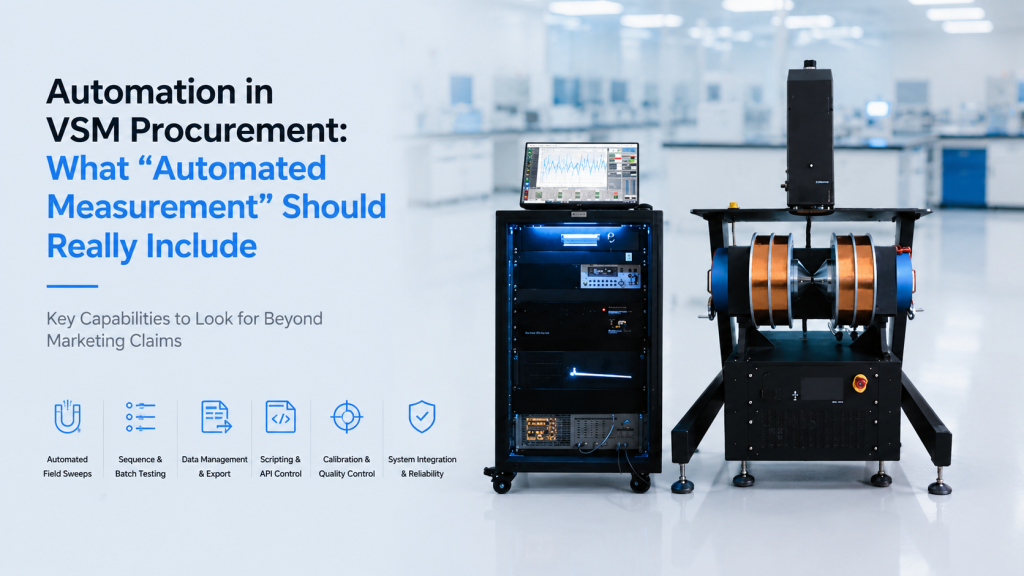
When buyers evaluate a Vibrating Sample Magnetometer (VSM), the phrase “automated measurement” often appears in technical brochures and quotations.
It sounds reassuring.
But it is also dangerously vague.
One supplier may use “automated” to mean that the software can automatically sweep the magnetic field and record an M–H loop.
Another may mean that the VSM can automatically execute a complete sequence involving:
- Magnetic-field sweeps
- Multiple temperatures
- Repeated hysteresis loops
- Time-dependent measurements
- Automatic sample centering
- Data saving and export
- User-defined measurement sequences
- Script or API control
- Integration with third-party instruments
Those are very different levels of automation.
For a serious VSM procurement project, asking only whether the system is “fully automated” is therefore not enough.
The better question is:
Which parts of the measurement workflow are automated, and which parts still require operator intervention?
This article explains what automated VSM measurement should actually include, how different levels of automation affect laboratory workflow, and what buyers should confirm before finalizing a VSM specification.
1. Start by Separating Measurement Automation from Instrument Control
Automation in a VSM can refer to several different things.
The most basic distinction is between:
Measurement Automation
The software automatically performs a predefined measurement.
For example:
- Sweep from +1 T to −1 T
- Record magnetic moment
- Sweep back to +1 T
- Save the hysteresis loop
Workflow Automation
The system automatically executes a longer experimental procedure.
For example:
- Set temperature to 300 K
- Wait for stabilization
- Run an M–H loop
- Change temperature to 250 K
- Wait again
- Run another loop
- Repeat down to 50 K
- Export all datasets automatically
Programmable Automation
The user can create customized experimental logic.
Examples may include:
- Nested field and temperature loops
- Conditional measurements
- Repeated measurements over time
- Communication with external equipment
- Script-based workflows
- Remote commands
These three capabilities should not be treated as equivalent.
A VSM may be highly automated for standard hysteresis measurements while providing limited flexibility for custom experimental sequences.
2. Automatic Magnetic-Field Sweeping Is the First Requirement
For most VSM buyers, the minimum useful automation capability is automatic magnetic-field control.
A conventional hysteresis measurement might require the field to follow a sequence such as:
0 → +Hmax → −Hmax → +Hmax
or:
+Hmax → −Hmax → +Hmax
The VSM software should ideally allow the operator to define:
- Starting field
- Maximum positive field
- Maximum negative field
- Field step
- Field sweep rate
- Measurement points
- Measurement direction
- Number of cycles
Step Mode vs Continuous Sweep
Buyers should also clarify whether measurements are performed using:
- Discrete field steps
- Continuous field sweep
- Both methods
In step mode, the field moves to a specified value, stabilizes, and then the magnetic moment is measured.
In continuous mode, the magnetic field changes while data are collected.
These approaches can produce different measurement speeds and may be suitable for different applications.
The important procurement question is not merely:
“Can the VSM sweep automatically?”
It is:
“How much control do we have over the sweep profile?”
3. Field Sweep Rate Should Be a User-Defined Parameter
Sweep rate is not merely a convenience setting.
In some magnetic materials, the measured response may depend on:
- Sweep rate
- Relaxation time
- Domain dynamics
- Magnetic viscosity
- Thermal effects
A real research protocol may therefore require several different sweep rates.
For example, published magnetometry experiments may specify separate rates for preparing the magnetic state and measuring the final hysteresis loop. One npj Quantum Materials study using VSM-mode magnetometry described a sequence involving controlled field preparation followed by hysteresis measurements at defined sweep rates.
This illustrates why a serious automated VSM measurement platform should allow the user to configure sweep rate rather than hiding it behind a fixed measurement routine.
4. Stabilization Logic Is Part of Automation
Changing the field is only one part of an automated measurement.
After the field reaches the target value, the system may need to wait before measuring.
This can involve:
- Fixed delay time
- Field stabilization criteria
- Temperature stabilization
- Signal averaging
- Sample vibration stabilization
The difference matters.
Consider these two systems:
System A
- Set field to 5000 Oe
- Wait exactly 2 seconds
- Measure
System B
- Set field to 5000 Oe
- Verify that the field is within tolerance
- Confirm temperature stability
- Wait for the required settling condition
- Measure
Both may be described as automated.
But System B provides much stronger experimental control.
For precision characterization, buyers should ask how the software determines that the system is ready to measure.
5. Automatic Hysteresis Loop Measurement Should Be More Than “Start and Stop”
A standard M–H loop is one of the most common VSM measurements.
A useful automated hysteresis function should ideally allow configuration of:
- Positive saturation field
- Negative saturation field
- Field step
- Number of measurement points
- Sweep direction
- Sweep rate
- Signal averaging
- Number of loops
- Data filename
- Sample information
Some users may also require:
- Different field spacing near coercivity
- Larger steps near saturation
- Smaller steps around zero field
- Repeated loops for reproducibility
A simple fixed-step loop may be sufficient for routine quality control.
Research users often need more control.
6. Repeated Measurement Sequences Are a Major Automation Upgrade
A single hysteresis loop is easy to automate.
The real value of VSM automation appears when multiple measurements can be chained together.
For example:
- Run five consecutive M–H loops
- Measure every 10 minutes for two hours
- Repeat a loop after thermal cycling
- Run multiple coercivity measurements
- Repeat after changing field history
Quantum Design’s magnetometry software documentation provides a useful example of this distinction: its sequence environment allows multiple measurement commands to be included in an automated sequence, rather than limiting operation to one individual measurement command.
The procurement lesson is important:
Automation should be evaluated at the sequence level, not just the individual measurement level.
7. Temperature Automation Changes the Capability of the System
For a room-temperature VSM, automation is relatively straightforward.
For temperature-dependent magnetometry, the requirements become more demanding.
A typical sequence might be:
- Set 300 K
- Stabilize
- Measure M–H
- Set 250 K
- Stabilize
- Measure M–H
- Set 200 K
- Repeat
- Continue to minimum temperature
The software may need to control:
- Temperature setpoint
- Heating or cooling rate
- Stability tolerance
- Stabilization time
- Measurement start condition
Moment vs Temperature
Some experiments instead require:
- Fixed magnetic field
- Continuous temperature sweep
- Magnetization measurement as a function of temperature
Typical examples include:
- M–T measurement
- ZFC/FC measurements
- Curie temperature investigation
- Magnetic phase-transition studies
For these applications, “automated VSM measurement” should ideally include coordinated control of both the magnetic field and temperature.
Quantum Design’s VSM software documentation, for example, distinguishes automated Moment vs. Field and Moment vs. Temperature measurement functions within its VSM sequence environment.
8. Nested Sequences Are More Important Than They Look
Advanced users may want:
For each temperature:
- Run several magnetic fields
- Measure moment
- Return to zero field
Or:
For each magnetic field:
- Sweep through several temperatures
- Measure magnetization
- Repeat
This requires nested experimental logic.
A simplified sequence might look conceptually like:
- Temperature = 300 K
- Field sweep
- Save data
- Temperature = 250 K
- Field sweep
- Save data
- Temperature = 200 K
- Field sweep
- Save data
For routine users, this may not matter.
For research laboratories, nested automation can eliminate many hours of manual intervention.
9. Time-Dependent Magnetization Should Be Considered Separately
Not every VSM measurement is an M–H or M–T curve.
Some experiments require magnetization versus time.
Examples include:
- Magnetic relaxation
- Flux creep
- Aging behavior
- Field-induced transitions
- Time-dependent stability
A measurement sequence may require:
- Prepare sample at a specified field
- Change field rapidly
- Hold at a target value
- Record magnetic moment every few seconds
- Continue for 30 minutes or several hours
Published magnetometry research often relies on tightly defined field histories and time-dependent acquisition rather than a simple hysteresis sweep.
Buyers performing these experiments should confirm that the software can define both:
- Preparation sequence
- Timed acquisition sequence
10. Automatic Sample Centering Can Be Part of Real Automation
A VSM signal depends on sample position relative to the pickup coils.
This introduces another question:
Does the system automatically verify or optimize the sample position?
Depending on the instrument architecture, centering may involve:
- Manual positioning
- Automatic axial scan
- Software-assisted centering
- Automatic centering before each measurement
- Periodic re-centering during long sequences
For long experiments involving large temperature changes, sample position may shift slightly because of mechanical or thermal effects.
Therefore, buyers should ask:
- Is centering automatic?
- Can centering be included in a sequence?
- Can it be triggered at selected temperatures?
- Does centering overwrite or interrupt the measurement procedure?
These details can matter more than they initially appear.
11. Data Saving Is Not the Same as Data Management
Almost every modern VSM saves data automatically.
That does not mean the data workflow is good.
A useful system should clarify what information is recorded.
Possible fields include:
- Magnetic moment
- Magnetization
- Applied magnetic field
- Measured magnetic field
- Temperature
- Time
- Sample mass
- Sample dimensions
- Measurement mode
- Averaging parameters
- Sweep direction
- Instrument status
Raw Data vs Processed Data
Buyers should also ask whether they receive:
- Raw instrument signal
- Calculated magnetic moment
- Processed magnetization
- Corrected data
- Both raw and processed data
Research laboratories should generally avoid systems that provide only a final graph without access to the numerical measurement data.
12. Data Export Should Be Defined Explicitly
“Data can be exported” is another vague specification.
Buyers should confirm which formats are supported.
Common requirements include:
- CSV
- TXT
- Excel-compatible files
- Proprietary raw files
- Image export
- PDF report
For research use, CSV or TXT is often useful because data can then be analyzed using:
- Python
- MATLAB
- Origin
- LabVIEW
- R
- Custom software
The export should ideally include metadata rather than only two columns labeled H and M.
Useful metadata can include:
- Sample ID
- Measurement date
- Instrument configuration
- Operator
- Temperature
- Sweep rate
- Measurement parameters
This improves reproducibility and traceability.
13. Automatic Calculation Is Different from Automatic Measurement
A VSM may automatically calculate magnetic parameters such as:
- Saturation magnetization (Ms)
- Remanent magnetization (Mr)
- Coercivity (Hc)
- Maximum moment
That is useful.
But calculation automation should not be confused with measurement automation.
There are three separate questions:
- Can the instrument collect the data automatically?
- Can the software analyze the data automatically?
- Can the user inspect the raw data and verify the calculation?
For research applications, all three matter.
A system that automatically reports Hc but hides the underlying hysteresis dataset may be convenient for routine testing but limiting for advanced research.
14. Batch Measurement Automation Should Be Defined Carefully
Some VSM buyers measure many samples each day.
They may ask for “batch measurement.”
This could mean several different things:
Batch Data Processing
Multiple completed datasets are analyzed automatically.
Batch Measurement Recipes
The same measurement program is applied repeatedly to different samples.
Automatic Sample Changer
The instrument physically changes samples automatically.
These are not equivalent.
A system that automatically runs a measurement after the operator manually inserts each sample is automated in software—but not fully automated at the sample-handling level.
Buyers should therefore ask:
Where does human intervention still occur between samples?
15. Script Control and API Access Are a Higher Level of Automation
Standard VSM software may already provide enough automation for most laboratories.
But some users need more.
Examples include:
- Custom research protocols
- External instrument synchronization
- Automated laboratory workflows
- Integration with optical equipment
- Custom temperature controllers
- External current sources
- Robotics
- Laboratory information systems
For these applications, buyers may require:
- API
- SDK
- Command interface
- GPIB
- Serial communication
- TCP/IP
- LabVIEW interface
- Python-compatible control
- Macro or script execution
Some established research-platform software environments support advanced scripts that can introduce branching, complex loops, and communication with third-party instruments. At the same time, vendor documentation also warns that advanced user scripts may bypass normal safeguards, so such functionality should be treated differently from standard certified sequence execution.
This distinction is extremely important.
Scriptable does not automatically mean safe, supported, or covered by the standard software scope.
16. Third-Party Instrument Integration Must Be Confirmed Before Purchase
A buyer may eventually want the VSM to communicate with:
- Temperature controller
- Optical source
- Electrometer
- Current source
- Power supply
- Rotator
- Vacuum gauge
- External field probe
If integration matters, the procurement specification should define:
- Which external instruments are involved
- Communication interface
- Command protocol
- Required synchronization
- Trigger requirements
- Who is responsible for integration
Do not assume that an RS-232 or USB connector automatically means open software integration is available.
A communication port and a documented control API are two different things.
17. Automation Should Include Error Handling
Most buyers focus on what happens when everything works.
Long automated experiments must also consider what happens when something goes wrong.
Examples include:
- Temperature fails to stabilize
- Magnetic field does not reach the target
- Communication is interrupted
- Sample signal exceeds the selected range
- Vibration becomes unstable
- Cooling system reports an alarm
- Measurement computer restarts
A robust automation system should ideally have defined responses such as:
- Retry
- Pause
- Abort
- Record error
- Save completed data
- Return system to a safe state
This is particularly important for overnight experiments.
A 12-hour automated measurement has limited value if a minor error at hour two silently invalidates the remaining ten hours of data.
18. Pause, Resume, and Partial Sequence Execution Matter
Long experimental sequences rarely proceed exactly as planned.
Researchers may need to:
- Pause a sequence
- Inspect the sample
- Modify a parameter
- Resume from the current step
- Restart from a selected measurement
- Skip completed sections
This sounds like a software convenience.
In practice, it can save hours or days.
Sequence-based research platforms commonly distinguish between running, pausing, resuming, aborting, and executing selected sections of a predefined sequence.
A procurement specification should therefore ask not only:
“Can the sequence run automatically?”
but also:
“Can the operator recover intelligently when the sequence is interrupted?”
19. Traceability Is Part of Laboratory Automation
Good automation should reduce human effort without reducing experimental transparency.
Each dataset should ideally preserve enough information to reconstruct how it was obtained.
Useful traceability data include:
- Sample name
- Sample mass
- Operator
- Date and time
- Magnetic-field profile
- Field sweep rate
- Temperature
- Measurement mode
- Averaging setting
- Software version
- Calibration information
For universities, shared facilities, industrial laboratories, and quality-control environments, this information can become important later when different users compare datasets.
Automation without traceability can produce large volumes of data that are difficult to audit.
20. Four Practical Levels of VSM Automation
Instead of asking whether a VSM is “automatic,” it is more useful to classify automation into levels.
Level 1 — Assisted Measurement
Typical functions:
- Software controls magnetic field
- Operator defines a single measurement
- Data are automatically recorded
- Manual intervention remains frequent
Suitable for:
- Teaching laboratories
- Occasional measurements
- Simple room-temperature characterization
Level 2 — Automated Measurement
Typical functions:
- Automatic M–H loops
- Automatic M–T measurements
- Adjustable sweep parameters
- Automatic data saving
- Repeat measurements
Suitable for:
- Routine materials characterization
- University laboratories
- Industrial testing
Level 3 — Automated Sequence Measurement
Typical functions:
- Field and temperature sequences
- Repeated measurements
- Nested workflows
- Automatic centering where supported
- Long unattended runs
- Structured data export
Suitable for:
- Materials research
- Magnetic phase studies
- Temperature-dependent magnetometry
- Research laboratories with multiple measurement protocols
Level 4 — Programmable / Integrated Automation
Possible functions:
- Script control
- Conditional logic
- External equipment communication
- User-defined loops
- API or remote commands
- Third-party instrument synchronization
Suitable for:
- Advanced research
- Custom experiments
- Automated laboratory platforms
- In-situ magnetometry
- Complex multi-instrument systems
This classification helps buyers specify what they actually need without paying for unnecessary complexity.
21. What “Fully Automated VSM” Should Not Automatically Imply
A quotation describing a system as “fully automated” should not automatically be interpreted as meaning that it includes:
- Automatic sample changer
- Unlimited user scripting
- Python API
- LabVIEW support
- Third-party instrument integration
- Automatic background subtraction
- Automatic sample mounting
- Automatic report generation
- Remote internet operation
These functions should be confirmed individually.
Otherwise, both buyer and supplier may believe they agreed on “automation” while actually imagining completely different systems.
22. Questions to Ask Before Accepting an Automation Specification
Before finalizing a VSM purchase, buyers should ask the supplier to clarify the following.
Magnetic Field Automation
- Can the field sweep automatically?
- Can sweep rate be programmed?
- Can step size be changed?
- Can nonlinear field sequences be created?
- Can multiple cycles run automatically?
Temperature Automation
- Can temperature be included in sequences?
- Can stability criteria be defined?
- Can M–T and M–H measurements be combined?
- Can heating and cooling sequences be programmed?
Measurement Sequence
- Can multiple measurements be chained?
- Can loops be nested?
- Can measurements repeat automatically?
- Can delays be inserted?
- Can sample centering be included?
Data
- What data are recorded?
- Are raw data available?
- Which export formats are supported?
- Are measurement parameters saved with each dataset?
Advanced Control
- Is scripting supported?
- Is an API available?
- Is the command protocol documented?
- Can third-party instruments be controlled?
- Is LabVIEW or Python integration possible?
Error Handling
- Can a sequence pause automatically after an error?
- Can measurement resume?
- Are completed data preserved?
- Are system alarms recorded?
These questions transform “automated measurement” from a marketing phrase into a measurable technical specification.
23. How Cryomagtech Approaches VSM Automation Requirements
When configuring a Vibrating Sample Magnetometer, Cryomagtech can evaluate automation requirements together with the actual measurement workflow rather than treating software as an isolated accessory.
Depending on the system configuration and application, requirements may include:
- Automatic magnetic-field sweeping
- Hysteresis loop measurement
- Repeated measurement sequences
- Temperature-dependent measurement
- Automated data collection
- Data export
- Sequence testing
- Custom measurement workflows
- External instrument integration requirements
👉 Product link placeholder: Cryomagtech Vibrating Sample Magnetometer Systems & Software Options
For custom projects, buyers should describe not only the magnetic specifications but also a representative measurement procedure.
For example:
300 K → M–H loop → 200 K → M–H loop → 100 K → M–H loop → export all data.
That single workflow description can reveal more about the required automation architecture than the phrase “fully automated VSM.”
24. Key Takeaways
“Automated measurement” in a VSM can mean very different things.
At the most basic level, it may mean automatic magnetic-field sweeping and data collection.
At higher levels, it may include:
- Automatic M–H measurement
- Temperature sequences
- Repeated loops
- Nested experiments
- Timed measurements
- Automatic data export
- Sample centering
- Script control
- Third-party integration
- Error recovery
The most important procurement principle is simple:
Do not buy the word “automation.” Buy a clearly defined automated workflow.
A good VSM specification should describe what the system must do from the moment the operator starts the experiment until the final data are saved.
That is the difference between software that looks automated on a brochure and a measurement platform that actually saves researchers time.
References
1. Quantum Design – MultiVu Sequence and VSM Software Documentation
Quantum Design documentation describes sequence-based instrument control, multiple measurement commands, Moment vs. Field and Moment vs. Temperature operations, data-file handling, and more advanced scripting capabilities. These are useful examples of how VSM automation can extend beyond a single magnetic-field sweep.
Check source: Quantum Design Multiple-Measure Sequence Application Note
2. npj Quantum Materials – Magnetic Memory and Distinct Spin Populations in Ferromagnetic Co3Sn2S2
This research example uses a defined magnetometry protocol involving controlled field preparation, specified sweep rates, and consecutive hysteresis-loop measurements, illustrating why advanced VSM experiments often require programmable sequences rather than a single automatic sweep.