
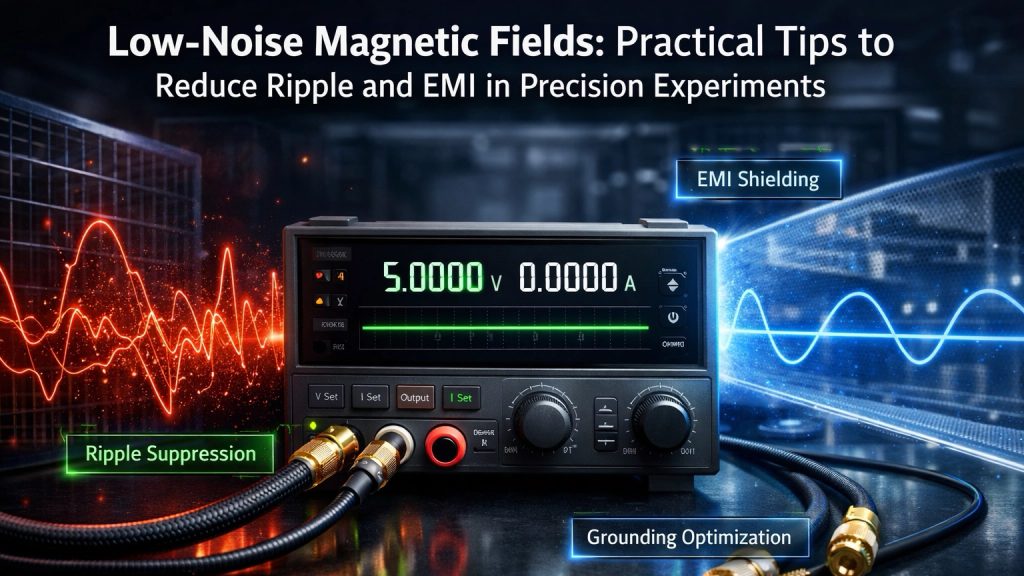
In many research papers, the phrase “low-noise magnetic field” appears without explanation.
In practice, achieving low noise is not a single specification.
It is a system-level engineering problem.
This article explains where magnetic field noise really comes from and how to reduce ripple and EMI in precision experiments.
1. What “Low Noise” Actually Means in Magnetic Experiments
Magnetic field noise usually shows up as:
- Drift over time
- Increased measurement scatter
- Poor repeatability
It is rarely caused by the magnet alone.
Most noise enters through the current source, wiring, grounding, and measurement chain.
2. Power Supply Ripple: The First Noise Source to Check
Current ripple directly converts to magnetic field ripple.
Key points:
- Even small current ripple becomes visible in sensitive measurements
- Switching supplies often introduce high-frequency components
- Poor regulation causes low-frequency field fluctuations
Low-noise experiments require high-stability current drivers, not generic lab power supplies.
3. EMI Coupling Through Cables and Loops
Electromagnetic interference often enters through wiring.
Common problems include:
- Large loop areas acting as antennas
- Unshielded cables near switching electronics
- Ground loops between instruments
Short cable runs, twisted pairs, and proper shielding significantly reduce EMI pickup.
4. Grounding: One Reference, Not Many
Improper grounding creates noise that cannot be filtered later.
Best practices:
- Use a single-point ground reference
- Avoid daisy-chained grounds
- Separate power ground from signal ground when possible
Many “mysterious” noise issues disappear after grounding is fixed.
5. Magnetic Shielding vs. Electrical Shielding
These are not the same.
- Electrical shielding reduces capacitive and RF coupling
- Magnetic shielding reduces external field disturbances
In many labs, improving electrical shielding delivers more benefit than adding magnetic shields.
6. Filtering: Where and How It Helps
Filtering should be applied with care.
Effective strategies include:
- Low-pass filters at current source outputs
- RC or LC filters close to the magnet
- Signal filtering at the measurement input
Over-filtering can slow response and distort dynamic experiments.
7. The Measurement Chain Matters
Low-noise fields mean nothing if the sensor chain is noisy.
Consider:
- Sensor bandwidth and noise floor
- Amplifier input noise
- Digitizer resolution and sampling strategy
Noise must be managed from source to data acquisition.
8. Why System Integration Beats Component Optimization
Optimizing individual parts rarely solves noise problems.
Low-noise performance comes from:
- Stable current drivers
- Proper wiring and grounding
- Coordinated filtering
- Mechanical and thermal stability
👉 Product link placeholder: Cryomagtech Low-Noise Magnetic Field Systems and High-Stability Drivers
Cryomagtech designs magnetic field systems with noise performance evaluated at the system level.
9. A Practical Low-Noise Checklist
Before blaming the magnet, check:
- Current ripple and regulation stability
- Cable routing and shielding
- Ground reference consistency
- Sensor and amplifier noise
Most noise problems are solvable without redesigning the experiment.
References
- IEEE – Noise sources in precision current-driven systems
https://ieeexplore.ieee.org - Wikipedia – Electromagnetic interference
https://en.wikipedia.org/wiki/Electromagnetic_interference
Final Thoughts
“Low noise” is not a marketing label.
It is the result of disciplined system design.
When noise is treated as an engineering problem, reproducible data follows.