
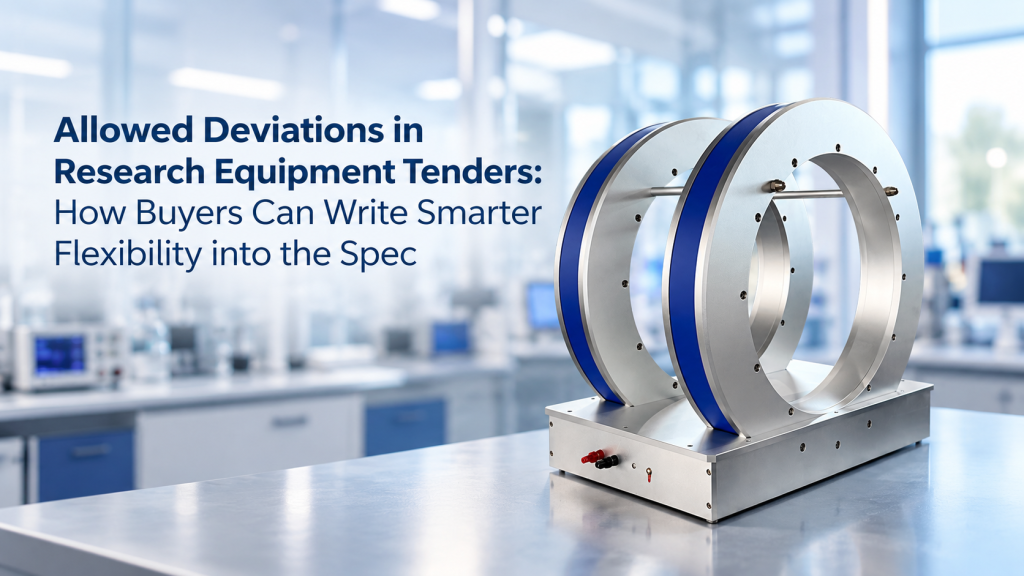
A research equipment tender should define what the system must achieve without unnecessarily dictating exactly how every supplier must build it.
That distinction matters.
In scientific instrumentation, overly rigid technical specifications can unintentionally eliminate capable suppliers, increase project cost, or produce repeated “deviation” statements even when the proposed equipment fully satisfies the real experimental objective.
Good research equipment tender specifications therefore need two things at the same time:
- Clear non-negotiable performance requirements
- Controlled flexibility for technically equivalent or superior solutions
This article explains how universities, research institutes, procurement teams, distributors, and system integrators can define allowed deviations without turning the tender into a vague or unfair specification.
1. Why Research Equipment Tenders Become Too Restrictive
Research systems are not commodity products
For standard commercial products, matching a catalogue specification may be straightforward.
Research equipment is different.
An electromagnet system, Helmholtz coil, cryogenic measurement platform, Hall system, VSM, MOKE system, or other integrated scientific instrument may contain multiple interacting subsystems:
- Mechanical structure
- Power supply
- Sensors
- Cooling system
- Control electronics
- Software
- Communication interfaces
- Safety protection
- Sample fixtures
- Measurement accessories
A small change in one parameter can affect several others.
For example, changing the pole gap of an electromagnet may influence:
- Maximum magnetic field
- Field uniformity
- Coil current
- Power consumption
- Cooling requirements
- Sample accessibility
Therefore, specifying every physical parameter as an exact value can unintentionally force suppliers to reproduce one particular design rather than solve the scientific requirement.
The real question is not “Is everything identical?”
The better question is:
Does the proposed system satisfy the required experimental function, performance, compatibility, and safety requirements?
This principle is also reflected in major public procurement frameworks.
EU Directive 2014/24/EU allows technical specifications to be expressed in terms of performance or functional requirements and requires references to certain technical standards to be accompanied by “or equivalent.” Eur-Lex
Similarly, the World Bank’s standard bidding documentation states that technical requirements may be defined through detailed technical characteristics, functional/performance requirements, or a combination of both. It also notes that performance-oriented specifications can allow specialized suppliers to apply their expertise and technology. World Bank
That is an important lesson for scientific procurement: flexibility should be engineered into the specification, not negotiated only after bids arrive.
2. Separate Requirements into Three Levels
One of the easiest ways to improve research equipment tender specifications is to stop treating every specification line as equally important.
Level 1: Mandatory requirements
These are requirements that directly determine whether the equipment can perform the experiment safely and correctly.
Typical examples include:
- Minimum required magnetic field
- Required operating temperature range
- Minimum sample clearance
- Required homogeneous field volume
- Electrical supply compatibility
- Required communication interface
- Essential safety interlocks
- Required measurement range
- Required environmental conditions
- Mandatory regulatory requirements
These requirements should be clearly identified as mandatory or pass/fail.
A supplier that cannot satisfy them should not be able to compensate simply by offering advantages elsewhere.
Level 2: Requirements with controlled deviation
Some specifications matter, but an exact numerical match may not be necessary.
Examples may include:
- Overall equipment dimensions
- Magnet weight
- Cooling-water flow
- Power consumption
- Pole diameter
- Certain instrument resolutions
- Cable length
- Internal component configuration
Instead of requiring an identical value, buyers can define:
- A minimum value
- A maximum value
- An acceptable range
- A percentage tolerance
- An equivalent-performance condition
This creates flexibility without removing technical control.
Level 3: Preferred or reference specifications
These are characteristics that describe the expected solution but are not essential to successful operation.
They might include:
- Preferred enclosure dimensions
- Preferred connector arrangement
- Preferred software layout
- Preferred accessory configuration
- Reference model dimensions
- Typical installation footprint
Clearly labeling these as preferred, reference, or nominal can prevent unnecessary disqualification.
3. Specify Performance First and Construction Second
This is one of the most important improvements buyers can make.
Define the experimental outcome
Suppose a laboratory requires an electromagnet for a spectroscopy experiment.
A weak specification might say:
- Pole diameter: exactly 75 mm
- Pole gap: exactly 40 mm
- Coil resistance: exactly 1.8 Ω
- Coil current: exactly 20 A
- Magnet weight: maximum 65 kg
Several of those values may simply have been copied from an existing manufacturer’s catalogue.
A stronger specification would begin with the actual experimental requirement:
- Magnetic field: ≥1.0 T at a 40 mm working gap
- Required clear gap: ≥40 mm
- Field uniformity: ≤1% within the defined sample volume
- Continuous operating capability at the specified field
- Stable bipolar field control
- Required mechanical access for the sample holder
- Compatible programmable power supply
- Suitable thermal protection
Now suppliers can optimize the magnet geometry, coil design, current, voltage, and cooling method while still being evaluated against the same scientific objective.
The same principle applies to Helmholtz coils
Instead of defining only:
- Exact wire diameter
- Exact number of turns
- Exact coil resistance
- Exact frame thickness
define the required result:
- Required magnetic field range
- Required AC or DC operation
- Number of axes
- Homogeneous working volume
- Maximum allowable field non-uniformity
- Clear working space
- Continuous duty requirement
- Required control and communication functions
Cryomagtech’s Magnet & Field Systems include both electromagnet and Helmholtz coil configurations, where geometry, cooling, power supply, field range, working volume, and control architecture can vary according to the experimental requirement. Cryomagtech
4. Use Minimum, Maximum, and Nominal Values Correctly
Not every specification should use “±5%.”
The direction of the tolerance matters.
Use “minimum” when more capability is acceptable
For example:
- Magnetic field: ≥1.0 T
- Sample clearance: ≥35 mm
- Measurement range: ≥±2 T
- Number of analog inputs: ≥4
If the laboratory needs at least 35 mm of clearance, specifying “35 mm exactly” provides no benefit.
Use “maximum” when exceeding the value creates a problem
For example:
- Maximum overall width: ≤600 mm
- Maximum power consumption: ≤5 kW
- Maximum field ripple: ≤0.05%
- Maximum noise level: ≤specified limit
Use a tolerance range when both directions matter
For example:
- Sample temperature: 300 K ±1 K
- Mechanical alignment: specified position ± tolerance
- Output field accuracy: target value within defined percentage
Use “nominal” when the value is descriptive
A nominal specification communicates the approximate design target without turning a non-critical dimension into a rejection criterion.
This distinction sounds simple, but it can dramatically reduce unnecessary technical deviations.
5. Define What an “Allowed Deviation” Actually Means
Simply writing “minor deviations are acceptable” is not enough.
Two evaluators may interpret “minor” differently.
A better tender clause
A research equipment tender can use language such as:
Minor deviations from non-critical technical parameters may be accepted where the bidder clearly identifies the deviation and demonstrates that it does not reduce the required functionality, performance, compatibility, safety, or intended experimental use of the system. Equivalent or superior technical solutions may be considered subject to documented technical justification.
This gives suppliers flexibility while keeping the buyer in control.
Require a deviation statement
Ask every bidder to provide a compliance table containing:
- Tender requirement
- Offered specification
- Compliance status
- Deviation, if any
- Technical explanation
- Supporting documentation
This is much better than discovering discrepancies during installation or final acceptance.
World Bank bidding documentation similarly provides for bidders to submit item-by-item descriptions demonstrating technical responsiveness and, where applicable, statements of deviations and exceptions. It also distinguishes material deviations from less significant nonconformities. World Bank
6. Distinguish Material Deviations from Non-Material Deviations
Not every deviation deserves rejection.
A material deviation affects the experiment
Examples might include:
- Required 1 T field, offered maximum 0.7 T
- Required 50 mm sample clearance, offered 30 mm
- Required continuous operation, offered intermittent duty only
- Required Ethernet control, but remote control is unavailable
- Required temperature range down to 10 K, system only reaches 80 K
These differences directly affect functionality.
A non-material deviation may not affect the result
Examples could include:
- System width is 620 mm instead of a preferred 600 mm where sufficient installation space exists
- Cooling-water requirement differs slightly
- Power-supply current is different because the magnet uses a different coil design
- Pole diameter differs while the specified homogeneous region is maintained
- Different connector manufacturer with equivalent electrical performance
The key principle is:
Evaluate deviations according to their impact on the intended experiment—not according to whether the catalogue numbers happen to match.
7. Avoid Accidental Vendor Lock-In
One of the most common problems in scientific tenders occurs when specifications are based too closely on one manufacturer’s catalogue.
Warning signs include
- Unusual dimensions copied exactly
- Exact internal component ratings
- Proprietary model terminology
- Unique accessory names
- Exact combinations of voltage and current that only match one supplier
- Brand-specific interfaces without a genuine compatibility reason
- Exact catalogue numbers
This can reduce competition even when that was never the buyer’s intention.
Both European procurement rules and World Bank procurement documents emphasize the use of equivalent solutions rather than unnecessarily restrictive references to particular standards, brands, or catalogue numbers. Eur-Lex
“Or equivalent” needs evidence
However, adding two words—“or equivalent”—does not solve everything.
The tender should define how equivalence will be demonstrated.
Possible evidence includes:
- Datasheets
- Performance curves
- Technical drawings
- Calibration data
- Test reports
- Compliance matrices
- Demonstrated interface compatibility
- Factory acceptance testing
That transforms “equivalent” from a vague commercial statement into an engineering criterion.
8. Be Especially Careful with System-Level Research Equipment
The problem becomes more important when the tender covers a complete scientific system rather than one standalone instrument.
Consider an integrated magnetic field system containing:
- Electromagnet or Helmholtz coil
- Bipolar power supply
- Gaussmeter
- Field probe
- Cooling system
- Temperature monitoring
- Control software
- Communication hardware
- Mechanical fixtures
If the tender independently locks every subsystem to exact catalogue values, the complete system may become unnecessarily difficult to engineer.
Specify system-level acceptance criteria
For example:
- Required field at specified working distance
- Field uniformity across defined volume
- Continuous operating duration
- Maximum thermal drift
- Field-setting accuracy
- Sweep functionality
- Remote-control capability
- Safety response
- Final acceptance test
Then allow the supplier to select the component combination required to meet those results.
This is particularly important for custom research equipment because subsystem specifications are often interdependent.
9. Write Acceptance Tests at the Same Time as Technical Specifications
A strong specification answers two questions:
What must the system do?
and
How will we prove that it does it?
Example: magnetic field system
Requirement:
- ≥1.0 T at a 40 mm pole gap
Acceptance method:
- Measure the magnetic flux density at the defined center position using a calibrated gaussmeter under specified operating conditions.
Requirement:
- ≤1% field variation over the required working volume
Acceptance method:
- Measure the field at predefined positions throughout the specified volume and calculate the maximum deviation from the reference position.
This removes ambiguity for both sides.
It also prevents a common procurement problem: buyers and suppliers agreeing on a specification but interpreting the verification method differently.
10. A Better Specification Structure for Research Equipment Tenders
A practical tender specification can be organized as follows.
A. Application
Explain what the system will actually be used for.
For example:
- Magnetic material characterization
- Sensor calibration
- Optical measurements under magnetic field
- Cryogenic electrical transport
- Magnetic field simulation
B. Mandatory performance requirements
Define the experimental limits that cannot be compromised.
C. Interface requirements
Specify compatibility with:
- Existing instruments
- Sample holders
- Optical paths
- Vacuum systems
- Cryostats
- Software
- Facility utilities
D. Preferred specifications
Identify desirable features that are not mandatory.
E. Allowed deviations
State how technically equivalent alternatives will be evaluated.
F. Compliance table
Require suppliers to declare compliance line by line.
G. Acceptance criteria
Define measurable tests for the critical specifications.
This structure creates a tender that is both technically strict and commercially open.
11. Advice for Distributors, Integrators, and Tender Intermediaries
Tender intermediaries face another problem: technical requirements often pass through several organizations before reaching the manufacturer.
During this process, a preference can accidentally become a mandatory requirement.
For example:
Researcher says:
“Approximately 50 mm would be convenient.”
The intermediary writes:
“50 mm required.”
The procurement document becomes:
“Exactly 50 mm. No deviation allowed.”
Three different meanings have now been created.
Before freezing a specification, ask one question
Why is this number required?
If the answer is:
“The sample is 42 mm wide,”
then perhaps the real requirement is:
- Clear working space ≥45 mm
If the answer is:
“That was the dimension of the system we used before,”
then it may only be a reference value.
Understanding the reason behind each critical number is one of the best ways to avoid unnecessarily restrictive tenders.
12. Flexibility Does Not Mean Lower Standards
This point is critical.
Smart tender flexibility does not mean:
- Accepting inferior performance
- Allowing suppliers to ignore specifications
- Turning mandatory requirements into suggestions
- Removing objective evaluation criteria
It means separating experimental requirements from one possible engineering implementation.
The best tender is not the one with the most specifications.
It is the one that clearly defines:
- What is essential
- What can vary
- How much it can vary
- How equivalence will be demonstrated
- How performance will be accepted
That gives buyers better competition while still protecting the scientific objective.
13. Key Takeaways
Good research equipment tender specifications should:
- Define performance before prescribing construction
- Separate mandatory, flexible, and preferred requirements
- Use minimum, maximum, nominal, and tolerance values correctly
- Clearly define acceptable deviations
- Require an item-by-item compliance statement
- Distinguish material from non-material deviations
- Avoid unnecessary brand or catalogue-specific requirements
- Allow documented equivalent or superior solutions
- Evaluate complete systems at the system level
- Define acceptance tests before the tender is published
For complex scientific equipment, a rigid specification is not always a precise specification.
Sometimes it is simply a specification that has confused one engineering solution with the actual research requirement.
The smarter approach is to protect the performance that matters while leaving enough engineering freedom for qualified suppliers to deliver it.
References
1. European Union – Directive 2014/24/EU, Article 42: Technical Specifications
Article 42 addresses technical specifications, including the use of performance or functional requirements and equivalent technical solutions. Eur-Lex
Source link: EUR-Lex – Directive 2014/24/EU
2. World Bank – Standard Procurement Document: Request for Bids, Goods
The World Bank document discusses functional/performance specifications, substantial technical equivalence, deviation statements, and avoiding unnecessarily restrictive brand or catalogue references. World Bank
Source link: World Bank – Request for Bids Goods