
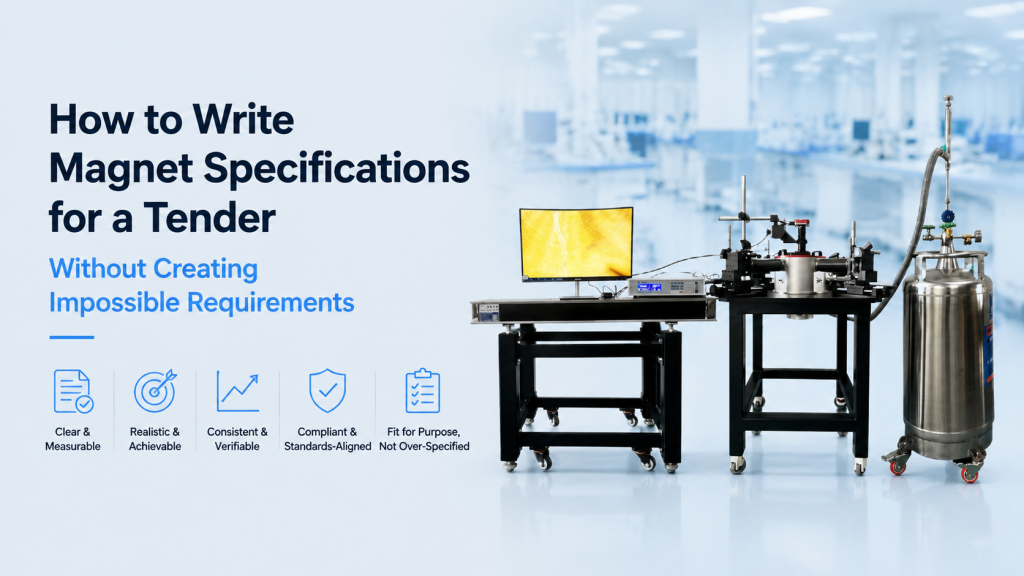
A research institution publishes a tender for a new magnetic system.
The requirement document looks impressive:
- Magnetic field ≥ 2 T
- High uniformity
- Large sample space
- Fast response
- Low noise
- Compact size
- Low power consumption
- Continuous operation
- Low maintenance
- Cryogenic compatibility
- Optical access
- High automation
Every individual requirement sounds reasonable.
But when combined together, the specification may describe a system that is extremely difficult—or physically impossible—to manufacture at the expected budget and timeline.
This is one of the most common challenges in scientific equipment tenders:
The problem is not that the buyer asks for high performance. The problem is that independent parameters are sometimes combined without understanding their engineering relationships.
For magnetic systems, the final performance is always a balance between:
- Field strength
- Pole gap
- Uniformity
- Cooling
- Power consumption
- Mechanical structure
- Sample access
- Response speed
- Stability
- Cost
A technically mature tender specification does not simply collect the highest numbers.
It defines the actual experimental requirement and allows suppliers to propose realistic solutions.
CERN’s accelerator magnet projects provide a useful example of how complex magnet systems require detailed technical specifications covering design requirements, manufacturing, quality control, and testing rather than isolated performance numbers.
For electromagnets, Helmholtz coils, Hall systems, VSM systems, and MOKE platforms, a good tender specification should answer:
“What scientific result must this system achieve?”
not only:
“How many maximum specifications can we list?”
1. Why Tender Specifications Often Become Unrealistic
Many unrealistic specifications are created with good intentions.
A research group wants the best possible system.
Different team members contribute requirements:
The physicist requests:
- Higher field
- Better uniformity
- Larger sample area
The engineer requests:
- Compact size
- Lower power
The facility manager requests:
- Less cooling
- Lower weight
The procurement department requests:
- Lower cost
- Short delivery time
Individually, these requests are understandable.
The problem appears when they are combined without considering physical constraints.
Example: Electromagnet Specification
A tender requests:
- 2 T field
- 50 mm pole gap
- ±0.01% uniformity
- Continuous operation
- Air cooling only
- Compact desktop size
Each item exists in some systems.
But together, they create a major engineering challenge.
A larger pole gap reduces magnetic efficiency.
Higher field increases power and heat.
Better uniformity requires more optimized pole design.
Air cooling limits continuous operation.
The specification is not impossible because one parameter is unreasonable.
It becomes difficult because the combination ignores the relationship between parameters.
2. Start With the Scientific Requirement, Not the Equipment Name
A common tender mistake is starting with:
“We need a 1 Tesla electromagnet.”
That is not enough information.
A supplier needs to know:
- Why is the field needed?
- What sample is measured?
- What space is required?
- How stable must the field be?
- How long does the experiment run?
- What environment is required?
The same 1 T requirement can produce completely different systems.
Example A: Hall Measurement
Need:
- Small sample
- High field accuracy
- Stable DC field
- Electrical access
Priority:
- Field stability
- Sample positioning
- Measurement repeatability
Example B: MOKE
Need:
- Optical access
- Magnetic reversal
- Laser path
- Sample tilt control
Priority:
- Pole geometry
- Optical clearance
- Field direction
Example C: VSM
Need:
- Sample vibration
- Magnetic moment measurement
Priority:
- Low vibration interference
- Field uniformity
- Sample position accuracy
The tender should define the experiment first.
The equipment is the solution.
3. Avoid Mixing Performance Requirements With Design Requirements
A tender specification should separate:
What Must Be Achieved
Examples:
- Magnetic field ≥ 1 T
- Uniformity ≤ 0.1%
- Temperature range 10–300 K
How It Must Be Achieved
Examples:
- Specific coil design
- Specific cooling method
- Specific mechanical structure
The first category defines the scientific need.
The second category defines one possible solution.
If the tender specifies the solution too early, it may exclude technically equivalent approaches.
Example
Requirement:
“System must use water-cooled copper coils.”
Question:
Why?
If the actual requirement is:
“Continuous operation at 1 T for 8 hours”
then different cooling architectures may satisfy the objective.
A better tender says:
“The magnet shall support continuous operation under the specified field and duty cycle.”
Then suppliers can propose appropriate engineering.
4. Field Strength Alone Is Not a Complete Magnet Specification
One of the most common tender mistakes is writing only:
“Magnetic field: 1 T.”
A useful magnetic specification should include:
Field Value
Example:
- ≥1 T
Working Gap
Example:
- 20 mm pole gap
Field Region
Example:
- 10 mm diameter spherical region
Uniformity
Example:
- Better than 0.1% over specified volume
Stability
Example:
- Drift over one hour
Operation Mode
Example:
- DC
- Sweeping field
- Pulsed field
Polarity
Example:
- Bipolar operation
Without these details, suppliers may interpret the requirement differently.
5. Pole Gap and Magnetic Field Are Directly Connected
This is one of the most important relationships in electromagnet design.
A larger gap provides:
- More sample space
- More optical access
- Easier cryostat installation
But usually requires:
- More ampere-turns
- More power
- Larger magnet structure
A smaller gap provides:
- Higher field efficiency
- Lower power
- Smaller magnet size
But reduces:
- Sample space
- Optical access
- Integration flexibility
Example
A tender requests:
- 2 T
- 60 mm gap
- Small footprint
A supplier may immediately identify a conflict.
The question is not:
“Can a magnet produce 2 T?”
The question is:
“Can it produce 2 T under this exact geometry?”
6. Uniformity Requirements Need a Defined Measurement Volume
Another common issue:
“Field uniformity: better than 10 ppm.”
This sounds excellent.
But:
Over what region?
Uniformity depends on:
- Volume
- Distance from center
- Measurement method
A magnet may achieve:
10 ppm over:
- 1 mm sphere
but not:
- 50 mm sample region
Better Specification
Instead of:
“Field uniformity <10 ppm”
write:
“Field uniformity better than 10 ppm within a spherical volume of X mm diameter centered at the sample position.”
Now suppliers know what must be achieved.
7. Sample Space Is Often More Important Than Maximum Field
Researchers sometimes specify field first.
But the experiment is performed on the sample.
The sample environment determines the real design.
Important questions:
- Sample size?
- Holder size?
- Electrical contacts?
- Optical path?
- Temperature stage?
- Vacuum chamber?
- Probe position?
Example
A Hall system requires:
- 1 cm × 1 cm sample
A MOKE system requires:
- Laser access angle
A cryogenic system requires:
- Cryostat body clearance
The magnetic system must be designed around the experiment.
8. Do Not Combine Maximum Values From Different Product Classes
A common tender problem is combining specifications from different systems.
Example:
From a small electromagnet:
- High field
From a large research magnet:
- Large gap
From a Helmholtz coil:
- Open access
From a precision calibration magnet:
- Extreme uniformity
Then combining all into one requirement.
The result may describe a system that does not exist commercially.
A good tender should be based on one realistic application scenario.
9. Duty Cycle Must Be Included in Magnet Specifications
Field requirements without operating time are incomplete.
A magnet producing:
1 T for:
- 30 seconds
is different from:
1 T continuously for:
- 24 hours
Important parameters:
- Continuous operation
- Intermittent operation
- Pulse duration
- Cooling conditions
- Maximum temperature rise
For high-field electromagnets, cooling is often one of the main design limitations.
10. Cooling Requirements Should Be Written Clearly
Cooling affects:
- Field stability
- Reliability
- Operating cost
- Installation complexity
A tender should specify:
If Water Cooling Is Allowed
Define:
- Flow rate
- Pressure
- Temperature range
- Water quality
If Air Cooling Is Required
Define:
- Ambient temperature
- Maximum operating time
- Noise limitation
A requirement such as:
“Water cooling is not allowed”
may unnecessarily eliminate suitable solutions unless there is a real facility reason.
11. Response Speed and Field Stability Are Different Requirements
Another common mistake:
“Fast magnetic field change with extremely high stability.”
These are related but different.
Fast response requires:
- Low inductance
- High voltage capability
- Control bandwidth
High stability requires:
- Thermal control
- Low-noise electronics
- Stable current regulation
A tender should specify:
Response Requirement
Example:
“Field change from 0.1 T to 1 T within 5 seconds.”
Stability Requirement
Example:
“Field drift less than X ppm/hour after stabilization.”
12. Power Supply Specifications Should Match the Magnet
A magnet and power supply are one system.
The tender should not specify them independently.
Important parameters:
Current
- Maximum current
- Bipolar capability
Voltage
- Compliance voltage
Stability
- Current stability
- Long-term drift
Control
- Analog input
- USB
- Ethernet
- RS-232
Safety
- Over-current protection
- Interlock
A high-performance magnet connected to an unsuitable power supply will not achieve the expected performance.
13. Helmholtz Coil Specifications Need Different Thinking
A Helmholtz coil is not simply a “weaker electromagnet.”
Its design priorities are different.
Important parameters:
Coil Geometry
- Diameter
- Separation
Field Region
- Uniform volume
Current
- Maximum current
Accessibility
- Open space
Frequency
- DC or AC operation
Cooling
- Natural
- Forced air
- Water cooled
A tender should describe the required magnetic environment, not copy electromagnet specifications.
14. Hall System Tenders Need Measurement Context
A Hall system tender should not only specify:
“Measure carrier mobility.”
It should define:
Sample
- Semiconductor type
- Size
- Thickness
Measurement Method
- Hall bar
- Van der Pauw
Temperature
- Room temperature
- Variable temperature
- Cryogenic
Magnetic Field
- Range
- Stability
Current Measurement
- Current range
- Resolution
Output
- Raw data
- Software calculation
Without this information, suppliers may quote very different systems.
15. VSM Tender Specifications Should Avoid Sensitivity Numbers Alone
A VSM specification often focuses on:
“Sensitivity: 10⁻⁶ emu.”
But sensitivity depends on:
- Sample size
- Measurement time
- Noise filtering
- Field conditions
- Frequency
A better specification includes:
- Expected sample type
- Magnetic moment range
- Measurement speed
- Temperature requirement
- Required output
The best system is not always the one with the smallest sensitivity number.
16. MOKE Tender Specifications Need Optical Details
MOKE systems are especially vulnerable to incomplete specifications.
A tender should define:
Geometry
- Longitudinal
- Polar
- Transverse
Optical Parameters
- Wavelength
- Incident angle
- Spot size
Magnetic Environment
- Field direction
- Maximum field
- Reversal method
Sample
- Size
- Thickness
- Mounting
Without optical information, two suppliers may quote systems that cannot be compared fairly.
17. Cryogenic Requirements Need More Than Temperature Range
A tender stating:
“Temperature: 4–300 K”
is incomplete.
Important details:
Stability
How stable?
Sensor
Which sensor type?
Cooling
Closed-cycle?
Liquid helium?
Sample Environment
- Size
- Wiring
- Optical access
Control
- Temperature sweeps
- Software interface
A temperature number alone does not define a cryogenic experiment.
18. Avoid Unrealistic Accuracy Requirements Without Measurement Method
Example:
“Magnetic field accuracy: 0.001%.”
The supplier immediately needs to ask:
Measured by:
- Hall probe?
- NMR?
- Fluxmeter?
At:
- Which field?
- Which temperature?
- Which position?
Accuracy is meaningless without the measurement method.
19. Tender Specifications Should Define Acceptance Criteria
A good specification answers:
“How will compliance be proven?”
Example:
Requirement:
Field ≥1 T
Acceptance:
Measured at:
- Specified pole gap
- Defined position
- Calibrated field probe
Requirement:
Temperature stability ±0.01 K
Acceptance:
Measured over:
- 30 minutes
- Defined temperature point
The acceptance method should exist before supplier selection.
20. Avoid Designing a Tender Around One Supplier’s Product Brochure
This is a subtle but common problem.
A requirement may contain:
- Exact dimensions
- Exact software function
- Exact accessory name
because someone copied a previous supplier document.
This creates:
- Limited competition
- Reduced flexibility
- Potentially unrealistic requirements
A better approach:
Define:
- Performance
- Interfaces
- Acceptance criteria
Then allow suppliers to propose solutions.
21. A Good Tender Uses Requirement Priorities
Not every parameter has equal importance.
A useful approach:
Mandatory
Must satisfy.
Example:
- Temperature range
- Field range
Preferred
Important but negotiable.
Example:
- Larger sample space
Optional
Future upgrade.
Example:
- Automation
This helps suppliers optimize the design.
22. Use “Required” and “Preferred” Carefully
Bad:
“Large sample space, high field, low power, low cost required.”
Everything becomes mandatory.
Better:
Required
- 1 T field
- 30 mm sample space
Preferred
- Larger optical access
Future
- Cryogenic upgrade
This creates realistic competition.
23. Consider Total System Cost, Not Individual Specification Cost
Adding one parameter may affect many others.
Example:
Increasing field may require:
- Larger magnet
- More power
- More cooling
- Larger power supply
- More infrastructure
The tender should consider:
- Purchase cost
- Installation
- Operation
- Maintenance
Procurement frameworks often emphasize total cost of ownership rather than initial price alone.
24. Include Site Conditions in the Tender
A supplier cannot design correctly without knowing:
- Available power
- Laboratory temperature
- Cooling availability
- Space
- Weight limitations
For large magnetic systems:
Important:
- Floor loading
- Transport route
- Cooling infrastructure
A technically perfect magnet may fail installation if site assumptions are wrong.
25. Avoid Impossible Combination Requirements
Before publishing a tender, ask:
“Are these requirements physically compatible?”
Example checklist:
Magnetic
- Field
- Gap
- Uniformity
Thermal
- Cooling
- Duty cycle
Mechanical
- Size
- Weight
Electrical
- Power
- Stability
Scientific
- Sample
- Measurement
The requirement should describe a system that can actually exist.
26. A Better Tender Writing Process
Step 1
Define scientific objective.
Step 2
Define sample and measurement conditions.
Step 3
Identify mandatory performance.
Step 4
Identify preferred features.
Step 5
Discuss engineering trade-offs.
Step 6
Define acceptance method.
Step 7
Allow suppliers to propose solutions.
This produces better technical competition.
27. Example: Improving an Electromagnet Tender Requirement
Weak Requirement
“Provide a 2 T electromagnet with high precision and large opening.”
Problems:
- No gap
- No uniformity
- No stability
- No sample information
Better Requirement
“Provide an electromagnet capable of generating ≥2 T at a 25 mm pole gap, with field stability better than X ppm/hour after thermal stabilization, within a defined uniform region suitable for a sample area of X mm.”
Now suppliers can design realistically.
28. Example: Improving a Helmholtz Coil Tender Requirement
Weak
“High uniformity Helmholtz coil.”
Better
“Provide a three-axis Helmholtz coil system generating a DC magnetic field of X mT within a spherical uniform region of X mm diameter, with independent axis control and specified current stability.”
The engineering target becomes clear.
29. Example: Improving a Hall System Tender Requirement
Weak
“High precision Hall measurement system.”
Better
“System shall measure carrier concentration and mobility of semiconductor samples using van der Pauw configuration over the specified temperature and magnetic-field range, including sample fixture, electrical measurement electronics, software calculation, and raw-data export.”
The supplier understands the complete workflow.
30. Example: Improving a VSM Tender Requirement
Weak
“High sensitivity VSM.”
Better
“System shall measure magnetic hysteresis curves for specified sample types with sensitivity suitable for the expected magnetic moment range, including required sample holders and software data processing.”
31. Example: Improving a MOKE Tender Requirement
Weak
“High-performance MOKE system.”
Better
“System shall support longitudinal and/or polar MOKE measurements with defined optical geometry, magnetic field orientation, sample dimensions, and temperature environment.”
32. How Cryomagtech Helps Evaluate Realistic Specifications
Cryomagtech works with customers on:
- Electromagnets
- Helmholtz coils
- Magnetic field systems
- Hall measurement systems
- VSM systems
- MOKE systems
- Cryogenic measurement platforms
For tender and formal procurement projects, the most effective approach is usually:
- Understand the scientific objective.
- Identify critical parameters.
- Separate mandatory requirements from preferences.
- Review engineering trade-offs.
- Define acceptance conditions.
A technically realistic specification helps both buyers and suppliers.
It improves competition, reduces clarification cycles, and increases the probability that the delivered system actually satisfies the research goal.
33. Tender Specification Checklist for Magnetic Systems
Before publishing a tender, review:
Application
- What experiment will be performed?
- What samples will be measured?
Magnetic Field
- Field value?
- Gap?
- Uniform region?
- Stability?
- Accuracy?
Mechanical
- Sample space?
- Optical access?
- Dimensions?
Thermal
- Duty cycle?
- Cooling?
- Temperature environment?
Electrical
- Current?
- Voltage?
- Stability?
- Control interface?
Software
- Automation?
- Data export?
- Communication?
Acceptance
- How is compliance verified?
Commercial
- Budget?
- Delivery?
- Installation?
- Training?
- Warranty?
If these answers are clear, suppliers can provide much more accurate proposals.
Key Takeaways
- A good tender specification defines the scientific objective, not just maximum technical numbers.
- Combining maximum field, largest gap, highest uniformity, lowest cost, and smallest size can create impossible requirements.
- Magnetic field specifications should include gap, uniform region, stability, and operating conditions.
- Uniformity requirements must define the measurement volume.
- Sample requirements often determine the correct system architecture.
- Cooling, duty cycle, and power consumption are strongly connected to magnetic performance.
- Electromagnet, Helmholtz coil, Hall, VSM, and MOKE systems require different specification approaches.
- Technical requirements should be separated from preferred design solutions.
- Mandatory, preferred, and optional requirements help suppliers propose realistic solutions.
- Acceptance criteria should be defined before the tender is released.
- A supplier should be evaluated on total system capability, not isolated specification numbers.
- Realistic specifications create better competition and reduce project risk.
The goal of a tender is not to describe the most powerful system imaginable.
The goal is to define the system that can actually deliver the required scientific result.