
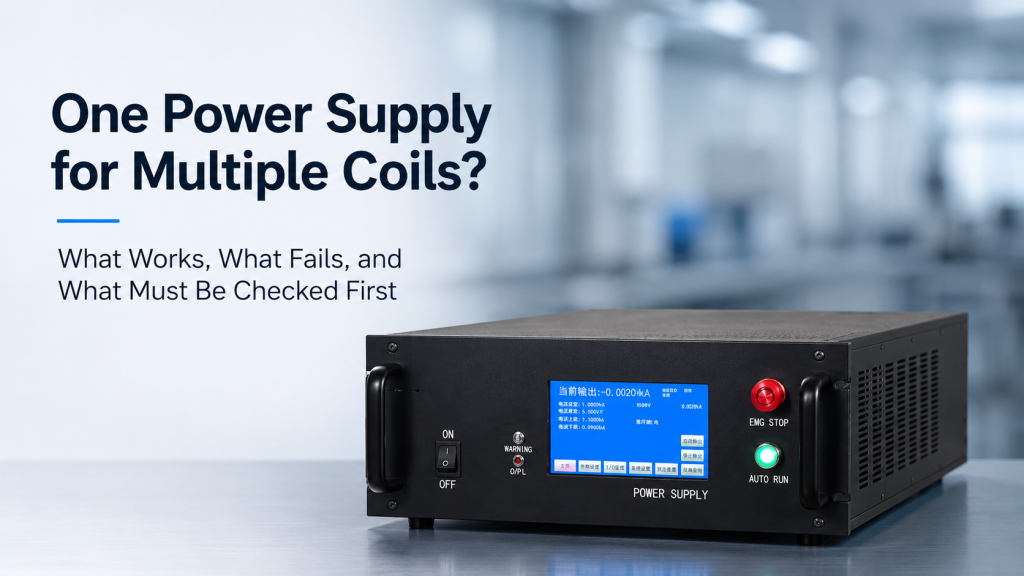
Many buyers ask a practical question:
“Can we use one power supply for multiple coils?”
The reason is understandable.
A research lab may already have a power supply.
A university team may need to reduce budget.
A calibration system may include several coils but not all of them operate at the same time.
A Helmholtz coil pair may look like “two coils,” so one supply seems natural.
Sometimes one power supply for multiple coils works very well.
Sometimes it creates unstable field output, current mismatch, overheating, poor control, or safety risk.
The key is not simply whether the connector can be wired.
The real question is:
“Do these coils need the same current, at the same time, under the same control logic, with safe voltage, current, thermal, and protection margins?”
This article explains what works, what fails, and what must be checked before using one power supply for multiple coils.
1. Why Buyers Want One Power Supply for Multiple Coils
The motivation is usually practical.
Buyers may want to use one power supply because:
- Budget is limited
- An existing supply is available
- The coils are not used at the same time
- The system seems electrically simple
- The buyer wants fewer instruments on the bench
- The project starts as a prototype
- The test only needs one field direction at a time
- The customer wants a lower-cost configuration
This is reasonable.
A serious supplier should not automatically say no.
But a serious supplier should also not say yes before checking the electrical and magnetic requirements.
2. The First Rule: Coils Are Loads, Not Just Wires
A coil is not only a length of wire.
A coil has:
- Resistance
- inductance
- current rating
- voltage requirement
- thermal limit
- insulation limit
- cooling condition
- field-current relationship
- polarity direction
- transient behavior
- stored magnetic energy
For magnet systems, the power supply is usually expected to control current because magnetic field is directly related to coil current.
Keysight explains that in constant-current mode, a power supply maintains a set current by adjusting voltage as required by the device under test.
Reference link: https://www.keysight.com/blogs/en/tech/educ/2023/bench-power-supply
That principle is central to coil driving.
A power supply is not only “delivering power.”
It is controlling the current that creates the magnetic field.
3. When One Power Supply Works Well
One power supply can work well when the coils are designed to operate as one electrical load.
Common Good Cases
One supply may be suitable for:
- A standard Helmholtz coil pair wired in series
- Two matched coils that must carry exactly the same current
- A coil pair designed as one axis
- A single-axis system with multiple coil sections
- Multiple coils used one at a time through a proper switching arrangement
- A fixed field setup where all coils share the same current requirement
- A magnetic exposure system with no independent axis control
In these cases, the coils are not being controlled independently.
They behave as one load from the power supply’s point of view.
4. Helmholtz Coil Pairs: One Supply Is Usually Normal
For a standard Helmholtz coil pair, one power supply is often the correct solution.
A Helmholtz coil arrangement uses two coils separated by a defined distance to create a region of relatively uniform magnetic field near the center. The field depends on the coil geometry and the current.
Reference link: https://en.wikipedia.org/wiki/Helmholtz_coil
In many Helmholtz coil systems, the two coils of one axis are connected so the same current flows through both coils.
This is important because the pair is designed to work together.
If the two coils carried different currents, the field uniformity and field center could shift.
Typical Arrangement
For one Helmholtz axis:
- Coil A and Coil B are matched
- The same current flows through both coils
- The current direction is arranged to produce the intended field
- The power supply controls the pair as one load
This is a good use of one power supply.
5. Series Connection: Simple, Predictable, but Higher Voltage Required
When coils are connected in series, the same current flows through each coil.
This is often useful for matched coil pairs.
Advantages of Series Connection
Series connection can provide:
- Same current through each coil
- simpler current control
- better current matching
- predictable field contribution
- easier wiring logic for matched pairs
- fewer current-sharing problems than parallel wiring
What Must Be Checked
Series connection increases total resistance and total inductance.
This means the power supply may need:
- More output voltage
- enough voltage headroom
- safe insulation margin
- suitable ramp capability
- inductive load protection
- proper cable rating
A supply that can drive one coil may not be able to drive two or three coils in series at the same current.
The current rating alone is not enough.
Voltage headroom must be checked.
6. Parallel Connection: Attractive, but Often Riskier
Parallel connection may look attractive because it can reduce the voltage required per branch.
But it can create current-sharing problems.
If two coils are connected in parallel, the current may not split equally unless the branches are carefully matched and controlled.
TDK-Lambda explains that parallel power supplies require correct current sharing, and unequal sharing can cause one unit to run hot while another is lightly loaded. The same basic concern applies to parallel load paths: current does not automatically divide the way the user hopes.
Reference link: https://www.us.lambda.tdk.com/resources/blogs/20150729.html
Parallel Coil Risks
Parallel coil wiring can create:
- unequal current distribution
- unequal heating
- field imbalance
- unpredictable field center
- higher stress on one coil
- difficult troubleshooting
- hidden failure if one branch opens
- poor repeatability
Parallel connection should not be used casually in precision field systems.
If equal current is required, series connection is usually safer and more predictable.
7. One Supply Cannot Provide Independent Control
This is the biggest limitation.
One power supply can only provide one output current waveform at a time.
If multiple coils require independent current values, one supply is not enough.
Independent Control Is Needed When
The system requires:
- Three-axis field generation
- vector field rotation
- independent X / Y / Z control
- different current on different coils
- compensation field plus main field
- field gradient control
- independent bias and sweep coil
- dynamic waveform on one coil while another stays fixed
- automated calibration with multiple field directions
For these cases, each independently controlled coil or axis usually needs its own driver channel.
One supply cannot generate three independent currents.
8. Three-Axis Helmholtz Coils Usually Need Multiple Channels
A three-axis Helmholtz coil system typically requires independent control of X, Y, and Z axes.
Each axis may need a different current at the same time to generate a target magnetic vector.
For example, to generate a vector field:
- X-axis may need 20 µT
- Y-axis may need -35 µT
- Z-axis may need 48 µT
This cannot be done with one single-output supply unless the system is extremely limited and uses switching for one axis at a time.
Practical Rule
If the system must generate arbitrary 3D vector fields, use independent driver channels.
If the system only tests one axis at a time, one supply with a proper switching system may be possible—but it will not provide true simultaneous three-axis control.
9. One Supply with a Switching Matrix: Useful but Limited
Some systems use one power supply and switch it between different coils.
This can work if only one coil or one axis is active at a time.
Useful Cases
A switching approach may be suitable for:
- sequential coil testing
- one-axis-at-a-time calibration
- low-budget prototypes
- simple magnetic exposure
- manual laboratory experiments
- checking different coil modules
Limitations
Switching introduces risks:
- no simultaneous control
- switching transients
- relay current rating limits
- contact resistance
- polarity mistakes
- software sequencing errors
- safety issues with inductive loads
- slower operation
- possible connector wear
A switching matrix must be designed for coil current, voltage, inductance, and safety.
Do not switch inductive loads casually.
10. Coil Resistance Must Be Checked First
Before connecting one supply to multiple coils, measure or confirm each coil resistance.
Important questions include:
- What is the resistance of each coil?
- Are the coils matched?
- Does resistance change with temperature?
- What is the total resistance in series?
- What is the branch resistance in parallel?
- What voltage is required at target current?
- What cable resistance should be included?
Basic DC Check
For a DC coil load:
Voltage demand is related to current and resistance.
If total resistance is too high, the supply may reach voltage limit before reaching target current.
A supply may be rated for enough current but still fail because the voltage is too low.
11. Coil Inductance Must Also Be Checked
Inductance matters when current changes.
A coil resists changes in current. The faster the current must ramp, the more voltage headroom the supply may need.
Inductance Affects
- Ramp speed
- settling time
- voltage requirement
- output stability
- protection design
- stored energy
- switching safety
- reversal behavior
- dynamic waveform capability
For DC-only operation, inductance mainly affects ramping and transients.
For AC, waveform, or fast sweep operation, inductance becomes much more important.
A power supply suitable for static DC operation may be unsuitable for fast field changes.
12. Current Rating Must Match Each Coil, Not Only the Supply
Buyers often check only the power supply rating.
That is incomplete.
Each coil also has a current limit.
A coil’s current limit may depend on:
- wire gauge
- insulation
- cooling
- duty cycle
- ambient temperature
- coil structure
- temperature rise
- continuous or short-time operation
If multiple coils are connected to one supply, the supply may be capable of more current than one coil can safely handle.
That creates risk.
The system should include current limits appropriate for the weakest coil in the circuit.
13. Voltage Headroom Is Often the Hidden Failure
A buyer may say:
“Our supply is 30 A. Can it drive these coils?”
The answer depends on voltage.
For example:
- One coil may require 30 A at 20 V.
- Two coils in series may require 30 A at 40 V.
- A warm coil may require more voltage than a cold coil.
- A fast ramp may require additional voltage because of inductance.
- Long cables may add voltage drop.
If the supply cannot provide enough voltage, it may not maintain the target current.
In magnet systems, losing current means losing magnetic field.
This is why voltage headroom is not optional.
14. Thermal Behavior Must Be Evaluated
Multiple coils connected to one supply may heat differently.
Heating depends on:
- current
- resistance
- cooling
- coil mass
- airflow
- duty cycle
- installation layout
- temperature rise
- cable losses
Common Thermal Problems
- One coil gets hotter than another
- resistance changes during operation
- voltage demand increases over time
- current sharing changes in parallel branches
- insulation temperature limit is approached
- field output drifts during long operation
A system that works for five minutes may not be suitable for five hours.
Continuous operation must be checked separately from short-duration operation.
15. Polarity and Field Direction Must Be Confirmed
When one supply drives multiple coils, polarity becomes critical.
Incorrect wiring can cause:
- opposing fields
- shifted field center
- reduced field strength
- poor uniformity
- wrong axis direction
- confusing software control
- invalid calibration results
For Helmholtz coils, the two coils must be wired so their fields reinforce correctly at the center.
For multi-axis systems, X, Y, and Z polarity must be clearly labeled.
For field reversal, the system must define what positive and negative current mean physically.
A wiring diagram is not a formality.
It is part of magnetic field correctness.
16. Protection for Inductive Loads Is Essential
Coils store magnetic energy.
When current is interrupted, switched, reversed, or disconnected, the system must handle the stored energy safely.
TDK-Lambda notes that when operating power supplies in series, protection components such as back-biased diodes may be required under certain conditions. The broader lesson is that non-standard power-supply connections require attention to protection, not just wiring convenience.
Reference link: https://www.us.lambda.tdk.com/resources/blogs/20090722.html
For magnet coils, protection may include:
- controlled ramp-down
- flyback protection
- output protection
- overvoltage protection
- overcurrent protection
- emergency stop behavior
- safe switching sequence
- connector interlocks
- cable and terminal ratings
A power supply and coil system should be designed as a protected electrical system.
17. Shared Supply Means Shared Failure Mode
Using one power supply for multiple coils reduces equipment count.
But it also creates a shared failure mode.
If the supply fails, all connected coils are affected.
If the supply goes into protection, the whole test may stop.
If the wiring is wrong, multiple coils may be affected.
If one coil overheats, the whole circuit may need shutdown.
This Matters For
- production testing
- long calibration runs
- multi-sample experiments
- automated test sequences
- safety-critical validation
- remote or unattended operation
A shared supply can be cost-effective, but the buyer should understand the operational risk.
18. Existing Power Supplies: What Must Be Verified
Many buyers ask whether they can use an existing lab power supply.
Sometimes yes.
But the supplier must check the actual model and load requirements.
Existing Supply Checklist
Before reusing a power supply, verify:
- Maximum current
- maximum voltage
- constant-current mode
- output stability
- ripple and noise
- polarity capability
- bipolar or unipolar output
- ramp control
- communication interface
- protection functions
- inductive load compatibility
- continuous operation rating
- cooling and airflow
- cable and connector compatibility
A general-purpose bench supply may be fine for simple coil testing.
It may not be suitable for precision field calibration, bipolar sweeps, low-noise Hall measurements, or automated vector control.
19. Noise and Ripple Can Affect Magnetic Measurements
Power supply noise becomes magnetic field noise.
This is especially important for:
- Hall measurements
- magnetometer testing
- low-field calibration
- sensor validation
- MOKE experiments
- low-noise material testing
- long drift measurements
If one supply drives multiple coils, noise may affect every connected coil.
Buyers should check:
- current ripple
- current stability
- long-term drift
- output noise
- grounding
- cable layout
- shielding
- measurement sensitivity
A high-current supply is not automatically a precision magnetic field driver.
20. When One Supply Is a Good Budget Strategy
One supply can be a good choice when:
- coils are designed as one matched pair
- the same current is required through all coils
- one axis is used at a time
- sequential testing is acceptable
- high-speed switching is not required
- independent vector control is not needed
- thermal behavior is well understood
- voltage and current margins are sufficient
- wiring and protection are designed properly
Example
A standard single-axis Helmholtz coil pair connected in series to one constant-current supply is a normal and reasonable architecture.
Another Example
A lab uses one supply to drive different coils one at a time through a properly rated manual switch or connector system.
This can work if users understand that it is not simultaneous multi-axis control.
21. When One Supply Is the Wrong Choice
One supply is usually the wrong choice when:
- multiple coils need different currents at the same time
- three-axis vector field control is required
- field rotation is required
- feedback control is required per axis
- coils have different resistance or inductance
- parallel current sharing is uncontrolled
- fast waveform generation is required
- reversal timing matters
- one coil must remain at bias while another sweeps
- safety protection cannot be guaranteed
- low-noise precision measurement is required but the supply is not suitable
In these cases, trying to save money on power supplies may create more cost through poor data, failed tests, or unsafe operation.
22. RFQ Questions Buyers Should Ask First
Before asking whether one supply can drive multiple coils, buyers should provide enough information.
Coil Information
- Number of coils
- coil resistance
- coil inductance
- current rating
- voltage requirement
- cooling method
- field-current relationship
- physical coil arrangement
- intended polarity
- continuous or short-time operation
Operation Requirement
- Will coils operate simultaneously?
- Do they need the same current?
- Do they need different currents?
- Is field reversal required?
- Is AC or waveform operation required?
- Is ramp speed important?
- Is one-axis-at-a-time operation acceptable?
- Is three-axis vector control required?
Power Supply Information
- Existing supply model
- current rating
- voltage rating
- constant-current capability
- bipolar or unipolar output
- ripple and noise
- communication interface
- protection functions
- continuous operation rating
Safety and Control
- Switching method
- emergency stop
- overcurrent protection
- overtemperature monitoring
- cable rating
- connector rating
- user access
- software interlock
- grounding plan
These details allow a real compatibility review instead of a guess.
23. Practical Decision Guide
Use One Supply When
- The coils are designed as one load
- all coils require the same current
- series connection is practical
- voltage headroom is enough
- operation is simple
- independent control is not needed
- thermal and protection limits are clear
Use Multiple Supplies or Channels When
- Each coil needs independent current
- vector field control is required
- three-axis operation is needed
- dynamic control is required
- current sharing would be uncertain
- feedback control is per axis
- different coils have different ratings
- precision calibration depends on independent field control
Use One Supply with Switching Only When
- coils are used one at a time
- switching is properly rated
- no current is switched unsafely
- software or manual sequence is clear
- users understand the limitation
- field verification is performed for each coil mode
This is the honest engineering approach.
24. How Cryomagtech Supports Power Supply and Coil Compatibility Review
Cryomagtech supplies Helmholtz coil systems, electromagnets, high-precision excitation power supplies, bipolar magnetic field drivers, and custom Magnet & Field Systems for research, calibration, and industrial testing.
For projects involving one power supply and multiple coils, we help evaluate:
- Series vs. parallel connection
- coil resistance and inductance
- voltage and current margin
- field-current relationship
- polarity and field direction
- one-axis or multi-axis operation
- independent channel requirements
- switching feasibility
- thermal limits and duty cycle
- cable and connector rating
- protection for inductive loads
- software and control requirements
- compatibility with existing customer power supplies
The best solution is not always the most expensive one.
But the lowest-cost wiring plan must still protect field accuracy, coil safety, and measurement reliability.
References
- Keysight – Bench Power Supply Basics and Constant Current Mode
https://www.keysight.com/blogs/en/tech/educ/2023/bench-power-supply - TDK-Lambda – Using Droop Mode Current Share Power Supplies
https://www.us.lambda.tdk.com/resources/blogs/20150729.html - TDK-Lambda – Operating Power Supplies in Series
https://www.us.lambda.tdk.com/resources/blogs/20090722.html - Wikipedia – Helmholtz Coil
https://en.wikipedia.org/wiki/Helmholtz_coil
Key Takeaways
- One power supply can drive multiple coils when the coils are designed to behave as one electrical load.
- A standard Helmholtz coil pair is commonly driven by one current source because both coils need the same current.
- Series connection is usually more predictable for matched coils, but it requires enough voltage headroom.
- Parallel connection can create current-sharing problems unless the branches are properly designed and controlled.
- One supply cannot provide independent currents for true multi-axis vector control.
- Resistance, inductance, voltage headroom, thermal limits, polarity, cable rating, and protection must be checked first.
- Reusing an existing power supply is possible only if its specifications match the coil load and measurement requirement.
- Saving money on one supply is useful only when it does not compromise safety, field performance, or control independence.
For coil systems, the key question is not only:
“Can one power supply be connected to multiple coils?”
The better question is:
“Can one power supply drive these coils safely and accurately under the real current, voltage, thermal, polarity, and control requirements?”