
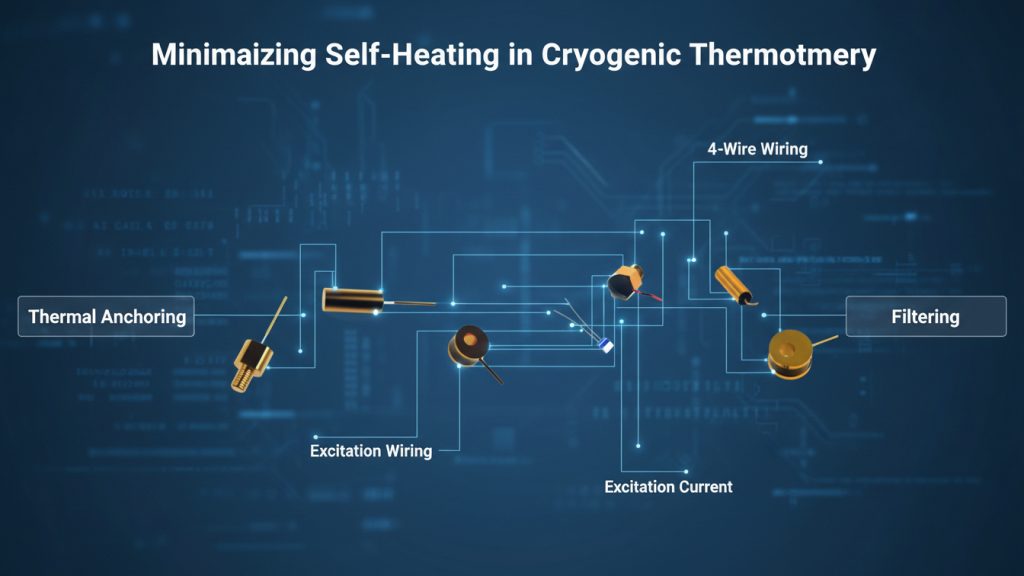
Accurate cryogenic temperature measurement is often limited not by sensor resolution,
but by self-heating caused by the measurement itself.
This issue becomes critical for high-resistance cryogenic thermometers,
especially below 10 K, where even nanowatt-level dissipation can distort readings.
This article explains why self-heating occurs and how to minimize it through
excitation current control, wiring techniques, filtering, and thermal anchoring.
1. Why Self-Heating Matters in Cryogenic Thermometry
Self-heating occurs when electrical power dissipated in a thermometer raises its actual temperature.
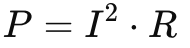
At cryogenic temperatures:
- Sensor resistance often increases sharply
- Thermal conductivity to the bath becomes very small
As a result, even microamp-level excitation currents can cause measurable temperature offsets.
2. Excitation Current: Less Is Almost Always Better
The most direct way to reduce self-heating is lowering the excitation current.
Best practices:
- Use the lowest current that maintains acceptable signal-to-noise ratio
- Avoid fixed currents across wide temperature ranges
- Prefer adaptive or range-dependent excitation
For high-resistance sensors, current levels often fall in the:
- 10 nA – 1 µA range
Modern cryogenic temperature monitors support ultra-low, stable excitation currents for this reason.
3. Four-Wire Measurement to Eliminate Lead Resistance
Two-wire measurements introduce additional power dissipation and systematic error.
A four-wire (Kelvin) configuration:
- Separates current injection and voltage sensing
- Eliminates lead resistance from the measurement
- Reduces unnecessary Joule heating in the sensor leads
This method is strongly recommended for:
- Cernox sensors
- Ruthenium oxide sensors
- High-value thermometers below 20 K
4. Wiring Choice and Thermal Anchoring
Wiring plays a dual role:
- Electrical signal transmission
- Thermal conduction into the sensor
Key guidelines:
- Use low-thermal-conductivity wires (e.g., manganin, phosphor bronze)
- Minimize wire cross-section where noise allows
- Add thermal anchor points at intermediate temperature stages
Proper anchoring allows heat generated in the leads to dissipate before reaching the sensor.
5. Filtering High-Frequency Noise
Electrical noise contributes indirectly to self-heating by increasing effective RMS current.
Recommended techniques:
- Low-pass RC filters near room temperature
- Cold filters near the cryogenic stage for sensitive measurements
- Twisted pairs and shielding to reduce pickup
Filtering improves both:
- Measurement stability
- True sensor temperature accuracy
6. Balancing Noise, Stability, and Heating
Reducing excitation current always increases noise.
The practical goal is not zero heating, but:
- Stable readings
- Reproducible temperature values
- Acceptable measurement bandwidth
Modern cryogenic temperature monitors allow users to tune:
- Excitation current
- Measurement averaging
- Filter bandwidth
7. Instrumentation Designed for Low Self-Heating
Minimizing self-heating requires system-level design, not just sensor choice.
Cryomagtech provides:
- Cryogenic thermometers and sensors
- Low-noise temperature monitors
- Controllers optimized for ultra-low excitation currents
👉 Product link placeholder: Cryogenic Thermometers & Temperature Monitors
References
- Wikipedia – Cryogenic temperature measurement
https://en.wikipedia.org/wiki/Cryogenics - IEEE – Low-temperature sensor measurement techniques
https://ieeexplore.ieee.org/
Key Takeaways
- Self-heating limits accuracy at low temperatures
- Excitation current must scale with resistance and temperature
- Wiring, filtering, and thermal anchoring are equally important
Careful design ensures the thermometer measures the sample—not itself.