
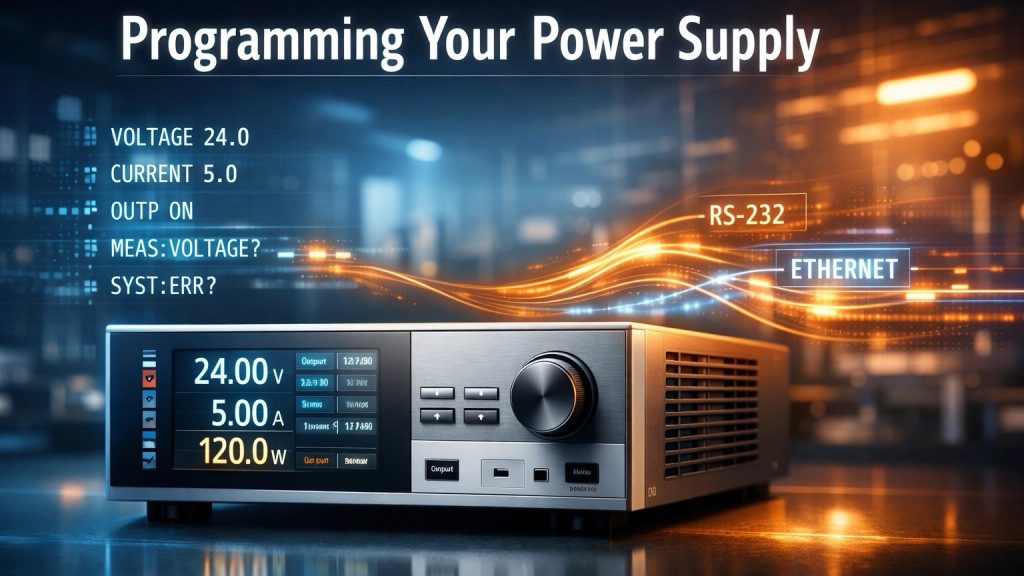
Why Programmability Matters in Modern Laboratories
In many laboratories, the power supply is no longer a standalone instrument.
It is part of an automated measurement system.
Manual control may work for simple tests.
However, modern experiments often require:
- Reproducible measurement sequences
- Long unattended runs
- Synchronized control with other instruments
This is where programmable excitation power supplies become essential.
Common Communication Interfaces in Laboratory Power Supplies
Most programmable power supplies support one or more standard interfaces.
Each has its strengths and limitations.
SCPI: The Language of Laboratory Automation
SCPI (Standard Commands for Programmable Instruments) is the most widely used command standard in laboratories.
With SCPI, users can:
- Set output current or voltage
- Define ramps and sweeps
- Query status and error conditions
SCPI commands are human-readable and supported by most test software environments.
This makes SCPI ideal for:
- Automated test scripts
- Integration with LabVIEW, Python, or MATLAB
- Long-term experiment control
Ethernet: Fast and Flexible Network Control
Ethernet-based control is increasingly popular in research labs.
Key advantages include:
- High communication speed
- Long cable distance
- Easy integration into lab networks
Ethernet interfaces often support:
- SCPI over TCP/IP
- Remote monitoring
- Multi-instrument synchronization
For complex setups, Ethernet simplifies system architecture.
RS-232: Simple but Still Useful
RS-232 is an older interface, but it remains relevant.
It is often used when:
- Systems are simple
- Distances are short
- Legacy software is involved
While slower than Ethernet, RS-232 is reliable and easy to implement for basic control tasks.
Automation Workflows: From Manual to Fully Scripted
A typical automation workflow includes:
- Power supply initialization
- Current ramping or sweeping
- Measurement synchronization
- Data logging
- Safe shutdown
By scripting these steps, laboratories gain:
- Repeatability
- Reduced human error
- Higher throughput
Python is especially popular due to its rich instrument control libraries.
Common Pitfalls in Power Supply Programming
Even experienced users encounter issues.
Typical mistakes include:
- Ignoring warm-up time before measurements
- Using step changes instead of controlled ramps
- Not handling communication errors
- Forgetting to log actual output values
These issues can silently degrade data quality.
Why a Programmable Excitation Power Supply Makes a Difference
High precision excitation power supplies are designed with automation in mind.
Typical features include:
- Full SCPI command set
- Ethernet and serial communication
- High-resolution output control
- Stable performance during long automated runs
👉 Product link placeholder: Cryomagtech High Precision Programmable Excitation Power Supply
Cryomagtech programmable excitation power supplies are built for laboratory automation, enabling reliable control in complex experimental workflows.
References
- Wikipedia – SCPI
https://en.wikipedia.org/wiki/Standard_Commands_for_Programmable_Instruments - IEEE – Instrument communication and automation
https://ieeexplore.ieee.org/
Final Thoughts
Automation is not only about convenience.
It is about data quality and reproducibility.
A programmable power supply turns manual experiments into reliable, repeatable systems.