
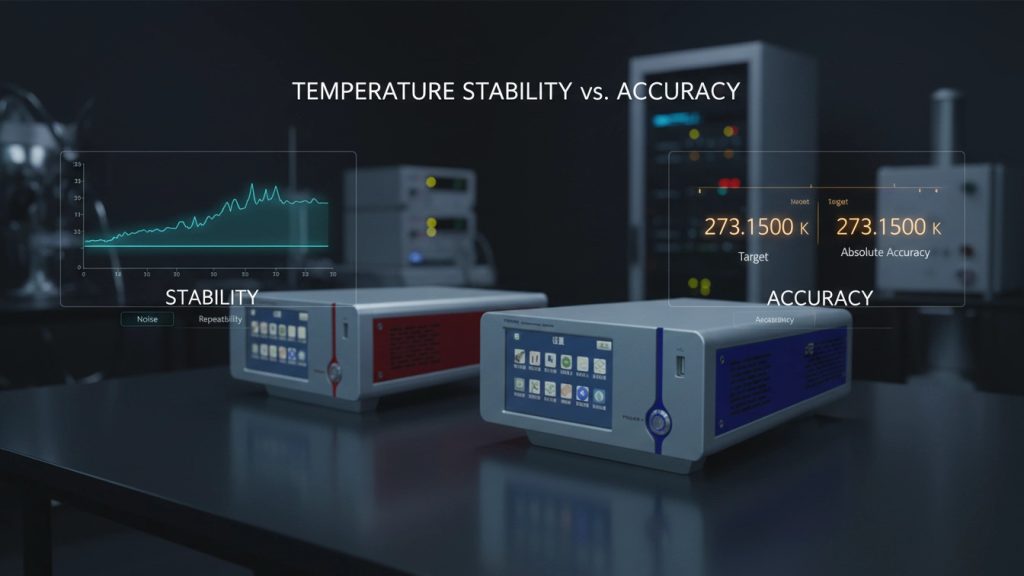
When selecting cryogenic temperature instrumentation,
many researchers focus on a single number: accuracy.
However, in real experiments,
temperature stability and noise often matter far more than absolute accuracy.
This article explains the critical differences between
accuracy, stability, noise, and repeatability,
and shows how to specify temperature performance correctly for your experiment.
1. Temperature Accuracy: What It Really Means
Temperature accuracy describes how close a measured value is
to a defined reference temperature.
It is typically determined by:
- Sensor calibration method
- Reference standards
- Readout electronics accuracy
Accuracy is important for:
- Absolute temperature reporting
- Cross-lab comparison
- Published reference measurements
However, high accuracy alone does not guarantee good experimental results.
2. Temperature Stability: The Key for Most Experiments
Temperature stability describes how much the temperature fluctuates over time.
It is usually specified as:
- ±mK over seconds, minutes, or hours
- Peak-to-peak or RMS variation
For experiments such as:
- Transport measurements
- Superconducting transitions
- Long averaging or overnight runs
stability is often more important than absolute accuracy.
A system can be off by 20 mK in absolute value
and still produce excellent data if it is stable.
3. Noise vs. Stability: Not the Same Thing
Noise refers to short-term fluctuations in the temperature signal.
Sources include:
- Sensor excitation current
- Readout electronics
- Ground loops and EMI
- Mechanical vibration
High noise reduces:
- Measurement resolution
- Signal-to-noise ratio
- Repeatability of derived parameters
A good temperature controller minimizes both:
- Low-frequency drift (stability)
- High-frequency noise (clean readout)
4. Repeatability: The Often Ignored Parameter
Repeatability describes how consistently the system reaches
the same temperature under identical conditions.
It is critical for:
- Temperature sweeps
- Cycling experiments
- Parameter mapping
Poor repeatability can occur even when:
- Accuracy looks acceptable
- Stability is good during a single run
This is often caused by:
- Sensor mounting
- Thermal anchoring
- Control loop tuning
5. Why Accuracy Is Often Over-Specified
Many datasheets highlight accuracy because it is easy to quote.
In practice:
- Absolute accuracy is limited by sensor calibration
- Calibration shifts over thermal cycles
- Real experiments depend on relative changes
Over-specifying accuracy can:
- Increase system cost unnecessarily
- Distract from stability and noise performance
- Lead to incorrect system selection
6. How to Specify Temperature Performance Correctly
Instead of asking only for accuracy,
consider specifying the following parameters:
- Temperature stability over time (e.g. ±5 mK over 1 hour)
- Noise level (RMS or peak-to-peak)
- Control bandwidth and response time
- Repeatability after thermal cycling
- Supported sensor types and excitation methods
This approach leads to better experimental outcomes
and clearer communication with suppliers.
7. Control Loops and Sensors Matter More Than You Think
Temperature performance is a system-level result.
Key contributors include:
- Sensor type (Cernox, diode, RuO₂, Pt100)
- Excitation current and filtering
- PID control parameters
- Thermal coupling to the sample
High-quality cryogenic controllers integrate:
- Low-noise sensor readout
- Flexible control algorithms
- Long-term monitoring and logging
8. Practical System Solutions
Cryomagtech provides cryogenic temperature solutions designed for
high stability, low noise, and repeatable control, including:
- Cryogenic temperature controllers
- Multi-channel temperature monitors
- Low-noise thermometers and sensors
👉 Product link placeholder: Cryogenic Temperature Controllers & Sensors
References
- Wikipedia – Temperature measurement
https://en.wikipedia.org/wiki/Temperature_measurement - IEEE – Precision measurement and control systems
https://ieeexplore.ieee.org/
Key Takeaways
- Accuracy is not the only metric that matters
- Stability and noise dominate real experimental performance
- Repeatability is critical for reliable data
- Correct specification prevents costly system mismatch
Understanding these differences leads to better experiments—and better purchases.