
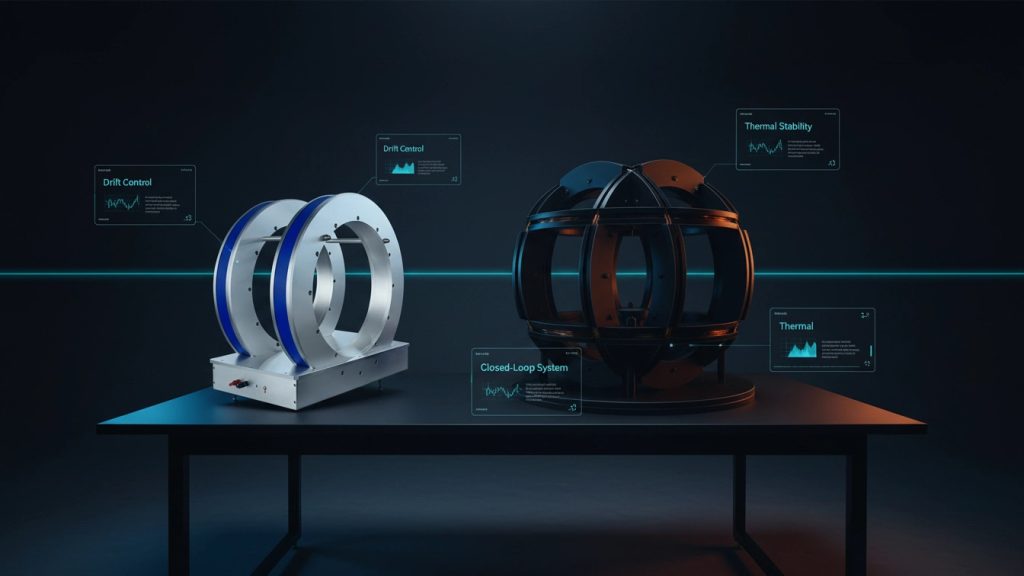
Long-duration magnetic field measurements—spanning hours or even days—are common in modern research.
Examples include transport measurements, magnetic aging studies, and long-term sensor calibration.
However, many experiments fail not because of noise,
but due to slow magnetic field drift over time.
This article explains the main drift mechanisms in long measurements
and presents practical engineering strategies to achieve stable fields over hours to days.
1. Thermal Effects: The Most Common Drift Source
In most laboratory magnetic systems, thermal behavior dominates long-term drift.
Key mechanisms include:
- Coil temperature rise after startup
- Resistance change with temperature (ΔR / ΔT)
- Power dissipation drift in current drivers
As the coil warms up, resistance increases.
If the system is voltage-driven, the current—and therefore the magnetic field—will decrease over time.
2. Coil Resistance Drift and Its Impact on Field Stability
Magnetic field strength is directly proportional to coil current.
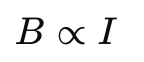
Even small resistance changes can cause measurable field drift:
- Copper coils typically change resistance by ~0.39% per °C
- Over long measurements, this becomes significant
This effect is especially noticeable in:
- Air-cooled electromagnets
- High-current Helmholtz coil systems
3. Environmental Magnetic Noise and Background Field Changes
Not all drift originates from the magnet itself.
Common environmental contributors include:
- Building power cycles
- Elevators and nearby machinery
- Daily variations in geomagnetic background
For experiments without magnetic shielding,
these slow variations can appear as low-frequency field drift in the data.
4. Why Constant-Current Drive Is Essential
One of the most effective ways to reduce drift is true constant-current operation.
Compared to voltage-driven systems:
- Constant-current drivers automatically compensate resistance changes
- Field stability improves by orders of magnitude over long timescales
High-precision current sources with:
- Low temperature coefficient
- Long-term current stability
are critical for overnight measurements.
5. Closed-Loop Field Control Using Sensors
For demanding experiments, open-loop current control may still be insufficient.
Closed-loop field control adds:
- A magnetic field sensor (Hall probe or fluxgate)
- Feedback control to correct slow drift
This approach compensates:
- Thermal drift
- Environmental field changes
- Power supply aging effects
Closed-loop systems are widely used in:
- Precision calibration setups
- Long-duration stability tests
- Sensor characterization laboratories
6. Warm-Up and Pre-Stabilization Strategies
Many long-term experiments fail because measurement starts too early.
Best practices include:
- Running the magnet at target current for several hours before data collection
- Monitoring coil temperature and current stability
- Waiting until thermal equilibrium is reached
A proper warm-up period significantly reduces early-time drift.
7. Software Monitoring and Long-Term Logging
Long measurements benefit from active monitoring.
Key parameters to log:
- Coil current
- Power supply temperature
- Magnetic field sensor output
- Ambient laboratory conditions
Control software can:
- Detect abnormal drift
- Trigger alarms
- Apply slow corrective feedback
8. System-Level Solutions for Long-Term Stability
True field stability over hours or days requires system-level design.
Cryomagtech provides integrated solutions combining:
- Helmholtz coils or electromagnets
- High-stability constant-current drivers
- Optional closed-loop field control
- Long-term monitoring software
👉 Product link placeholder: Helmholtz Coil & Electromagnet Systems with Precision Drivers
References
- Wikipedia – Electromagnetism and magnetic field control
https://en.wikipedia.org/wiki/Magnetic_field - IEEE – Precision current sources and long-term stability
https://ieeexplore.ieee.org/
Key Takeaways
- Thermal drift is the dominant long-term error source
- Constant-current drive is essential for stability
- Closed-loop control further improves performance
- Warm-up and monitoring are critical for overnight measurements
Stable magnetic fields are engineered—not assumed.