
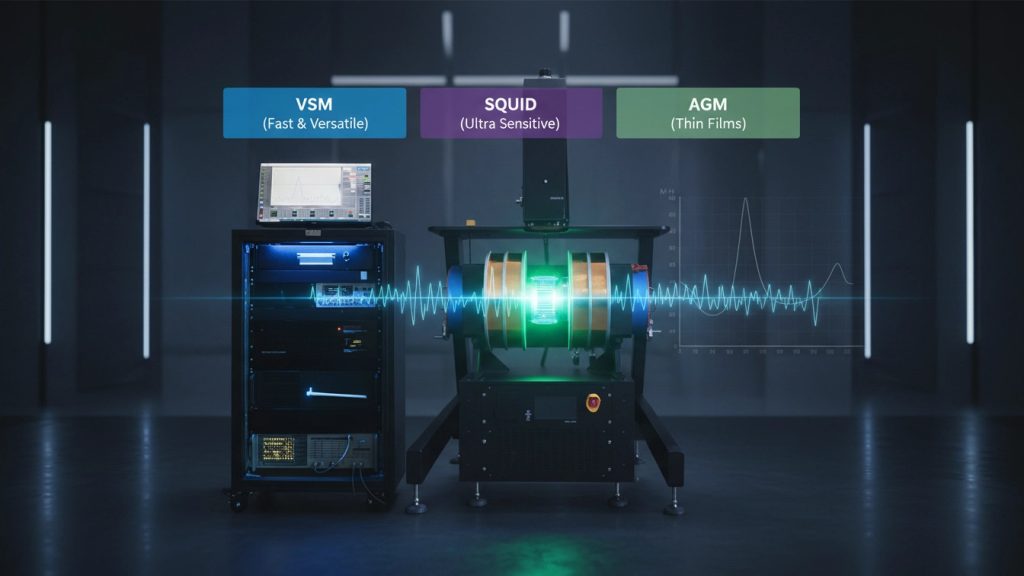
Magnetization measurements are foundational in materials science, spintronics, and magnetic device research.
Yet one question appears repeatedly in labs and procurement discussions:
Should I use a VSM, a SQUID, or an AGM?
Each technique measures magnetization, but they differ dramatically in sensitivity, cost, complexity, and experimental constraints.
This article provides a practical, side-by-side comparison to help researchers choose the right tool for their application.
1. What Do VSM, SQUID, and AGM Actually Measure?
All three techniques measure the magnetic moment of a sample under an applied magnetic field.
The difference lies in how that signal is generated and detected.
| Technique | Signal Principle |
|---|---|
| VSM | Voltage induced by vibrating sample |
| SQUID | Quantum interference in superconducting loop |
| AGM | Force on sample in a magnetic field gradient |
Understanding this difference explains most performance trade-offs.
2. Vibrating Sample Magnetometer (VSM)
How It Works
In a VSM, the sample vibrates sinusoidally in a uniform magnetic field.
The changing magnetic flux induces a voltage in pickup coils proportional to magnetization.
Strengths
- Wide dynamic range
- Fast measurement speed
- Compatible with high magnetic fields
- Robust and relatively low maintenance
Limitations
- Sensitivity lower than SQUID
- Mechanical vibration introduces noise floor
Typical Use Cases
- Thin films and bulk materials
- Hysteresis loop measurements
- Temperature- and field-dependent magnetization
- Routine lab and industrial measurements
VSMs are often the most practical daily-use magnetometer.
👉 Product link placeholder: Cryomagtech Vibrating Sample Magnetometer
3. Superconducting Quantum Interference Device (SQUID)
How It Works
SQUID magnetometers detect magnetic flux changes using superconducting loops and Josephson junctions.
Strengths
- Ultimate sensitivity (down to ~10⁻⁸ emu or better)
- Excellent for ultra-weak magnetic signals
Limitations
- Requires cryogenic operation
- High purchase and operating cost
- Limited maximum field compared to VSM systems
Typical Use Cases
- Extremely weakly magnetic samples
- Biological or molecular magnetism
- Fundamental physics research
SQUIDs excel when nothing else is sensitive enough.
4. Alternating Gradient Magnetometer (AGM)
How It Works
AGMs measure the force exerted on a magnetized sample in an alternating magnetic field gradient.
Strengths
- High sensitivity for small samples
- No cryogenics required
Limitations
- Limited maximum field
- More sensitive to alignment errors
- Less flexible than VSM for temperature control
Typical Use Cases
- Thin magnetic films
- Nanomaterials
- Low-field magnetization studies
AGMs occupy a niche between VSM and SQUID.
5. Head-to-Head Comparison
| Feature | VSM | SQUID | AGM |
|---|---|---|---|
| Sensitivity | Medium | Very High | High |
| Max Field | High | Medium | Low |
| Speed | Fast | Slow | Medium |
| Cryogenics | No | Yes | No |
| Cost | Moderate | Very High | Moderate |
| Maintenance | Low | High | Medium |
There is no “best” instrument—only the best fit.
6. Choosing Based on Real Experimental Needs
Ask these questions before deciding:
- How small is your magnetic signal?
- Do you need high magnetic fields?
- Is cryogenic operation acceptable?
- How often will measurements be performed?
- Who maintains the system?
For many laboratories, the answer points to VSM as the most balanced solution.
7. Practical and Scalable Solutions
Cryomagtech provides VSM systems designed for research laboratories requiring:
- Reliable hysteresis and temperature-dependent measurements
- Integration with electromagnets or superconducting magnets
- Expandable configurations without cryogenic complexity
👉 Product link placeholder: Cryomagtech VSM Systems
References
- Wikipedia – Vibrating sample magnetometer
https://en.wikipedia.org/wiki/Vibrating_sample_magnetometer - IEEE – SQUID magnetometry fundamentals
https://ieeexplore.ieee.org/
Key Takeaways
- SQUID offers unmatched sensitivity, at high cost and complexity
- AGM fills a specialized niche for small samples
- VSM provides the best balance of performance, flexibility, and usability
Choosing the right magnetometer is less about prestige,
and more about experimental reality.